
Portugal – Norway: Portugal Finish With Ten Men But See Off Norway As Jorge Jesus Run Continues (2-1)
By the final whistle, a ten-man Portugal saw off Norway 2-1 in their UEFA Nations League game at the Estadio Dragao. A stunning first half goal from Kristoffer Ajer was cancelled out by an equally stunning strike from Joao Cancelo and a late goal from Goncalo Ramos gave Jorge Jesus and Portugal the victory on the night.
Tactical analysis and match report by Gaurav Krishnan.
We decided to make this article free to read. If you want to support our work, consider taking a subscription.
Portugal finished with ten men but saw off Norway as Jorge Jesus’ perfect run continued with his side winning 2-1. At the Estadio Dragao, the hosts Portugal overturned Kristoffer Ajer’s 36th-minute opener with Joao Cancelo lashing in a strike into the net resulting in an immediate equaliser. Portugal then scored via Goncalo Ramos’ 79th-minute winner, and then survived Francisco Conceicao’s 86th-minute dismissal.
The result sealed a quarter-final place with four wins from four in Group A4 and extended Portugal’s post-World Cup rebuild under Jesus. The sides had met a week earlier in Oslo as well. Norway who were World Cup quarter-finalists in the summer taking England to extra time, controlled large stretches of that first meeting yet lost 2-1.
Portugal arrived in Porto still digesting their own World Cup exit. A 1-0 last-16 defeat to Spain with Mikel Merino’s 91st-minute strike ending both the tournament and Cristiano Ronaldo’s World Cup career under Roberto Martinez. However, Jorge Jesus’ early Nations League results with wins over Wales, Norway, Denmark and now Norway again, has been built without the focal point of Ronaldo in attack.
Norway manager Stale Solbakken had insisted beforehand that Norway “are not a low-block team” and would try to take the game to Portugal, citing their strong first hour in Oslo. But the Dragao produced a more territorial Portuguese night and saw the Selecao emerge victorious.
Portugal lined up in a 4-1-3-2 shape. Diogo Costa started in goal with a back four of Joao Cancelo at right-back, Ruben Dias and Renato Veiga at center-back and Nuno Mendes at left-back. Palhinha anchored the midfield pivot with Vitinha just ahead of him in midfield, while Bruno Fernandes started on the left, Francisco Conceicao on the right with Joao Felix and Goncalo Ramos up front.
Norway lined up in a 4-3-3 formation. Egil Selvik started in goal with a back four of Fredrik Aursnes at right-back with Kristoffer Ajer and Leo Ostigard at center-back and David Moller Wolfe at left-back. The midfield trio comprised Sander Berge, Patrick Berg and Martin Odegaard. While Andreas Schjelderup started down the right flank, Antonio Nusa down the left flank with Erling Haaland leading the line as the lone striker.
First Half Helter Skelter
In possession in their IP play, Portugal built short in a 3-2-5/3-1-6. Costa found Dias or Veiga as Palhinha dropped between or beside the centre-backs to create a temporary back three and free the full-backs.
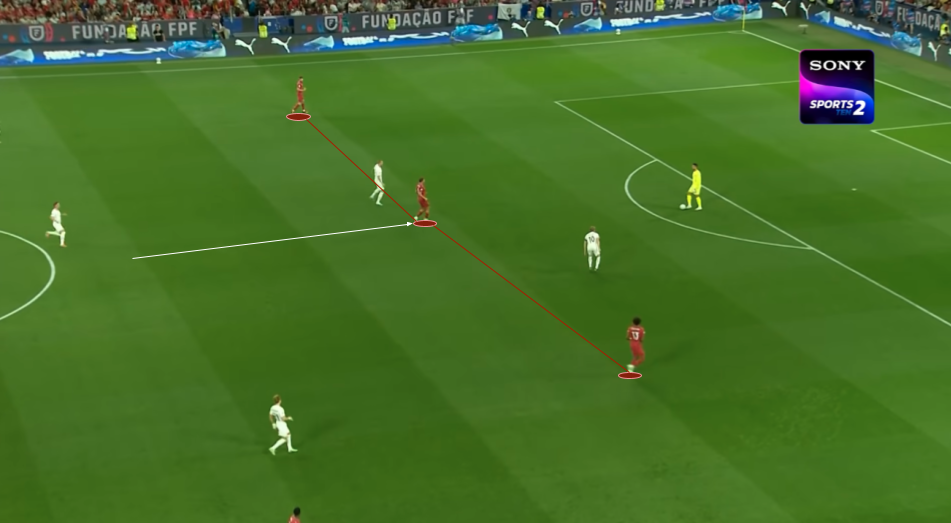 An early instance of Palhinha dropping from the midfield pivot into the Portugal back three as Dias and Veiga split.
Vitinha received on the half-turn and became the tempo setter and metronome described in Portuguese reporting as “the pendulum” of the side in possession and, out of possession “the shadow” of Odegaard.
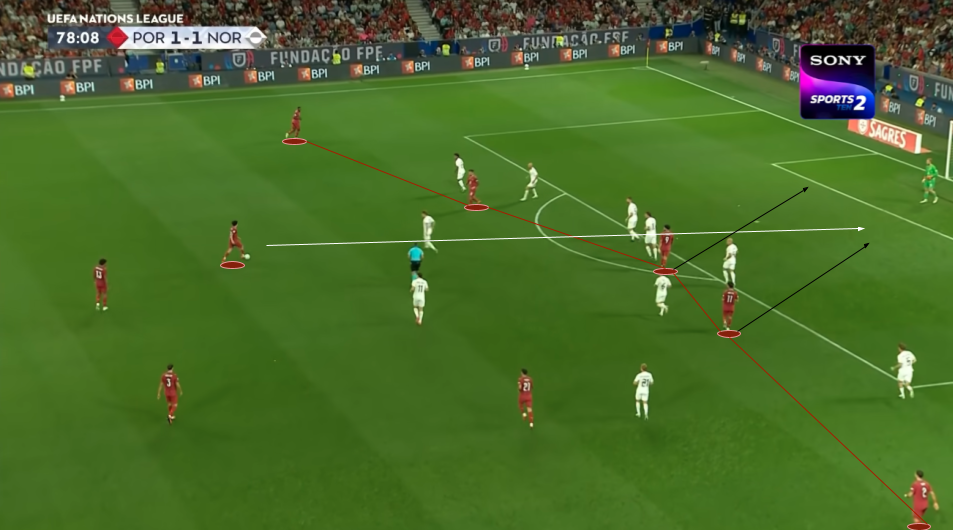
Cancelo and Conceicao formed the most reliable right-side link as Conceicao stayed high and wide, while Cancelo either overlapped or stepped inside into the right half-space once Felix dropped. On the left, Fernandes began wide but spent long periods as a second interior attacking midfielder which released Mendes to underlap or push high, Felix operated as a mobile false nine / right-sided playmaker, timing runs between Ostigard and Ajer or dropping to combine. Ramos pinned the centre-backs with early diagonal runs rather than holding the ball up statically.
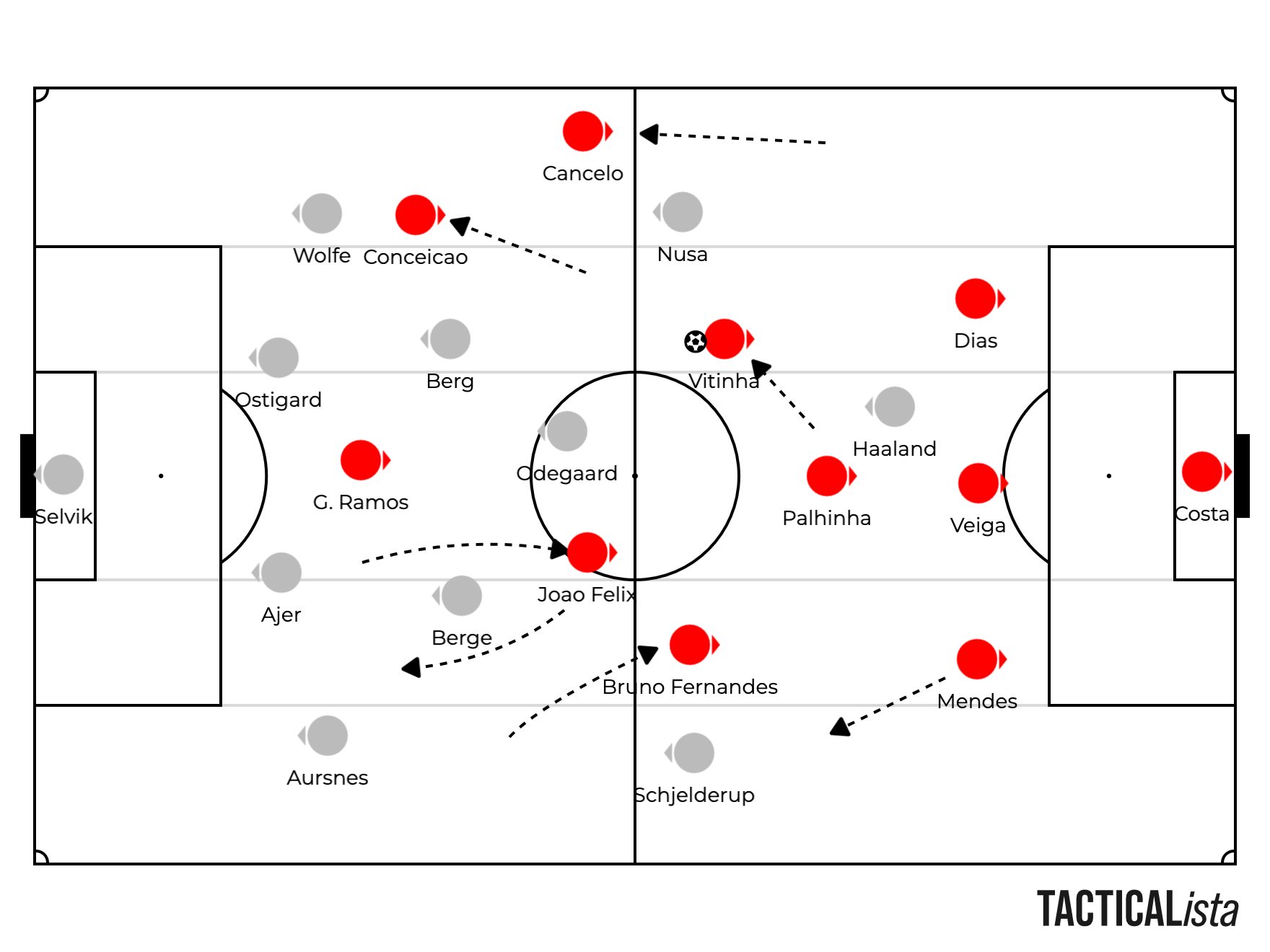 Portugal’s movement in possession. Palhinha stays in the pivot as Vitinha drifts across the middle, and Bruno Fernandes drops inside from the left as Joao Felix also drops and then moves towards the left. Meanwhile, Mendes pushes up slightly on the left while on the Portugal right, Cancelo and Conceicao push high and wide pinning the Norway defense.
The net effect, was an attack that often numbered a front five or six in a 3-2-5/3-1-6 with Ramos occupying both centre-backs, Felix and Fernandes between the lines, and the two full-backs supplying width. Portugal finished with roughly 59% possession, 434 accurate passes to Norway’s 274, and 20 shots to Norway’s 9 with 7 on target to Norway’s 3. Portugal also edged xG in the region of 1.76 to 2.13 xG to Norway’s 0.44–1.03 xG by the end of the game.
Norway’s out-of-possession, OOP shape was a compact 4-4-1-1 or 4-5-1 for long periods. Haaland was the highest presser, with Odegaard drifting and Berge and Berg protecting the central lane. They did press high in the opening quarter, forcing a few loose Portuguese turnovers as Mendes was untidy early on. Cancelo was booked in the 12th minute for a foul on Wolfe as well. But the intensity could not be sustained. Once Portugal shifted the point of attack to the flanks, Norway’s wide players were stretched and the centre-backs were left dealing with Ramos’ runs plus late box crashing from Felix.
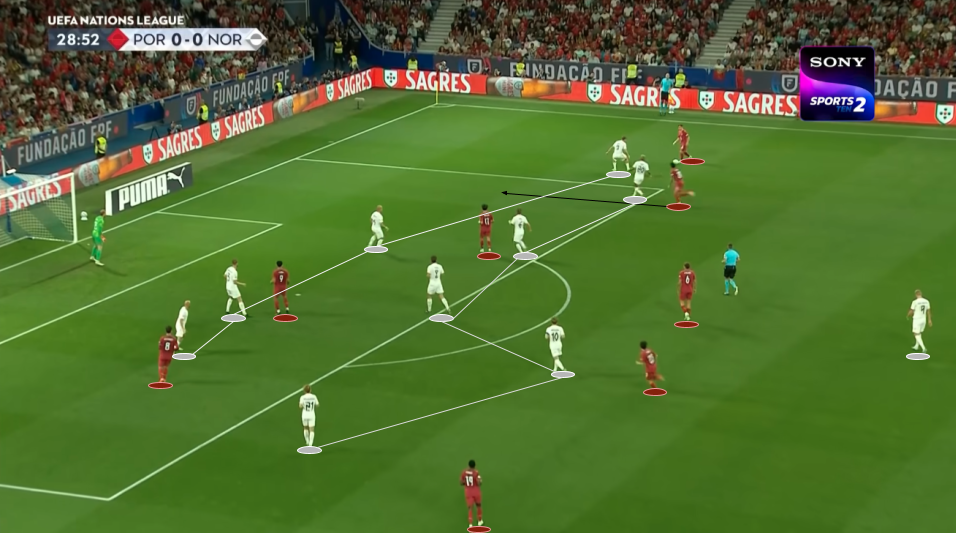 Portugal attack in a 3-1-6 vs Norway’s 4-5-1/4-4-1-1 OOP shape in the first half.
The first half was even in score but uneven in territory. Nusa cut inside early and forced a Costa save. Felix, fed by Conceicao, had a shot blocked around the 21st minute. Cancelo was tipped over by Selvik and Fernandes and Ramos both tested the Norwegian goalkeeper. Norway’s clearest threat before the goal was Haaland’s aerial presence and the occasional direct ball.
In the 36th minute Odegaard’s free-kick was taken down by Ajer, whose half-volley from the edge dipped into the top corner after a slight deflection off Palhinha. Two minutes later Mendes’ long throw was only half-cleared and Cancelo met the loose ball with a thunderous volley that flew into the net beating Selvik. Half-time ending 1-1 flattered the visitors on the balance of play and judging by the final-third entries from both sides.
Jesus’ Tweaks In The Second Half
Norway’s build was more vertical in a 4-3-3. Selvik and the centre-backs looked for Haaland early when the Portuguese press arrived, otherwise Berge and Berg screened and Odegaard received between the lines. Schjelderup and Nusa were the transition outlets with Nusa in particular carrying the ball inside from the left. Solbakken’s pre-match stance was proactive, yet the shape that appeared was compact in the middle third, designed to smother Vitinha and Palhinha’s combinations and protect the box. Wide midfielders or wingers were repeatedly pinned by Portuguese full-back advances, leaving Odegaard to cover large distances. Set pieces remained the clearest route and the game’s opener came from one.
Out of possession Portugal pressed in a 4-1-3-2 / 4-2-3-1 hybrid OOP shape. Ramos led the press as Felix and Fernandes jumped on the Norwegian centre-backs’ first options, and Vitinha locked onto Odegaard, man-marking him throughout the game. When the Portuguese press was bypassed they dropped into a mid-block with Palhinha screening the centre-backs and the full-backs narrow enough to deny Nusa and Schjelderup easy isolation.
Jesus’ second-half adjustments kept the same principles while freshening the engine room. At 63 minutes Dalot replaced Cancelo and Ruben Neves replaced Palhinha, preserving the pivot while adding a more progressive passer beside Vitinha. Solbakken’s changes were rather forced and then reactive. Haaland, whether through a fresh knock or pre-planned fatigue management after heavy recent minutes, made way for Jorgen Strand Larsen on 67 minutes while Nusa was replaced by Oscar Bobb on 74 and Berg by Thelo Aasgaard on 87. The loss of Haaland removed Norway’s primary hold-up and penalty-box threat.
And Portugal’s winner arrived on 79 minutes exactly as their positional play had promised. Vitinha’s lofted pass over the centre-backs found Felix’s run, and Felix squared first time, and Ramos finished left-footed from close range. It was Ramos’s third goal of the international window and the clearest illustration of the post-Ronaldo movement pattern, which was direct, diagonal and early.
 Ramos’ goal. Portugal attack with a front five. Vitinha plays a ball over the top of the Norway defense as Felix meets it and squares first time for Ramos to finish.
Late Red For Conceicao As Portugal Hold Firm
Late-game management became the decisive tactical aspect of the game. Conceicao received two yellow cards in quick succession and was sent off around the 86th minute leaving Portugal down to ten men. Fernandes was also booked in the process. Jesus responded by introducing Bernardo Silva for Vitinha and, deep into stoppage time, Nuno Tavares and Francisco Trincao.
Portugal’s shape tightened toward a 4-4-1, with Neves and Bernardo controlling the central rest-defence and the remaining attackers dropping to protect the box. Norway pushed Strand Larsen and Bobb forward and looked for second balls, but created no clear chance of equal weight to the earlier Portuguese openings. Selvik had already been forced into several saves but Costa was largely untroubled after the interval.
The game ended 2-1 to Portugal with Jorge Jesus continuing his fine run of results for the Selecao.
Takeaways
For Norway, Solbakken’s attempt to play through the middle and direct to Haaland, a tactic which was so successful for an hour in Oslo, was answered by Portugal’s wide flank play and incisive passing. Haaland being subbed off effectively cut off Norway’s biggest goal threat as Portugal managed the game professionally. Solbakken and Norway will now have to regroup and focus on their remaining UEFA Nations League fixtures.
Meanwhile, for Portugal, Jesus’ four wins in four have led to Portugal going through. The ten-man finish was a proper professional performance rather than a dominant one, however the xG difference, the shot count and the timing of the winner all pointed towards Jesus’ getting it right in his fresh rebuild of Portugal. They may be without Ronaldo, but Goncalo Ramos is firing and Jesus’ Portugal seem hard to beat.
We decided to make this article free to read. If you want to support our work, consider taking a subscription.
Use the arrows to scroll through all available match plots. Click to enlarge.
Check the match plots page for plots of other matches.


Comments