
Scotland – Morocco: One Touch from Saibari, One Giant Step Toward the Knock-outs For Morocco (0-1)
Scotland hadn’t experienced a happy ending against Morocco in the 1998 World Cup. This time was no different. A run behind the backline from Saibari to collect Diaz’s clipped pass and power it home gave Mohamed Ouahbi’s team an early lead. Transitions were another tool for the Moroccans to create chances, but the finish was lacking. At the end of each half, Morocco surrendered possession, which led to a momentum shift toward Steve Clarke’s men, who were close to upsetting the Moroccans.
Tactical analysis and match report by Achraf Lamdarhri.
We decided to make this article free to read. If you want to support our work, consider taking a subscription.
In the 2022 World Cup, Morocco, under Walid Regragui, pulled off a historic yet unexpected performance that secured them a smooth sailing to the semi-final of the competition. Morocco displayed defensive integrity, solidified by a killer transitional style that caught opponents off guard. After a successful period with the Moroccan national team, Walid Regragui left his position to former Morocco-U20 coach, Mohamed Ouahbi, who steered that young group of players to win the FIFA U20 World Cup. An unprecedented glory, which culminated in Ouahbi leading the Moroccan national team at the most prestigious competition.
It didn’t take that long for Ouahbi to put his touch. In fact, Morocco kept the defensive solidity of the medium and low block that was present under their former head coach, Walid Regragui, and maintained the transitional trait of their style. The current version of Morocco added intensity high up the pitch, hunting loose balls and forcing turnovers, whereas this group of players made a significant leap under Ouahbi during in-possession phases. Wide connections and diagonality were the main features of Morocco’s on-ball play, which seemed to have answers for the majority of situations against Brazil.
Before squaring off against Morocco, the Scotland national team arrived with hope and optimism under long-serving head coach Steve Clarke. Having secured the three points against Haiti, the Scots topped Group C, knowing that a positive result against Morocco would highly likely guarantee them their first-ever progression to the World Cup knockout rounds. Under Steve Clarke, Scotland remains a pragmatic and defensively solid team, and is counting on counter-attacks to maximise the profiles they have in their hands. The wingbacks provide width, midfielders generate goal threat, arriving from deeper areas, with John McGinn offering creative solutions.
Steve Clarke started with Andrew Robertson, Jack Hendry, Grant Hanley, and Nathan Patterson at the backline. Lewis Ferguson operated as a pivot with Scott McTominay and Ryan Christie, slotting in the central midfield positions. John McGinn functioned on the right and Kieran Tierney on the left, with Ché Adams leading the attack.
Mohamed Ouahbi kept the same lineup as the Brazil game. Achraf Hakimi started on the right and Noussair Mazraoui on the left, whereas Issa Diop and Chadi Riad sat at the heart of the defense. Ayyoub Bouaddi joined Neil El Aynaoui in the pivot. Brahim Diaz and Bilal El Khannouss hugged the touchlines, with Ounahi and Saibari having the license to roam.
Morocco’s early lead
After kick-off, both teams’ intentions resurfaced immediately. Scotland retreated into a compact medium block, in which McGinn and Tierney remained narrow on the right and left half-spaces, respectively. The former kept tabs on El Aynaoui, who tended to step back, as Mazraoui peeled off wide, whilst Kierney was ready to jump onto Hakimi, who inverted inside. McGinn was tasked to curve his run from the right half-space to cut off the in-out passing lane. Behind McGinn, Christie adjusted his lateral movements according to the ball side as he kept his eyes on El Aynaoui when the latter operated as a pivot. And he shifted across toward Ounahi, who pulled wide, when McGinn ran toward the dropping El Aynaoui.
Centrally, Adams took a diagonal position between Riad and Bouaddi, whereas McTominay followed the eighteen-year-old. Saibari had the license to dash deeper as a false nine. At the start, he dropped in as a situational right back. As a response, Roberston handed his zone over to Hendry. As they worked the ball to the right, the Moroccans looked to find a getaway from the touchlines. So, Diop would swap positions with Bouaddi to tie McTominay on the right half-space. Behind Diop, Hakimi positioned diagonally, drawing Ferguson and Christie with him. Adams stayed between Saibari and Bouaddi. Hence, El Aynaoui remained free in the center, showing himself for the ball. Morocco shifted the ball across until they pushed the Scots gradually backward.
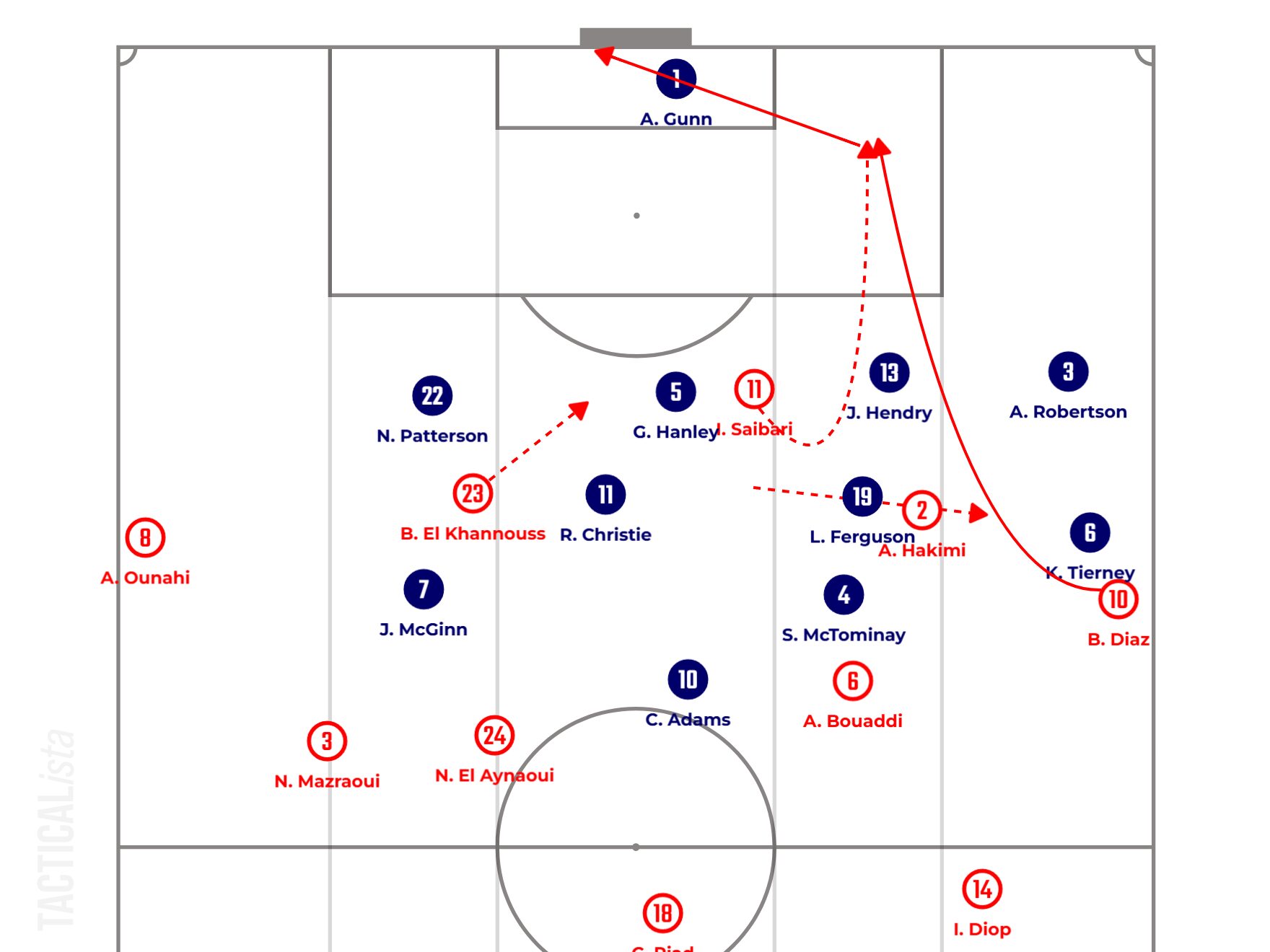
1st minute: After swinging the ball across, Morocco settles on the right side. Hakimi arrives from the left, approaching Brahim Diaz and bringing Ferguson with him. Diaz notices Saibari’s curved run between Hanley and Hendry to beat the offside. A clipped ball over the top from Brahim Diaz sets Saibari up inside the box. The latter powers past the goalkeeper, firing the ball to the top left of the net.
After the goal, Scotland locked on in a medium block, with the Moroccan national team, working the ball across the backline, probing and trying to figure out passing lanes and spaces to progress. Hakimi, Saibari, and Diaz alternated positions on the right side. Ouahbi’s players attempted to replicate the dynamics, leading to the first goal, by looking for pinging passes over the top for runners. However, the Scots put pressure on the ball, forcing the Moroccans to recycle. One of Saibari, Diaz, and Hakimi would distract the center-backs, with Ferguson cutting off direct access to one of them. The other two would provide double width to tie Tierney and Robertson on the same line vertically.
In the meantime, El Aynaoui would drop as a situational center-back, giving Diop license to shift across as a situational right back. That unlocked access to the right half-space as McTominay shifted horizontally late. With all the aforementioned pieces in place and Bouaddi tying Christie with him in the center, Hakimi would dash in from the wide channel into the gap between the lines. However, Robertson anticipated Diop’s pass into the half-space, stepping out, and targeting Hakimi’s blinside to dispossess him. El Aynaoui would jump onto the ball holder, which left a gap between Diop and Riad for Adams to dart into and link between Robertson and Christie. Scotland tended to take advantage of McGinn’s central position to develop the transition. Fortunately, Chadi Riad stepped up aggressively to halt the Scots’ movements.
Morocco focused on working out their attacks from the right side. As the ball rolled across the back three, Tierney stuck with the inverted Hakimi. As the play was funneled near the flanks, Tierney pulled wide to offer support to Robertson against Diaz. Meanwhile, Ferguson followed Bouaddi, who moved from the center toward the space behind Robertson, whilst McTominay approached Tierney to shut down the out-in angles. As a consequence, Ouahbi’s players were forced to recycle and switch to the left side.
Patterson’s lateral shift was quick enough to prevent El Khannouss from having the time to control the ball. Moreover, McGinn coming closer enabled him to collect the loose ball and initiate the transition. The latter noticed Hakimi following McTominay to the center, which resulted in numerical superiority on the right. Tierney was ahead of Brahim Diaz, roaming alone on the left half-space, picking up the ball and surging forward. He spotted Adams running between Mazraoui and Riad. However, the latter was able to clear Tierney’s cross.
Scotland in-possession, Morocco’s transitions
In possession, Scotland constructed its attack in a 4-3-3 shape. Ferguson stepped back between the center-backs, forming a situational back three with the distances slightly large to generate space for the far side defender and capitalise on Morocco’s front two lateral swing. Ten minutes in, Hanley —the far side center-back— picked out the dropping Christie. El Aynaoui jumped onto, regaining possession. Saibari collected the ball and surged forward in a three-versus-three situation. El Aynaoui and Saibari attacked the central channel to push Scotland’s situational back three deeper and vacate the left half-space for Ounahi to receive the pass. Hanley shifted toward Ounahi, and Hendry covered El Aynaoui around the far post, whereas Saibari targeted Ferguson’s blindside to sneak behind, trying to meet Ounahi’s pass at the edge of the six-yard box. However, Saibari, missing the intersection point with the ball, prevented his team from doubling the score.
From goalkicks, Angus Gunn launched long balls toward the narrow front three. Adams tended to drop into the landing zone of the ball, with McGinn and Tierney working off his shoulder to fight for second balls. Scotland’s midfielders operated in close proximity for the same goal. On the other side, Morocco’s midfielders were able to exert physical presence while dueling, which allowed them to collect the loose balls and retain them. Meanwhile, El Khannouss, joining the duel zone in the center, supplied the midfielders with an option to start the counterattack. Not only that, but Brahim Diaz, Saibari, and Ounahi, operating centrally with Scotland’s center-backs not jumping on, offered Morocco the overload around Ferguson to navigate the counter.
Morocco returned to replicate the same dynamics that led to the first goal from the right side. This time, Brahim Diaz provided width, attracting Robertson toward him. Scotland’s center-backs were busy, keeping an eye on Saibari, with Ferguson shifting late from the center to the right half-space. As a result, Hakimi proceeded with a run from the touchlines toward the gap between Hendry and Robertson. Behind, El Aynaoui would swap positions with Bouaddi horizontally, darting behind Adams toward the right inside channel, who jumped onto Riad. El Aynaoui, unpressurized, would attempt to slice Scotland’s defense open with a channel pass into Hakimi. However, Tierney, drifting inside, allowed him to intercept the pass and look to switch the play to McGinn. Scotland seemed to target the far side player to work out their counters. However, Morocco’s situational back three narrowed, shutting down the center, with Mazraoui stepping up to dispossess McGinn.
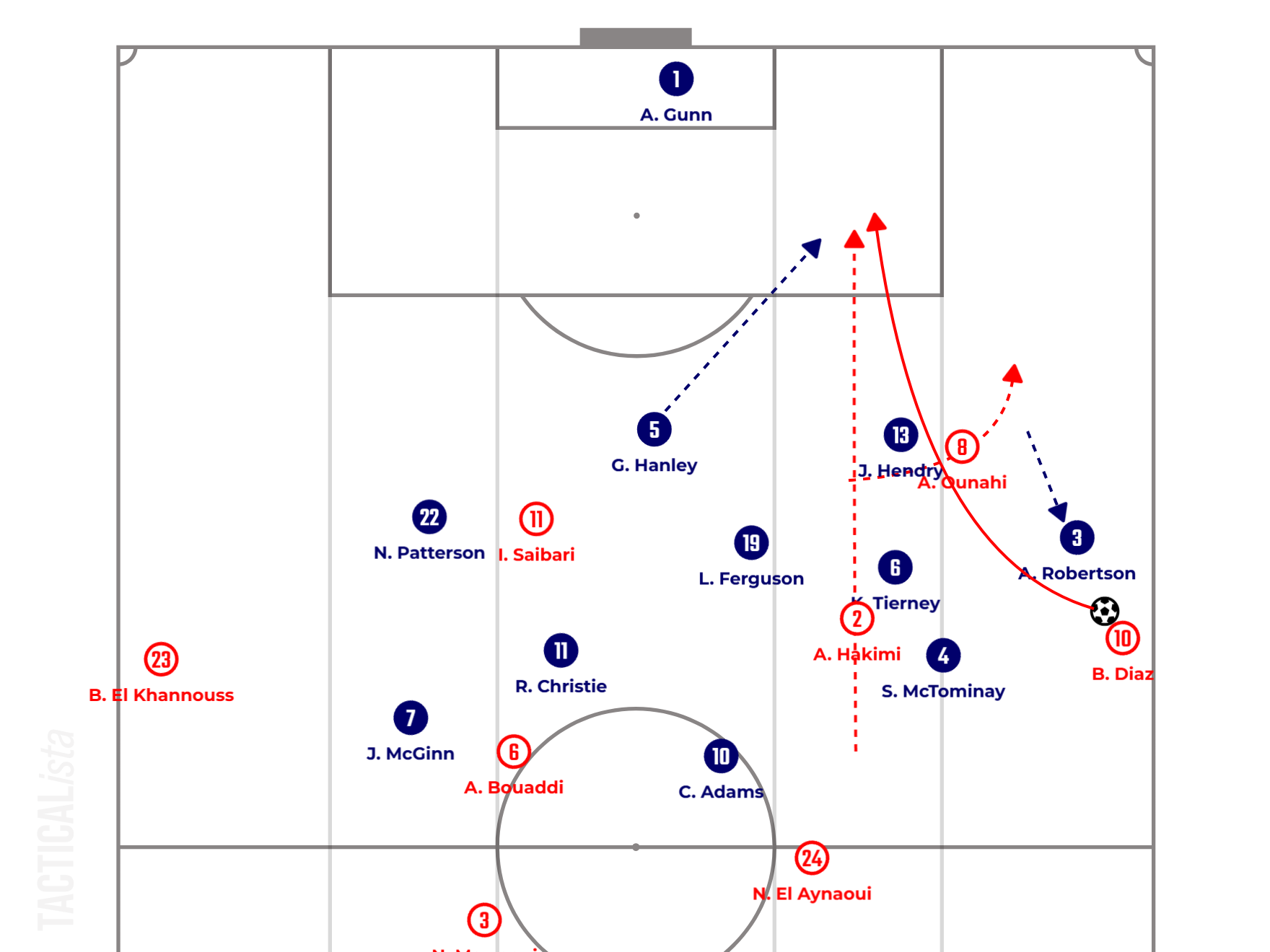
17th minute: After regaining the ball in the middle third, Morocco opts for slowing down the tempo, holding onto the ball, and settling into their in-possession shape. After picking out Brahim Diaz near the touchlines, Hakimi surges forward between the center-backs as Ounahi pulls Hendry across into the flank behind Robertson. Hanley sweeps behind his teammate, handling Hakimi’s late arrival. However, a miscommunication with the goalkeeper could’ve cost Scotland the second goal.
Morocco seemed to give up possession and retreat to defend in a 4-4-2 medium block. As a response, Scotland looked to invite the Moroccan pressure to exploit the space behind the backline. El Khannouss and Diaz ran toward Scotland’s situational wide center-backs, with Saibari taking charge of Hendry. Ounahi occupied Ferguson, El Aynaoui marked McTominay, and Bouaddi dropped out to cover the central channel and keep tabs on Christie. Morocco attempted to funnel the play toward Scotland’s right side by El Khannouss curving his run to cut off the angle between Robertson and Tierney, with Hakimi backing him up by stepping out onto Scotland’s left wingback.
As the Scots worked the ball toward the right, Morocco shuffled the block toward the ball-side. In the meantime, Adams darted from the left half-space toward the center, and McGinn peeled off wide. The distances between Diaz-Hanley and Mazraoui-Patterson were too large for them to arrive in time. Resultantly, Scotland channeled the play to Patterson, who spotted Adams’ run beyond Diop. However, the latter fouled the former, causing him a booking.
A passive approach from Morocco as the end of the first half neared
From deeper situations, Morocco lined up in a 4-3-3 in which the center-backs split wide alongside Bono, Ounahi swung between inside and peeling off wide, depending on the ball-side. Scotland jumped to press high up the pitch from a 4-1-4-1 initial shape. When the Moroccans directed the play toward the right, Adams took a close position to Bouaddi, operating diagonally between the latter and Bono. McTominay blocked off the out-in passing lane between Diop and the inside of the pitch. Tierney occupied Hakimi. Behind, Ferguson darted wide to mark Diaz, with the back four monitoring El Khannouss and Saibari. Christie shuffled toward El Aynaoui, cutting off the diagonal angle toward Ounahi, whereas McGinn narrowed inside and was ready to pounce on Mazraoui. Morocco circulated the ball toward Chadi Riad, who instantly went against Scotland’s lateral movements, returning to the right side.
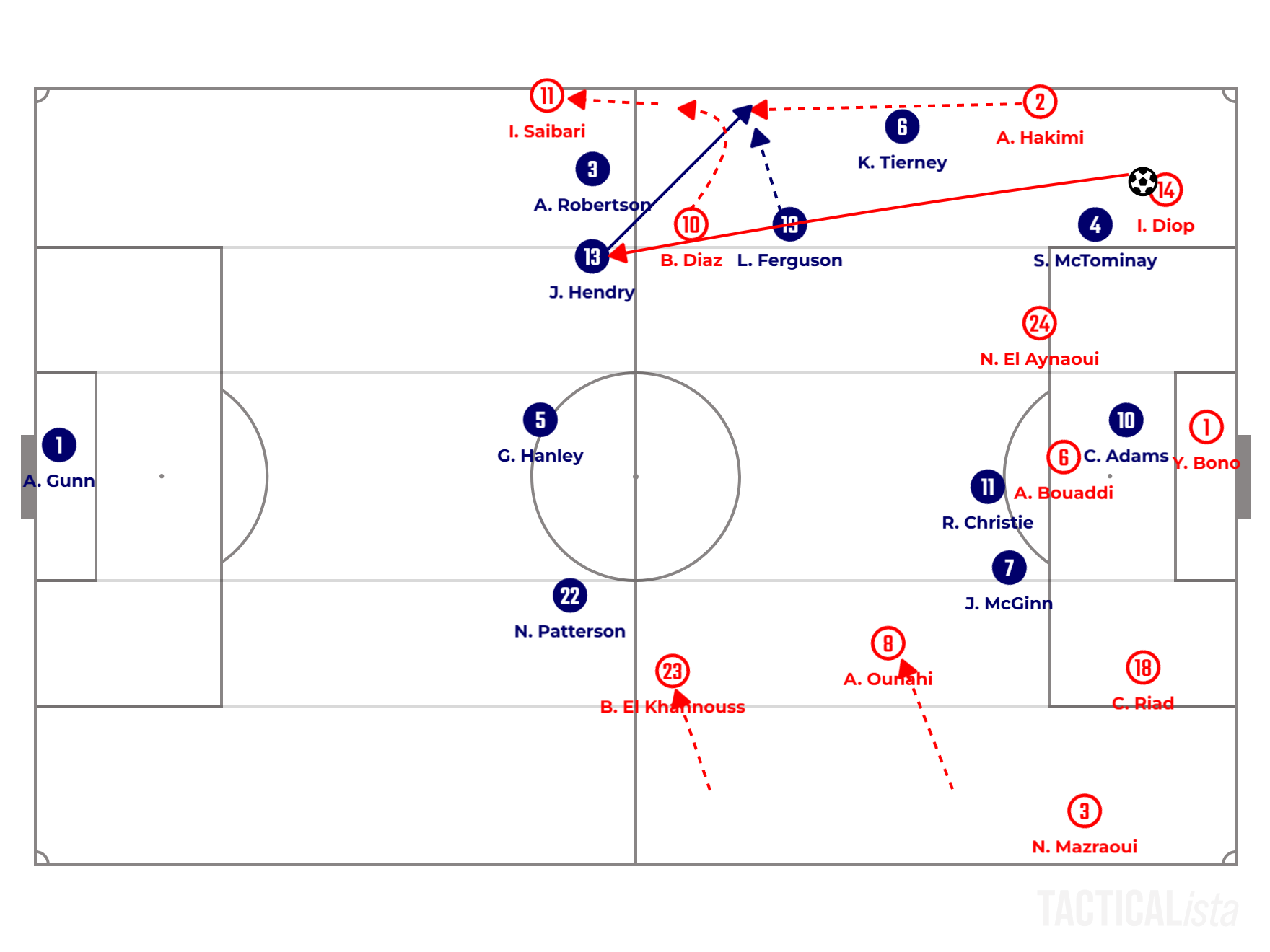
29th minute: After working the ball toward the right, Diop realizes Saibari’s run behind Scotland’s backline. Hendry clears Diop’s long ball, whilst Brahim Diaz withdraws toward the right to collect the knockdown after Hakimi pushes on and wins the second ball. Diaz skips past Ferguson, drifting infield and finding Saibari at the edge of the box. A one-two combination takes place between the pair, enabling Diaz to penetrate the box. Scotland retreats with Saibari, Ounahi, and El Khannouss pushing the backline rearward. Ferguson offers support to Robertson against Diaz. The latter prods the ball back to El Aynaoui, who arrives late and blasts the ball over.
When sitting in a 4-4-2 medium block, Saibari and Ounahi started narrow before one of them jumped onto the ball holder at the backline, whereas the other stuck to Ferguson to deny central progression. That gave Scotland’s ball holder time and space on the ball, due to the distances one of Morocco’s front two had to cover. Morocco’s ball-side wide midfielder remained inside to cover the inside channel. One of Bouaddi and El Aynaoui monitored the ball side central midfielder, with the other dropping to cover the center. Morocco’s far-side midfielder dashed in to engage with Scotland’s far-side central midfielder. On the right side, McGinn sneaked behind Bouaddi, who was distracted by Christie’s movements, to come short. McGinn, pulling across from the right half-space toward the center, opened a diagonal lane with Hanley. Meanwhile, Adams pinned the center-backs, allowing McGinn to turn and carry the ball toward the flanks, where Mazraoui halted his forward actions.
Scotland built momentum as the end of the first half neared. On the left side, Robertson pushed on with Tierney drifting infield. The pair and McTominay encountered pressure on the left side from Hakimi, Diaz, and Bouaddi, preventing them from working out the ball via wide combinations. As a reaction, Scotland looked to switch to the right side, where McGinn and Patterson advanced. That saw El Khannouss withdrawing into the backline to avoid an overload around Mazraoui. Christie instantly retreated down the right half-space to capitalize on the space around Morocco’s block. The Scots managed to shift the ball around quickly to Patterson, who had space to cross the ball into the box. McGinn dragged Riad across with him to allow Adams to meet the cross around the penalty area. However, the Scottish striker let the ball slide past him.
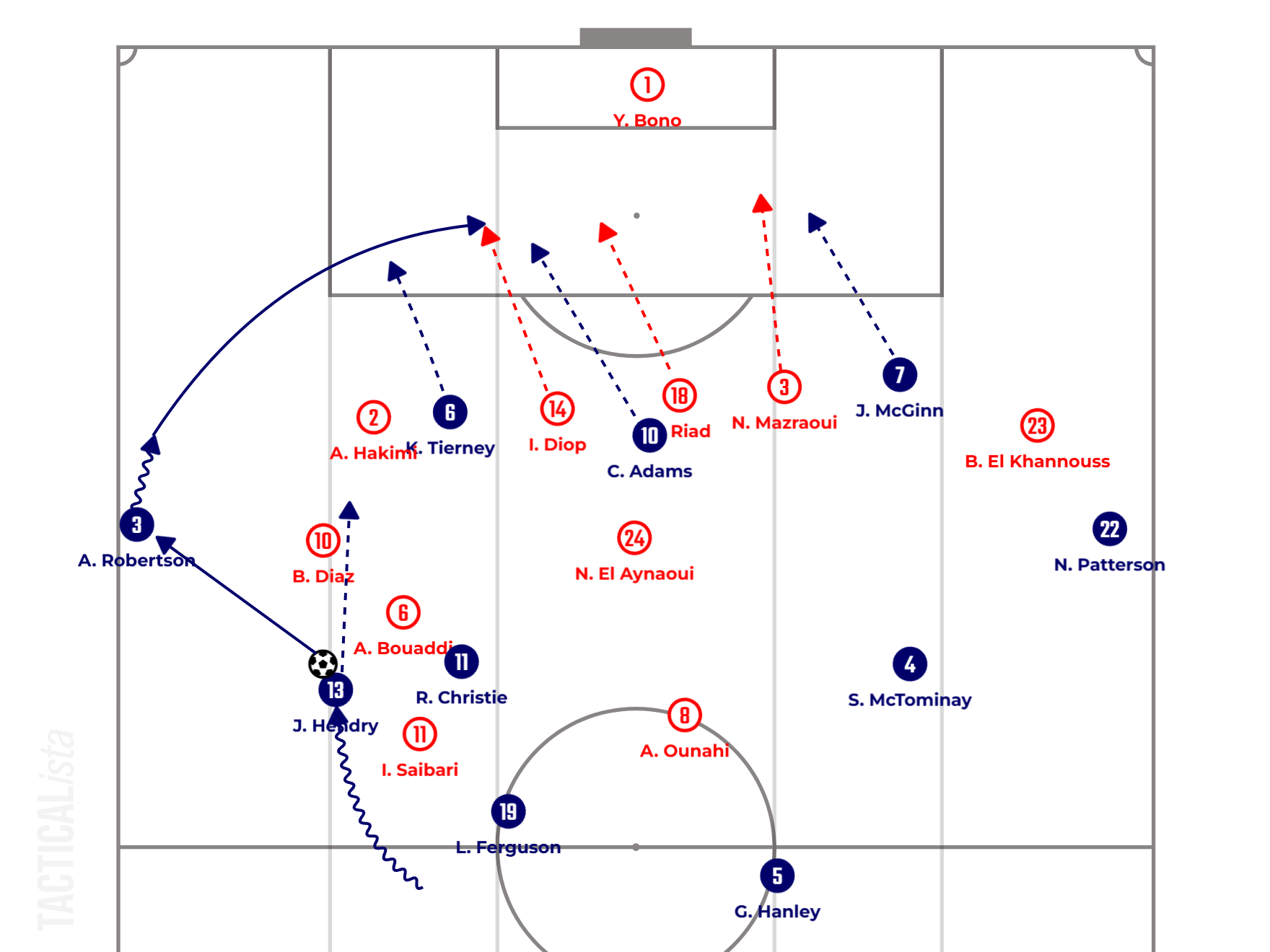
47th minute: After carrying around Morocco’s front line, Hanley feeds Roberston near the touchlines. The latter spots Tierney running between Hakimi and Diop in order to free up the space around the penalty area for Adams. However, Diop adjusts his position as he doesn’t fully commit to Tierney, staying slightly behind, which enables him to clear the cross.
Morocco’s wide buildup and combinations
In the second half, Scotland kept the same structure when pressing high up the pitch. As they funneled the play toward Diop, Tierney took charge of Hakimi, and McTominay ran diagonally toward Diop, screening Bouaddi, whereas Adams approached the eighteen-year-old. Morocco’s trio wriggled their way out of pressure via an in-out-in passing sequence, with Bouaddi offering progression by carrying the ball toward the left. Scotland retreated into a 4-4-2 medium block. El Khannouss pulled out Patterson and surged forward behind Scotland’s right back. Mazraoui glided the ball back down the flanks for El Khannouss to attack the byline and cut it back to Saibari. The latter’s shot collided with Hendry before hitting the woodwork.
The Moroccan national team kept moving the ball out, relying on wide combinations. On the right, Hakimi would pull wide behind Roberston, who followed Brahim Diaz. Bouaddi would fill the right half-space coming from behind and draw Christie with him. That vacated the space in the inside channel for El Aynaoui to come across and access Hakimi. The latter found Bouaddi roaming between the lines, whilst Saibari pushed the center-backs deeper. That resulted in a gap between Hendry and Tierney, where Bouaddi attempted to slide the ball for Hakimi and release him beyond his marker. However, the eighteen-year-old underhit the pass.
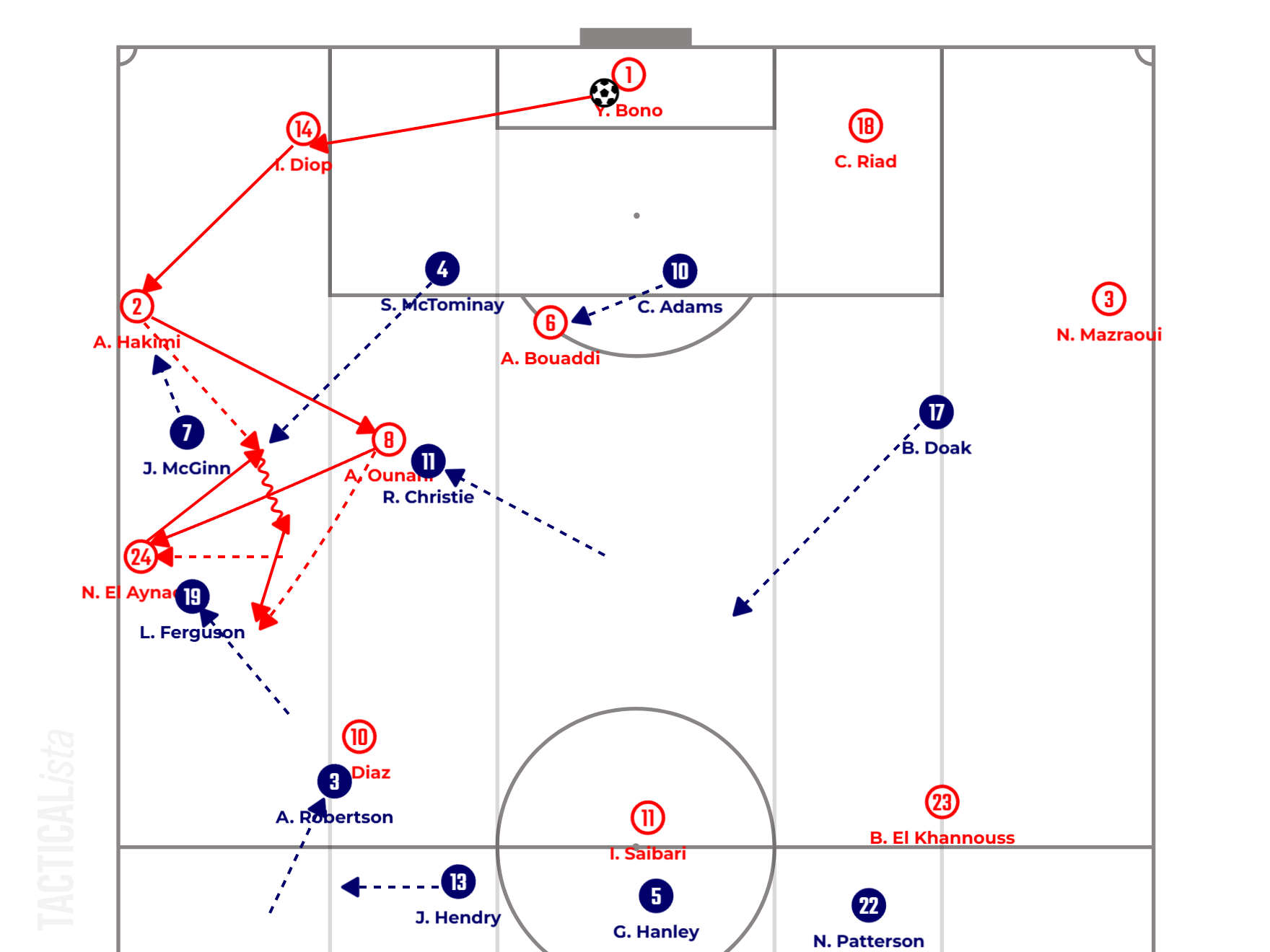
64th minute: Morocco’s buildup. After funneling the play toward Hakimi, Ounahi comes short diagonally with El Aynaoui dashing wide behind McGinn. After Ferguson jump onto El Aynaoui, Ounahi pulls wide, dragging Christie with him and vacating the half-space for Hakimi to creep behind McGinn. The Moroccan right back skips past McTominay to feed Ounahi. From there, the latter passes back inside to El Aynaoui, who stands on the ball, letting Scotland retreat. That enables Morocco a long spell of possession, lowering the tempo of the game as time progresses.
Thirty-one minutes into the second half, Scotland tended to transition from a medium block to a high press. However, Morocco found a path down the wide channel to progress. Ounahi dropped as a situational right back, passing the ball around McGinn to access Hakimi near the touchlines. Scotland’s jump indeed shut down central access, but left them vulnerable out wide and behind the backline. Hakimi, unpressurized, slid a diagonal pass from the flank toward the right half-space, which broke down Scotland’s defensive line and released Diaz between the center-backs. In the meantime, Saibari sprinted ahead of Patterson, gesturing for Brahim Diaz to square the pass. However, the latter opted for the individual solution, which Hanley and Hendry prevented, thanks to their recovery pace.
Momentum swing
Nearing the end, cracks began to appear through Morocco’s medium block. Scotland’s backline exploited the distance between Saibari and Ounahi, who focused only on what was in front of their eyes. As a result, the Scots were able to access one of the midfielders directly. McTominay and McLean drew Morocco’s midfield line upward, whereas Dykes, McGinn, and Doak pinned the Moroccan defensive line. McTominay and McLean operated at different heights to execute a diagonal up, back, and through pattern and infiltrate the space between the lines. Scotland cut through the Moroccans diagonally with Dykes linking the midfield and Ben Doak. The latter took on El Khannouss, trying to play the ball across the goal. However, Mazraoui blocked off Doak’s delivery.
Switches of play were another alternative Scotland relied on to take advantage of Morocco’s vulnerabilities on the far side of the pitch. Still nine minutes left, Patterson noticed Robertson operating alone on the left side. Hakimi was late in stepping out, which allowed Robertson to head the ball to McGinn. The latter dashed behind Hakimi, dragging Bouaddi with him and evacuating the half-space for Robertson to drive in and set McTominay at the edge of the box. El Aynaoui’s recovery pace disturbed McTominay from pulling off a shot.
A minute later, McLean dropped around Saibari and carried forward. In the meantime, McTominay shifted across toward the right half-space, appearing for the ball. McLean responded with a line-breaking pass between El Khannouss and El Aynaoui, whilst Dykes ran around Riad, providing McTominay room to advance. The latter set off the striker in the box; however, the extra nudge enabled Riad to put his body between the ball and Dykes, denying Scotland’s threat.
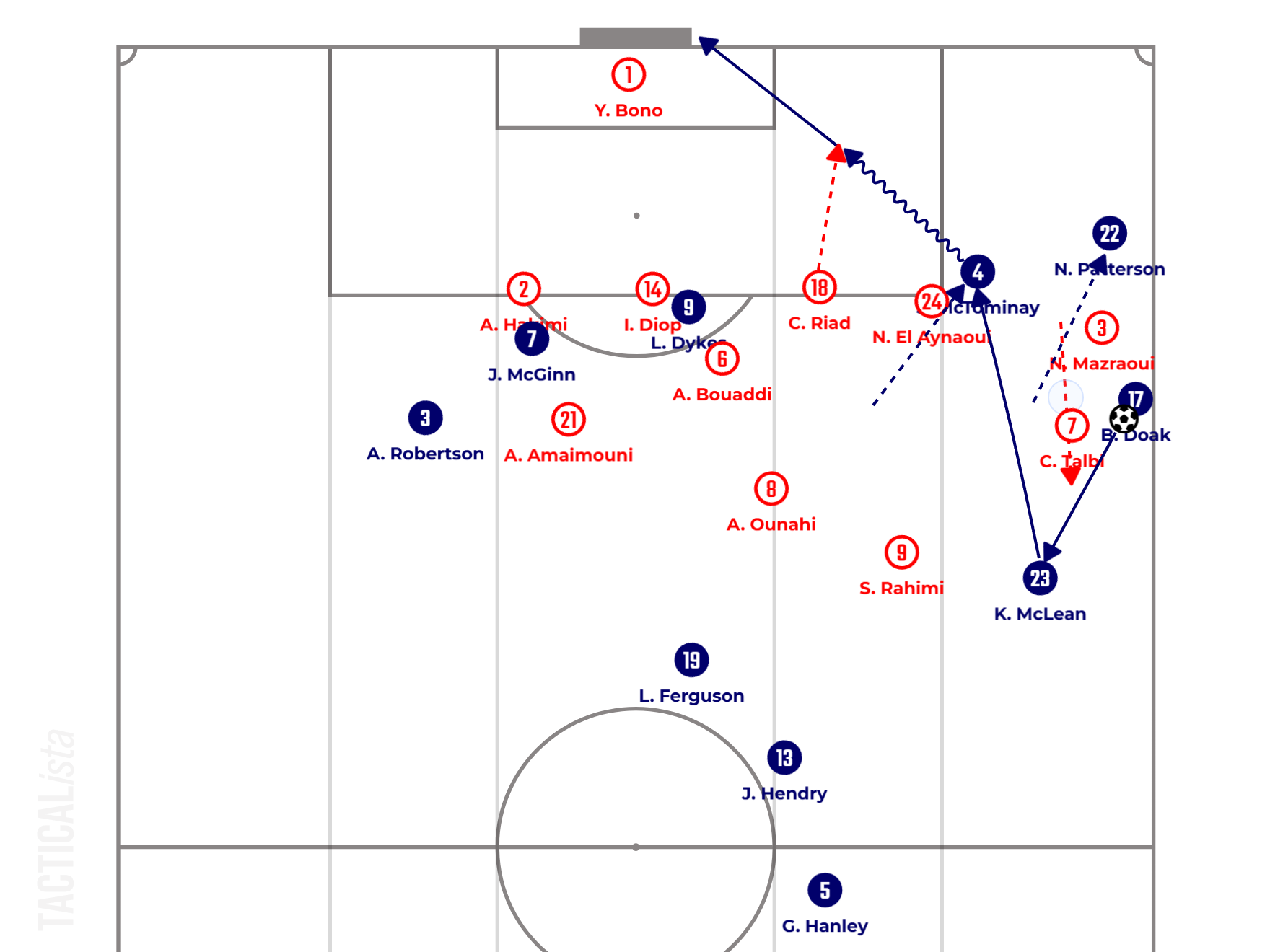
85th minute: Scotland’s attack. Patterson underlap draws Talbi backward. McTominay crept toward the right and around El Aynaoui. The former receives McLean’s pass on the half-turn, leaving Morocco’s midfielder in his wake, penetrating the box to shoot. Chadi deflects McTominay’s effort toward the side netting.
Takeaways
The Moroccan national team similarly approached the Scotland game as they did against Brazil. Ouahbi’s team dominated proceedings, probing and looking for routes to dismantle Scotland’s defensive block. Having a runner like Saibari to punish the spaces behind the opposing team and a playmaker of the caliber of Brahim Diaz paved the road for the Moroccans to draw an early advantage. Additionally, Mohamed Ouahbi’s men were able to generate chances from high regains and turnovers; however, efficiency was lacking.
The first two games highlighted that Morocco tended to give up possession in advantageous game states and retreat to defend. That created a momentum swing toward the opposition’s favor, as seen at the end of each half against Scotland. Steve Clarke’s team figured out routes through and around Morocco’s block, which put the Scots in high-quality situations that usually required a last-second intervention from the Moroccans.
Use the arrows to scroll through all available match plots. Click to enlarge.
Check the match plots page for plots of other matches


Comments