
Turkey – Paraguay: Wasteful Turkey Punished Again as Resilient Paraguay Hold Firm for Crucial Victory (0-1)
Turkey suffered a frustrating 1-0 defeat to Paraguay in their second 2026 FIFA World Cup Group D fixture, with Matías Galarza scoring the tournament’s fastest goal after just 65 seconds. Despite controlling possession for long periods and spending the entire second half with a numerical advantage following Miguel Almirón’s dismissal, Turkey were unable to find a breakthrough. Although the scoreline suggests a closely contested encounter, the match was largely played in Paraguay’s half as Turkey dominated territory and chance creation, only for a combination of wasteful finishing and determined Paraguayan defending to condemn them to another disappointing World Cup defeat.
Tactical analysis and match report by Mustafa Hassan
Turkey entered their second Group D fixture under increasing pressure after failing to convert promising periods of play into a positive result in their opening match. Vincenzo Montella’s side had arrived at the tournament with considerable expectations following an impressive qualifying campaign and a talented young attacking core. With the group becoming increasingly competitive, Turkey knew that anything less than a victory would leave their hopes of reaching the knockout stages hanging in the balance ahead of the final round of fixtures.
Meanwhile, Paraguay were aiming to build momentum after a disciplined start to their World Cup campaign. Gustavo Alfaro’s side had developed a reputation for defensive organisation and resilience, qualities that were expected to be tested against one of the most technically gifted teams in the group. A positive result would significantly strengthen Paraguay’s position in the race for qualification.
Montella selected a 4-2-3-1 system. Uğurcan Çakır started in goal behind Mert Müldür, Merih Demiral, Abdülkerim Bardakcı and Ferdi Kadıoğlu. İsmail Yüksek partnered Hakan Çalhanoğlu at the base of midfield, while Yunus Akgün, Arda Güler and Kenan Yıldız operated behind Kerem Aktürkoğlu.
Alfaro opted for a 4-4-2 formation. Orlando Gill started between the posts behind Juan Cáceres, Gustavo Gómez, Omar Alderete and Júnior Alonso. Andrés Cubas and Diego Gómez formed the midfield partnership, with Miguel Almirón and Matías Galarza providing support from wide areas. Julio Enciso partnered Isidro Pitta in attack.
Paraguay’s Press Punishes Turkey’s Left-Sided Build-Up
Turkey’s early build-up structure was designed to create numerical superiority on the left side and progress possession through short combinations. Whenever Uğurcan Çakır initiated attacks, possession was frequently directed towards Abdülkerim Bardakcı on the left of the back line. Around the ball, Turkey consistently created a heavy overload, with as many as five players occupying the same zone in an attempt to provide multiple passing options and facilitate progression through Paraguay’s first line of pressure.
As Bardakcı moved wider in possession, Hakan Çalhanoğlu dropped into the defensive line to occupy the vacated central space and maintain stability during circulation. Further forward, Kenan Yıldız drifted inside towards the left half-space in the middle third, offering a vertical passing option between the lines, while Ferdi Kadıoğlu maintained an extremely wide position close to the touchline. The intention was clear: create triangles around the ball, generate passing angles and draw Paraguay’s defensive block towards one side before exploiting the resulting spaces elsewhere.
The execution created a different outcome. Rather than stretching Paraguay’s shape, Turkey’s concentration of players in a single area often made the zone excessively crowded. Passing lanes became compressed, decision-making windows shortened and any technical mistake immediately exposed Turkey to transitions. Paraguay recognised this vulnerability from the opening whistle and responded with an aggressive, highly coordinated pressing scheme.
Isidro Pitta led the pressure by attacking the ball carrier, while Diego Gómez stepped forward on a curved pressing run towards Çalhanoğlu. This movement simultaneously prevented the return pass towards Çakır and denied access into Turkey’s deepest midfielder. On the outside, Miguel Almirón remained tight to Kadıoğlu, while also helping to block the passing lane towards Yıldız. The result was that Andrés Cubas could remain free behind the initial pressure, positioned perfectly to attack loose balls and second possessions.
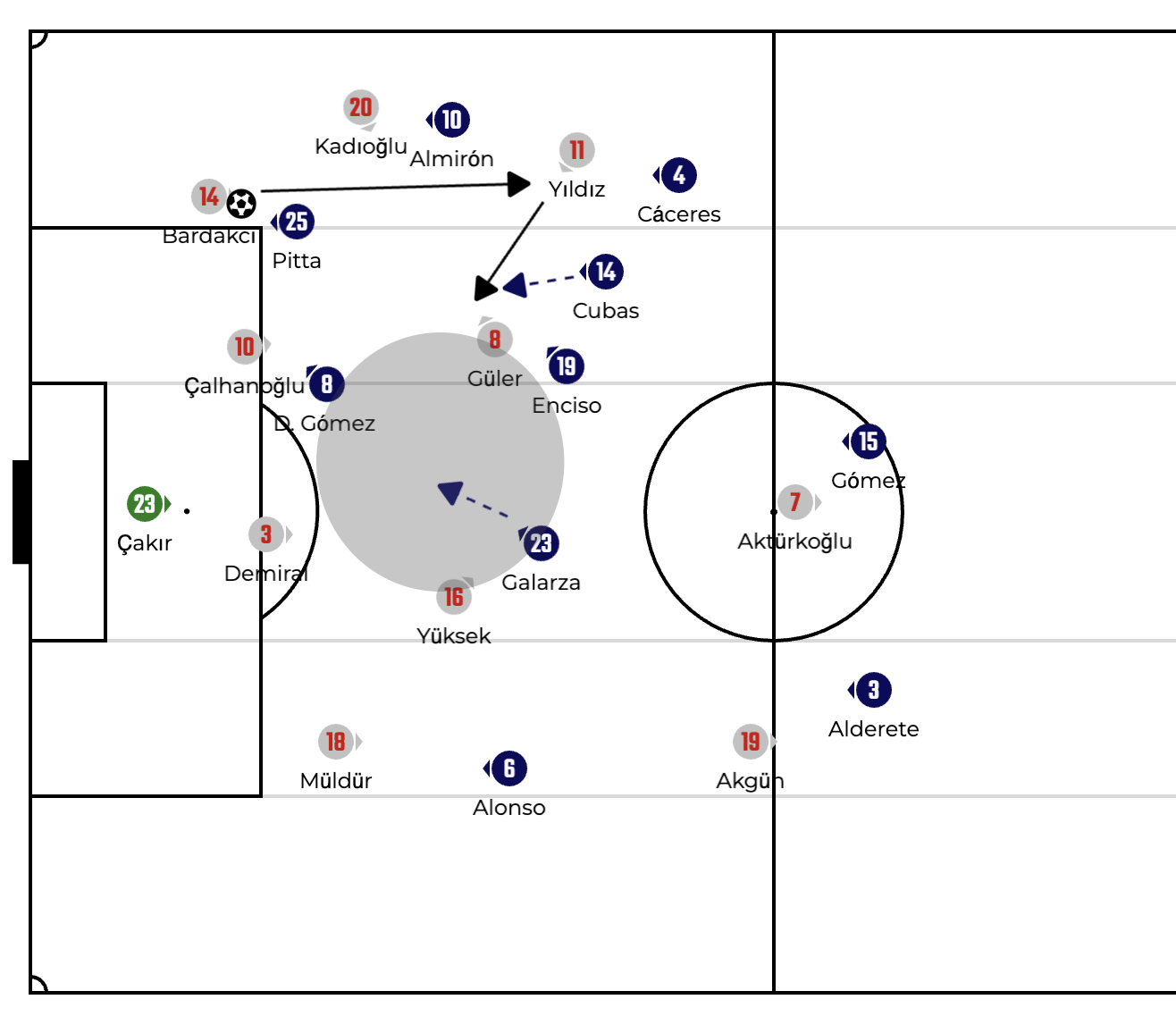
Paraguay’s aggressive high press disrupted Turkey’s overloaded left flank and directly led to Galarza’s early winner.
The opening goal emerged directly from this pattern. Under intense pressure and with few clean passing options available, Turkey failed to progress possession securely. The resulting loose ball fell to Cubas, whose positioning allowed him to immediately regain control. Without hesitation, he threaded a forward pass into the path of Matías Galarza, who drove into space and produced an excellent finish from outside the penalty area. It was a goal born not from sustained possession, but from Paraguay’s intelligent understanding of Turkey’s build-up structure and their ability to exploit its weaknesses.
Paraguay’s Compact Low Block Forces Turkey Wide
After taking the lead, Paraguay immediately shifted their priorities towards protecting the advantage. Gustavo Alfaro’s side retreated into a compact 5-2-3 low block that was specifically designed to eliminate central access and deny Turkey the opportunity to combine through the middle. Rather than aggressively contesting possession, Paraguay focused on controlling space, narrowing passing lanes and forcing Turkey away from the areas where their technical attackers could have the greatest influence.
Turkey attempted to stretch the pitch horizontally during their possession phases. Kenan Yıldız and Mert Müldür provided maximum width on opposite sides, while Arda Güler, Yunus Akgün and Kerem Aktürkoğlu occupied more central positions between Paraguay’s defensive and midfield lines. Behind them, Hakan Çalhanoğlu acted as the primary distributor, constantly searching for vertical passing opportunities capable of breaking defensive lines and accelerating attacks.
Paraguay’s defensive structure proved extremely effective at neutralising these intentions. The front three screened central progression, while the midfield pair remained compact in front of the back line, ensuring that passing lanes into Turkey’s attacking midfielders were consistently blocked. Whenever Çalhanoğlu or the centre-backs attempted to play through the middle, they were met by immediate pressure or found their options completely removed.
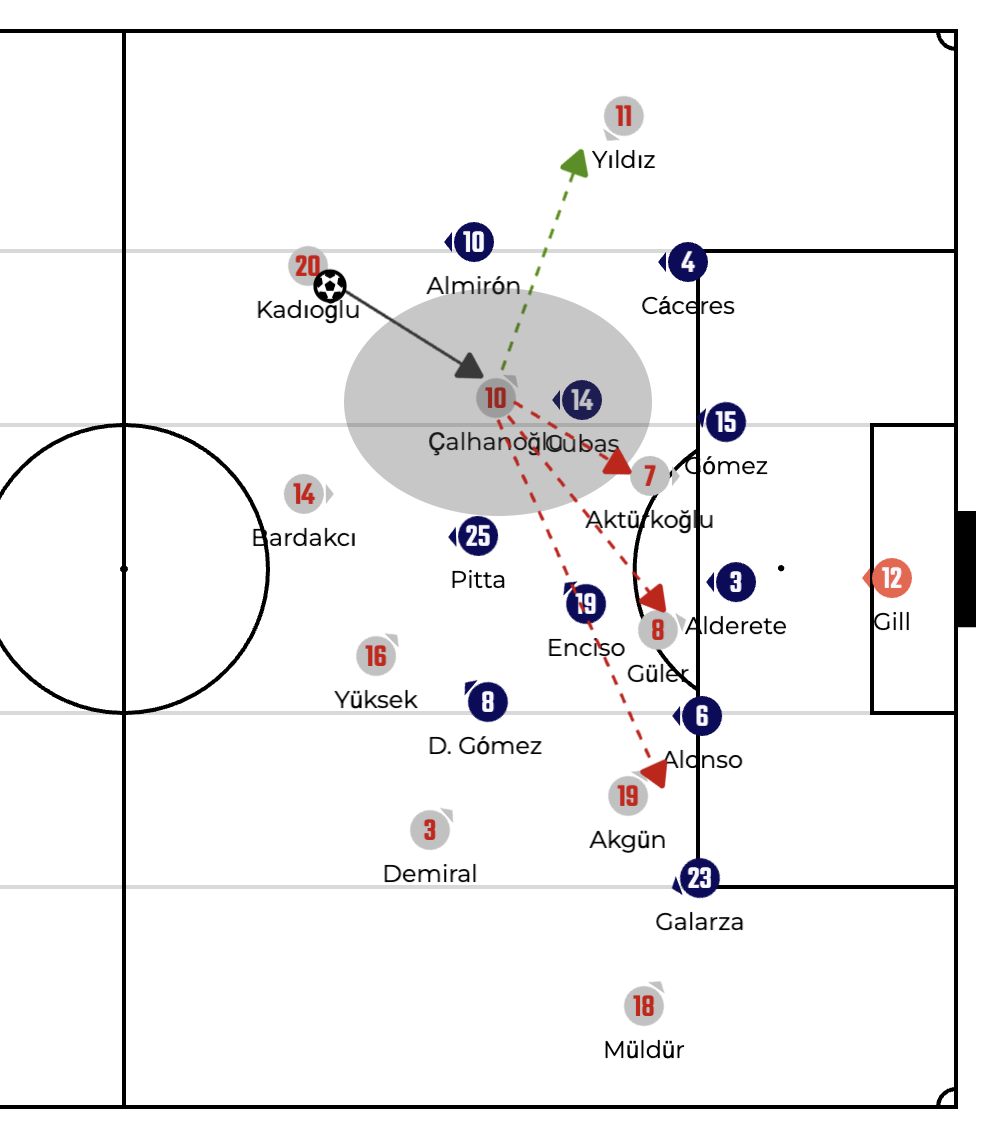
Paraguay protected the centre with a compact 5-2-3 shape, forcing Turkey into low-value crossing situations throughout the match.
As a result, Turkey were repeatedly funnelled towards the flanks. Although this allowed them to accumulate territorial dominance and a significant volume of attacking actions, the nature of those attacks often favoured Paraguay. Crosses were delivered into a crowded penalty area, where the South American side possessed numerical superiority and were comfortable engaging in aerial duels and second-ball battles.
Turkey generated plenty of attempts but struggled to create genuinely high-quality opportunities from open play. Most of their shots arrived from unfavourable positions or through heavily contested situations, resulting in relatively low expected-goals values. Their most dangerous moments instead came from set-pieces, where Paraguay’s structural advantages were reduced and Turkey were finally able to create chances capable of seriously threatening Orlando Gill’s goal.
Turkey’s Central Overloads Fail to Break Paraguay’s Reinforced Block
Following Miguel Almirón’s dismissal, Gustavo Alfaro immediately prioritised defensive stability over attacking presence. Paraguay abandoned their front-two structure by withdrawing Pitta and introducing Bobadilla, allowing the midfielder to occupy the space previously covered by Almirón and restore balance across the second line. Further substitutions, including the introduction of Velázquez, were primarily designed to provide occasional counter-attacking depth while preserving the compactness of Paraguay’s defensive organisation. The result was an increasingly disciplined 5-3-1 defensive shape whenever Turkey established sustained possession, with all ten outfield players positioned behind the ball and focused on protecting central zones.
Turkey responded with a series of attacking substitutions aimed at increasing presence between the lines. Barış Alper Yılmaz and Gökdeniz Gül were introduced to operate in the half-spaces on either side of Arda Güler, who increasingly functioned as a false nine, dropping away from Paraguay’s defensive line in an attempt to create connections between midfield and attack. Behind them, Hakan Çalhanoğlu remained Turkey’s primary organiser, dictating circulation and constantly searching for progressive passes capable of destabilising the block.
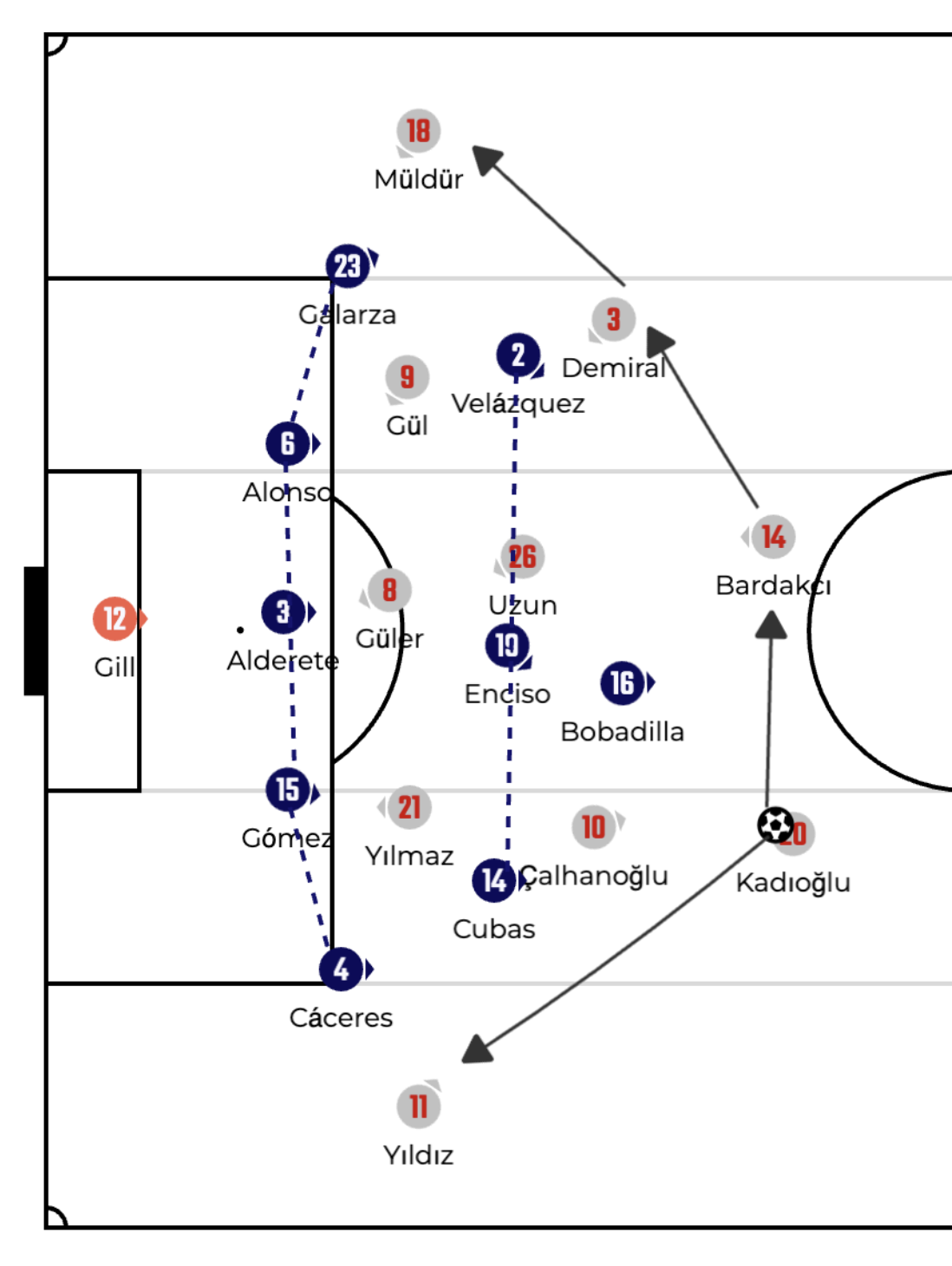
Paraguay’s post-red-card 5-3-1 block congested central spaces, forcing Turkey into sterile U-shaped possession and low-value attacking opportunities.
Paraguay, showed little concern for protecting the flanks. Instead, their entire defensive structure became increasingly focused on congesting central areas, denying access into Güler and preventing Turkey’s attacking midfielders from receiving in dangerous pockets. As a consequence, Turkey’s possession developed into a predictable U-shaped circulation pattern around the perimeter of Paraguay’s block. The ball moved repeatedly from side to side without penetrating the compact central structure, forcing attacks towards wide areas where crossing opportunities carried limited value. Although Turkey accumulated a significant number of attempts during the closing stages, most originated from low-probability situations, allowing Paraguay’s disciplined defensive organisation to preserve their narrow advantage until full-time.
Takeaways
Paraguay’s aggressive press targeted Turkey’s overloaded left-sided build-up, with Cubas consistently positioned to recover loose balls and launch transitions, a pattern that directly produced Galarza’s decisive early goal.
After taking the lead, Paraguay’s compact 5-2-3 low block denied central progression and funnelled Turkey towards the flanks, forcing Montella’s side into crosses and low-quality shooting opportunities despite overwhelming territorial dominance.
Even after Almirón’s red card, Paraguay’s reshaped 5-3-1 block remained compact around the centre. Turkey responded with half-space rotations around the false-nine movements of Güler, but their attacks became predictable U-shaped circulation, resulting in high shot volume but limited chance quality.
Comments