
Crystal Palace – Arsenal: The Gunners Get Their Parade (1-2)
Continental competition can give additional glow to the campaigns of both clubs in this clash, but Arsenal already are in the mood to celebrate. An achievement not accomplished for over a generation belongs with the team again, and they kicked off their stint with new status in style.
Tactical analysis and match report by Emmanuel Adeyemi-Abere.
We decided to make this article free to read. If you want to support our work, consider taking a subscription.
Crystal Palace have had little to fight for in domestic football in 2026. They were eliminated as FA Cup holders in the third round of the competition in January, having exited the Carabao Cup a month before, and their topflight League status, which was never in doubt, was confirmed for the following season earlier in May. Form has fallen off for the outfit who have shipped at least two goals in their last five fixtures, but Conference League aspirations are keeping dreams alive of more silverware.
Meanwhile, Arsenal are jubilating at their first Premier League title since 2004, marking a historic moment in their modern era at the Emirates Stadium. Four wins with clean sheets against Newcastle United, Fulham, West Ham and Burnley meant dropped points for Manchester City would be fatal at the Vitality Stadium, and so it proved in midweek. Things can get even better when the Champions League final rolls around against Paris Saint-Germain on Saturday, but for now, it is time to celebrate.
Mikel Arteta used an experimental lineup for this trip to South London. Kepa Arrizabalaga featured between the posts in place of his compatriot David Raya. Christian Mosquera, Piero Hincapié, Riccardo Calafiori and Martín Zubimendi were present in the backline. Myles Lewis-Skelly stayed in the midfield with Christian Nørgaard. Gabriel Jesus got an opportunity to play upfront over Viktor Gyökeres, backed up by the trio of Gabriel Martinelli, 16-year-old Max Dowman and Noni Madueke.
Similarly, Oliver Glasner took the opportunity to rotate in his final fixture at Selhurst Park. Chadi Riad, Jefferson Lerma and Nathaniel Clyne covered the slots in central defense, and Rio Cardines came in for Tyrick Mitchell as the left wing-back. Daichi Kamada and Will Hughes held down the two pivot positions. Ismaïla Sarr stayed as the runner from the left of the front three, and Jørgen Strand Larsen allowed Jean-Philippe Mateta to stay in reserve while Justin Devenny displaced Yeremy Pino.
A breakthrough birthed in Brazil
In the new year, Arsenal have continually tinkered with the balance of their various units to get enough open play output from their attack. Lately, they seem to have stumbled on the right balance.
Especially given the absence of Leandro Trossard, much of the play gravitated to the right side of the pitch. There, Zubimendi took on the role of a right back who was capable of distributing the ball from deeper positions and popping up in the final third. The main actors were Dowman, who continues to impress with his ball handling and technique, Jesus, joining to link up as a fourth man down the channels, and Madueke, whose qualities have been a useful alternative to Bukayo Saka on the wing.
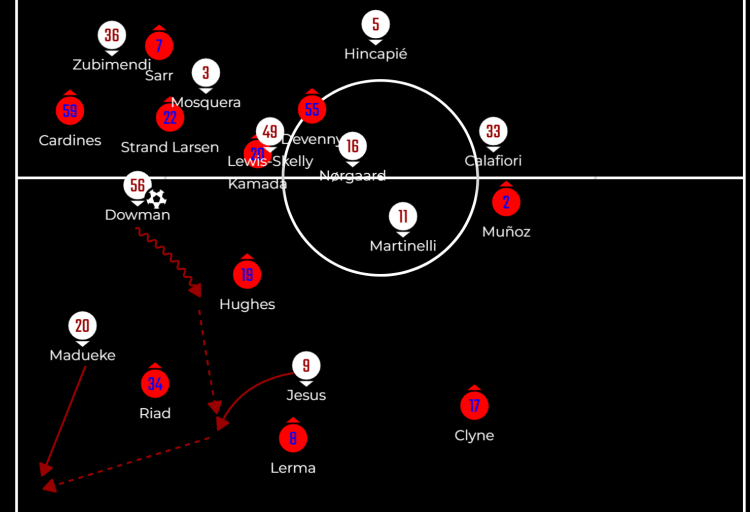
9th minute: offensive sequence from Arsenal. Strand Larsen is unsettled in an aerial duel with Mosquera, and Dowman collects the ball. He drives diagonally infield, committing Hughes, and Jesus recognizes his role of hitting the space on the shoulder of Lerma, feeding a first-time pass towards Madueke. By this point, Cardines has retreated, but Madueke manages to go around the outside of the wing-back. However, Jesus had remained deep, and no one was present across the face of the goal.
But even with the rotation in the starting eleven, certain relationships remained intact. Calafiori continued to be an all-action threat from a centralized role on the left, and he was capable of swapping positions with Lewis-Skelly to progress and retain possession inside the block. While Martinelli did not readily serve the fullback with the same frequency as Trossard, the possibility was often signaled.
Where Martinelli does make a difference is in his intuition to find spaces in transition, backed up with the change of speed to get into dangerous positions. Aside from three big opportunities missed for Jesus in the first 20 minutes of the match, the wide forward passed up the other presentable chance of a productive opening phase after he broke away in a counterattack from a corner kick for the hosts.
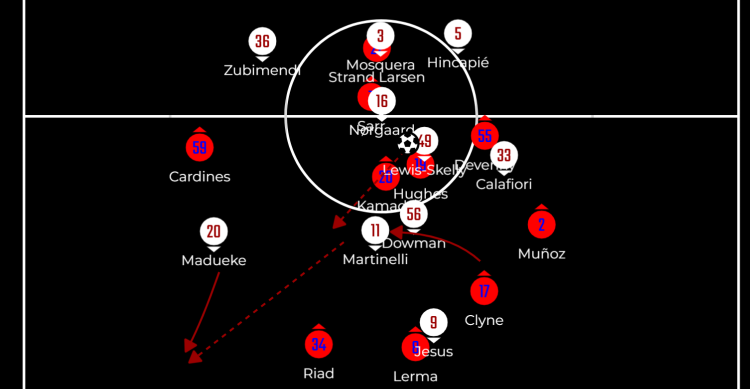
29th minute: offensive transition from Arsenal. Lewis-Skelly had mistimed a jump for the ball, and Hughes had eased him out of the way. Dowman then tried to flick the ball into his control, carrying the attention of Kamada. As Jesus slid towards the left side, Martinelli moved more centrally, came off the shoulder of the two pivot players, and was available for Lewis-Skelly to hit when Arsenal won the third ball. Madueke was then again available wide right with Dowman and Calafiori in the pockets.
These elements of Arsenal’s attacking play produced a breakthrough. Dowman flicked the ball around the corner, and Martinelli had drifted into a central position. Jesus jostled to get behind the backline, received a through ball from Martinelli, and his low drive found a way beyond Dean Henderson.
Palace’s problems pile up
Both managers made several alterations to their teams at the start of the second half. For Palace, a triple substitution saw Sarr step out for Pino in the frontline, Muñoz make way for Mitchell, with Cardines rotating to right wing-back, and Kamada come off for Wharton. Meanwhile, Arteta allowed Calafiori came off for Gabriel Magalhães, and Hincapié had moved to left back. Further afield, Kai Havertz had also replaced Nørgaard in the middle of the park, so Lewis-Skelly sat even deeper.
It did not take long for the guests to grab another goal in their customary fashion. Gabriel had sent Martinelli into a 1 v 1 duel with Clyne down the left channel, and Lerma launched into a recovery challenge to concede a corner kick. The wide forward lined up a delivery towards the far post, where Havertz had stooped to flick the ball back into a more central position. Madueke made his move to the ball, hitting a volley towards the target and into the net. The Gunners were now two goals to the good.
Palace would have struggled to slip much further below their usual standards on both sides of the ball after the restart, and they benefitted from facing a side with a reconfigured spine. However, their plans were thwarted when Wharton was caught up in a tackle with Lewis-Skelly and he had to come off with an ankle injury: Devenny dropped into midfield, and Evann Guessand completed the frontline.
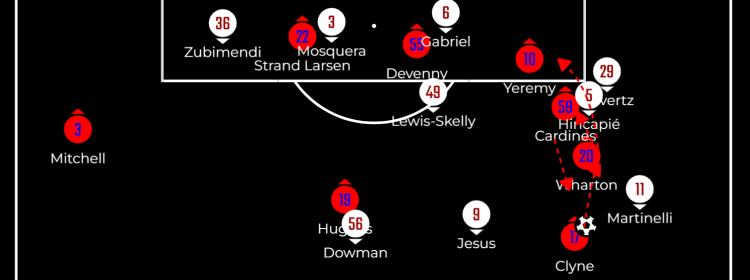
53rd minute: offensive sequence from Crystal Palace. After the hosts had forced their opponents back into a lower block, Havertz tried to stop Cardines crashing a more central position with an inside carry. He approached from an angle that could have allowed Yeremy to receive between the lines, but the ball broke upwards from the duel towards Clyne. Havertz kept drifting outwards, so Hincapié jumped to Cardines when the ball was worked inside, and Yeremy ended up with a chance to shoot.
Arsenal allow the level to loosen
Further changes followed for both sides. Mikel Merino made his first appearance in four months for Arsenal after recovery from surgery for a foot injury, replacing Dowman as an attacking midfielder.
Havertz moved upfront to take the place of Jesus when Eberechi Eze was handed minutes in midfield against his former club, and Eze then shifted wide left so Havertz could drop deeper and Martinelli moved wide right as Gyökeres filled in for Madueke, who seemed to have pain in his hamstring. For the hosts, Mateta attempted to provide a more threatening presence upfront in place of Strand Larsen.
Before Martinelli had switched sides, he had been the protagonist with two driving carries against Cardines to create chances for Havertz. However, the German fluffed his lines on both occasions, and Merino could not convert the shanked shot from the second attempt into a goal bound effort.
Palace had been second best, but true to their character under Glasner, they kept pushing forward for a consolation goal. The hosts got one when Mateta slipped between the central defenders to divert a Yeremy delivery past Kepa. And they thought they had equalized out of nowhere when Yeremy lashed the ball beyond his compatriot, but Guessand was offside when the strike deflected off his body.
Gyökeres and Eze then burst into the box during second half injury time with excellent openings to restore the two-goal lead, but both missed the mark. It did not matter too much, though, because the big ears were on their way to North London, and Arsenal had crowned the moment with a triumph.
Bottle this feeling 🍾 pic.twitter.com/OjIRGO50yc
— Arsenal (@Arsenal) May 24, 2026
Takeaways
Arsenal are officially the best team in the Premier League, and this moment has been coming for the best part of four years. The additional squad depth has stabilized the structure of the side even further, and the foundations for the group put them in a position to perform better than Manchester City over the course of the campaign. A final tally of 85 points does not compare to some of the sides from the last decade, but the Gunners are worthy champions, and there could be more to come next Saturday.
Meanwhile, Crystal Palace do not have the same depth of resources to rotate their team with impunity, and it has been a steep learning curve for the camp in their first continental campaign. Glasner will be particularly attentive to the fitness of Wharton, who will likely play a key role in any success against Rayo Vallecano in midweek. One should not read too much into the recent form of a team who know where their bread is buttered, and the hope is that the Austrian will leave on the high note he deserves.
Use the arrows to scroll through all available match plots. Click to enlarge.
Check the match plots page for plots of other matches.


Comments