
Belgium – Senegal: The Unlikeliest Of Comebacks (3-2)
Hooking off your two best attackers, two teammates arguing on the pitch and two goals down with five minutes left, Belgium looked done. However, Senegal’s own insecurities would bleed out at the worst possible time, and Rudi Garcia’s team have kept their World Cup ambitions alive.
Tactical analysis and match report by Joel Parker.
We decided to make this article free to read. If you want to support our work, consider taking a subscription.
In another addition of European vs African teams, the matchup between Belgium and Senegal was one of the closer games to call.
Belgium and Senegal had very similar tournament experiences: two disappointments before running up the scores in the final game to secure a position in the knockouts. The difference was that Senegal was in a group with France and Norway, whilst Belgium showcased big issues against Egypt and Iran. Both teams scored five in their final games; Belgium topped their group, whilst Senegal snuck in, the only third-placed team to have qualified on three points.
With the return of Jérémy Doku, underlaps became more accessible as Rudi Garcia found a better combination of fullbacks, as well as the old guard pulling more of their weight. Pape Thiaw turned to his bench to gain a much better goal difference: what followed was a combination of powerful shot and excellent goals from long range. Nevertheless, this is a team very capable of playing between the lines (especially through Lamine Camara making third man runs off the striker), but higher up the field, this can become a detriment to the rest defense.
No surprise that Garcia kept the same team that beat New Zealand 5-1. Nathan Ngoy had returned from suspension, but Arthur Theate kept his place, whilst the fullback pairing of Timothy Castagne and Maxim De Cuyper remained intact.
Thiaw made three changes from the team that beat Iraq 5-0. Abdoulaye Seck, Camara and Ibrahim Mbaye were out, replaced by Pathé Ciss, Habib Diarra and Iliman Ndiaye.
Senegal in song
Whilst many of the big European teams have delved into risk-averse structures, Senegal have taken a different stance in their basic 4-3-3 system. This can be a double-edged sword: three goals scored against France/Norway, six conceded in the process. Against Belgium, the opening half hour saw Thiaw’s team in control as Belgium’s 4-4-2/4-2-4 mid-block was disorganized and Senegal maneuvered the ball with plenty of wide rotations.
Fullbacks Ismail Jakobs and Krépin Diatta pushed high into the second/third lines, leaving space for Pape Gueye (and, in the brief situation, Idrissa Gana Gueye) to drop onto the left shoulder of Moussa Niakhaté, the only player dropping near the center-backs. This created a flexible field for the wingers to create two-versus-ones on the Belgium fullbacks: if Jakobs pushed inwards, Sadio Mané held width and when Diatta hugged the touchline, Ndiaye was inside. Mané and Ndiaye used double movements to create separation, and Senegal where not afraid to stretch the opposition block vertically; long channel passes put Belgium’s defensive line under pressure and the pass inside to Habib Diarra saw spaces continuously open up on the outside for Senegal to progress.
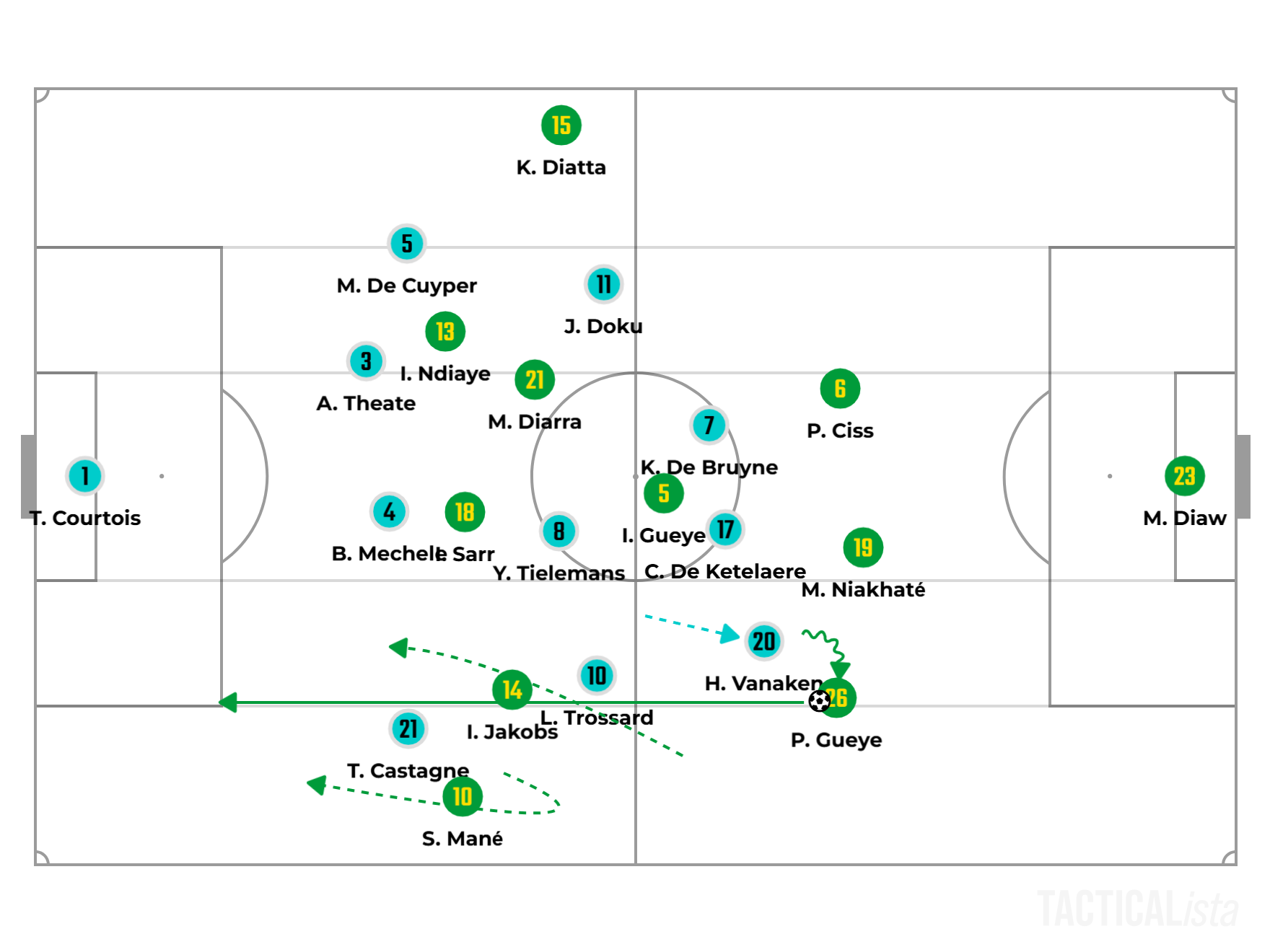
1st minute: Rotation from Senegal’s left side. As Pape Gueye dropped into the left fullback spot, Hans Vanaken followed and took a Belgian player out of the center. As this happened, Jakobs got ahead of Trossard and Mané’s double movement baited Castagne to commit, with the passing lane showing between Gueye and the winger, only to circle around the fullback to reach the long channel pass.
Senegal moved the ball effectively but did not need to be inventive, as the Belgian block left plenty of holes for them to exploit. Charles De Ketelaere and Kevin de Bruyne put little intensity on the ball; both took turns to shield the single pivot, but this left one of them jumping towards the two center-backs, so they comfortably circulated around. With Sarr occupying both center-backs, Senegal had a situation where they had a three-versus-two on the base of the buildup, whilst stopping the Belgian center-backs from jumping towards the channels: soon the gaps appeared. On the left, it was easy for Jakobs/Pape Gueye to get behind Leandro Trossard on the third-man run, whilst Castagne’s overcommitments in his jumps saw the space open behind the fullback; if Mané dropped to collect, Pape Gueye and Jakobs filled in with runs in that channel.
On the right, Belgium was placed under more direct tensions. Concerned with the inside run, Youri Tielemans constantly dropped between Theate and De Cuyper. Though Ndiaye was ushered out wide, losing Tielemans into the defensive line saw spaces around Vanaken open. As De Cuyper jumped onto Diatta, and Doku chose to zonal mark to block the passing lane to Ndiaye, the lane would open to Diarra on the inside, only for Ndiaye to meet the ball on the outside.
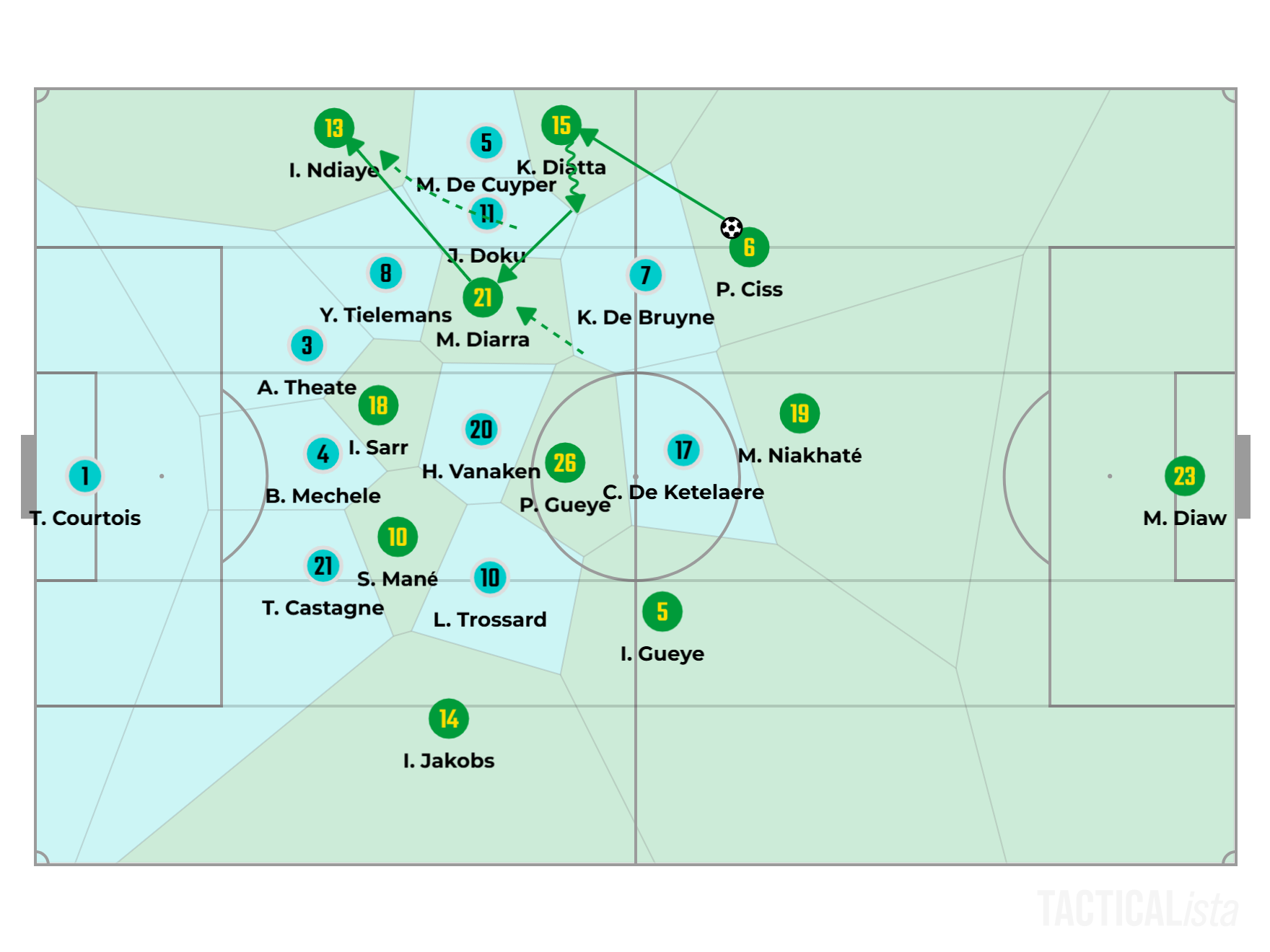
10th minute: Senegal tension on the right side. Tielemans dropped to mark the run of Ndiaye from the inside, only for a large pocket for Diarra to move into and connect the move together. In this situation, a dangerous ball was put in by the Everton winger but cleared by Brandon Mechele.
As a result, Senegal had the far better opportunities in the opening stage of the game. In transitional/more direct situations, Ismaïla Sarr was an excellent outlet, hanging around the center-backs whilst having the better of them when chasing the high passes. Twelve minutes in, he engineered an excellent chance after a high ball from Jakobs. Mané moved the ball back out to Jakobs, whose cross forced a flap out of Thibaut Courtois and Sarr could only divert his shot onto the post and push the rebound agonizingly wide from close range.
Just before Infantino’s commercial break, Senegal struck. Wide rotations and double movements provided again, as Diarra made a wall pass to the free Diatta on the outer channel. Possession would circulate back towards the left side. Jakobs underlapped, Mané pushed the ball back onto his right foot and his in-swinger reached Sarr. His header came off the post; Diarra paid close attention. With Courtois not in position, it was an easy finish for a deserved Senegal lead.
Belgium left little to be desired
The rest of the first half saw Belgium hold more of the possession against Senegal’s 4-5-1 medium block. For Belgium, the same structure was in place as in the New Zealand game. Tielemans was closest to the center-backs in circulation, as Vanaken bounced from a wide-left spot to crash the box from deep. Once again, the forwards kept their flexible stances to little effect.
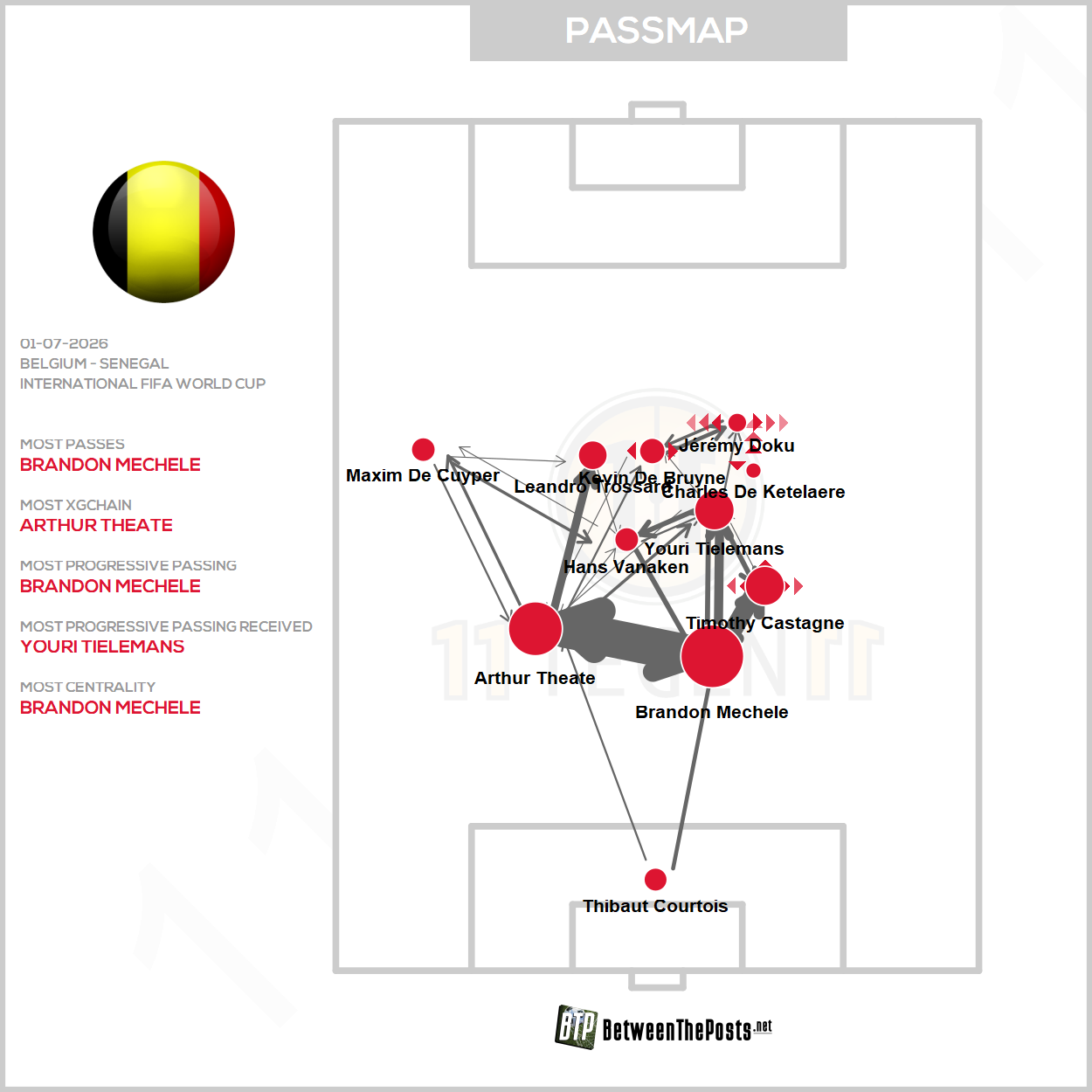
Belgium’s passmap highlights a lot of issues. No active presence on the right side, lots of safe circulation amongst Theate, Mechele, Castagne and Tielemans. However, ahead is a clustered frontline with no synergy and behind is a buildup without a lot of progression.
Doku dropped into pockets but barely made any of the mazy dribbles that pull defenders towards him (just one successful take-on throughout the game). As a result, Doku, De Bruyne and De Ketelaere all clustered towards the inside-right without any of the underlaps that they produced in the previous game. Castagne took up deep, narrow positions on the outside of Mechele and was in no position to support Doku (or insert any of the Belgian attackers) on the over/underlap. At the base, the center-backs did not probe the opposition through their carries, as they had done, nor were their many line-breaking abilities coming from this zone.
As a result, it was easy for Senegal to drop the wide center-midfielder and Idrissa Gueye to the ball side and get solid defensive coverage. Against Belgium’s right, Senegal faced few problems, but issues started to appear against the left where Trossard could pin Diatta more successfully, whilst De Cuyper made the halfspace run or De Ketelaere floated from center to left halfspace. The distance grew between fullback and Ciss, whilst Idrissa Gueye would join the midfield three and not always screen behind them. Diarra was not as disciplined as Pape Gueye to drop, and the run could be made. The Belgians did trigger this move into the box, but no chance creation followed.
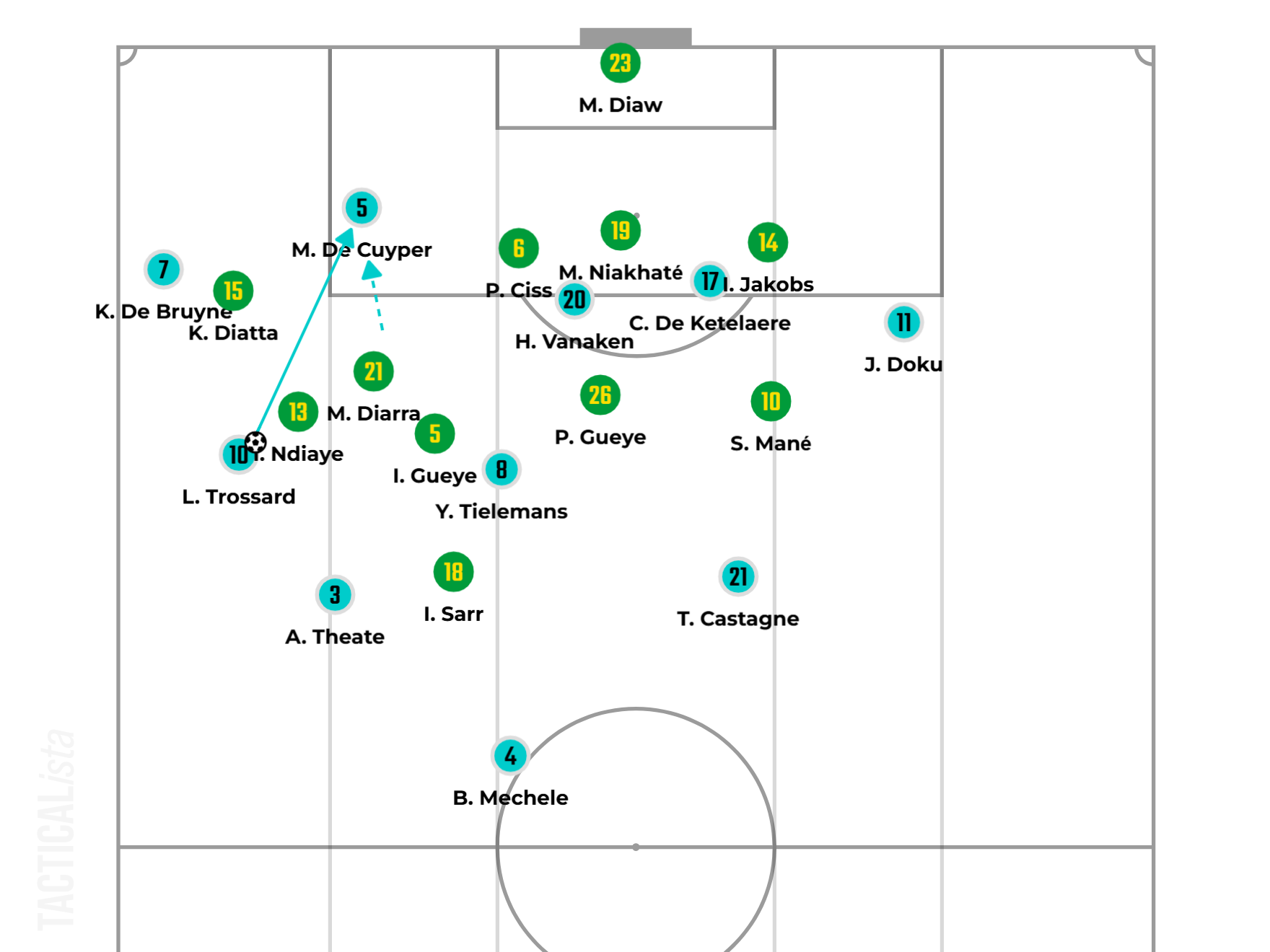
40th minute: Warning signs in the Senegal block. After De Bruyne made an unconnected inside run, he stayed wide to keep Diatta wide and Diarra was not focused on De Cuyper’s run in the halfspace.
Sarr finds his inner Bergkamp
At the start of the second period, Senegal picked up where they left off. Garcia turned to Romelu Lukaku for an outlet, but possession was firmly in Senegalese arms as the wide rotations remained in place.
Chances were being created from the left. From the first thirty seconds, Senegal kept the ball high, and Mané produced another cross into the box, one which was initially cleared, but a chance fell for Ndiaye, which trickled wide. A few moments later, Mané gave Castagne more problems through his dribbling. The cutback was made towards Diarra, who moved against the grain of the dropping defense, only for a poor connection with the ball.
However, a few minutes later, Senegal produced one of the goals of the tournament so far. Exchanges around the defensive line were not the cleanest, only for Moussa Niakhaté to take a touch into the channel before delivering an excellent crossfield pass, over the top towards the sprinting Sarr. Behind the defensive line, his chest control teed a powerful blast on the half-volley for the second goal of the game. Think of Dennis Bergkamp’s goal against Argentina, only if Bergkamp was more central, controlled with his chest… and instead of chopping around Roberto Ayala, he blasted it home from close range.
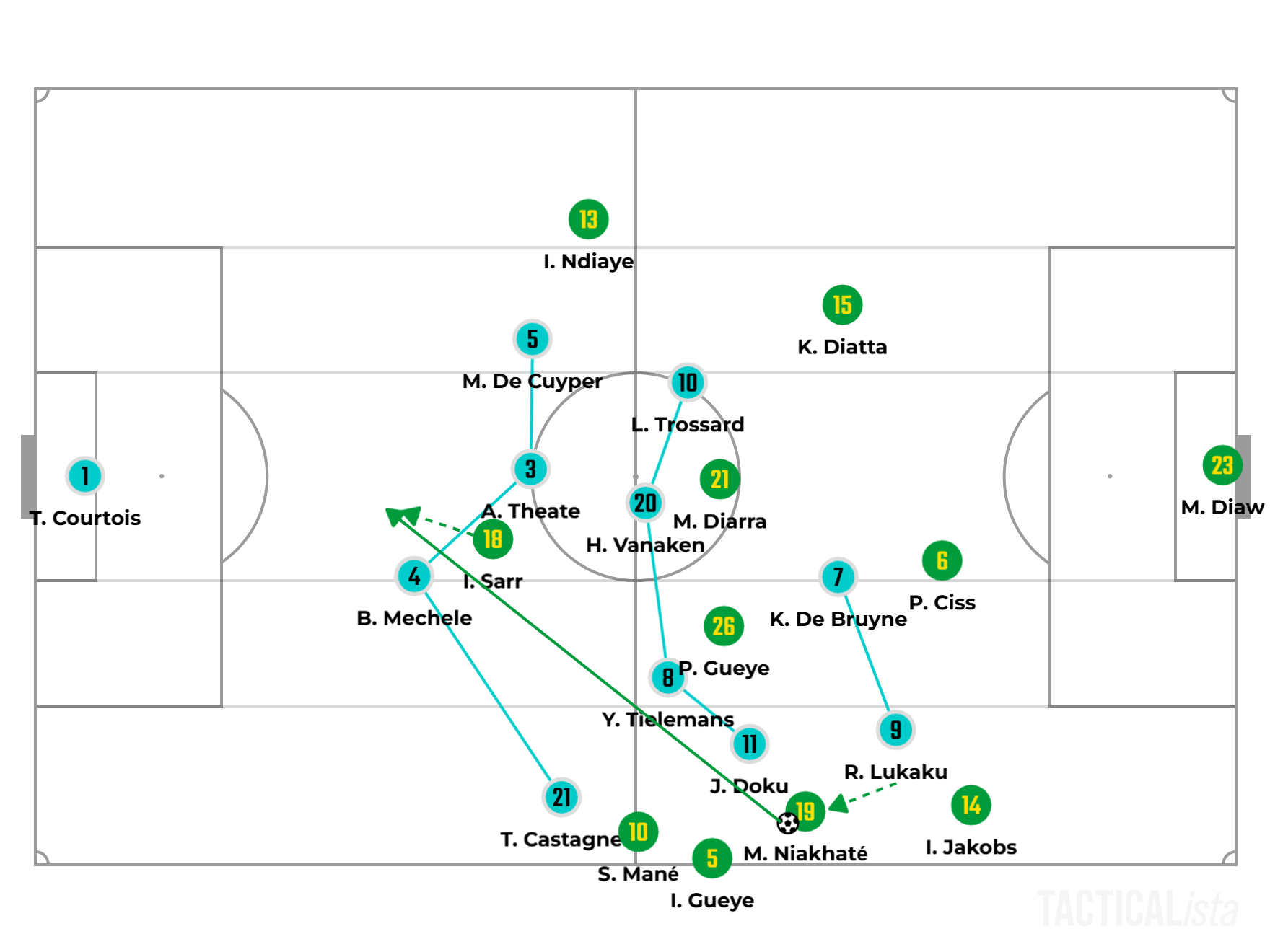
50th minute: Buildup to one of the goals of the tournament. Once again, the Belgian medium block offered little intensity against the ball and Doku arrived too late to approach Niakhaté. Meanwhile, Mechele was positioned deeper than the rest of the defenders, and the pass was perfect to travel over the center-back and reach Sarr’s run.
The unlikeliest of comebacks…
With Senegal in control, one would expect the second half to run out comfortably for Thiaw’s team, especially with the events that followed. Firstly, an extraordinary double sub in response to the goal as De Bruyne and Doku were replaced by Nicolas Raskin and Dodi Lukebakio. Secondly, before the next break, a confrontation between Trossard and Tielemans as Pitbull, followed by DJ Otzi, blasted on the stadium speakers, all things preparing for a humiliating exit.
Even as Senegal started to drop off more consistently, Belgium was hardly pushing the needle on the creative front. Senegal still had moments where they pressed higher, which was effective in pushing the Belgians wider from deep positions. In the final third, underlaps were no longer desired, and they leaned on Lukebakio for output on the right side. All this whilst Garcia’s team were not pinning Senegal deep, from the seventieth minute to the final whistle, Senegal completed twenty-six more passes than their opponent, whilst both teams made the same amount of final third passes in the period (thirty-nine).
The difference was the reactionary nature of Senegal’s block. When all three center-midfielders where behind the ball, Belgium had no openings, but spaces appeared when Senegal lost possession on the transition, with one of the midfielders committed, and Belgium could connect between the lines. With five minutes left, Lukaku tried to flick towards Trossard, only to be intercepted. Pape Matar Sarr, who had replaced Diarra, lost the 50/50 with Diego Moreira, who had replaced Vanaken. The ball spun high for fellow substitute Thomas Meunier, who put the ideal ball in for Lukaku to score from close range.
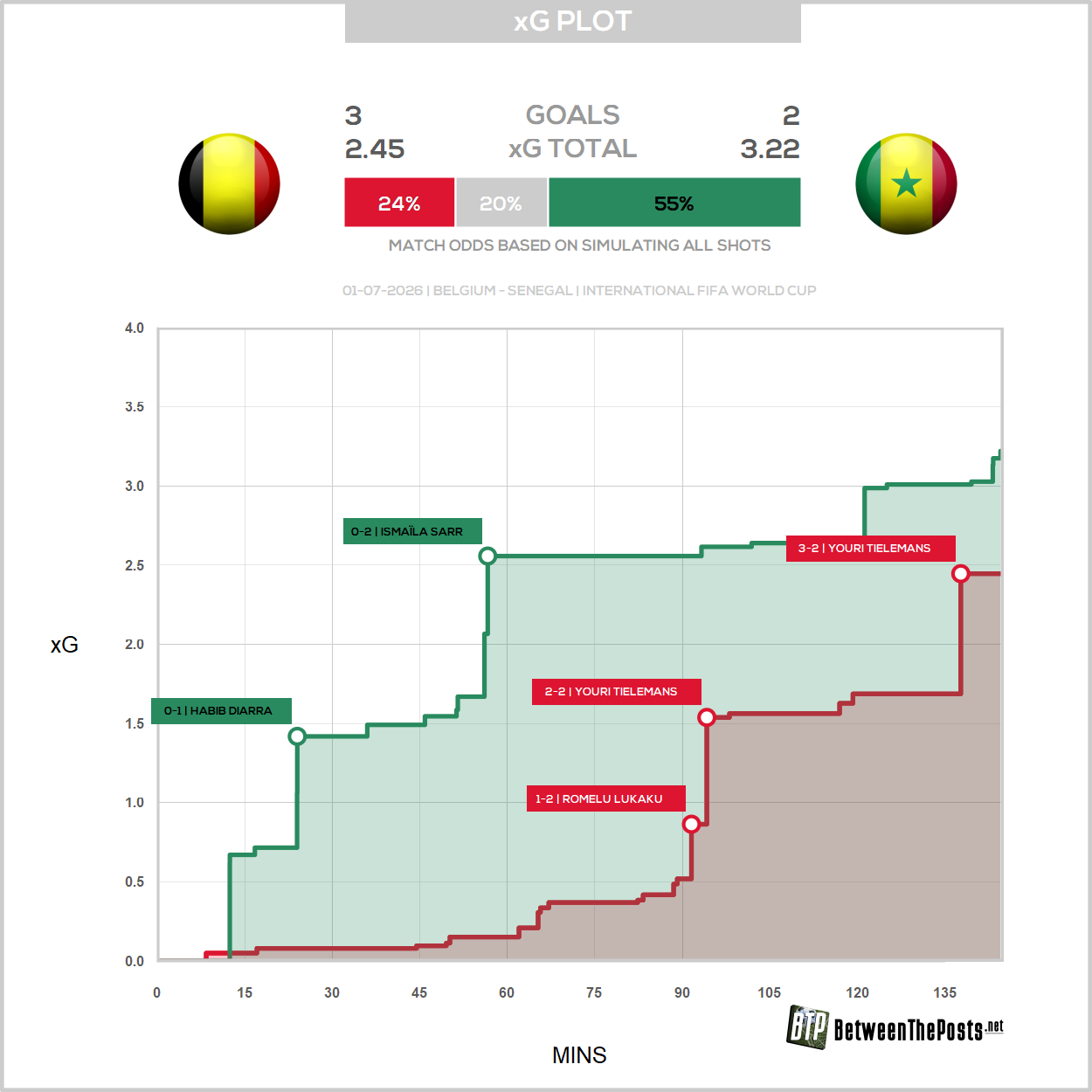
An uncreative Belgian performance… until the last minutes of the game.
A few minutes later, a critical error cost Senegal dearly. Belgium blocked a potential transition and recirculated. The switch was made to Moreira, and he played the pass back to Trossard to put a cross into the box. Mory Diaw left his goal, only to miss the punch and Tielemans was the player to even the scores. From on-pitch arguments to pulling the nation back in contention within fifteen minutes, the type of lunacy only the World Cup tends to offer.
… completed at the death
In extra time, the first half played out as one would expect. Belgium had more of the possession but was inactive, with only one shot being produced by both teams. The second half saw Senegal get second wind, sparked by two teenagers appearing on the right side: Paris Saint-Germain’s Ibrahim Mbaye and Gambinos Stars (on loan from Bayern München) Bara Sapoko Ndiaye.
The wide rotations came into effect, Mbaye sticking on the touchline with third man runs coming from both Sapoko Ndiaye and Diatta, with Pape Matar Sarr providing the passes from the base. On the one-hundred-and-eighth minute, the three-man combination paid off, and Ndiaye’s cutback reached Mbaye, only to divert his shot wide of the post.
However, with four minutes left, Belgium was gifted the golden opportunity. Moreira’s low ball across goal spilt towards Lukebakio, whose shot hit the top of the crossbar. But in the process, Tielemans was tackled by Lamine Camara inside the box and a penalty was awarded. Tielemans stepped up, a penalty to deny more penalties and he converted in excellent style, finding the top right corner.
Takeaways
A dramatic turnaround in the knockouts, one which was deprived of quality between the two teams. Belgium showed their vulnerabilities in the defensive phase, whilst the poor structure around their starting forwards continued to be in place. Senegal were well worth their lead, yet their own arrangements off the ball saw them struggle in more transitional situations.
Nevertheless, a dramatic shift in momentum saw Belgium’s tournament continue, and a disappointing campaign for one of Africa’s finest come to its conclusion, although they scored some bangers in the process. Belgium may have beaten the United States in preparation for this tournament, but Mauricio Pochettino’s team have showcased a variety of ways in which they can fly through defensive blocks. Garcia must find more security.
Use the arrows to scroll through all available match plots. Click to enlarge.
Check the match plots page for plots of other matches.


Comments