
New Zealand – Belgium: Kiwis Chewed By Belgians Sweet Tooth (1-5)
Belgium entered the final group stage game in critical condition. By the end of it, they restored faith in their World Cup campaign through more accessible underlaps, a balance between the double pivot and output from the old guard to see them finish at the summit of Group G.
Tactical analysis and match report by Joel Parker.
We decided to make this article free to read. If you want to support our work, consider taking a subscription.
With Group G separated by only three points, both New Zealand and Belgium could dramatically change their fates with one result.
Darren Bazeley’s team had taken the lead in both games against Iran and Egypt, only to start the final group stage match at the bottom on a single point. The team evolves around Chris Wood, but New Zealand have shown that they do have the technical players to circulate possession and not just lump it to the target man.
Belgium’s campaign had been a disastrous one, without a win going into the final match. Rudi Garcia had failed to establish an effective way to progress the ball in the opposition half, whilst any form of structure fell flat with wingers that like to drift inside, and maximum width not replicated through the fullbacks, certainly on the right side.
Bazeley had used the 4-2-3-1 formation as his go-to, and the same shape would be in place once again. He made two changes: Tyler Bindon came in at center-back to replace Michael Boxall and Ryan Thomas was in for Callum McCowatt.
Garcia made five changes to the team that drew 1-1 with Iran. Jérémy Doku was back after attending the birth of his child, so he was added to the attack. Nathan Ngoy was suspended, so Arthur Theate took his place at center-back. Timothy Castagne, Hans Vanaken and Charles De Ketelaere were the additions to the line-up.
More accessible underlaps
From the start of the game, it was clear that Belgium was going to get more joy out of the underlaps. Matches against Iran and Egypt posed different problems. Egypt launched an aggressive counterpress on Doku and fullbacks, Timothy Castagne (positioned on the left in the first game) and Thomas Meunier did not support attacks against the first line consistently, so the tempo dropped, and Egypt built the block. Against Iran, Maxim De Cuyper underlapped, but was used more as a positional pawn as Leandro Trossard dribbled around the outside. The same problems occurred once again, but against New Zealand, these problems were averted.
New Zealand set themselves higher in the 4-2-3-1/4-4-1-1 formation. Thomas could follow his run to move up on Thibaut Courtois, and in the medium block, Just and Sarpreet Singh took narrow positions to keep the space around the center compact. As a result, Belgium could increase the tempo from deeper positions, with clean exits outwards to the fullbacks. In the double pivot, Youri Tielemans was the deepest as Hans Vanaken pushed into more forward positions, so the passing distribution was clean and the touches from the center-backs (especially without Ngoy present) were reduced.
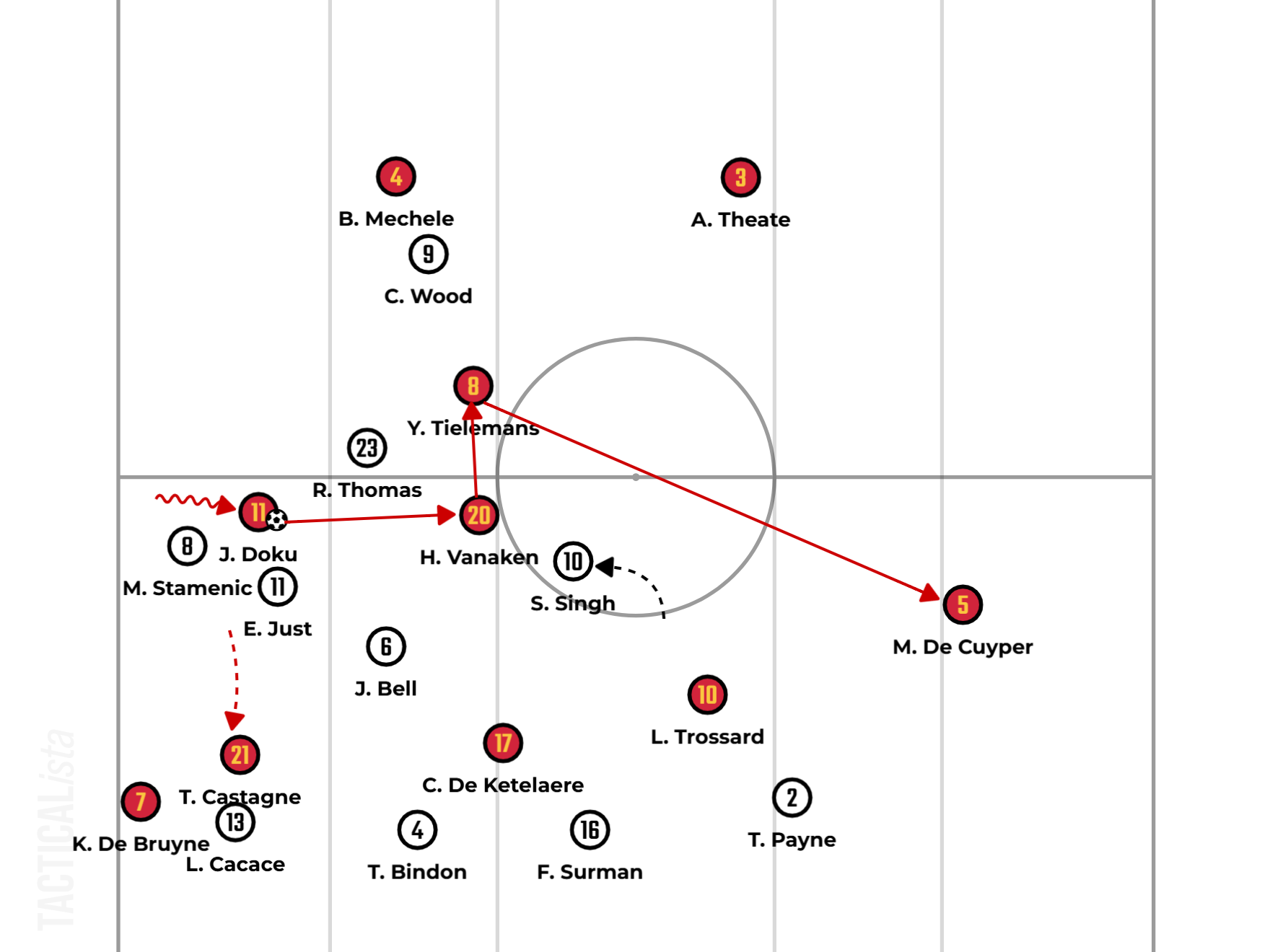
8th minute: Clean exit to progress through New Zealand’s medium block. As Castagne underlapped, Just was dragged deeper and Doku had a dribbling route inside. Vanaken passed back to Tielemans, facing play, having attracted Singh into a narrower spot. The passing lane remained open and Tielemans passed to De Cuyper in the left fullback spot. In this phase, Vanaken continued his run between Stamenic and Bell, before dummying the ball into the box from De Cuyper, only for Vanaken and De Ketelaere to play with their food inside the area. Bell would clear.
Without facing a back five, or back six in Iran’s case, Belgium could place a lot more tensions on the back four of New Zealand. Obviously, Doku’s return was key to this, with his unpredictable touches, a strong attraction for the opposition fullback/midfielder in the second line. Belgium kept their flexible stance amongst the forwards, so Doku appeared on both channels between phases, but at a higher tempo. This struck a better balance because there were more spaces for the forwards to connect.
On the right, Castagne underlapped Doku, and Kevin de Bruyne could provide similar actions between both halfspaces: this may not be at the ruthless levels of yesteryear, but De Bruyne still engineered plenty of the shots they took. Alternatively, De Cuyper could provide the underlap on the left with Trossard on the outside, but this was far more connected than it was against Iran, and the movement could still create space for De Bruyne on the lateral. As Tim Payne and Liberato Cacace were encouraged into the outer channel, Belgium constantly had players available, as neither Joe Bell nor Marko Stamenic could get goal-side of the halfspace runner. Therefore, Belgium dominated the opening spells with plenty of low balls across goal or cutbacks towards Vanaken crashing the box, or a variety of attackers perched on the edges.
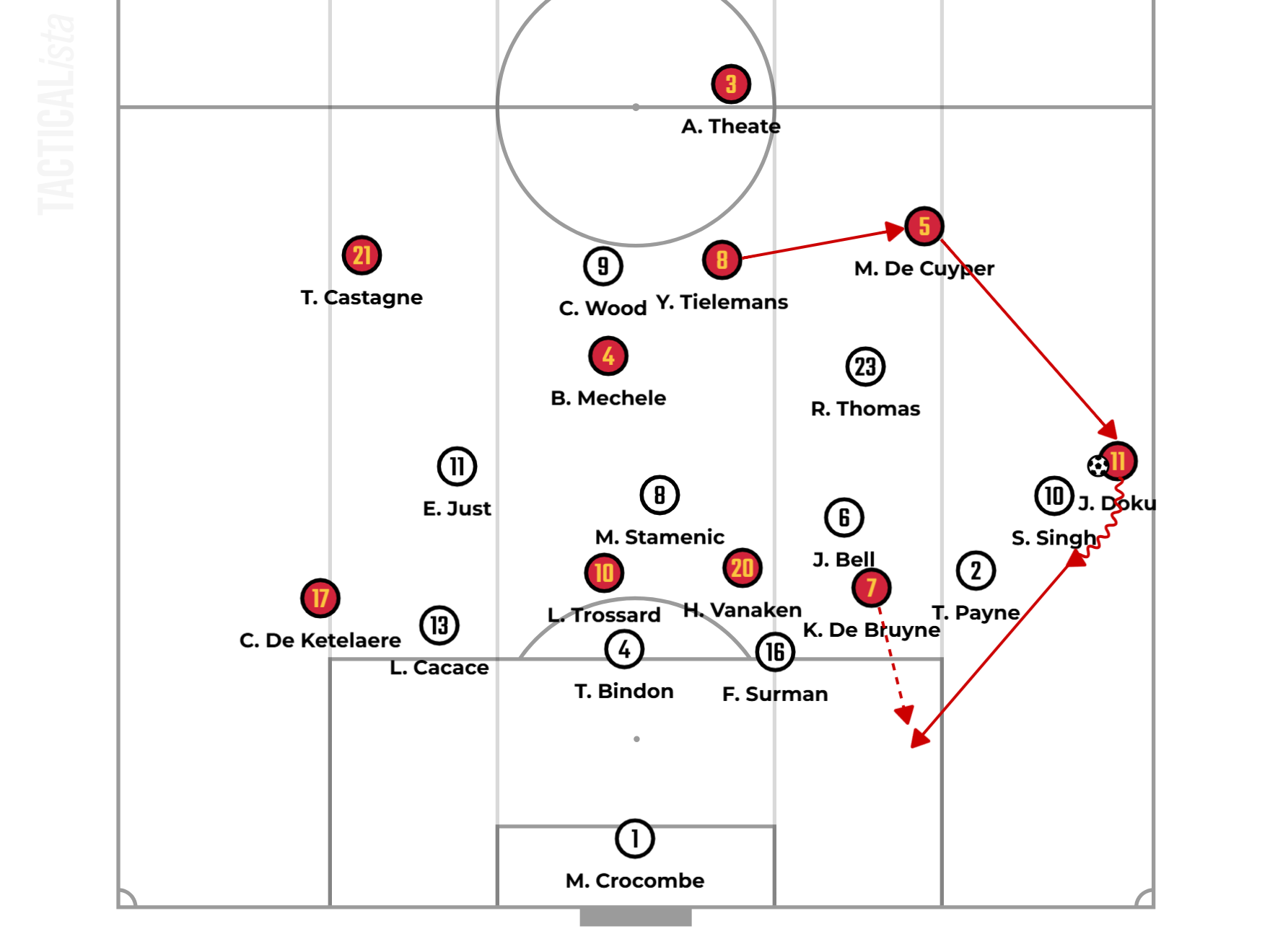
10th minute: Buildup to De Bruyne’s pass across the goal. In this phase, New Zealand had the same numbers in the block as Iran/Egypt, only that their defensive occupation was much weaker. As Doku dribbled on the outside, Payne anticipated and drifted over to be caught in no-man’s land. De Bruyne was already on the goal-side of Bell and sprinted into the halfspace to connect to his pass.
Garcia’s team already had more access in and around the box, and the threat soon followed. Trossard was the key man in this regard, as he continuously popped up on the left side of the penalty area. From a throw-in, New Zealand cleared the initial phase only for Vanaken to knock a pass straight back to Trossard, who found himself in plenty of space. His shot hit the inside of the post and somehow evaded the goal line as the ball bounced off Tyler Bindon and scrambled away. Trossard had two more shots blocked, De Bruyne was always lined up to shoot from the outside of the box and Doku had an acute shot from the left go straight towards the goalkeeper.
After delays from a VAR check (a Belgian penalty turned over after review) and the commercial break enforced by Infantino, Belgium maintained its momentum and the threat from direct play/set plays was still active. De Bruyne deceived by playing short to Doku on the occasional corner, but just before the half-hour mark, his direct delivery paid off. Trossard stood next to the goalkeeper and a defender, as Belgian runners moved at the back post. The cross bounced off Payne and Trossard turned the ball back in the direction of the goal.
New Zealand phases to no avail
The twenty minutes between the goal and half-time (including stoppage time) saw some more possession phases come from Bazeley’s team, as Belgium were not interested in pressing high. Like many of the underdogs, New Zealand arranged themselves with the double pivot in proximity and dropping in, Stamenic often moved to the left shoulder of Bindon and Cacace moved high for Just to be flexible in his positioning, moving inside from the left wing. They could perform as a box-midfield and Belgium still showed some vulnerabilities in their 4-4-2 defensive structure, even as the wingers have dropped deeper, in comparison to the first match.
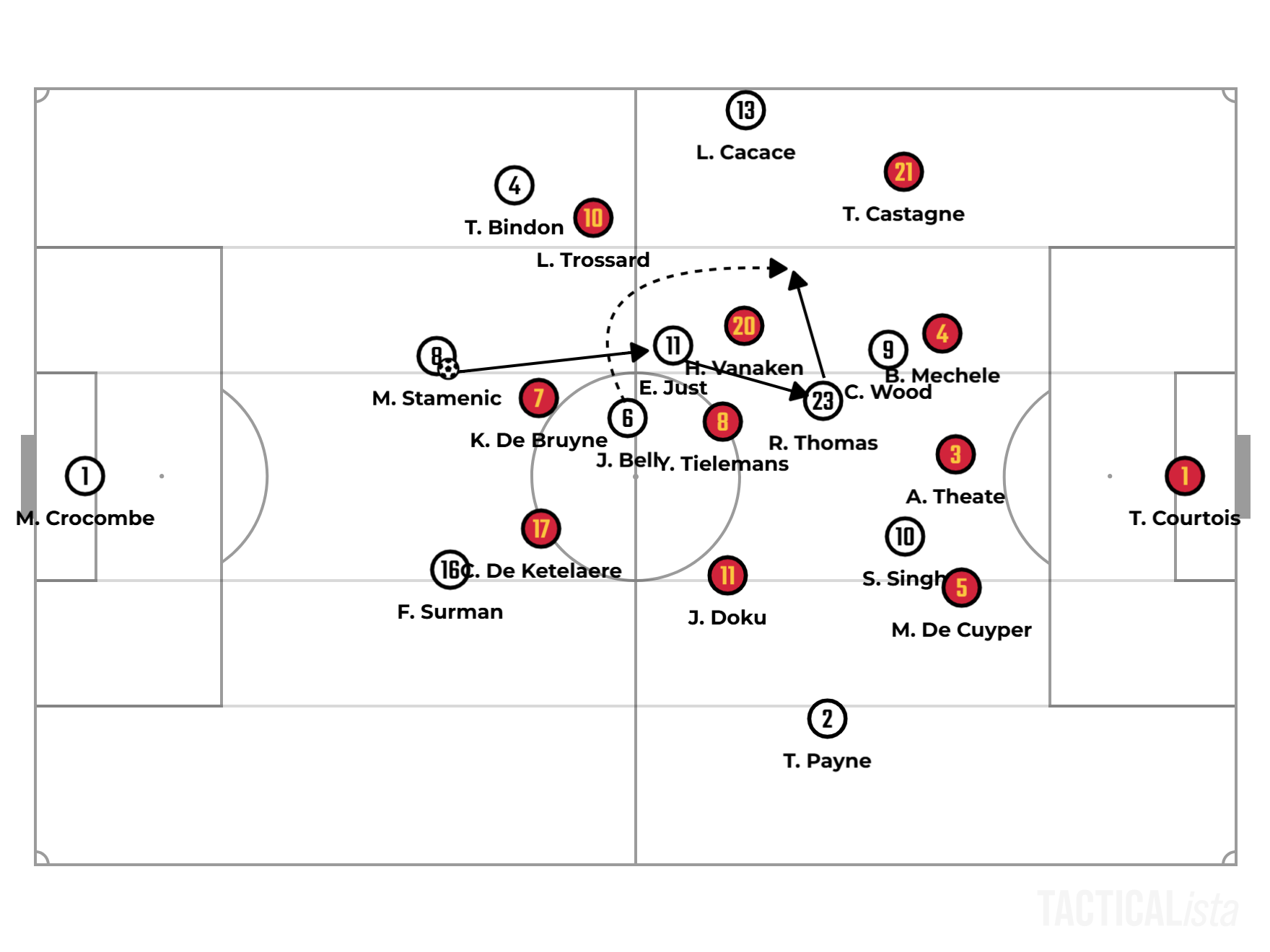
40th minute: Progress through the lines against Belgium’s 4-4-2 medium block. Just dropped in front of the center-midfielders and a vacant space was made for Bell to provide a third man run from the pivot spot. Just passed to Thomas, and both center-midfielders were committed as Trossard maintained a high spot.
Despite some neat and tidy sequences, converting these sequences into shots was a difficult task for New Zealand. They got some higher access on the outside left channel, but could not activate a limited Chris Wood, who still had multiple defenders around him, whilst the crossing ability was not effective.
Meanwhile, as the New Zealand team remained high, it could not stop Belgium transitioning against them. Trossard continued to be involved; in one phase, he played a one-two with De Bruyne, only for the Napoli attacker to put the ball over the crossbar. On another, Trossard appeared between the lines, behind both of the center-midfielders. He would play a pass through to Charles De Ketelaere, whose low shot was saved by Max Crocombe.
Goals lead to cruise control
A double substitution from Bazeley saw both wingers changed and Just moved behind Wood in the process. Two youngsters, Jesse Randall and Benjamin Old (not what his name suggests), struggled to establish more compactness in the wider channels, and Belgium punished an ill-prepared arrangement in the low block. Doku attracted bodies, once again, dragging Old inside and Vanaken appeared free to knock a pass back into the vacant space, where De Bruyne lay waiting. Bell was the closest to jump, only for a wonderful pass to be played through to Trossard. His first shot was blocked by Vanaken, before he scored on the rebound.
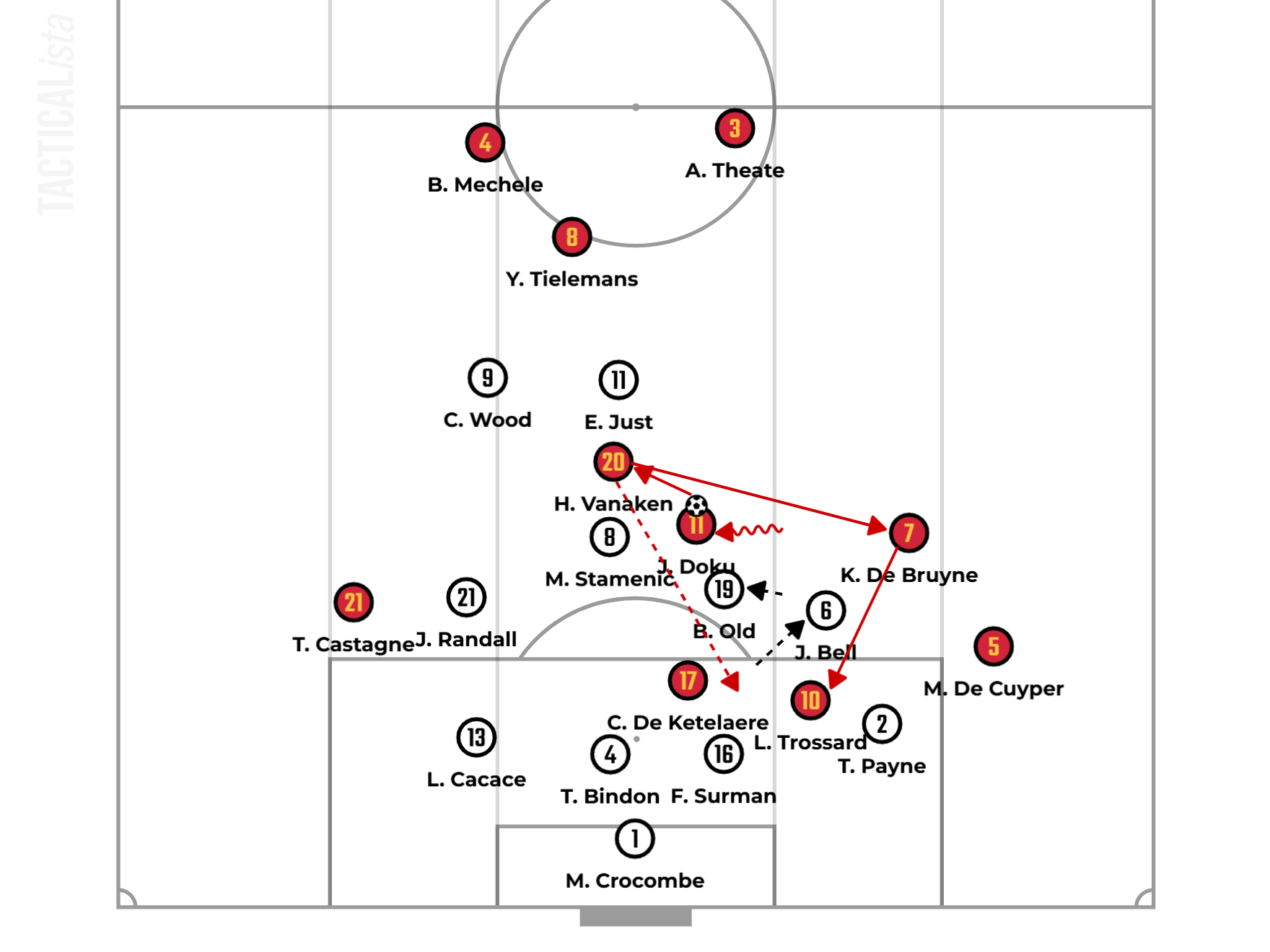
49th minute: Buildup to Trossard’s second goal. As Doku dribbled inside, space opened on the outside if Vanaken could move the ball against the grain. De Bruyne played one of his trademark passes between Bell and Payne for Trossard, who had found space inside the box.
After Just forced a good low save out of Courtois, Belgium firmly had the game in their grasp. Before the hour mark, Doku was taken off and Matias Fernandez-Pardo continued to make some key contributions around the edges of the box, also having a good chance on the transition from a New Zealand corner. Nevertheless, Belgium soon added a third when one of the distanced efforts from De Bruyne finally paid off. Trossard was influential once more, having dribbled from the middle third to edges of the box, whilst a passive New Zealand block was unreactive as De Bruyne fired a low shot into the bottom far corner.
Further cruise control measures took place as Trossard and De Bruyne were soon replaced by Alexis Saelemaekers and Amadou Onana. New Zealand did get their moment, six minutes from time. A corner was punched away from Courtois, only for Just to control and fire an excellent shot into the roof of the goal. Ironically, with Egypt and Iran on an even score, this did briefly knock Belgium off the top spot on goal difference.
However, Romelu Lukaku already had an immediate impact off the bench in the first game and would do the same in this one, only this time, the goal would be his. A channel pass from Castagne found Saelemaekers and fellow substitute, Nicolas Raskin, was left in acres of space in the halfspace. He had time to float a cross towards the back post and Lukaku headed in from close range to restore Belgium’s place at the top of the group.
In the game’s final moments, Belgium added a fifth, even as New Zealand recovered bodies on the defensive transition. Lukaku laid off for Saelemaekers, and he squeezed his shot in at the front post.
Takeaways
After two dismal displays, Belgium made quite the recovery to finish top of Group G and dramatically change their fate in the tournament. Against passive back fours, and with Doku’s electricity, Garcia’s team can find advantages through the underlap and Trossard appearing in multiple positions, all to take the creative burden of De Bruyne, who has had occasional flashes of brilliance.
They have found their mojo at a critical time, yet issues in the defensive block and synergy amongst some of the attackers remain an issue. By finishing top, Belgium will face one of the unknown nations that will finish third, whilst on the same bracket as the United States (who they smashed 5-2 in Atlanta, back in March) or Bosnia & Herzegovina. Perhaps the route towards the quarter-finals is visible after all.
Match plots will be added as soon as possible.


Comments