
Norway – Senegal: Haaland and Norway do what they do best, Senegal backed against the wall (3–2)
Norway continues to thrive under its dark horse status in this tournament. Ståle Solbakken’s side was more composed and more clinical to defeat Senegal in the second matchday of Group I, already securing qualification for the Round of 16. Senegal lacked composure in key moments and can blame its captain for a number of costly individual errors.
Tactical analysis and match report by André Martins.
We decided to make this article free to read. If you want to support our work, consider taking a subscription.
Norway faced Iraq on Matchday 1, a tactically well-organised side with significantly inferior individual quality. Senegal lost to France, one of the World Cup favourites, after causing them plenty of problems in the first half. The clash between Norway and Senegal therefore promised a great deal and was potentially crucial in deciding the identity of Group I’s runner-up, assuming France finishes top.
What followed was a meeting between two high-quality teams. One maximised its strengths; the other committed mistakes that made the task far too difficult.
Unsurprisingly, Ståle Solbakken named the same starting eleven that faced Iraq. Ørjan Nyland started in goal behind David Møller Wolfe, Torbjørn Heggem, Kristoffer Ajer and Julian Ryerson. A midfield three of Fredrik Aursnes, Sander Berge and Martin Ødegaard operated behind Antonio Nusa, Alexander Sørloth and Erling Haaland.
Pape Thiaw also trusted the players who started against France. In his usual 4-2-3-1, Edouard Mendy was in goal, with El Hadji Malick Diouf, Moussa Niakhaté, Kalidou Koulibaly and Krépin Diatta forming the back four. Pape Gueye and Idrissa Gana Gueye anchored midfield, while Sadio Mané, Lamine Camara and Ismaïla Sarr supported Nicolas Jackson up front.
Norway happy to go long
Norway organised itself in a more or less asymmetrical 4-3-3 during the first phase of build-up. Berge acted as the deepest midfielder, while the fullbacks occupied different heights. Ryerson stayed deeper than Møller Wolfe, allowing Sørloth to hold the width on the right. One of Ståle Solbakken’s successful tactical adjustments, as the striker had struggled in the half-space against Iraq. Ødegaard or Aursnes could drop deeper in turns to provide an overload, but Norway found it difficult to progress through central areas.
Partly because both midfielders prefer receiving to feet. There were therefore few runs into space to help progress possession. Senegal also deserves credit. The Lions of Teranga responded with a man-to-man press on Norway’s half. Camara joined Jackson centrally, while Mané and Sarr stepped out onto the opposing fullbacks. Senegal’s double pivot shadowed Norway’s advanced midfielders, although they could become overloaded by Norway’s three-versus-two superiority in midfield. In exchange, Senegal’s back four preferred keeping a plus one against Haaland rather than stepping out aggressively.
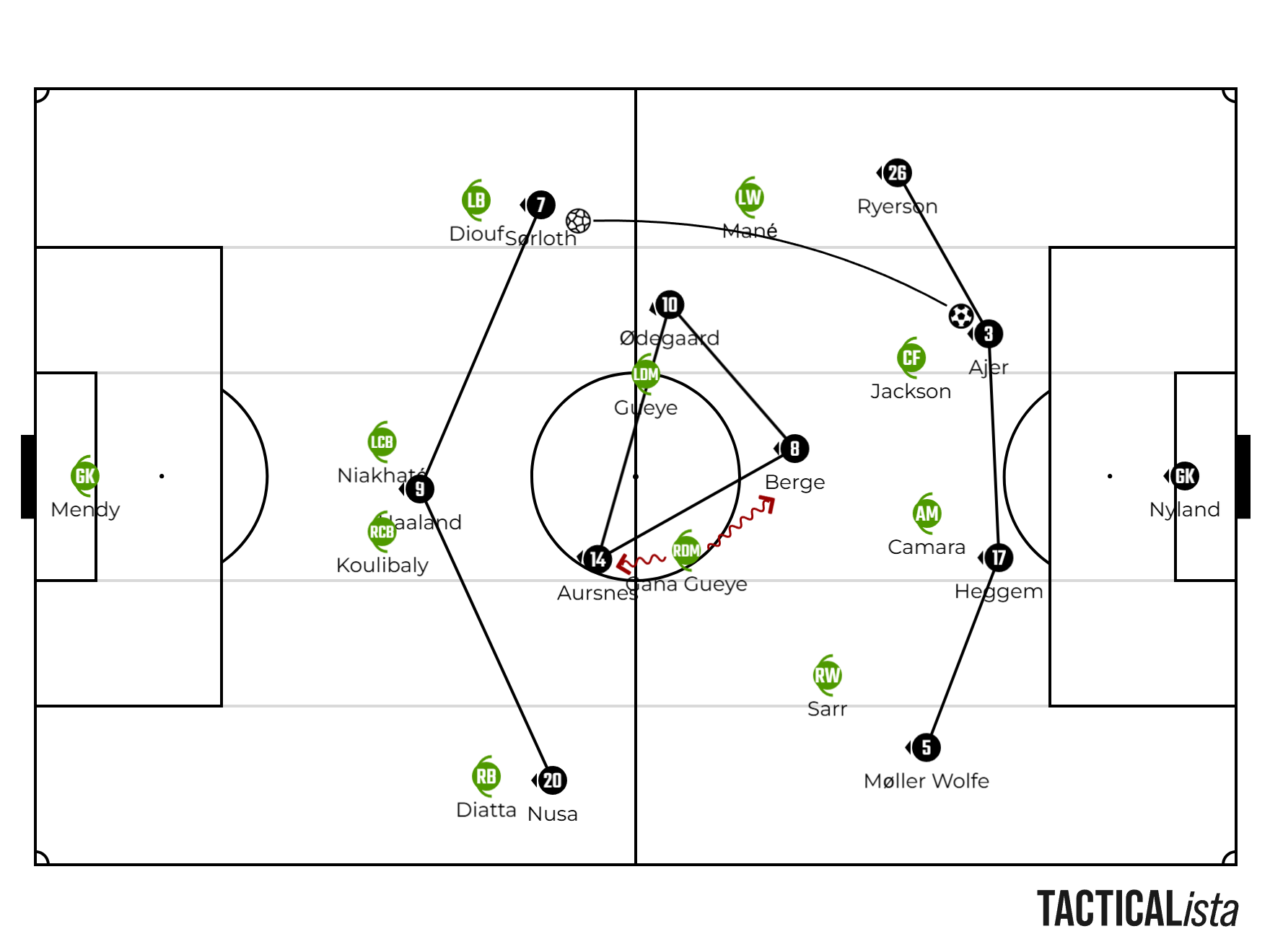
5th minute: An example of Senegal’s hybrid pressing structure and how Norway reacted to it. Four Senegalese players match Norway’s back four. Gana Gueye is ready to jump onto Berge or Aursnes. Ajer plays long towards Sørloth, who is able to turn and exploit Norway’s numerical superiority in midfield to find a free teammate.
Norway deliberately attracted Senegal’s block higher up before attacking the space behind it. Haaland and Sørloth were naturally the main targets. The play down the flanks, particularly through the left-sided triangle, had already been one of the positives against Iraq. Against Senegal, Norway also activated the right side thanks to Sørloth’s hold-up play. Nyland’s distribution was crucial to making this plan work. Accelerating circulation during the first phase occasionally caught Senegal’s press before it was fully set, allowing Norway to find a free player in midfield.
That is how the Vikings produced a dangerous move that ended with an off-target Ødegaard shot. In the 14th minute, Marcus Pedersen recycled possession all the way back to the goalkeeper. Senegal had been attacking when they lost the ball through a poor pass. The Senegalese players decided to continue pressing the goalkeeper, but they were numerically outmatched. Nyland found Møller Wolfe with a difficult lofted pass, and the fullback connected with Berge. Ødegaard received centrally and found Sørloth out wide. The striker then released Pedersen in behind, who cuts it back. Another reminder of how important deep overlapping runs from fullbacks can be.
Up until that point, the clearest opportunity had come from an Ajer header in the 3rd minute. Mendy produced a great save to keep it out.
Norway’s pressing trap and Senegal’s courage on the ball
Norway also maintained a plus one at the back through its diamond-shaped pressing structure from a mid-block 4-4-2: Haaland and Ødegaard up front, with Aursnes stepping onto the Senegalese pivot closest to goal. The shape of the diamond then collapsed around the ball side to trap possession.
Senegal, however, was brave and technically secure enough to play out from the back. When Norway’s press was bypassed, the Scandinavians dropped into a 4-1-4-1, with Berge screening the defence and Haaland left alone up front.
There were moments when Norway should not have been able to find those lofted passes towards Sørloth, yet he consistently dominated Diouf in aerial duels and in judging the flight of the ball.
As mentioned earlier, Senegal pressed man-to-man high up the pitch. In reality, Pape Thiaw’s side initially settled into a zonal 4-4-2 block before transitioning into man-oriented pressure whenever the opportunity arose. The wingers joined Jackson and Camara to match Norway’s numbers in the backline.
This reactive approach caused problems for Norway’s midfielders, who often received with their backs to goal, particularly Aursnes.
As the first half progressed, Norway diversified the ways it attracted Senegal’s block. When the Senegalese side was more passive, goalkeeper Nyland would position himself on the ball between his centre-backs, scan the field, and release into a free space attacked by a teammate.
More bodies on the last line
Once Norway established possession in the final third, the shape often evolved into something resembling a 3-2-5 or even a 3-1-6, allowing them to place more bodies on the last line.
It also enabled the formation of the familiar Aursnes–Nusa–Møller Wolfe triangle on the left side. The winger held the width, while the fullback and midfielder occupied the half-space at different heights.
In the 37th minute, this structure served mainly as a decoy to allow Nusa to find Haaland behind Niakhaté. The Cyborg controlled perfectly for Ødegaard, who had burst freely into the box. Mendy came out on top in the one-versus-one, much to the frustration of Norway’s captain.
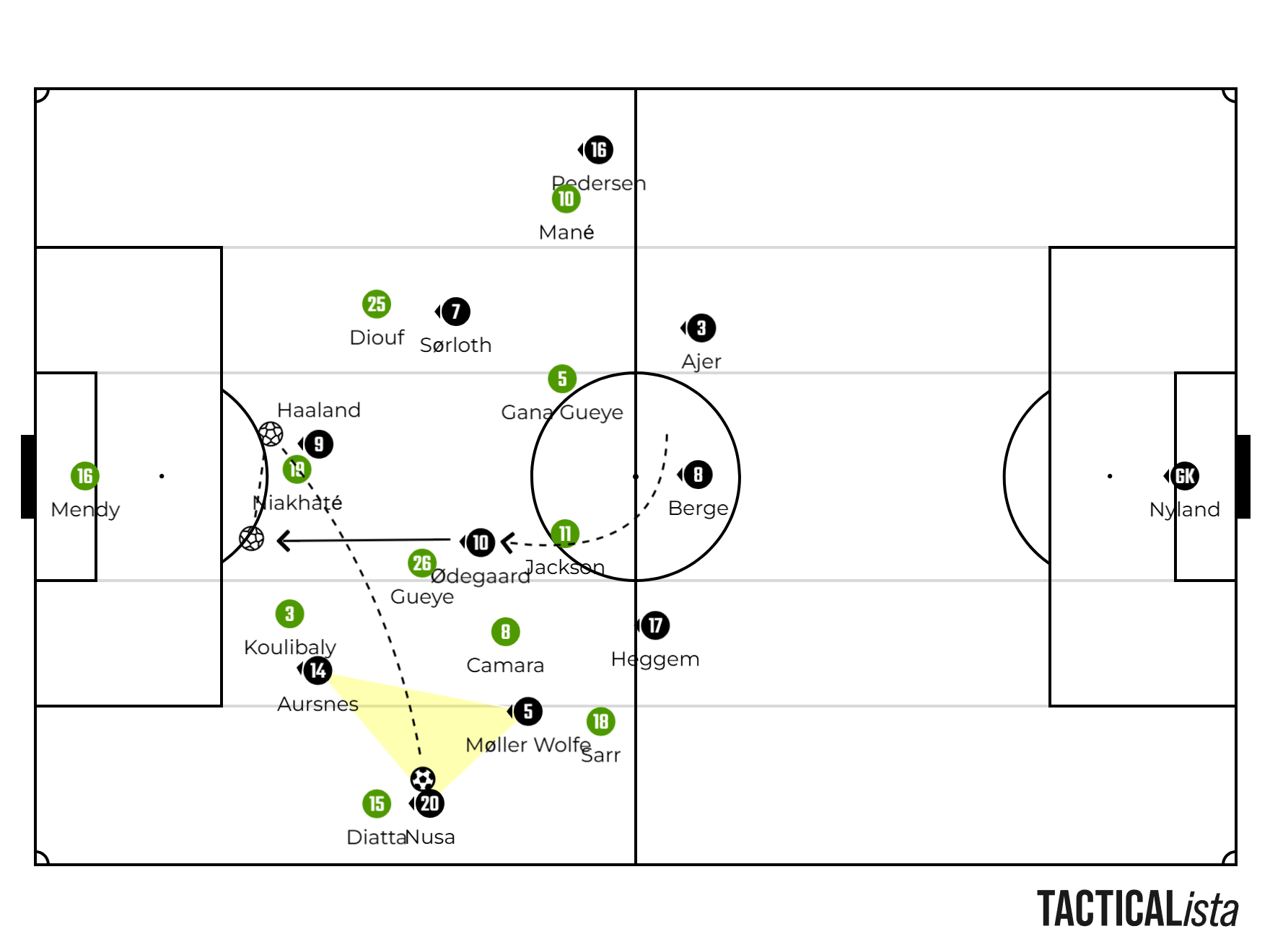 37th minute: The movements behind Norway’s best chance of the first half. Ødegaard drops towards Berge to receive before switching play towards the left-sided triangle. This time, the movements of Aursnes and Møller Wolfe pin nearby defenders and open the space for Ødegaard’s run between the centre-backs.
A few minutes later, however, the same structure — combined with Ajer’s ball carrying between Jackson and Camara — allowed Norway to break through Senegal’s pressing shape. The situation could have become even more dangerous. The long balls towards Sørloth continued to bear fruit. They bypassed Senegal’s press, helped Norway establish possession higher up the pitch, and eventually led to Marcus Pedersen’s opener.
Senegal pressed man-to-man and forced Norway’s rest defence to recycle all the way back to Nyland. The goalkeeper launched another long pass towards Sørloth, who controlled comfortably with his back to goal. Perhaps believing the duel was already lost, neither Diouf nor Mané applied enough physical pressure. The striker was able to turn and find Ødegaard between the lines.
The captain’s through ball towards Haaland was misplaced, but Koulibaly’s clearance fell straight into a central area. Pedersen punished the mistake and beat Mendy.
Several aspects of this goal deserve attention.
The way Sørloth slows down time through his body positioning and heavy but effective touches. The passivity of Gana Gueye, who does not step out onto Ødegaard despite the permanent plus one protecting the backline. And, of course, Koulibaly’s major error — one that would not be his last contribution to Norway’s goals.
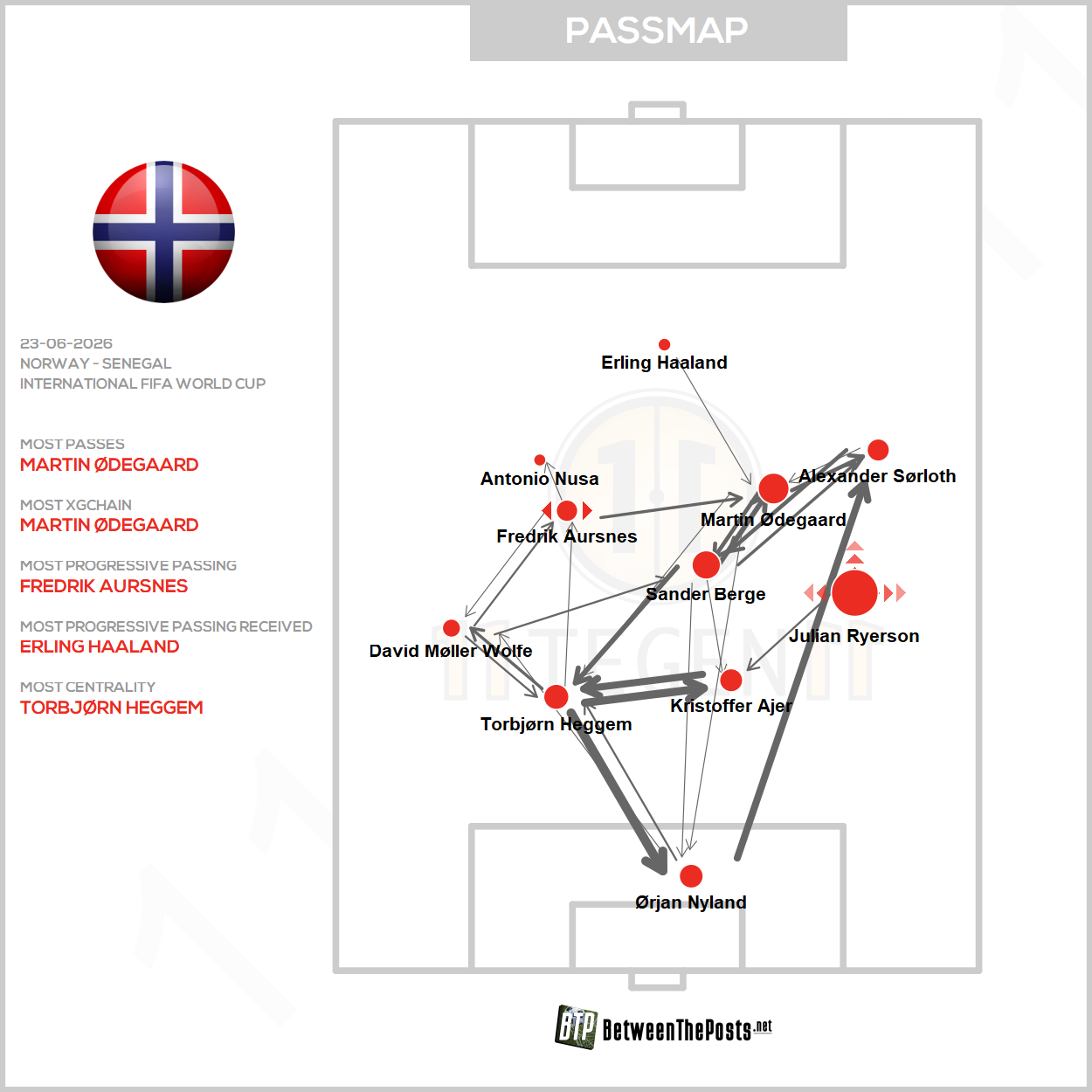
Norway’s pass map illustrates the importance of the direct connection between Nyland and Sørloth positioned wide on the right, followed by combinations with Ødegaard. On the other hand, the left-sided triangle was underused because building short against Senegal’s man-to-man pressure was often too risky.
The rest defence strikes back
Senegal was betrayed by its captain… and by its rest defence.
The warning signs were already visible after Norway’s first goal. Senegal reacted emotionally, committing more players forward and rushing attempts to break Norway’s first line of pressure. The result was several central turnovers and dangerous transitions. One such counterattack could have been lethal had Ødegaard chosen to find Møller Wolfe alone on the left.
The second Norwegian goal came from precisely this type of situation.
Established in possession in the final third, Senegal was almost operating in a 3-0-7 when Gana Gueye attempted an overly ambitious ground pass between the lines. Ødegaard intercepted, combined with Berge, and carried through the middle.
At the moment possession was lost, Senegal’s fullbacks were spread wide, while Norway’s wingers occupied more central positions. Once Gana Gueye was eliminated, the two Senegalese centre-backs found themselves defending a two-versus-four situation.
The runs of Nusa and Sørloth provided additional options, even though Ødegaard ultimately chose the more difficult solution with a perfectly weighted pass towards Haaland, who produced a flawless finish. Koulibaly came within inches of intercepting the final ball.
Senegal places enormous trust in its individual quality. That is why the team is so willing to build short under pressure and commit large numbers forward. Complementary movements are also a constant feature of its attacking play.
All of this requires a great deal of discipline to avoid destabilising the structure through a little too much bravery.
Senegal attempted to overload the ball side both to encourage combinations and to isolate a winger on the opposite flank before switching play. The circulation, however, was not quick enough. Instead, the team found more success attacking through central areas, where crossing runs unsettled Norway’s defensive line.
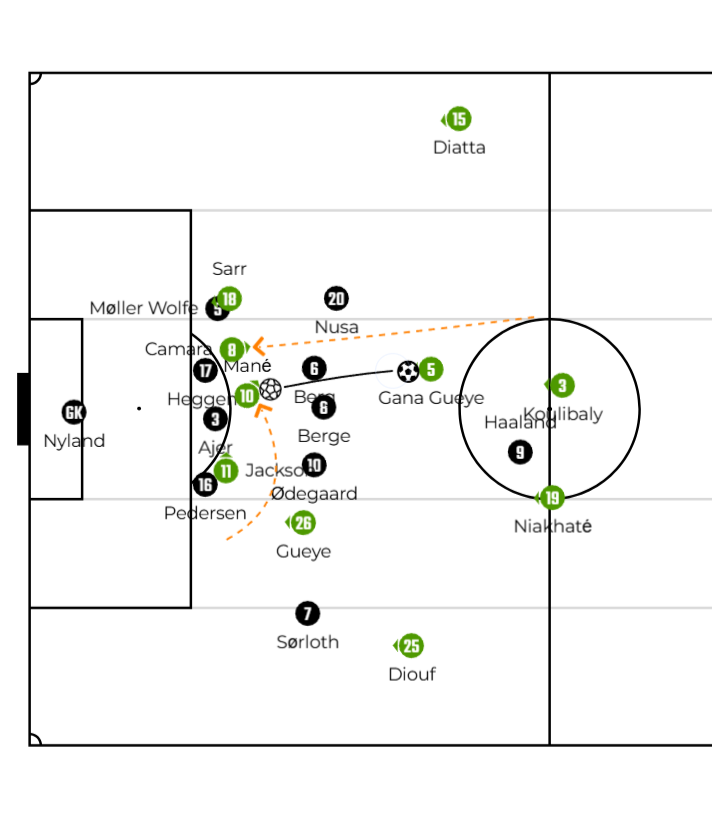
53rd minute: The move leading to Senegal’s goal. Gana Gueye releases Mané, who receives with his back to goal. Sarr makes a run in behind, mirrored by Camara a few metres away. All of Norway’s centre-backs are pinned and can only react by following their direct opponent. The delay is enough for Sarr to control and score despite the physical challenge from Møller Wolfe.
Same patterns, same outcome
As the match progressed, it became more open and less controlled.
Norway’s defensive recoveries were slower than before, but its ability to bypass Senegal’s press remained intact. The extra man in midfield was still there because Senegal’s backline refused to step out and maintained its protective plus one.
In short, the tactical observations from the opening stages remained valid throughout the match.
Which also meant that the things working for Norway kept working.
That included the long passes towards Sørloth positioned wide on the right. The Atlético Madrid striker accumulated aerial duel victories, and the introduction of Ismail Jakobs in place of Diouf changed little. Senegal probably should have been more aggressive in dealing with him, even if it meant committing tactical fouls.
It was once again Sørloth who allowed Norway to establish possession high up the pitch before Haaland’s second goal.
Emotion appeared to overwhelm Senegal once more just after reducing the deficit. Inside the box, Koulibaly again deserves scrutiny. He had the opportunity to clear long but instead produced, intentionally or not, something resembling a directional first touch that fell kindly for Patrick Berg.
The Bodø/Glimt midfielder delivered the cross that Haaland instinctively and elegantly finished with his right foot.
Berg had replaced Aursnes at half-time. With his more offensive ball-carrying profile, he provided additional solutions and greater fluidity during build-up, often rotating around Ødegaard.
For Senegal, the introductions of Ibrahim Mbaye and later Pathé Ismaël Ciss pushed the team towards a more cross-heavy approach. The PSG winger held the width on the right, while the Rayo Vallecano player pinned the centre-backs, alongside Jackson and a more central Sarr.
Without the ball, Ciss operated as part of Senegal’s double pivot in the 4-2-3-1.
The rushing in possession and the vulnerability of Senegal’s rest defence, however, continued to undermine the team’s efforts. Pape Thiaw’s side eventually pulled one goal back in stoppage time, but it was not enough to secure their first point of the tournament.


Comments