
Norway – England: Bellingham Drags England To The Semi Finals (1-2)
England dominated possession in the first half in their 4-3-3 formation which became a 3-2-5 shape against a Norway low block. They went behind against the run of play though, and ultimately relied on a Jude Bellingham double to get through this game as they lost tactical control of the midfield in the second half.
Tactical analysis and match report by Josh Manley.
We decided to make this article free to read. If you want to support our work, consider taking a subscription.
Norway made history with their win over Brazil in the last round, not just because they qualified for a World Cup quarter final for the first time, but because they did it against such distinguished opponents.
England meanwhile won their Round of Sixteen tie in dramatic fashion, being pushed to the limit by Mexico after going down to ten men in the second half. Jude Bellingham impressed once again, he has done throughout the tournament.
Ståle Solbakken’s side lined up in a 4-3-3 formation here, with a back four of Julian Ryerson, Kristoffer Ajer, Torbjørn Heggem, and David Møller Wolfe. The midfield trio consisted of captain Martin Ødegaard, Sander Berge, and Patrick Berg. Alexander Sørloth, Erling Haaland, and Andreas Schjelderup then formed the front three.
For Thomas Tuchel’s England it was also a 4-3-3 shape. Ezri Konsa was deployed as the right back alongside John Stones, Marc Guéhi, and Nico O’Reilly. Declan Rice started in midfield despite fitness concerns, joined by Elliot Anderson and Bellingham. Noni Madueke and Anthony Gordon were the wingers chosen to flank Harry Kane this time around.
England’s slow possession
The Three Lions had the majority of possession in the first half of this game as Norway were often content to sit back in a 4-1-4-1 low block without the ball. The overall tempo of the game for much of the first half was somewhat pedestrian though, perhaps due to the hot and humid conditions.
Tuchel also made a change from his usual midfield arrangement for England, as Rice took the deepest midfield role in this game and Anderson was deployed as the left sided number eight. Usually, the two are in the opposite roles. Again, the reason for this can only be speculated on, but it was perhaps an effort to reduce Rice’s running workload after his recent sickness and nerve issues.
The rotations of the wide triangles for England often brought them into a 3-2-5 structure against Norway’s low block. Konsa usually stayed deep on the right side, close to the center-backs, while Bellingham was high between the lines and Madueke held the width on the right.
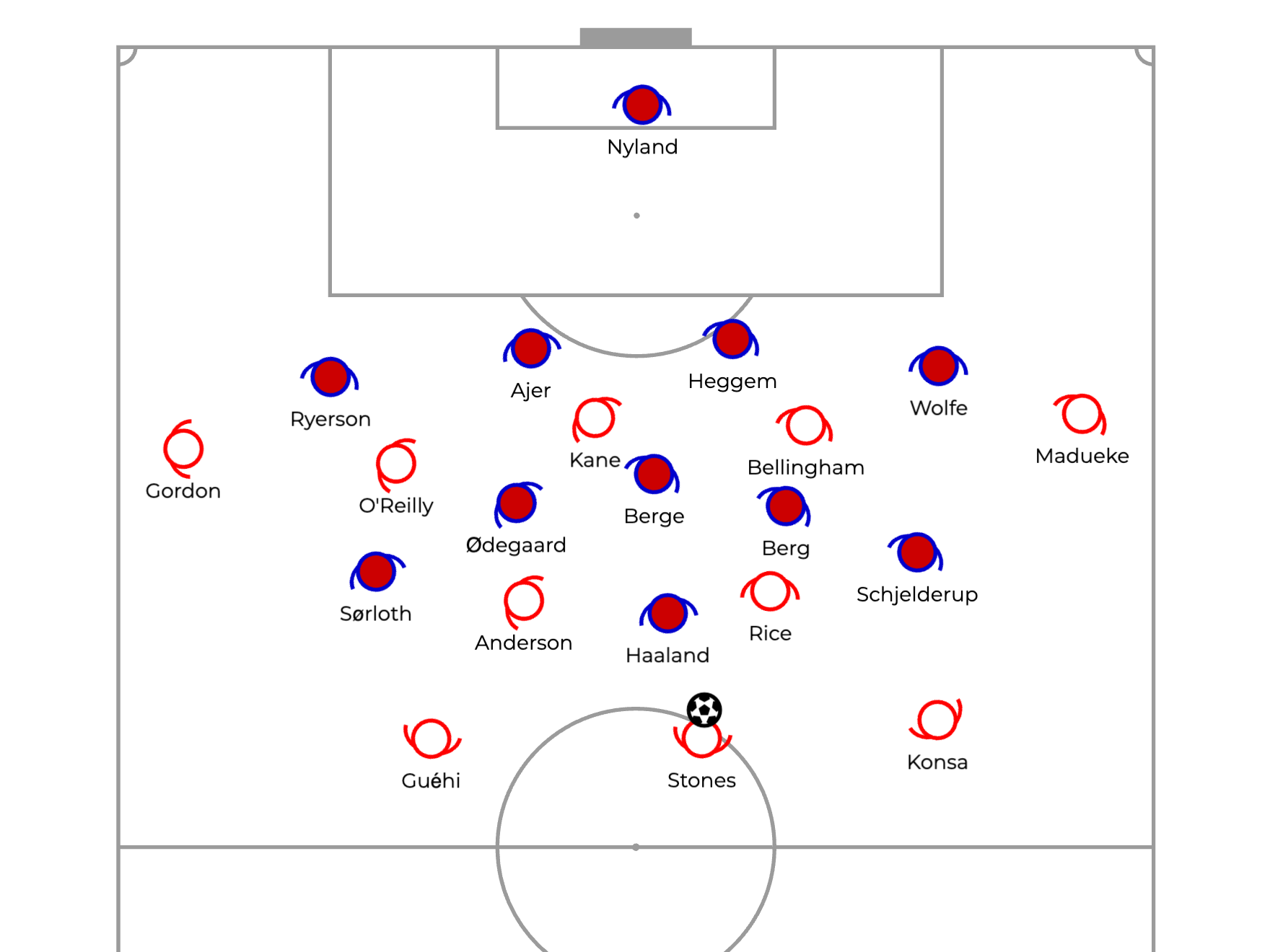
England’s first-half attacking structure.
On the left, O’Reilly often advanced in the halfspace or wide while Anderson dropped alongside Rice, although still with license to make forward runs. Gordon would then be wide or indenting in coordination with O’Reilly’s positioning.
England’s possession was stable and focused on trying to switch the play to the wingers in order to change the tempo of the attack. In the early stages, there was a clear intent to hit diagonals to Madueke for him to get isolations against left back Wolfe.
There were few chances created for either team overall though. When Norway went ahead from a transition phase after the half-hour mark, it was somewhat against the run of play. England replied with their own transition goal on the brink of half time thanks to Bellingham taking proceedings into his own hands with a powerful run from midfield.
Midfield tinkering
Tuchel made two changes at half time, replacing Rice and Madueke with Eberechi Eze and Bukayo Saka. This saw a change in the midfield area, as Anderson returned to the deeper role, Bellingham to the left sided number eight, and Eze played as the most advanced on the right of the trio.
England enjoyed less control of possession in the second half though and overall struggled to impose themselves in the midfield area. This led to further midfield changes from Tuchel throughout the half.
With both Bellingham and Eze in the midfield trio, England’s midfield looked relatively open at times, with both players keen to take up advanced positions. Ødegaard began to have a larger influence on the game in terms of Norway’s ball circulation.
When the Norwegians had the ball, both Ødegaard and Berge would drop around the number six area to secure stable circulation with the center-backs. The fullbacks would advance, while Berg would roam in central areas.
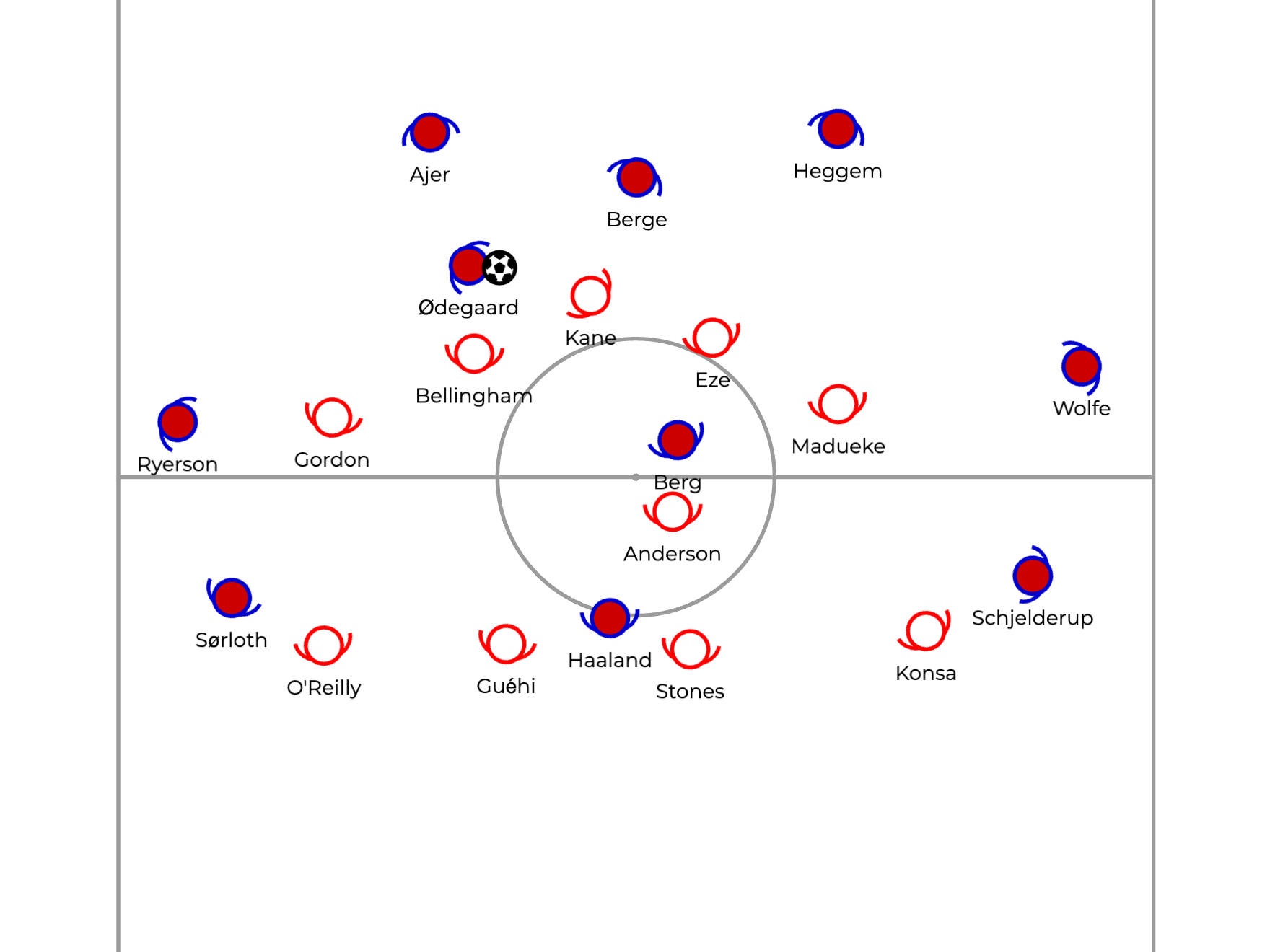
Norway in possession.
England wanted to take a man-oriented approach against the Norway midfield, as they have done against most opponents in this tournament. However, the freedom with which Norway’s midfielders roamed, especially Ødegaard, made it difficult to pursue these man-orientations in an organized way.
Norway made changes of their own as the second half advanced. Both wingers were replaced by the tricky pairing of Oscar Bobb and Antonio Nusa, giving England a new threat to deal with in wide areas.
Tuchel decided to try and solve his midfield issue shortly afterwards, bringing on Reece James for Gordon. This saw Eze move to a left-wing role, while James played as the deeper midfielder with Anderson and Bellingham returning to the positions in which they started the game.
Despite Norway’s improved performance, both sides continued to struggle to create chances, and the game continued into extra time.
Bellingham the saviour again
There were more midfield adjustments from Tuchel in the final stages of normal time. Morgan Rogers replaced Konsa, which saw James moving to right back, Anderson deeper again, and Rogers in the number eight role. Djed Spence had also replaced O’Reilly at left back.
The moment that would define this period of extra time arrived within just a few minutes though, as Bellingham got himself into the right position to net the rebound from Rogers’ long-range shot, putting England 2-1 up.
Despite the impetus for Norway to attack now, they managed few shots during the extra time period. Surprisingly, Haaland was substituted at half time in extra time, presumably unable to continue physically. As he left the pitch, so seemingly did the belief from either side that Norway were capable of grabbing an equalizer in this game.
Tuchel brought Dan Burn on for Bellingham in the final ten minutes of extra time, with England going into a 5-4-1 shape, enjoying the extra height with which to defend crosses into their box. In the end, England had few issues in seeing out their win.
Takeaways
This has been a historic tournament for Norway, and surely not the last time this group of players will cause problems for opponents on the international stage. However, their game is focused around the service they can provide for Haaland, and they were unable to provide much in this match. Despite being the better team for parts of the second half, they were unable to convert that into clear chances.
Tuchel said after the game that he was unhappy with the performance of his England side. In the first half they were relatively comfortable but lacked final third quality until Bellingham’s moment of inspiration, while in the second half they struggled to wrestle control back after their midfield adjustments. Big moments from big players often decide international tournaments, and that has still been the case for England even with all of the tactical nuances that Tuchel has added to this side.
Use the arrows to scroll through all available match plots. Click to enlarge.
Check the match plots page for plots of other matches.


Comments