

Arsenal – Chelsea: Arsenal Fight Back Against Intense Chelsea (2-1)
Chelsea took an early lead through Morgan Rogers and looked to keep the tempo high at the Emirates Stadium. However, Arsenal were able to expose weaknesses in Chelsea’s defensive line with their right-sided attacks, before Ødegaard sealed the deal in the second half, giving Arsenal a 2-1 win.
Tactical analysis and match report by Josh Manley.
We decided to make this article free to read. If you want to support our work, consider taking a subscription.
Reigning Premier League champions Arsenal had started the season in a confident manner so far prior to this game, winning both of their opening games with little trouble. Chelsea had also had a winning start, showing plenty of promise under new boss Xabi Alonso in victories over Fulham and Brighton.
Mikel Arteta lined his side up in a 4-2-3-1 shape here, with a back four of Ben White, Ezri Konsa, Gabriel Magalhães, and Riccardo Calafiori. Declan Rice and Myles Lewis-Skelly continued their strong central midfield partnership, while Martin Ødegaard started as the number ten. Bukayo Saka and Christos Tzolis then flanked Kai Havertz up top.
Chelsea meanwhile continued with the 3-4-3 system Alonso has utilized so far. Josh Acheampong, Maxence Lacroix, and Wesley Fofana made up the back three while Pedro Neto and Jorrel Hato played wing-back roles. Reece James and Roméo Lavia played centrally behind a front three of Cole Palmer, João Pedro, and Morgan Rogers.
Arsenal attack down the right
Alonso’s side could hardly have wished for a better start, as Rogers’ volley from the edge of the box found the bottom corner of David Raya’s net within the first two minutes. This sparked a game which was quite intense and had plenty of end-to-end passages of play.
Chelsea were set up in a 3-4-3 formation, which one may expect to become a 5-4-1 shape without the ball. However, Neto’s role changed this slightly. In defensive phases, he was often pushed up into the midfield line to stay close to Calafiori, who indented from Arsenal’s left back position.
This left Acheampong as the one who would play against Tzolis on the left, and Chelsea therefore found themselves in 4-4-2-like variations when defending, as Rogers also came back on the left side to track White.
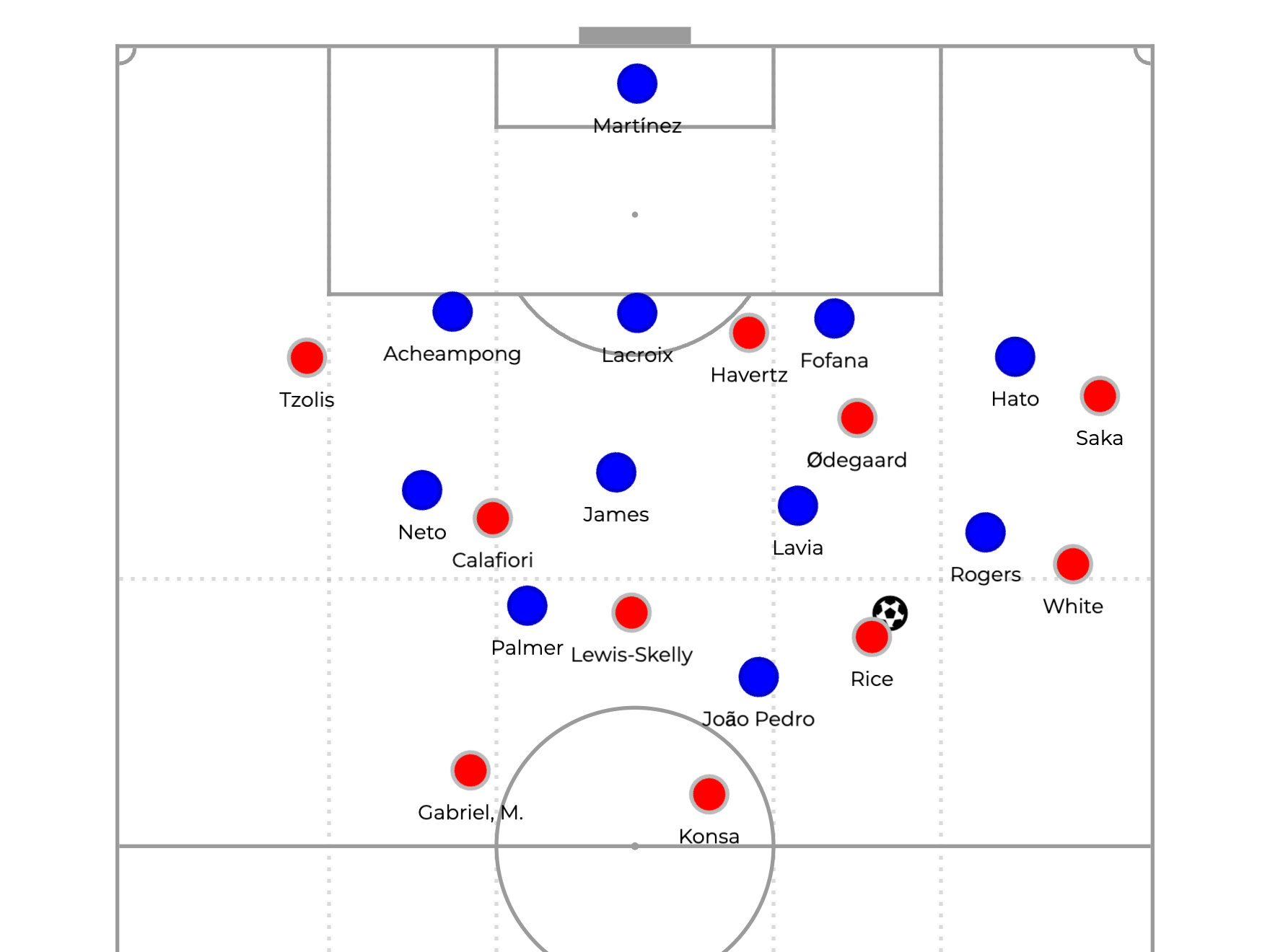
Shapes in Arsenal’s possession phase.
Against this, Arsenal were attacking with a right-sided focus. Rice often dropped off between or to the right of his center-backs, while Lewis-Skelly played as the number six.
White had the freedom to rotate with Saka and Ødegaard in a right-sided triangle, while Havertz also often drifted into this area of the pitch. Arsenal’s movement around the edges of the box on this side was excellent and created constant problems for Chelsea’s defense.
Arsenal were able to use the space between Fofana and Hato to good effect when the latter would go out to engage Saka in wide areas. The lateral movements from Havertz and Ødegaard as well as the overlaps from White allowed them to play through gaps in Chelsea’s backline.
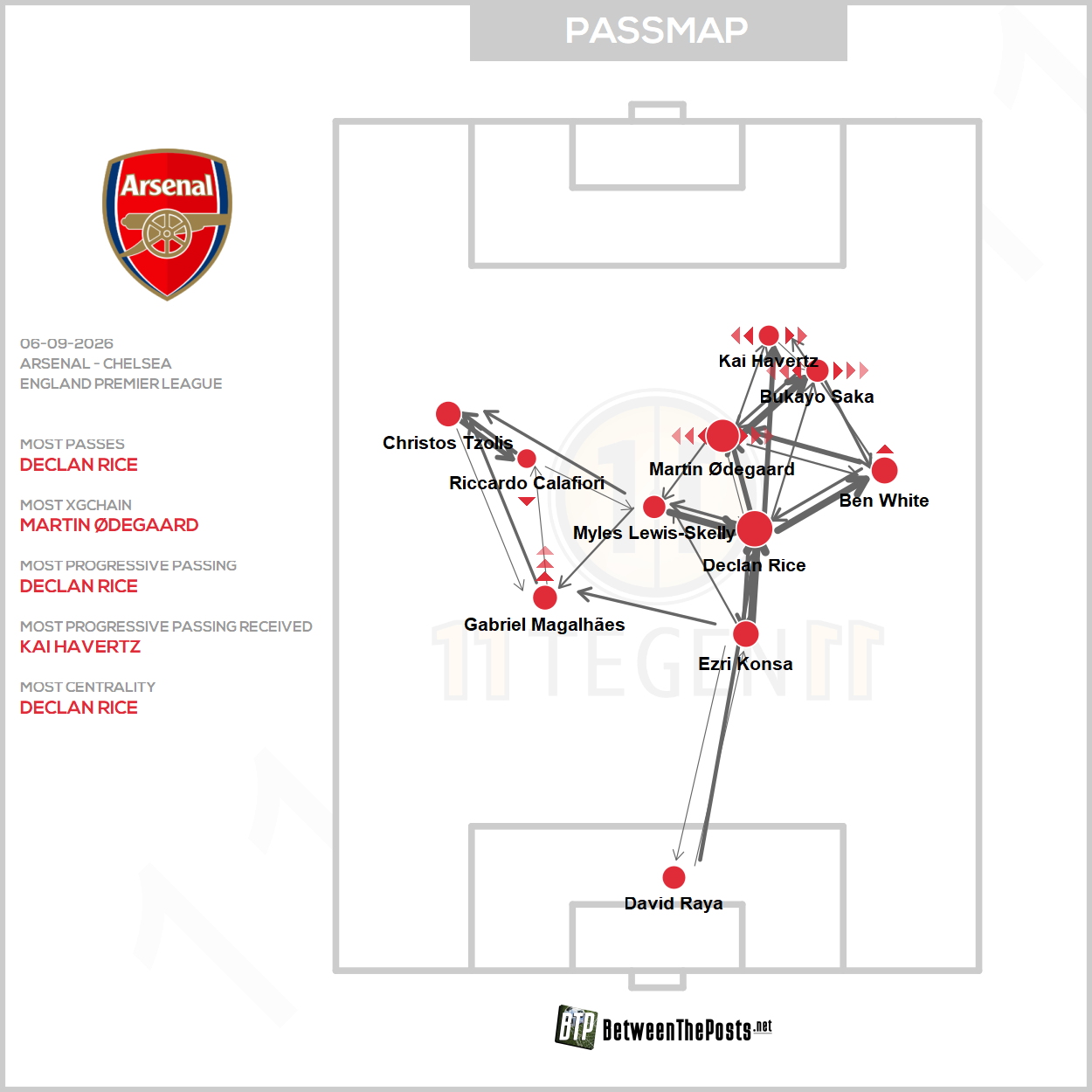
Arsenal’s passmap shows their right-sided focus.
The ease with which opponents are able to get into the penalty box with combination play around the corners of the box also cost Chelsea a goal against Fulham. It seems to be a key area of concern for Alonso’s team at the moment.
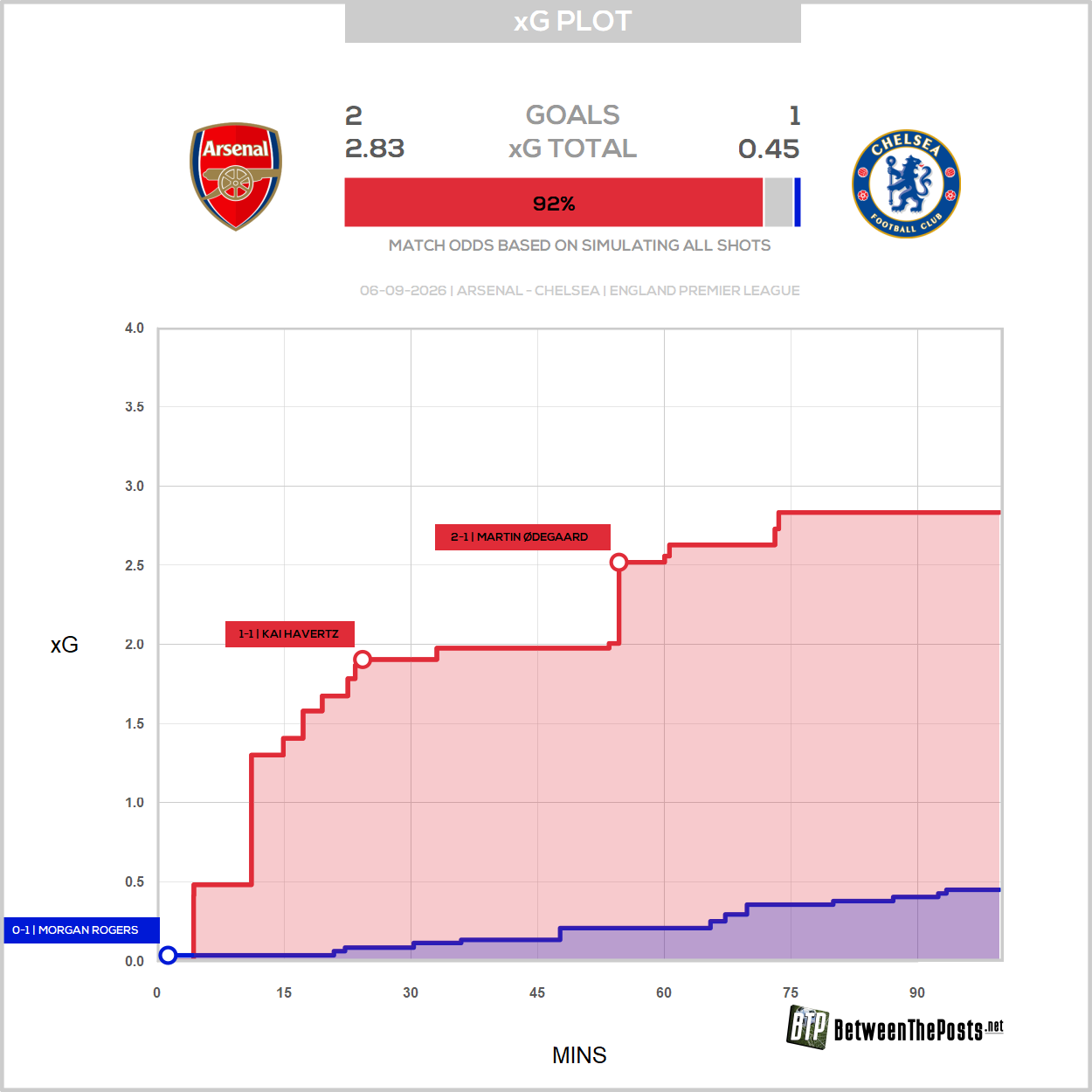
The protection in front of the box from James and Lavia was also lacking in key moments, such as in Havertz’s equalizing goal in the first half, where he was able to dribble across the edge of the box with insufficient pressure before getting a near-post finish off.
Chelsea’s rotations
One of the most interesting aspects of Alonso’s Chelsea so far has been the positional rotations in their possession phase. These rotations were also very much on display in this game.
Against the 4-4-2 defensive shape of Arsenal, Chelsea often had James dropping outside the Arsenal defensive shape into the first line. This would be accompanied by the very active forward movements of Acheampong down the right side, often underlapping Neto who held the width on the right, acting as a prominent outlet for Chelsea switching the play over to this side.
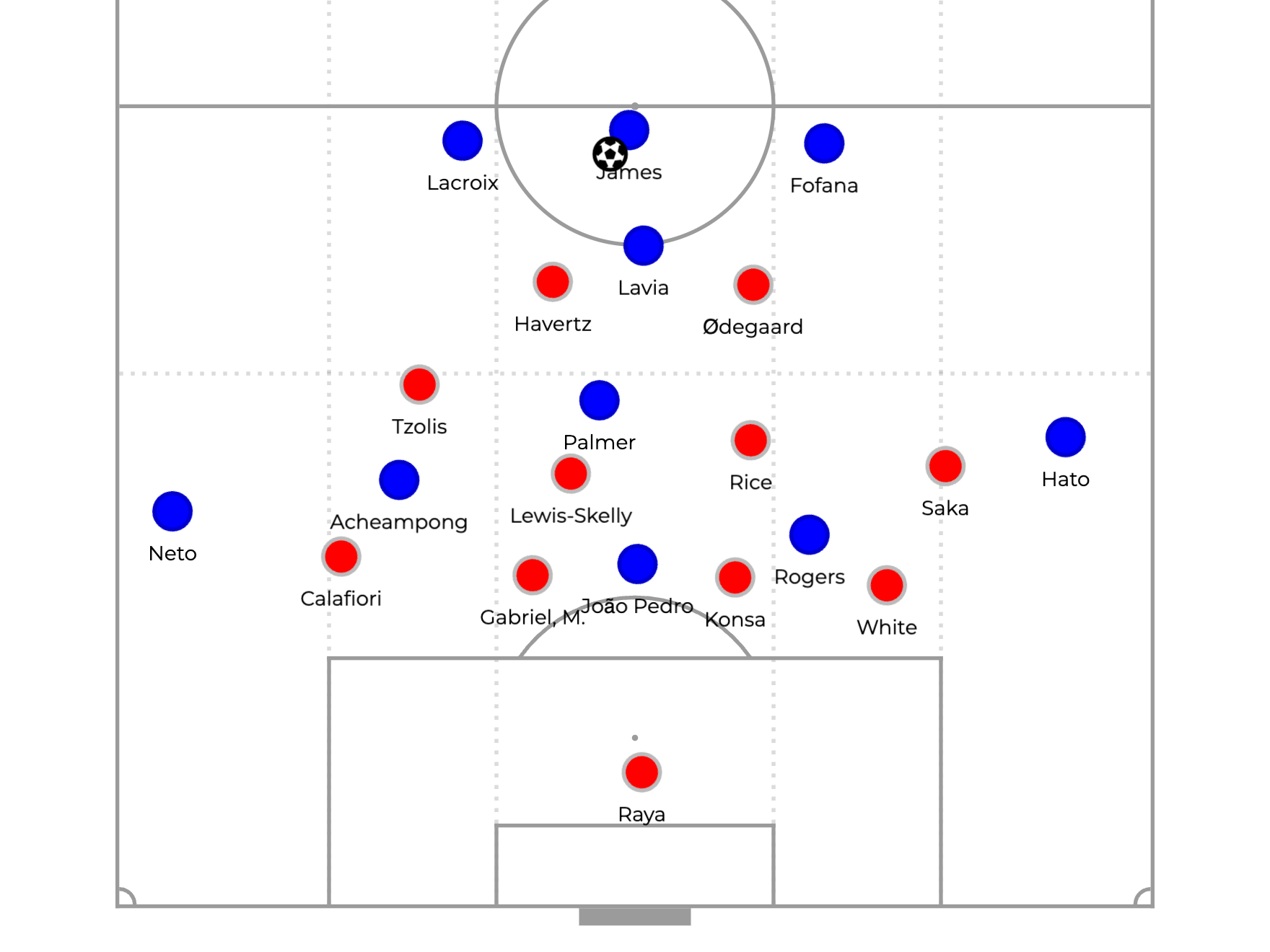
One variation of Chelsea’s attacking rotations.
All of this helped clear space for Palmer to drop deeper in the right halfspace, although he also had freedom to roam into central areas too. With the freedom given to him by Alonso, Palmer becomes something of a catalyst for Chelsea’s attacks, drifting into deeper areas to pick up the ball and try to change the picture using his creativity.
Lavia could perform a similar duty to James in dropping between center-backs, while on the left side Hato and Rogers would rotate between left halfspace and left wing. Rogers and João Pedro were both key outlets for Chelsea with their ability to receive long balls and hold defenders off physically.
Captain Ødegaard steps up
Chelsea’s possession percentage was higher in the second half as Arsenal had been able to go ahead just after the break thanks to Ødegaard. It was another goal which showed Chelsea’s issues defending the edge of their box, as the Norwegian was able to ghost into the box, untracked by Chelsea central midfielders or center-backs.
In many of Arsenal’s second-half possession phases, Ødegaard was playing a deeper role compared to the first half. He also had plenty of positional freedom to drop into Arsenal’s second line and provide connections in buildup, stabilising Arsenal’s play with his technical security.
Alonso was the first coach to make changes, bringing Pep Chavarría and Malo Gusto on for Hato and Lavia. Gusto became part of Chelsea’s right-sided rotations allowing James to take a more consistently deeper role, while Chavarría played on the outside of Rogers as wing-back.
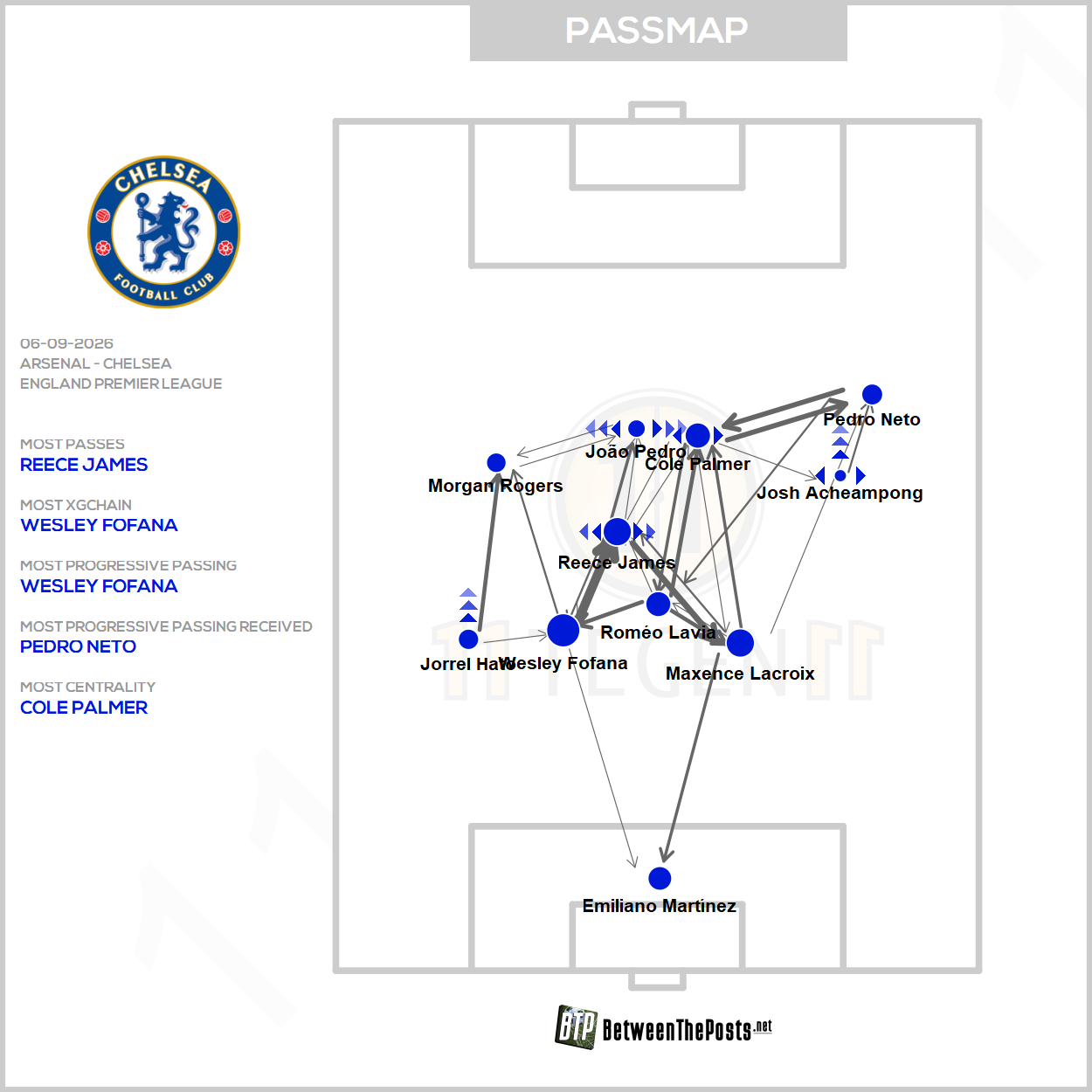
The active role of Acheampong going forward is shown in Chelsea’s passmap.
Arsenal made changes too, bringing on Martín Zubimendi and Piero Hincapié in another move intended to add extra stability and defensive solidity to their setup. As the game reached its final stages, Arteta’s side had more low block phases to defend, which past evidence shows that they are extremely comfortable with.
Chelsea went close late on through Estêvão who had replaced Neto on the right but ultimately were unable to create any clear chances. Because of this, the expected goals figures for this match paint a picture of a game in which Chelsea had no stake, which is actually not the case. Alonso’s side fought well but were unable to convert good play into high-value shots.
Takeaways
Arsenal have started this season full of confidence, as one would expect from champions. Their right-sided combinations and general play around the area were strong in this game, and defensively they were able to prevent Chelsea’s star attackers getting clear chances.
Alonso can still take positives from this game, although it shows that Chelsea have work to do to reach the level Arsenal currently operate at. The defensive phase is a core issue, with spaces appearing in the defensive line and in front of it when they defend in a low block.
Use the arrows to scroll through all available match plots. Click to enlarge.
Check the match plots page for plots of other matches.


Comments