Bayern Munich – Arsenal: Declan Rice’s late strike secures draw for Arsenal (2-2)
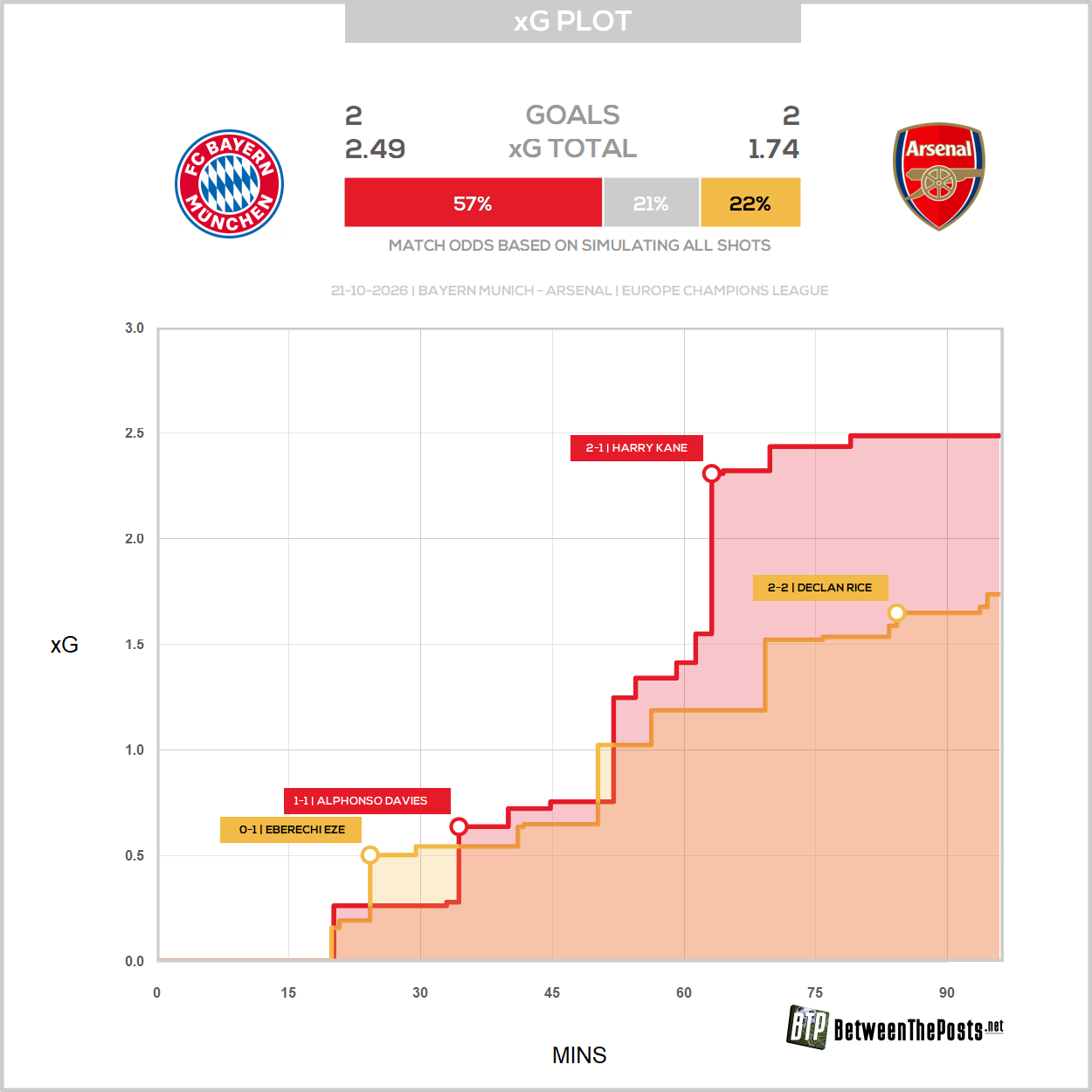
Bayern Munich hosted Arsenal in the Champions League’s glamour tie of the round. It’s fair to say that this was a game many people hoped would be an early preview of this season’s final. The two European giants play some of the most attractive football in the competition, and sparks would inevitably fly as two competing styles clashed. Eberechi Eze opened the scoring after coming on for the injured Bukayo Saka. Declan Rice cancelled Harry Kane’s penalty to salvage a 2-2 draw for The Gunners at the Allianz Arena.
Tactical analysis and match report by Aderemi Qoyum.
We decided to make this article free to read. If you want to support our work, consider taking a subscription.
There’s no love lost between Bayern Munich and Arsenal, especially following their tense encounters in European knockout ties over recent seasons. The two European heavyweights have created a very modern rivalry that transcends the usual definitions. Battles have been fought on high-intensity tactical grounds, press conferences, and the transfer market as both clubs constantly aim to cement their status at the pinnacle of European football. However, that has done little to dim the flames of a mutual competitive drive.
Vincent Kompany went with a 4-2-3-1 shape for Bayern Munich at the Allianz Arena. Manuel Neuer started in goal behind a defensive line consisting of Josip Stanišić, Kim Min-jae, Dayot Upamecano, and Konrad Laimer. In the double pivot, Aleksandar Pavlović paired with young Tom Bischof who replaced Joshua Kimmich who was out due to a death in his family. Up top, Alphonso Davies took up an advanced wide position alongside Ismael Saibari and Serge Gnabry, who replaced the suspended Michael Olise, operating behind Harry Kane as the central striker.
Mikel Arteta looked to match Bayern’s shape with his own 4-2-3-1 set-up. David Raya started in goal, protected by Riccardo Calafiori, Gabriel Magalhães, Ezri Konsa, and Jurriën Timber. In midfield, Declan Rice lined up next to Bruno Guimarães, with Martin Ødegaard pulling the strings in the central attacking midfield role. Bukayo Saka and Noni Madueke provided width on the flanks, leaving Kai Havertz to lead the line up front.
Early setback and structural traps
Bayern looked to exploit their home advantage through vertical attacks and Kane’s creativity, while Arsenal focused on defensive solidity and structured rotations. Saka threatened early before an apparent injury forced his substitution for Eberechi Eze in the 10th minute. Both teams adopted aggressive man-to-man pressing, aiming to win possession high up the pitch and pin their opponents back.
In possession, Arsenal sought to establish early dominance through fluid midfield rotations and hybrid full-back roles. One of Arsenal’s midfield trio frequently dropped between the centre-backs to set up a deep build-up base, while the other two shifted into dynamic midfield positions, with Declan Rice at times moving wide into the left-back area.
Riccardo Calafiori and Jurriën Timber inverted heavily during short build-up sequences—Calafiori taking up a higher halfspace or wide position while Timber remained deeper, though Timber pushed high on the right whenever David Raya prepared to go long. Up front, Kai Havertz regularly dropped deep, particularly toward the right half-space, dragging Kim Min-jae with him to disrupt Bayern’s backline structure.
To counter Arsenal’s complex rotations, Bayern set up in a solid 4-2-4 mid-block paired with a very high defensive line that dynamically altered its structure based on Arsenal’s positioning. When Martin Ødegaard dropped deep, Aleksandar Pavlović was forced to track him, while Tom Bischof stayed tight to Bruno Guimarães. Up front, Ismael Saibari and Harry Kane kept tabs on Arsenal’s centre-backs.
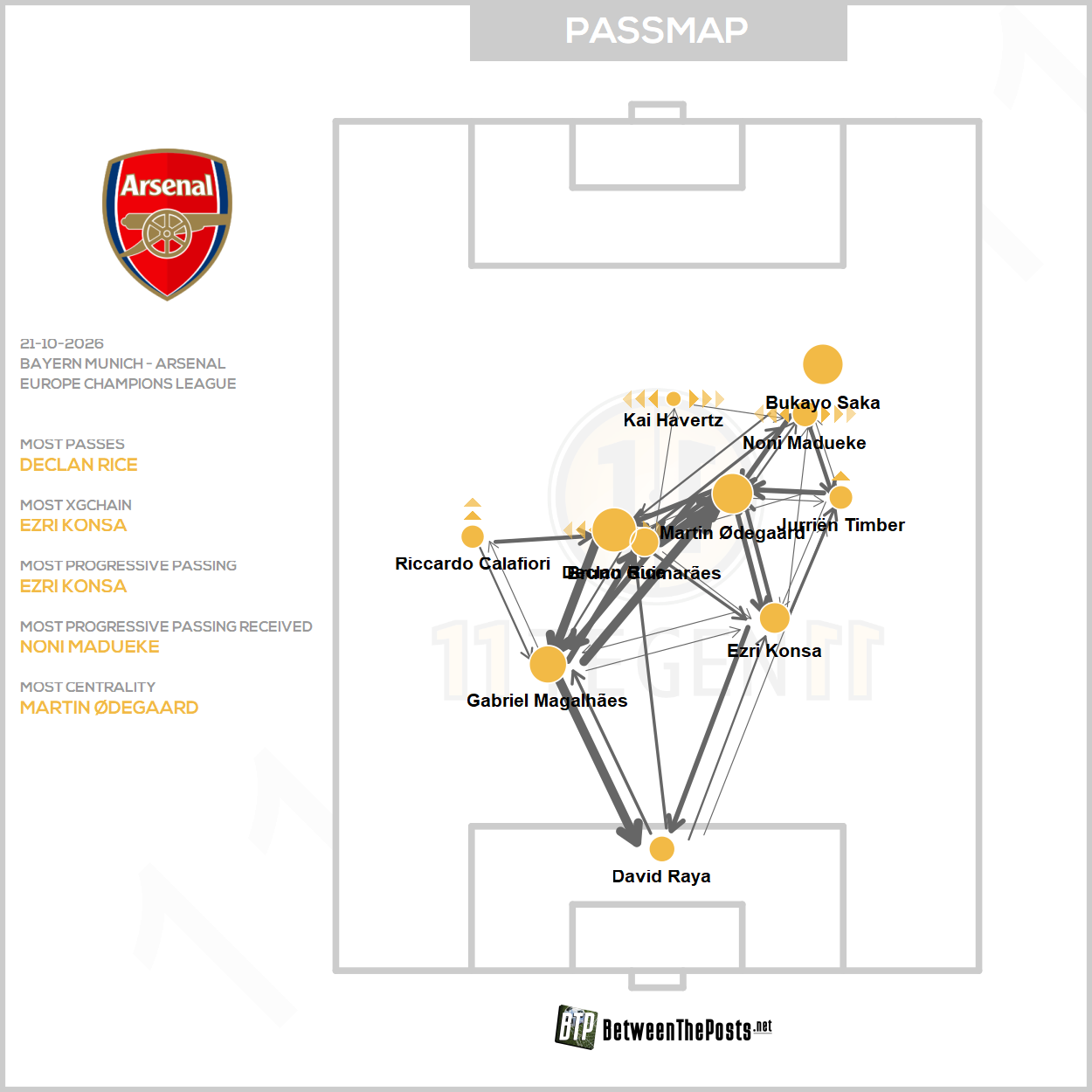
Arsenal’s Passmap
However, Bayern repeatedly struggled with how to track the trilemma of Rice, Calafiori, and Eze. When Calafiori inverted high and Rice shifted into the wide left area, Serge Gnabry was overloaded and uncertain of whom to mark. Simultaneously, Konrad Laimer was pinned by Eze and reluctant to step up to press Calafiori, leaving Gnabry caught in two minds on whether to focus entirely on Rice.
Early on, Bayern successfully forced Arsenal to recycle play back to Raya, who opted to launch the ball long at almost every opportunity rather than continuing short build-ups. However, whenever Arsenal managed to sustain possession, it afforded their creative engines the time and space needed to dictate the tempo and thread balls behind the opposition defense.
This structural dynamic directly paved the way for Arsenal’s opener in the 25th minute: with time to operate, Ødegaard spotted Eze’s run behind Bayern’s high line as Laimer was caught napping and wrong-footed, allowing Eze to burst clear and finish beautifully with his left foot.
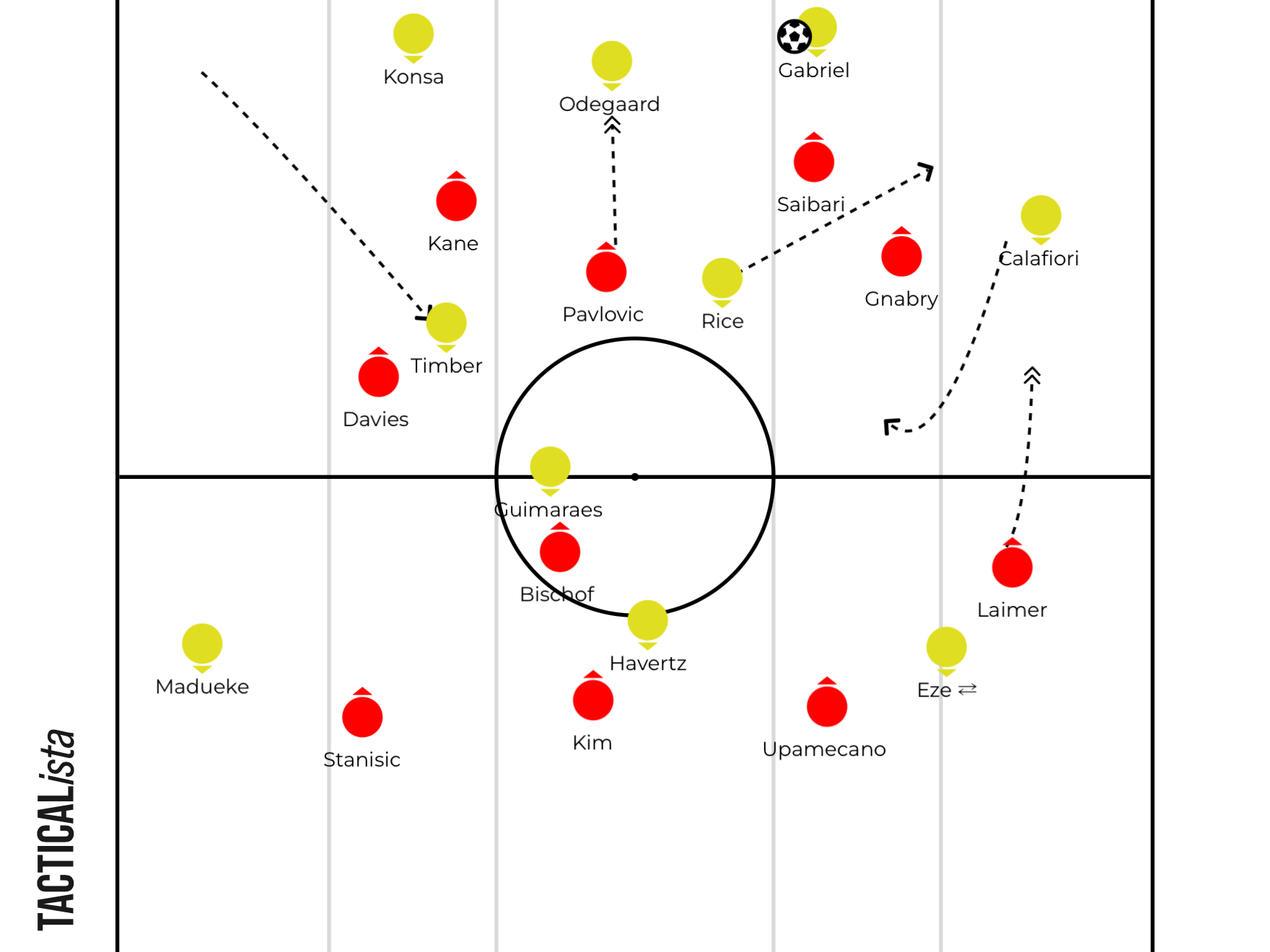
Minute 12′: Arsenal in-possession rotation with Ødegaard dropping deep against Bayern’s 4-2-4 mid-block press and high defensive line.
Kane finds space
In the build-up phase against Arsenal’s high press, Kompany relied heavily on Harry Kane dropping deep into midfield and even into the defensive third to orchestrate play, particularly in the absence of Joshua Kimmich. Drawing parallels to William Saliba’s tight man-marking of Kane in their recent UEFA Champions League encounter, Arteta instructed Ezri Konsa to follow Kane into deep zones to prevent the in-form forward from operating in pockets of space.
Arsenal were initially able to press Bayern man-to-man effectively, but they struggled significantly with the explosive pace of Gnabry and Davies running into channels. Rather than playing short combinations into feet under pressure, Bayern repeatedly looked for direct through-balls into space for both wingers.
A clear warning sign came in the 21st minute: Kane hit a quick goal-kick restart and instantly picked out Alphonso Davies on the left flank. Davies accelerated into space, driving a rapid 3v2 counter-attack before picking out Saibari who laid the ball to Gnabry, whose one-on-one strike was brilliantly saved by Raya.
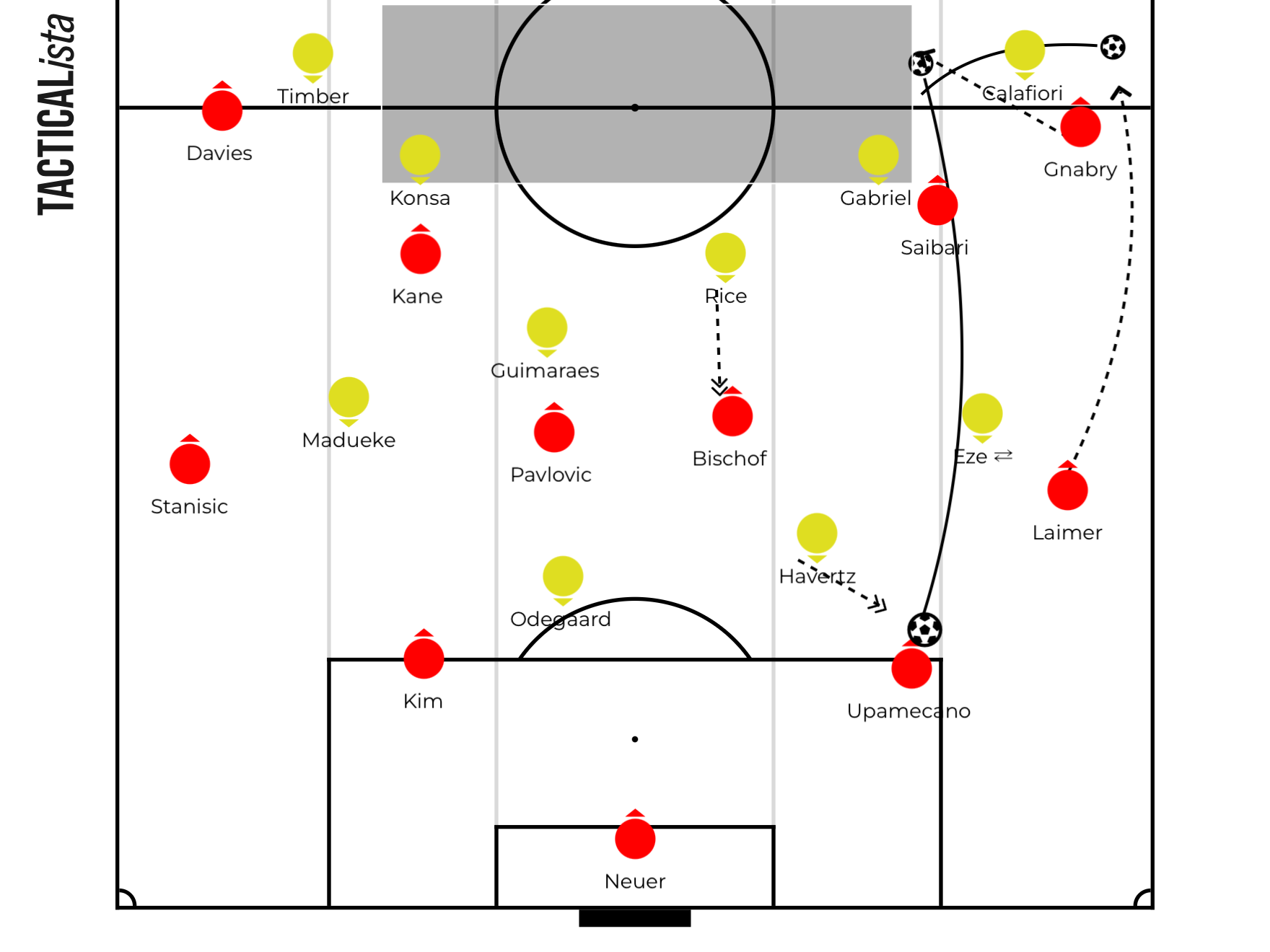
Minute 22′: Bayern’s 4-2-4 build-up structure with Kane dropping deep and dragging Konsa along against Arsenal’s man-to-man press. Here, they build through the right side with Laimer receiving after making a delightful run off Eze.
Bayern equalised in the 35th minute through Kane’s freedom in midfield and their direct outlet strategy. After a quick combination from a throw-in, Kane found space as Konsa retreated rather than staying tight, allowing the striker to release Davies with an excellent through-ball from halfway. The Canadian outpaced Timber before calmly finishing past Raya to make it 1-1.
Harry Kane with the equaliser
At the interval, Kompany brought on Jonathan Tah for Kim Min-jae to tighten up physical presence in the central defense. The opening moments of the second half saw both goalkeepers called into action: Manuel Neuer pulled off a sharp stop in the 48th minute to stop a Guimaraes header, immediately mirrored by David Raya making a crucial athletic save a minute later to deny Saibari after Bayern attacked on the break.
As the match settled, Bayern faced Arsenal’s well-organised 4-2-4 deep defensive block, which successfully kept Bayern’s play in front of them and denied central penetration. With the creative trio of Michael Olise, Joshua Kimmich, and Jamal Musiala sidelined, Kane’s responsibility grew even larger as he continuously dropped deep to orchestrate play and unlock the defence.
Arsenal’s compact shape forced Bayern into half-chances, echoing Kane’s precise passes to Gnabry and Saibari earlier in the match. When Bayern established settled possession, full-backs Stanišić and Laimer advanced into high half-space positions while Gnabry and Davies stretched the pitch wide. While Pavlović and Bischof circulated possession efficiently, they lacked vertical penetration. Conversely, when Arsenal regained possession in their own half, they lacked the direct pace and transitional threat of Bayern, leading to fizzled attacks involving Odegaard, Eze and Havertz.
The structural pressure eventually told in the 60th minute when a shot from Kane struck the arm of Timber inside the penalty area. Kane stepped up in the 61st minute and calmly converted the penalty kick to give Bayern a 2-1 lead.
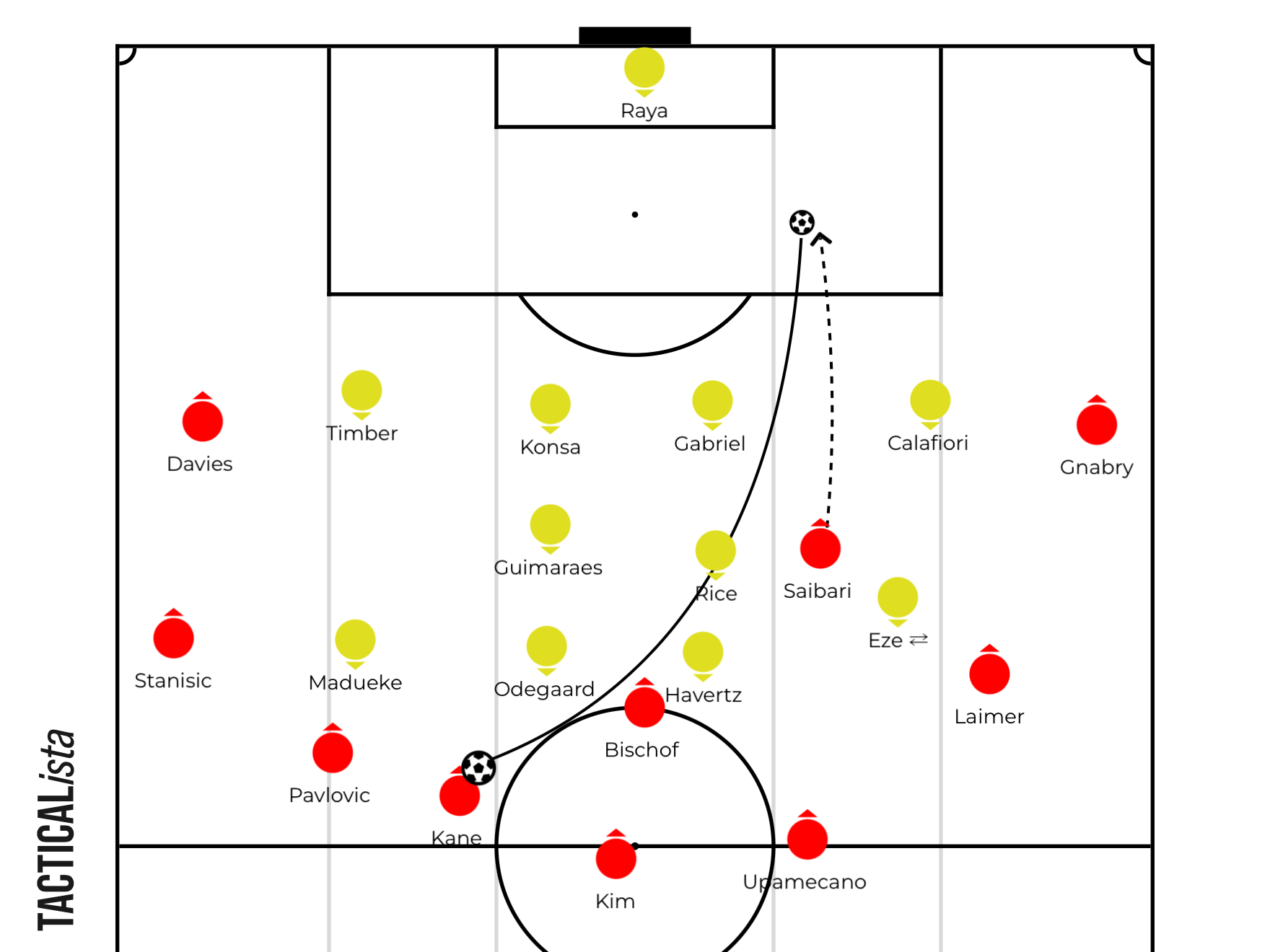
Bayern IP against Arsenal’s 4-2-4 block. In the first half, Kane launches a wonderful pass to Saibari who failed to control it.
Rice steals a draw
Despite holding periods of sustained possession, Arsenal struggled to break down Bayern’s defensive block. They lacked a specialized player capable of receiving between the lines and in tight spaces under pressure to spark creativity. Furthermore, their sluggish tempo in possession allowed Bayern’s defensive shape ample time to recover and reform.
All through the game, Arsenal attempted to manufacture overloads down the right side utilising Ødegaard, Timber, Madueke, and Rice, occasionally supported by Havertz dropping from the centre-forward position. To counter these overloads, Bayern shifted defensively with Davies dropping all the way back into the defensive line to form a resilient back five.
The game turned when Arteta introduced a double substitution: Myles Lewis-Skelly and Viktor Gyökeres. Lewis-Skelly provided the crucial midfield profile who could cleanly receive between the lines and under pressure to evade tackles, while Gyökeres brought a potent transitional threat in the channels alongside superior physical presence to hold up play and link the Gunners’ attacks—elements Arsenal had lacked throughout the match.
The tactical reward arrived in the 81st minute when substitute Gyökeres held off Tah and laid the ball off into the path of Rice. The midfielder struck a lovely effort past Neuer to complete a dynamic team move and bring the score to 2-2.
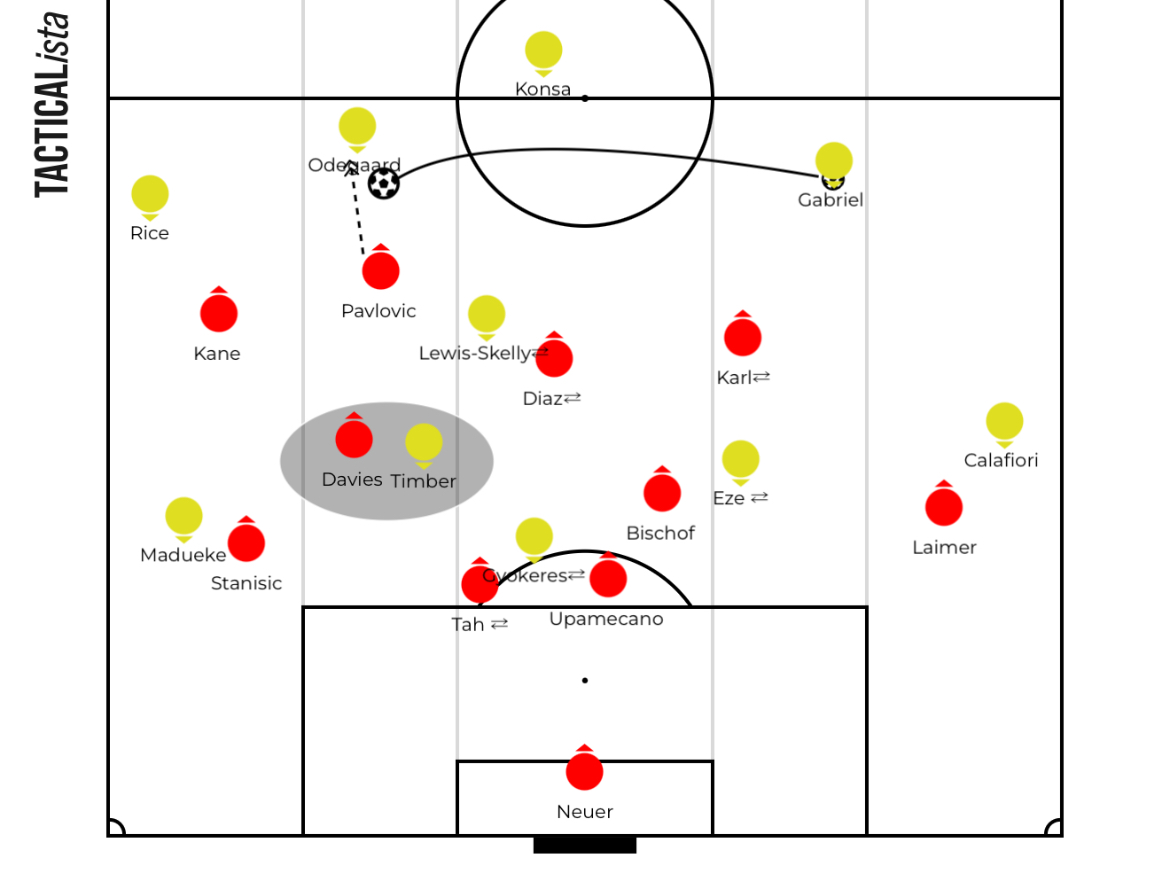
Minute 77′: Arsenal in possession against Bayern’s low block, illustrating the right-side overload structure just before the late equalizer.
Takeaways
The early injury to Saka will be the primary concern for Arteta following this thrilling draw. However, the resilience shown by the Gunners to come back at the Allianz Arena underlines their elite mental strength and technical flexibility.
For Bayern Munich, failing to close out the game after taking the lead will feel frustrating for Kompany. Their fading physical intensity in the final twenty minutes allowed Arsenal back into the match, but a point against a direct top-tier rival leaves both teams well-positioned in the Champions League standings.