
Belgrano – River Plate: River Plate Convert Total Control into Victory (0–3)
River Plate controlled the game from start to finish against a disjointed Belgrano side. Their momentum increased as the match progressed, eventually translating into goals. Belgrano’s lack of coordination on and off the ball allowed River to secure a comfortable victory.
Tactical analysis and match report by Ebuka Ogoegbunam.
River Plate played their second consecutive away game after failing to win against Sarmiento Junín the previous week. They were looking to secure a more comfortable position near the top of the table and needed a win to do so. Seventeen points from twelve games had not been enough for River, with pressure mounting ahead of every match.
Belgrano came into the game unbeaten in their previous six matches, having won their last three. They were also one of the league’s strongest defensive teams, having conceded seven goals in twelve games. They had the opportunity to extend their unbeaten run while maintaining their defensive record at home against River.
For River Plate, Santiago Beltrán started in goal behind a back four of Gonzalo Montiel, Lucas Martínez Quarta, Nicolás Otamendi and Francisco Ortega. Aníbal Moreno played as the sole pivot in midfield, behind the attacking midfield trio of Tobías Andrada, Thiago Almada and Tomás Galván. Ángel Correa and Lucas Beltrán formed the front two in River’s 4-1-3-2 shape.
Belgrano’s 4-2-3-1 shape featured Thiago Cardozo in goal, with a back line of Leonardo Morales, Alexis Maldonado, Lisandro López and Adrián Spörle. Franco Vázquez partnered Adrián Sánchez in midfield. Lucas Zelarayán operated as the attacking midfielder behind the front three of Emiliano Rigoni, Lucas Passerini and Ramiro Hernández.
River’s Midfield Rotations
River gained control in the first half through the movements of their attacking midfielders. Their 4-1-3-2 setup gave them advantages in build-up. They created overloads in deeper areas, with Galván, Almada and Andrada constantly dropping deep to receive the ball and control the phase of play.
Belgrano were not persistent in pressing when River Plate’s centre-backs had the ball. Instead, they reacted to the movements of the midfielders dropping deep. River used these overloads to find the spare player and break through the lines.
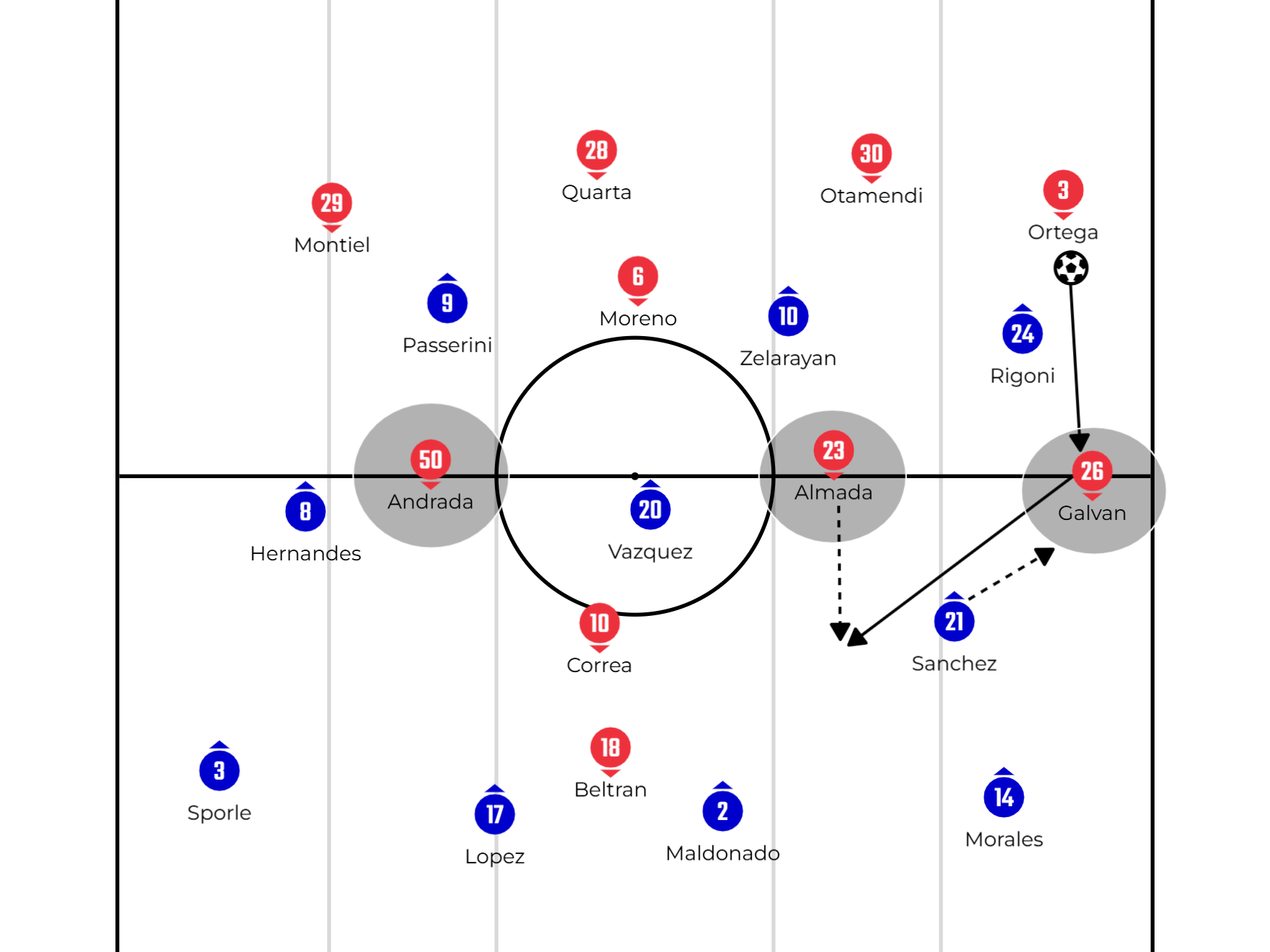
River progressing through deep overloads created by the positioning of Almada, Galván and Andrada.
Belgrano’s 4-4-2 mid-block was passive and often left spaces between midfield and defence. Correa exploited these spaces by acting as a second striker and supporting Beltrán. He frequently dropped between the lines to receive the ball, while also making runs in behind Belgrano’s defence.
Belgrano struggled to defend the spaces between the lines. When Beltrán dropped deep, Correa often made attacking runs beyond Belgrano’s defensive line. River’s midfield fluidity made it difficult for Belgrano to keep up and gave River easier access to the final third.
Belgrano were often forced to sit deeper, allowing River to enjoy more possession.
The home side’s approach
In possession, the home side adopted a more direct approach than their opponents. Their 4-2-3-1 shape allowed the left-back, Spörle, to advance high up the pitch, while the left winger, Hernández, had the freedom to roam as a free player alongside the attacking midfielder, Zelarayán.
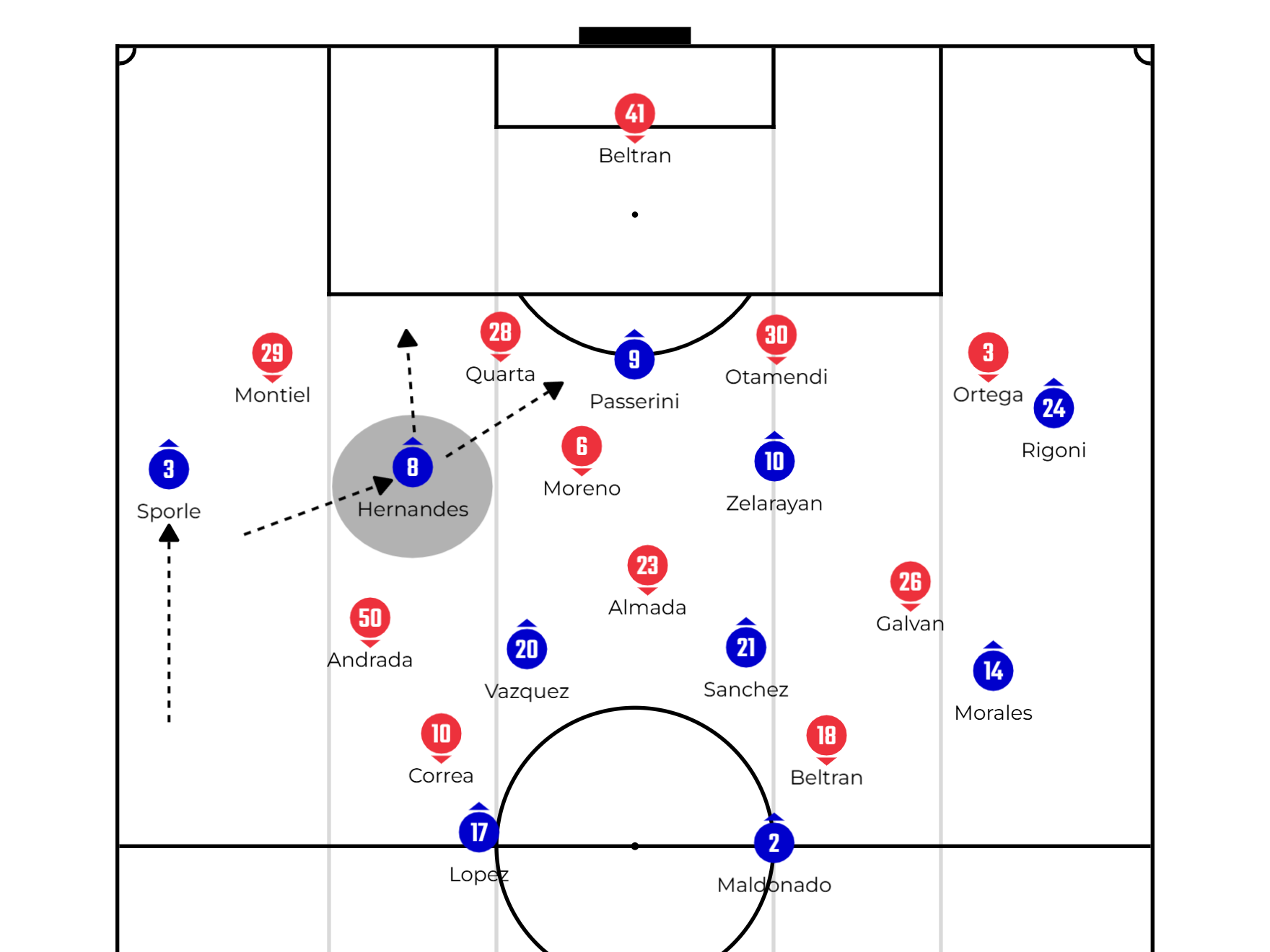
Belgrano used the left side as their main attacking route, with Hernández given the freedom to roam around the pitch.
In the first half, Belgrano often played long balls towards Passerini, but he struggled to win his duels against the physicality of Otamendi and Martínez Quarta in River’s defensive line. This made it difficult for Belgrano to establish control. River’s ability to win first and second balls gave them control of midfield and the deeper areas.
When Belgrano had possession, they often used the left side to progress up the pitch. However, their entries into the final third did not create much of a threat.
Correa’s impact for River Plate
River progressed into the final third by exploiting the gaps Belgrano left in front of their defensive line. When Correa or Almada occupied these spaces, Belgrano’s back line hesitated to step out. This gave River’s players room to shoot from the edge of the box.
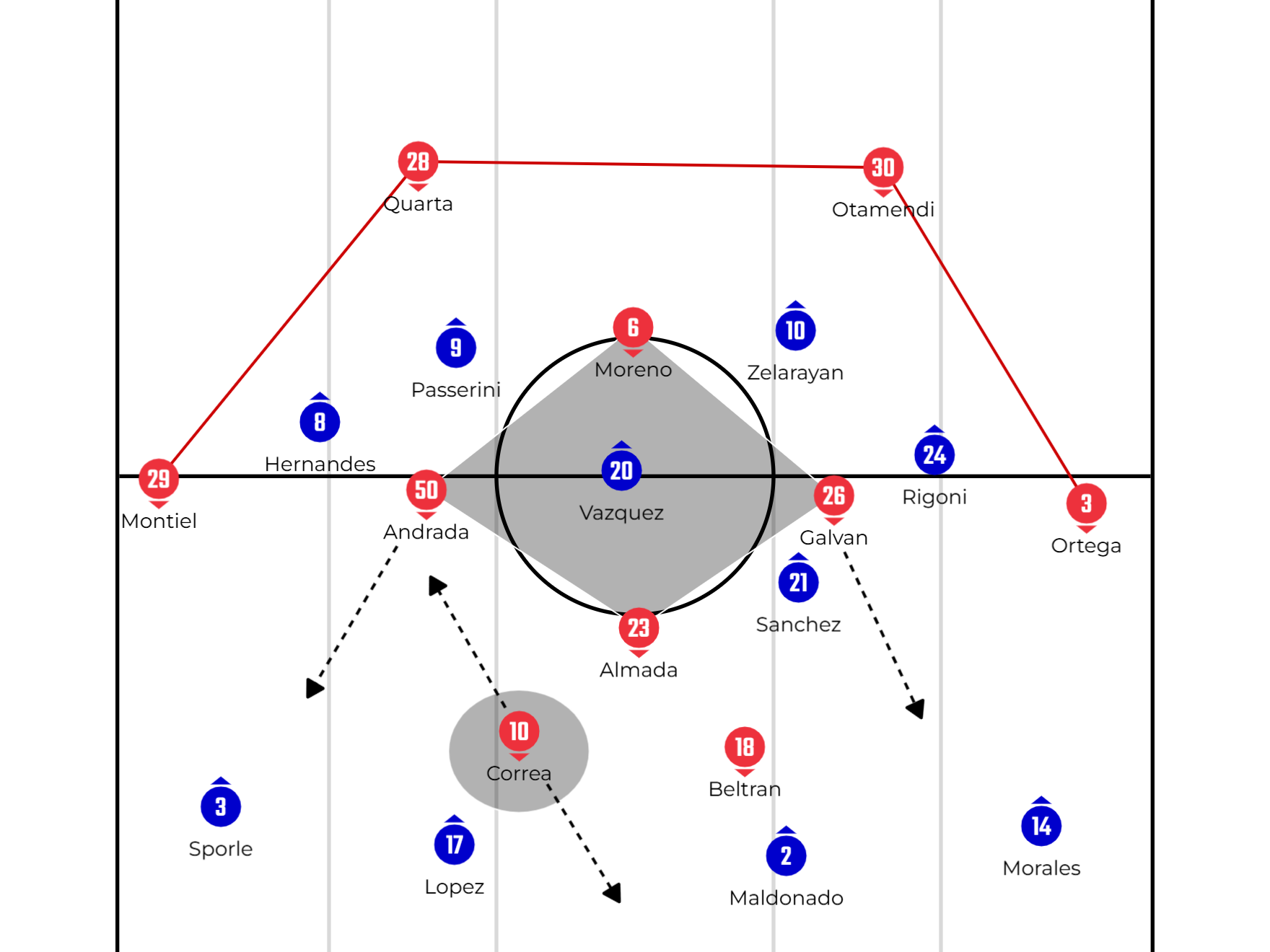
Correa operating as the free player between the lines.
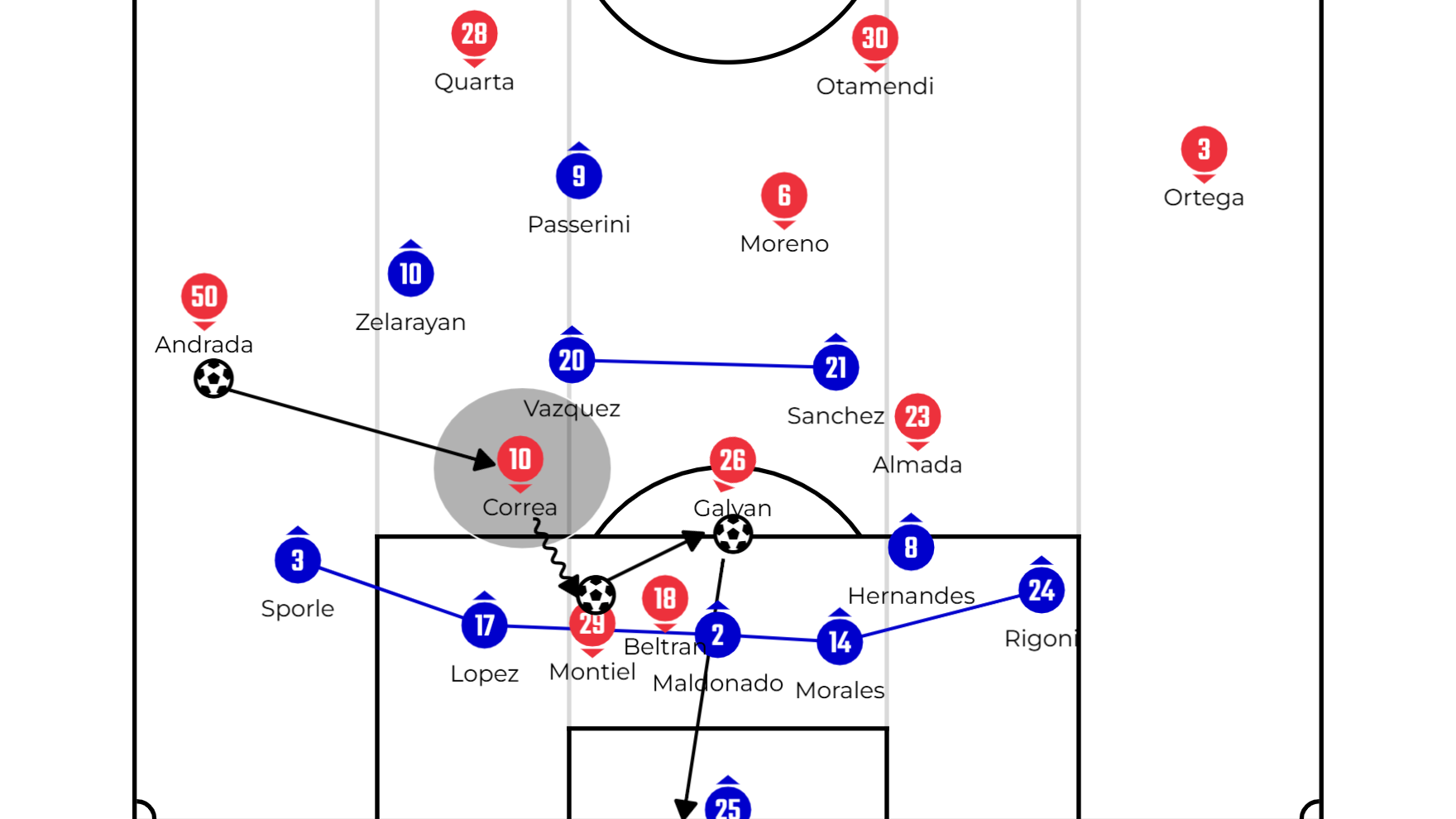
Correa’s attacking threat was evident. His runs into the box and ability to occupy dangerous spaces made River a threat whenever they advanced. His impact was clear in the opening goal, when River exploited the spaces between the lines.
Andrada’s diagonal pass found Correa between the lines, allowing him to drive into the box before Montiel played the ball into Galván’s path to score. River’s pressure and dominance resulted in a goal towards the end of the first half.
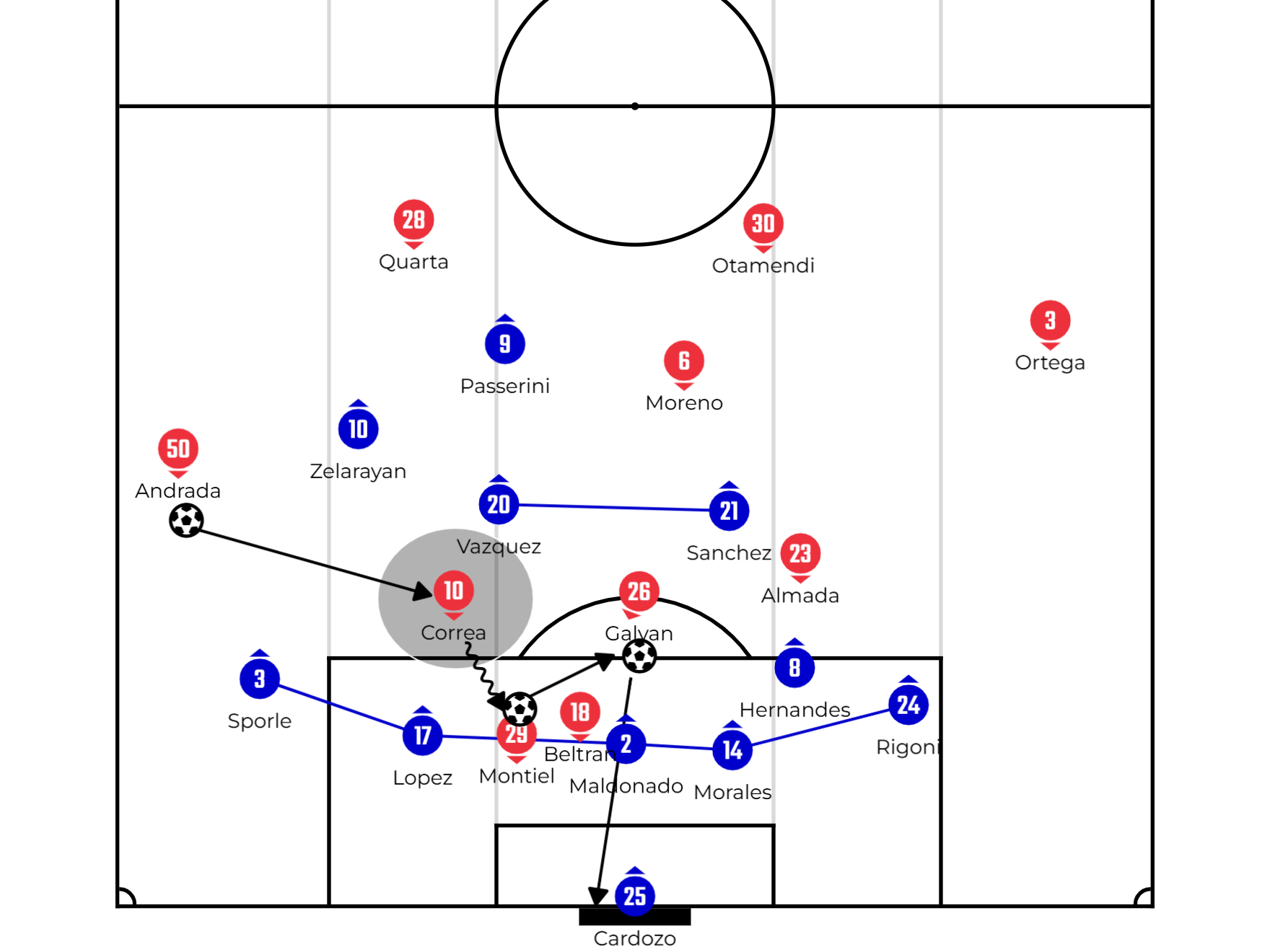
River’s opening goal began with an exploitation of the spaces between the lines.
In the second half, the game became more open as Belgrano began pressing the ball more aggressively. Both sides applied pressure, although River pressed more intensely. Belgrano created more chances than they had in the first half, delivering balls into the box for Passerini, whose headers forced saves from River’s goalkeeper.
River scored their second goal after an error by Morales, who gifted possession to Beltrán. Beltrán played the ball into space for Correa, who beat the goalkeeper to score. In the 71st minute, River added a third when Almada glided past Belgrano’s midfield before beating the goalkeeper with a shot from outside the box. With the home side three goals behind, the game had moved beyond their reach. Although the match became more end-to-end, Belgrano could not take their chances to reduce the deficit.
Belgrano’s 12 shots and expected-goals (xG) figure of 1.04 suggest that the match was not entirely one-sided in terms of chance creation. However, their inability to convert their opportunities proved costly.
Takeaways
River Plate’s 3–0 victory over Belgrano was built on midfield fluidity, positional rotations and the exploitation of spaces between the lines. Operating in a 4-1-3-2, River used Tobías Andrada, Thiago Almada and Tomás Galván to create deep overloads and progress through Belgrano’s midfield.
Belgrano’s passive 4-4-2 mid-block struggled to contain these movements, leaving gaps between midfield and defence. Ángel Correa exploited these spaces by dropping between the lines to link with Lucas Beltrán, while their coordinated movements created opportunities to penetrate the defensive line.
River converted their superiority into goals by exploiting gaps between the lines, capitalising on a defensive error after the break and Almada’s individual progression through midfield before scoring from outside the box.
Ultimately, Belgrano’s defensive disorganisation and ineffective direct approach allowed River to control the contest. River’s positional fluidity, central penetration and clinical finishing proved decisive.
Match plots would be added as soon as possible!