
Boca Juniors – Defensa y Justicia: Boca’ Win the Clausura in Added Time (1-0)
Boca’s victory sealed the league win in the clutch. Having gone through a series of missed chances earlier in the game, they came up big, exploiting zones they had targeted throughout the game without success. The Boca substitutions proved to be key in their latest league win.
Tactical analysis and match report by Ebuka Ogoegbunam.
Boca Juniors host Defensa y Justicia at La Bombonera in the last round of the Clausura group stage, with a league title at stake. Boca are already through to the playoffs, but a win would take them to 63 points, which would leave them in a very strong position to be crowned Campeón de Liga for finishing first in the annual table. They also need Argentinos Juniors to drop points against Huracán, and Rosario Central can only reach 62.
Defensa arrive in good form, with one defeat in their last seven and a 1-1 draw at Independiente. They sit fourth in Zone A on 28 points, have 47 in the annual table, and are chasing a Copa Sudamericana place. Boca won 4-0 in their last meeting in April, but Defensa won 2-1 the time before that, so this looked like the final league straw.
The home side set up in their usual 4-2-3-1 base, having Álvaro Montero in goal defending a back line of Leandro Lozano, Lautaro Di Lollo, Facundo Herrera, and Lautaro Blanco. Leandro Paredes and Milton Delgado played in the middle with Santiago Ascacíbar higher in the attacking midfield. Alan Velasco, Sebastián Villa, and Miguel Merentiel made up the front three in attack.
Defensa y Justicia’s 4-3-3 shape had Matías Borgogno in goal with Valentín Loza, Damián Fernández, David Martínez, and Demián Domínguez making the back four. César Pérez and Santiago Sosa were the midfield pairing while Maximiliano Porcel played behind the attacking unit. Jeremías Lucco, Juan Manuel Gutiérrez, and Leandro Fernández were the three in attack.
Boca’s wingers in possession
Boca set up in a 4-2-3-1 shape with the fullbacks holding the width, while the movements of the wingers were flexible between the lines. Paredes operated deep and was given the role of helping the team progress in build-up. Delgado was given the license to push forward to join the attack.
Defensa set up in a 4-1-4-1 shape, going man to man in midfield while being more conservative at the back by keeping their defense rigid in the defensive line.
The home side started with a strong push for the title, while the away side looked to put pressure on them. Boca’s rotations helped them arrive in the final third, and these rotations mostly occurred on the left-hand side. Velasco moved inside frequently during the game, drawing his marker, which created space for isolation on the left-hand side.
With Blanco pushing forward, he found space on the left to drive at his marker and deliver multiple crosses into the box, even with the Defensa y Justicia right winger tracking his movements. This was one of Boca’s main attacking routes, but they struggled to connect with the final balls. They couldn’t turn those deliveries into clear chances.
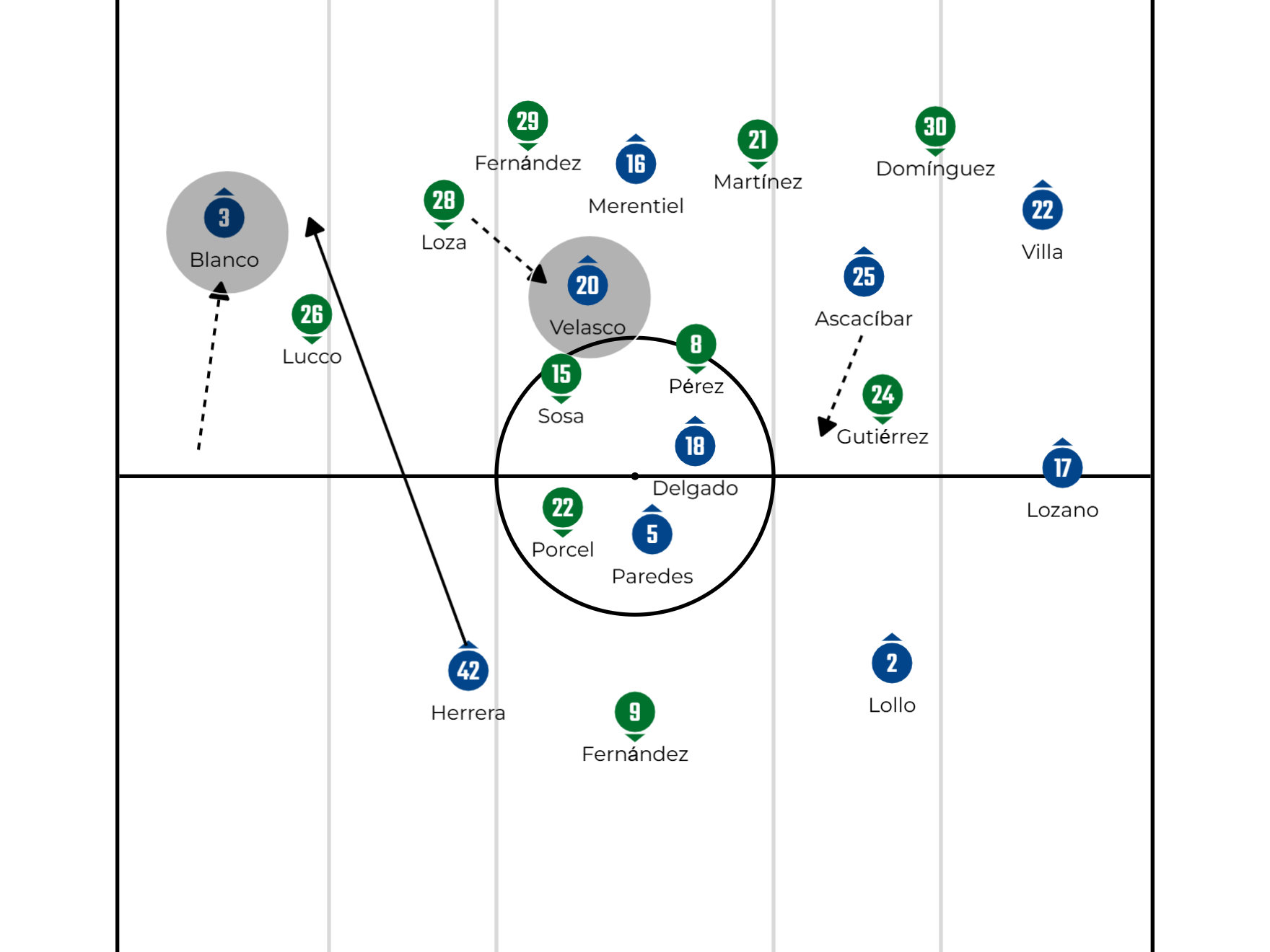
Velasco’s positioning attracted Loza out of the defensive line, leaving Blanco more isolated.
In situations where Defensa’s right back, Loza, did not follow Velasco into midfield, Velasco and Ascacíbar were able to receive between the lines. That allowed Boca to progress centrally but also exploit the right-hand side. Because Boca’s wingers had freedom to roam, Velasco often drifted to the right, joining Villa and creating overloads to help progress play in those wide areas. Those movements made Boca’s attack less predictable, giving them different routes, central combinations, wide attacks, and runs in behind the defense.
Boca were unpredictable in possession, with a lot of variety behind their attacking structure. Velasco moved inside while the fullback occupied the width; at times, Velasco and the fullback both occupied the width; and Velasco also drifted to the right-hand side to overload that area. Boca had multiple ways of attacking Defensa’s block.
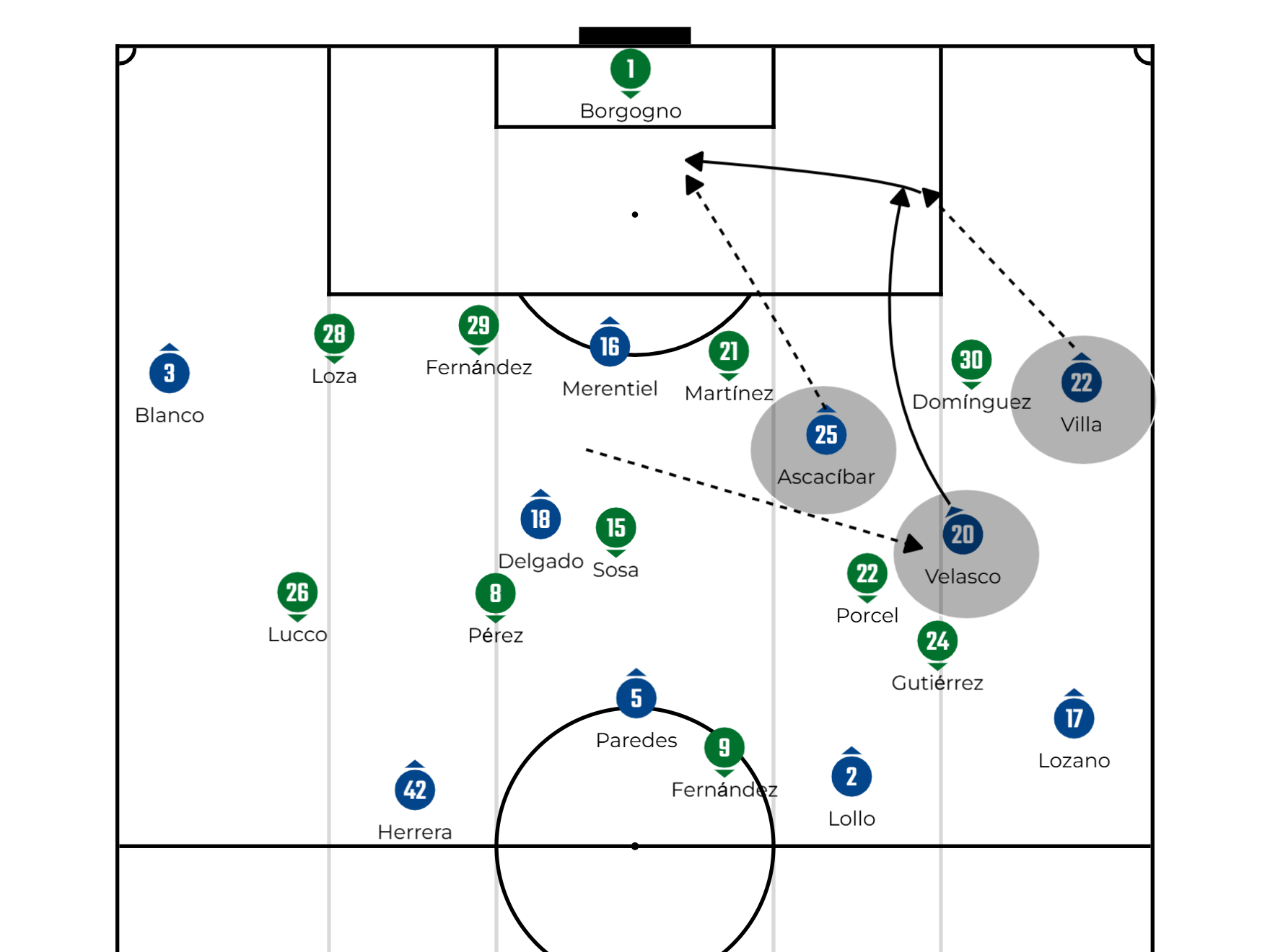
Velasco drifted to the right-hand side, forming an overload in that area.
Defensa’s build up
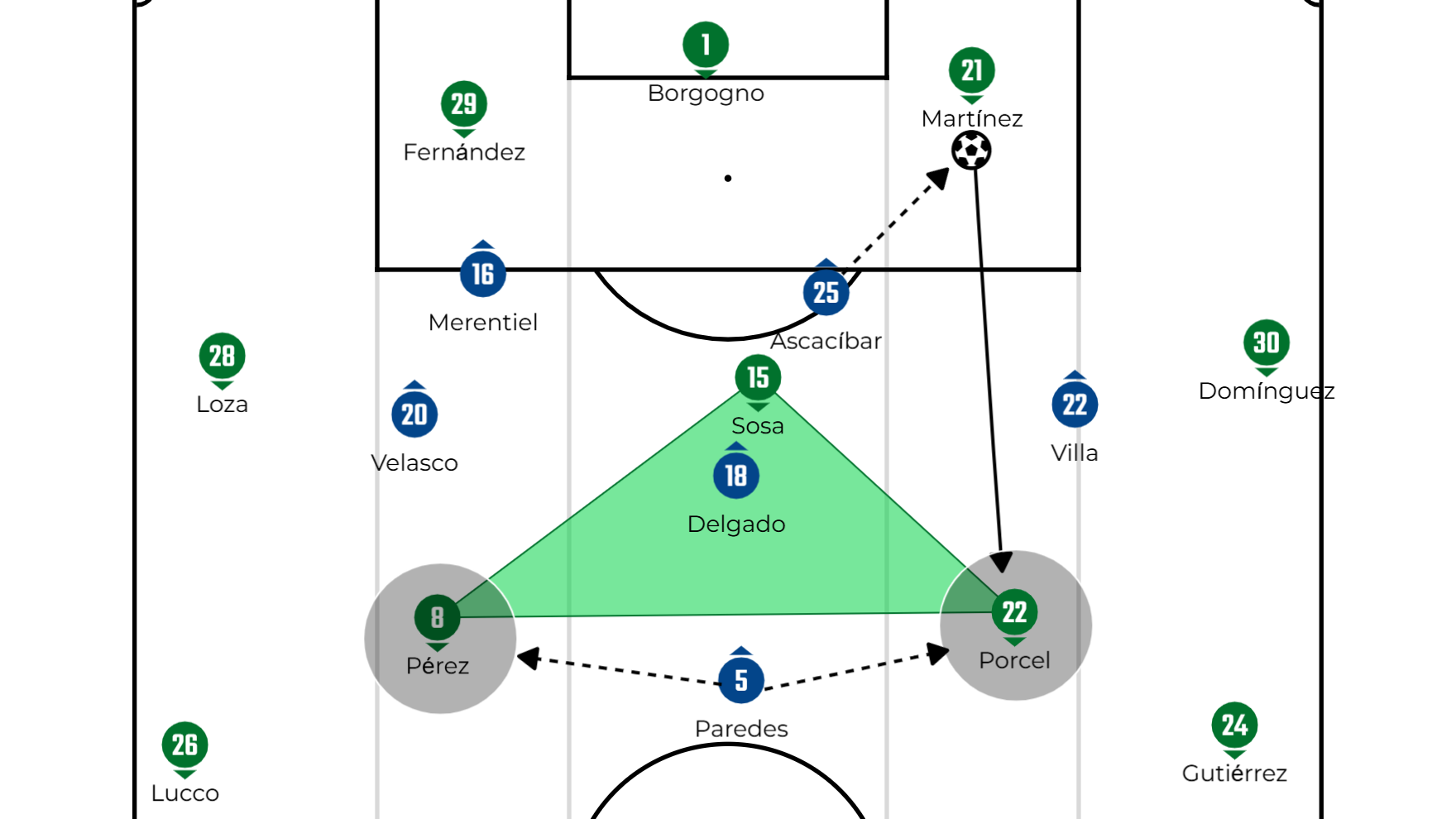
Defensa set up in a 4-1-2-3 shape with the ball. Sosa was the deepest midfielder, while Pérez and Porcel were used slightly higher up as the number eights in possession. Defensa’s setup from goal kicks gave them progression into the middle third, as they got the better of Boca’s pressure.
Boca pressed in a 4-1-3-2 shape, using Paredes as the midfielder screening the back line while pushing Delgado high up to join the wingers in covering the narrow lanes. Villa and Merentiel were the front two leading the press. Defensa were able to play through Boca’s first two lines by using the two number eights positioned high up.
Paredes faced overloads in the defensive area, and with none of the Boca center-backs jumping out of the defensive line, Defensa were able to find these number eights when Boca pressed from goal kicks.
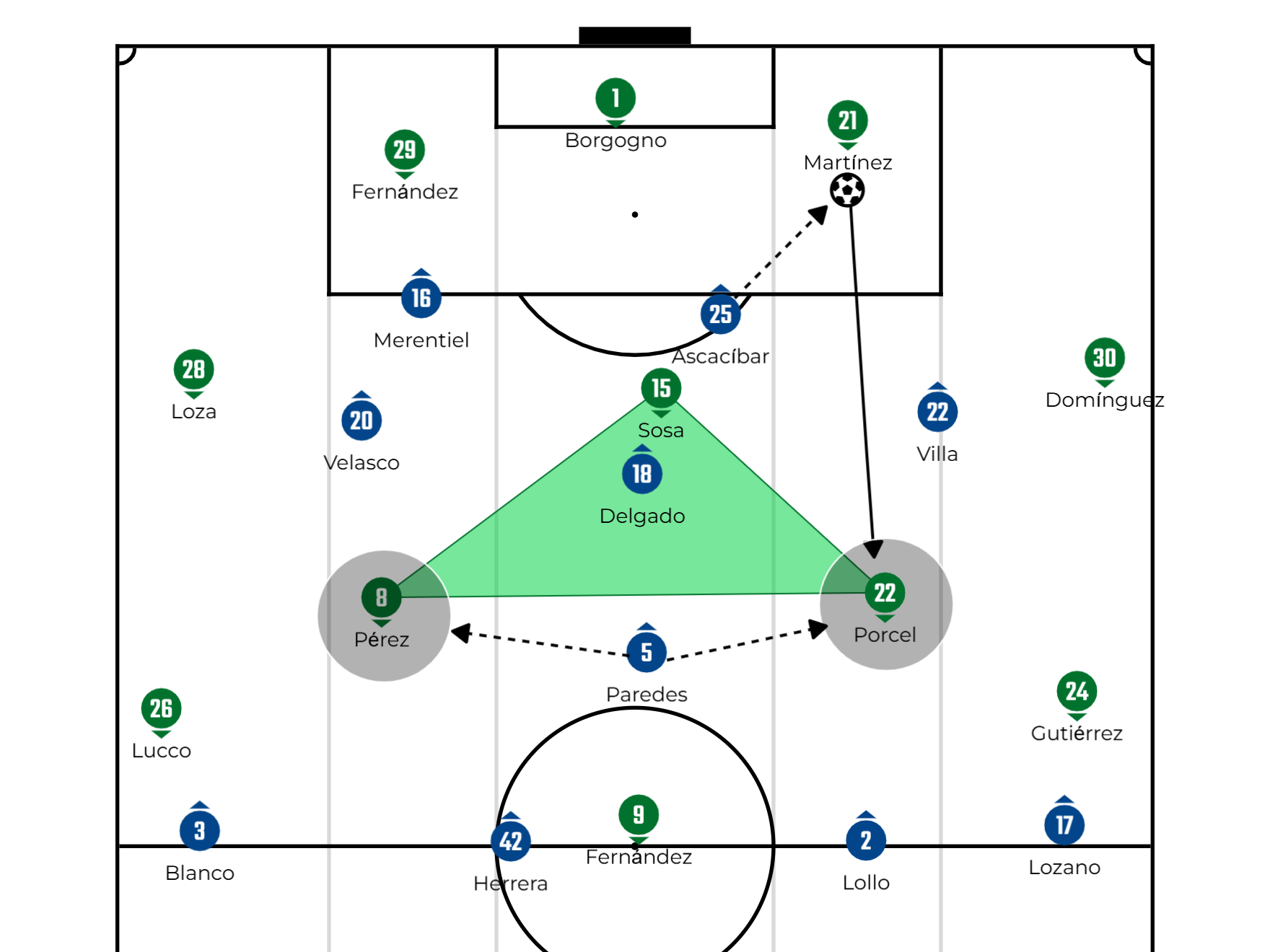
Defensa found their number eights between the lines by exploiting Paredes’ role in midfield, where he was often overloaded.
Defensa y Justicia were very direct in possession, looking to use their two number eights to drive attacks while having their striker drop deep to link up play, but they struggled to build rhythm in their attacking sequences and weren’t particularly threatening in the final third, since they found it hard to create consistent attacking momentum or turn possession into clear chances.
However, Defensa were able to generate just a few moments from headers in the box, but this didn’t prove to be enough. In the whole game, Defensa generated 0.45 xG, which indicated their poor attacking threat against Boca.
Boca’s league winning moment
Rosario Central were up two goals to nil, making them top of the league in the meantime. The longer the game went on without a goal from the home side, the more concerned the fans looked. In the 96th minute (90+6), Boca were able to push forward and eventually found a goal late on.
They exploited the same sequence they had been exploiting all game from the left-hand side. Blanco’s cross found Di Lollo’s head, whose header landed in the path of Enner Valencia. Valencia’s shot beat the keeper as Boca scored the winning goal. Rosario thought they had won the league until Valencia’s late winner.
Boca celebrated a league victory after recording 63 points across the Apertura and Clausura in the annual table. Rosario Central had a combined total of 62 points, while Argentinos Juniors had a combined total of 60 points.
Takeaways
Boca Juniors showed variety in their attacking approach, using flexible movements between the lines and wide areas to exploit Defensa y Justicia’s defensive structure. Velasco frequently moved inside to attract defenders and create space for Blanco to advance on the left, where he could drive at his marker and deliver crosses into the box. Boca also created overloads on the right, with Velasco and Villa combining in wide areas, while Ascacibar and Velasco found opportunities to receive between the lines. These rotations gave Boca different routes to progress and made their attack less predictable, although they initially struggled to convert their wide deliveries into clear chances.
Defensa, meanwhile, struggled to establish consistent attacking rhythm despite their direct approach. Their 4-1-2-3 build-up structure allowed their two number eights to exploit the spaces around Paredes and progress through Boca’s 4-1-3-2 press. They also looked to use their striker dropping deep to link play and their aerial strength to create opportunities from crosses. However, their attacking threat remained limited. Boca’s ability to create different attacking routes eventually proved decisive, as Blanco’s delivery found Di Lollo, whose header set up Enner Valencia for the late winner.
Match plots will be added as soon asppossible!