
Brazil – Japan: Brazil eliminate Japan with an anime-worthy comeback (2-1)
Brazil came from behind to beat Japan with a storyline worthy of an anime episode, featuring resilience, redemption and a last-minute goal. Japanese football was directly influenced by Brazil in the early stages of its rise, while the anime Captain Tsubasa became hugely popular in Brazil. Within this interesting relationship, the two nations had not faced each other at a World Cup since 2006, and narrowly avoided meeting in 2018 and 2022. This felt like a matchup that was destined to happen.
Tactical analysis and match report by Marcus Arboés.
Carlo Ancelotti arrived at the World Cup in charge of a Brazil side surrounded by low expectations from both the media and the fans, with more questions than answers. He kept losing players to injuries until he found an ideal team that won two matches 3-0 and advanced as group winners. Goalkeeper Alisson, center backs Marquinhos and Gabriel Magalhães are the defensive pillars, with Douglas Santos and Danilo completing the back line; Casemiro, Bruno Guimarães and Lucas Paquetá make up the midfield; Matheus Cunha plays as a false nine or number ten, while Vinícius Júnior and the young Rayan operate as the wide attackers. This team is the result of several injury withdrawals before the World Cup, including Militão, Estêvão, Rodrygo and Wesley, in addition to Raphinha during the tournament itself.
Japan share one thing in common with Brazil: bad luck with injuries before and during the World Cup. They lost Mitoma, Minamino and Endo before the tournament even began. For this match, center back Itakura and the team’s most talented player, Takefusa Kubo, were also unavailable due to fitness issues. As a result, Hajime Moriyasu, who has been in charge of Japan since 2018, lined up with Zion Suzuki in goal; Tomiyasu, Taniguchi and Hiroki Ito as a back three; natural wingers Keito Nakamura and Ritsu Doan as the fullbacks; Kaishu Sano and Kamada as the double pivot; Daizen Maeda, Junya Ito and Ayase Ueda forming the front three in a 3-4-2-1 outline.
Moriyasu’s strategy to stop Brazil
The “anime storyline” begins not only with the World Cup meetings that almost happened, but also with a historic friendly in which Japan came from 2-0 down to win in the second half during the early stages of Ancelotti’s tenure. This time, however, Moriyasu was who dictated the tactical battle in first half, building a versatile team capable of defending in a low block while exploiting transitions quickly and effectively.
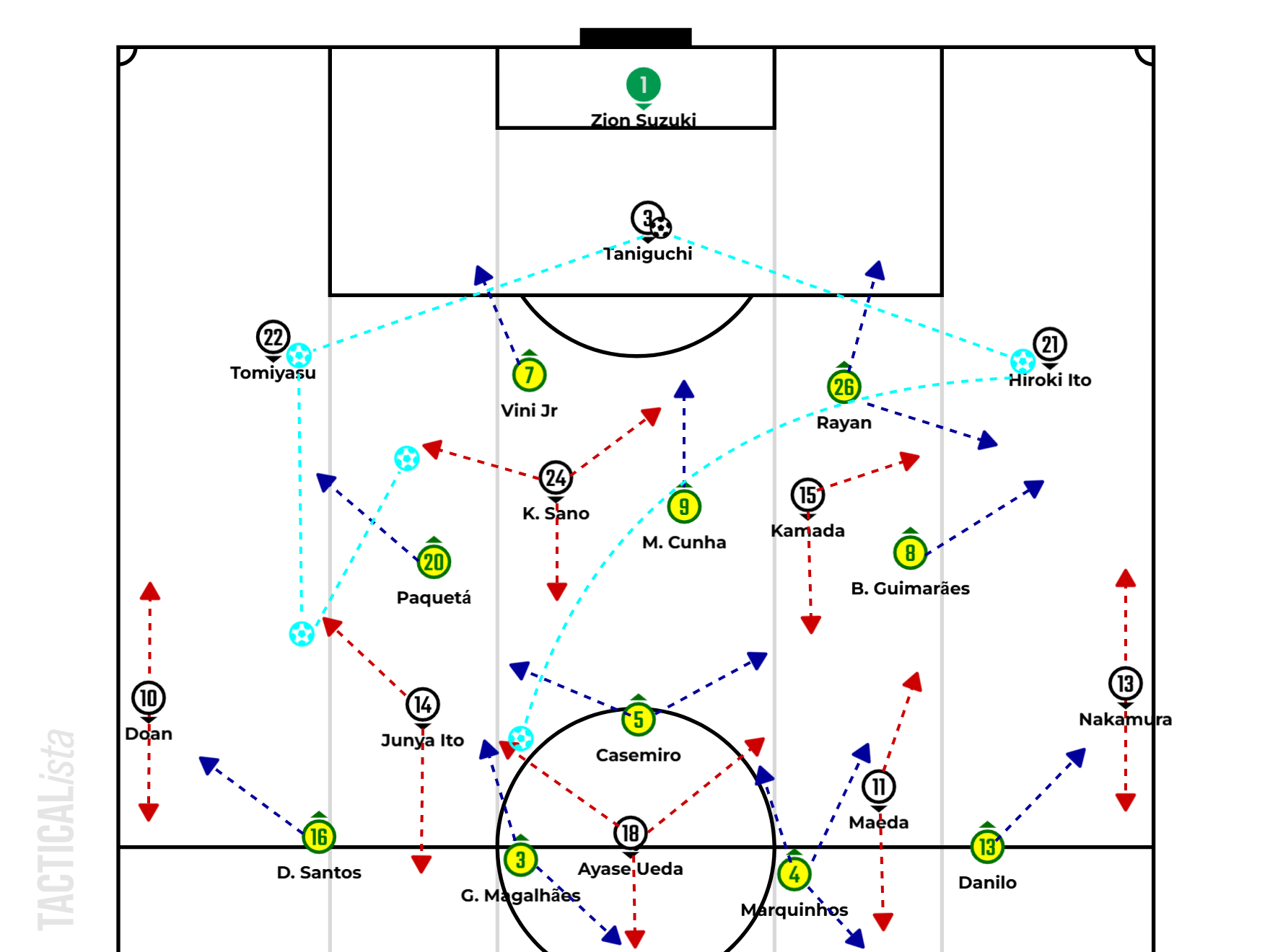
Japan’s build-up in a 3-2-5 shape looking for the free man against Brazil’s man-oriented marking in a 4-1-3-2 formation.
Throughout the first half, Brazil enjoyed more possession, while Japan defended in a compact and well-coordinated manner. In possession, they followed positional play principles to progress vertically and at speed into the attacking third. Their build-up started with the goalkeeper and the three center backs, with the two holding midfielders dropping behind Brazil’s first line while the five attacking players made supporting and penetrating runs to manipulate Brazil’s defense.
Against Scotland, I highlighted Brazil’s defensive value, as they don’t need to be especially aggressive or intense to take the ball. Vinícius Júnior and Rayan closed the passing lanes to the wide center backs. Behind them, Matheus Cunha, Bruno Guimarães and Paquetá protected the central areas, shifting across to the side where Japan tried to build. Danilo and Douglas Santos matched up with Japan’s wide fullbacks, while Casemiro and the center backs shared the responsibility of marking the three Japanese attackers, especially Ayase Ueda.
Ueda, Feyenoord’s number nine, had been one of Japan’s main attacking weapons throughout the World Cup. He plays as a target man, with excellent hold-up play and the ability to secure possession and help the team progress. However, Gabriel Magalhães managed to unsettle him several times, preventing him from controlling the ball cleanly. Japan used the holding midfielders dropping deeper as supporting options to free the wide center backs to attempt long passes toward Ueda. When that wasn’t available, they relied on third-man combinations, with Junya Ito and Maeda dropping inside to free the Japanese midfielders to receive facing forward.
Japan’s goal came after an attempt to direct attack. Brazil won the ball back and started a counterattack through Casemiro, but Danilo made the poor decision to force a pass through the middle. Kaishu Sano anticipated it and launched a counterattack from the counterattack, driving forward at speed and getting past Casemiro with ease, as the Brazilian couldn’t commit a foul because he was already on a yellow card. Gabriel Magalhães positioned himself poorly and failed to close the space, allowing the Japanese pivot to produce a flawless finish.
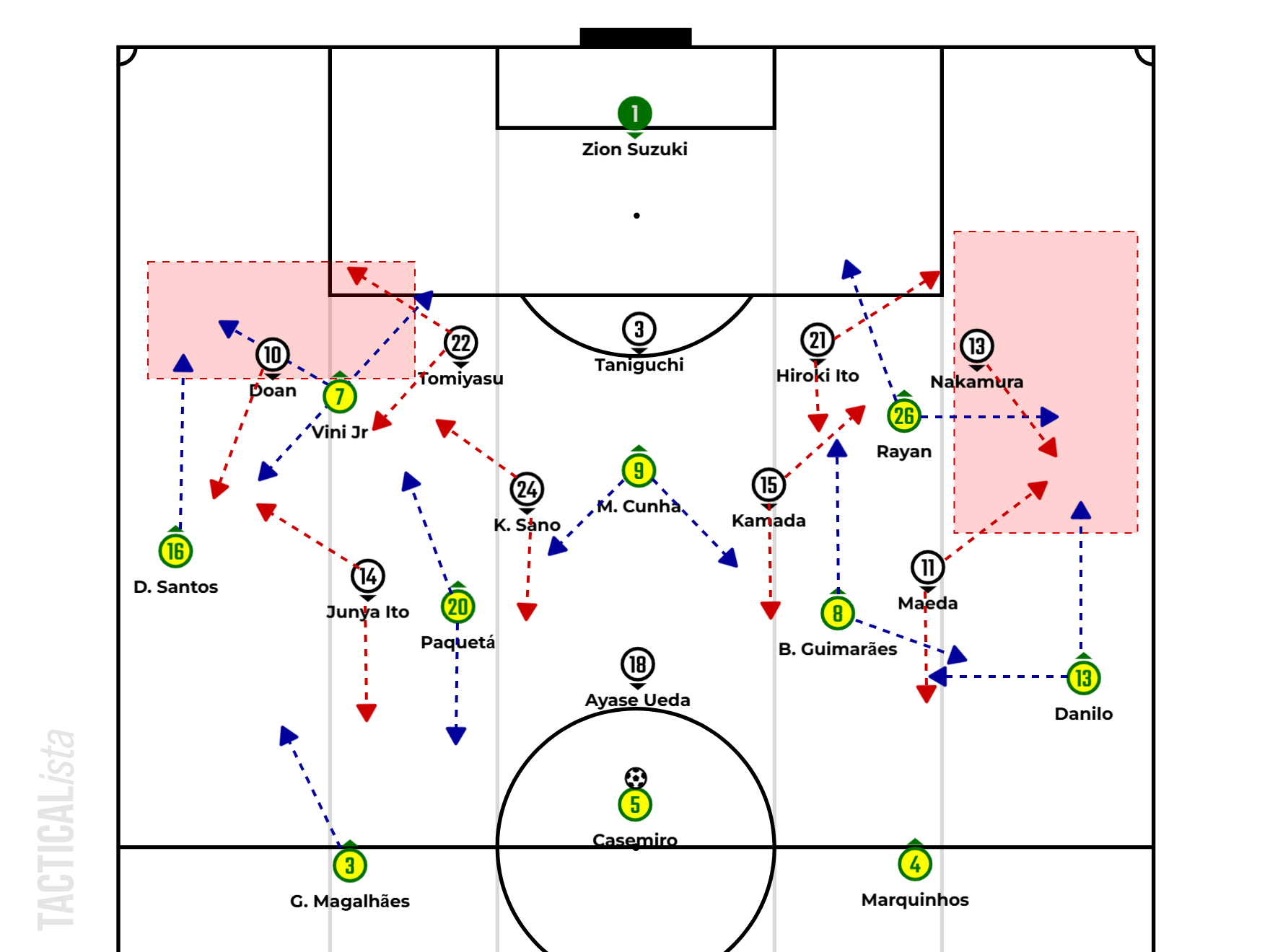
Japan’s zonal back line in a 5-4-1 shape to block Brazil’s attacks down the flanks.
Brazil’s relational/functional attacking style, built from a 4-3-1-2 outline with a false nine, was already detailed in the analysis during the group stage. Once again, in this match, the center backs started the build-up with Casemiro positioned inside, using the close combinations between Douglas Santos, Paquetá and Matheus Cunha with Vinícius Júnior on the left, or Bruno Guimarães’ support for Danilo and Rayan, who combined with each other to move forward while still keeping the midfield well occupied.
Moriyasu’s biggest concern was undoubtedly finding a way to stop Vinícius Júnior’s attacking influence. To do that, he first had to make sure there was no comfortable space inside. Ueda initiated the first pressure during Brazil’s build-up, while the holding midfielders alternated between stepping forward to press centrally or dropping to cover in a coordinated manner. The wingers, Maeda and Junya Ito, closed down the center backs and also helped protect the outside whenever Brazil tried to create superiority down the flanks.
On the left, where Brazil prefer to attack most often, Ritsu Doan and Tomiyasu consistently stopped Douglas Santos and Vinícius Júnior by closing spaces through very well-organized zonal behavior. One covered the other’s advance, and the available crossing angle was almost always unfavorable, forcing mistakes or making Brazil restart the build-up and circulate possession again.
On the right, it was even simpler. Many expected Rayan to be the player to unbalance the game from the wing, but because Brazil attacked so frequently down the opposite side, he moved into the box as a crossing target. Whenever Brazil tried to switch play, it was Danilo who received the ball out wide. He isn’t an adventurous right fullback, so he usually controlled the ball and looked for a pass without creating discomfort in the area where Japan had conceded two of their three goals during the group stage.
A redemption plot twist
Brazil didn’t play poorly throughout the first half, but they were clearly affected by Japan’s goal and, as explained, struggled against a very well-organized defense. The Brazilian players looked nervous in their decision-making, unsure of where to attack and lacking both confidence and composure. At times, they even appeared frustrated with one another.
Against Morocco, Ancelotti had made two substitutions at halftime. Casemiro, who had played poorly in the opening match, was the player most criticized by the Brazilian fans, and everyone expected him to be substituted again, especially because he was already on a yellow card. However, Ancelotti surprised everyone.
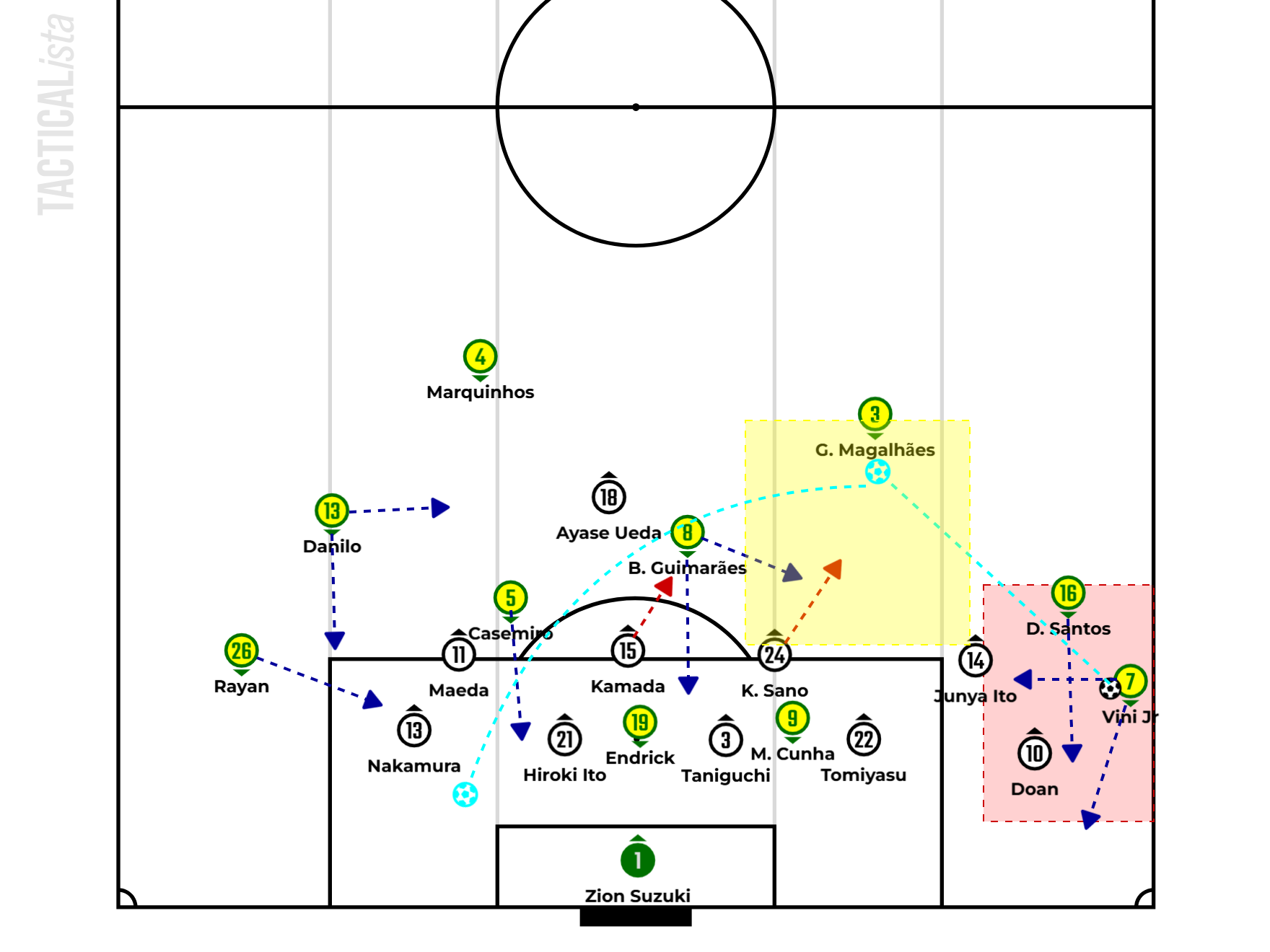
Brazil’s attack pinning the right side of Japan’s defensive lines to create crossing space while filling the penalty area.
We didn’t need a post-match interview with the Brazilian players to understand Carlo Ancelotti’s instructions. After Lucas Paquetá’s injury in the first half, he introduced Endrick to add another aerial presence. Having a true number nine in the box meant Rayan no longer needed to move inside as often, only attacking the penalty area when crosses came from the opposite side. Playing wider on the right, he relied on his individual ability and his combinations with Danilo to create crossing opportunities from the flank.
Of course, Brazil’s trademark remained their strength down the left. The attacking pattern was clear: Douglas Santos and Vinícius Júnior doubled up on the wing and looked to deliver crosses, while Endrick, Casemiro, Matheus Cunha and Rayan occupied the penalty area, pinning Japan’s last line and forcing the holding midfielders to protect the box. This created a large amount of frontal gap in the half-space, which Bruno Guimarães and Gabriel Magalhães took advantage of to deliver crosses.
It was from one of these situations that Vini and Douglas pinned the marking on the wing, Bruno Guimarães and Casemiro dragged the holding midfielders away, and Gabriel Magalhães received the ball with enough freedom to deliver a cross against the movement of Japan’s defensive line, finding Casemiro behind Hiroki Ito. The two players directly responsible for Brazil’s goal were also the two who had made mistakes on the goal they conceded, completing a redemption worthy of a “hero’s journey.”
The comeback could’ve come even earlier. Vinícius came close to scoring a spectacular historic goal, and Brazil’s crosses kept finding teammates inside the box. Zion Suzuki was responsible for preventing at least three Brazilian goals, while Japan no longer had the same energy to counterattack effectively. Moriyasu even substituted Doan and Nakamura for two natural fullbacks instead of improvised wide players in order to strengthen the defense.
The detail behind Brazil’s winning goal
If you’ve ever watched Captain Tsubasa or other football and sports anime, you probably know that their authors love dramatic winners on the very last chance. Just when the match seemed destined to end in a draw, something unpredictable happened. And this quick goal contains more details than it may seem at first glance
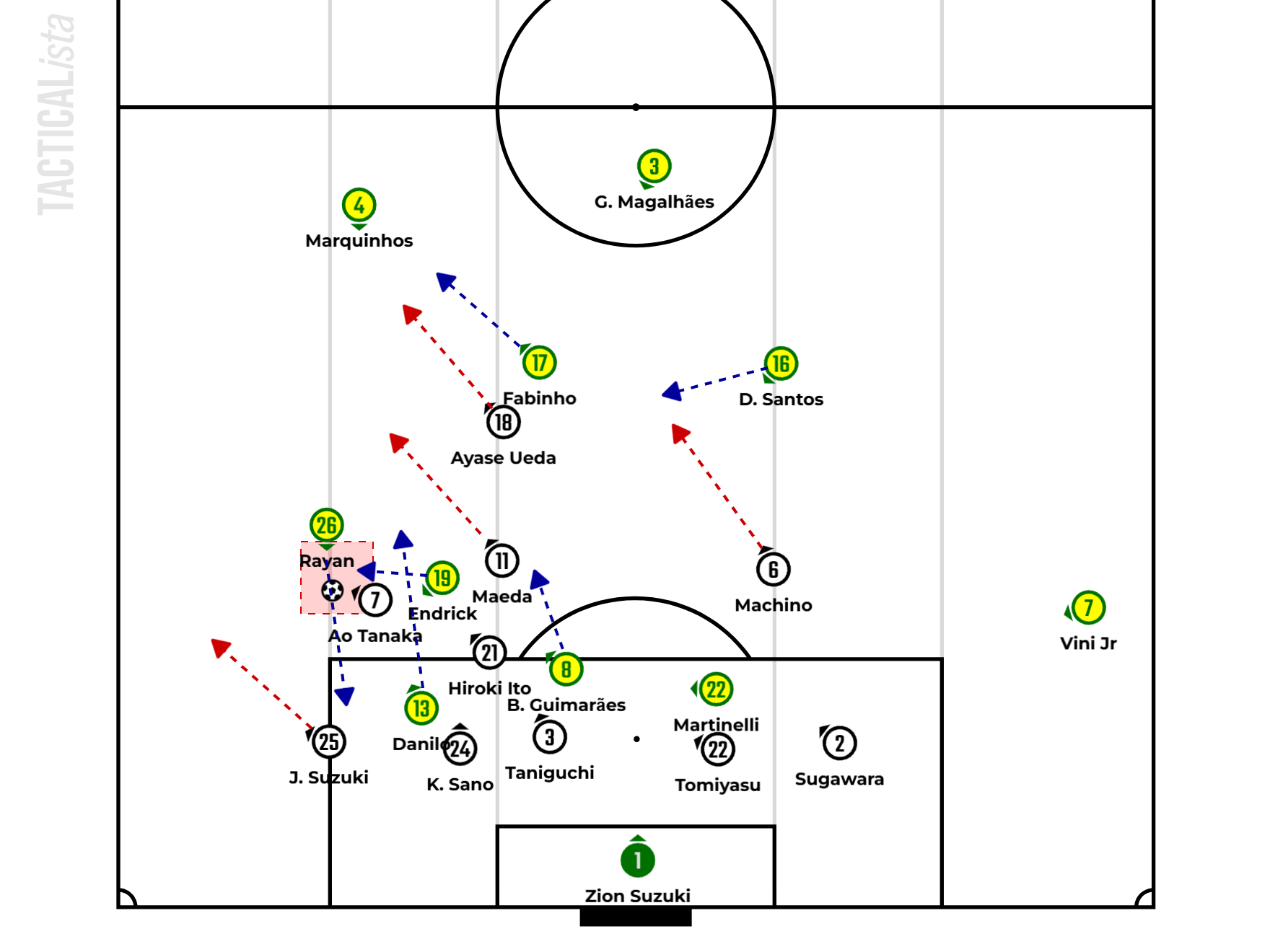
The moment Rayan wins the ball back, with Japan preparing to launch a counterattack.
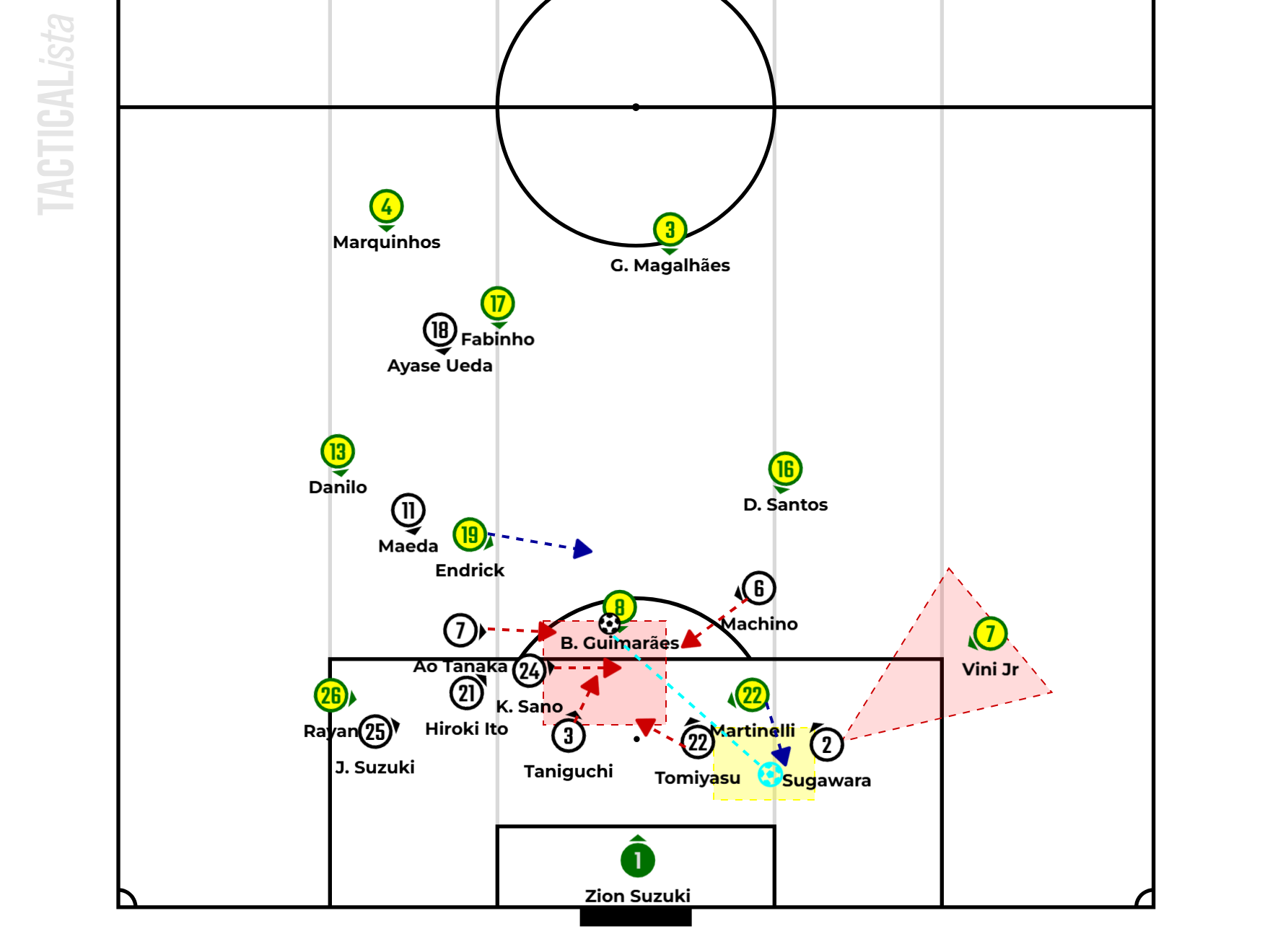
Bruno Guimarães’ assist to Martinelli into the gap between the right fullback and the center back.
At the beginning of another move down the right, Ao Tanaka managed to dispossess Endrick, who immediately initiated the post-loss pressure by closing down the Japanese midfielder so Rayan could win the ball back. At that moment, Maeda, Ueda, Machino and Julian Suzuki had already started their counterattacking runs, while the Brazilian players, except for the two young forwards, had begun tracking back. Because of this movement, Bruno Guimarães ended up positioned at the edge of the penalty area.
With the counterpress working, Rayan passed to Bruno Guimarães against a disorganized and desperate Japanese defense. At that moment, every defender tried to block the shot and protect Zion Suzuki, but the only available gap appeared between the right center back and the right fullback. Tomiyasu tucked inside to block the shooting angle, but Sugawara didn’t track the run because, a second before the pass, he had scanned and noticed Vini making an overlapping run as an option on the wing. Martinelli took advantage of the decision the two defenders, while Bruno Guimarães wrong-footed the entire Japanese defense before delivering a perfect pass.
Takeaways
In this episode, the anime storyline proved cruel to the Japanese, who defended as long as they possibly could, especially goalkeeper Zion Suzuki. Martinelli, who had already been highlighted for playing as an midfielder, scored the winning goal from a Bruno Guimarães assist. Both were among the players most criticized by the Brazilian fans before the World Cup. It was fitting that they, just like Gabriel Magalhães and especially Casemiro, found redemption during the tournament, breaking expectations through their performances on the pitch.
Japan took the field with the best team in the country’s history and certainly have a football project that is bearing fruit, but they came up against the team that has shown the greatest improvement curve since the beginning of the World Cup. Brazil now face Haaland’s Norway.
Use the arrows to scroll through all available match plots. Click to enlarge. Check the match plots page for plots of other matches.


Comments