

Scotland – Brazil: Neymar returns, Vini climbs the top scorers list and Brazil leads Group C (0-3)
Brazil finally seems to have found itself. A convincing win over Scotland reaffirmed the team’s playing identity both in and out of possession, while securing first place in World Cup Group C. Against a Scottish side that only threatened through aerial play, Brazil relied on Vinícius Júnior’s individual brilliance, two assists from Bruno Guimarães and Neymar’s long-awaited return, on a night that saw Carlo Ancelotti fully win over the Brazilian fans.
Tactical analysis and match report by Marcus Arboés.
Scotland changed once again. After defeating Haiti, Steve Clarke fielded another different starting XI following the defeat to Morocco. Facing Brazil, he opted for a taller reference striker and added an extra midfielder. Gunn remained in goal; Patterson returned at right-back, with Robertson on the left. Hendry partnered McKenna (replacing Hanley) in central defense, while Ferguson and McTominay were joined by McLean in midfield, replacing Christie. Gannon-Doak started on the right wing, McGinn operated as the left-sided attacking midfielder and Shankland played as the target man.
Carlo Ancelotti finally appears to have found his ideal lineup. Brazil struggled against Morocco before comfortably beating Haiti, although Raphinha suffered an injury that will keep him out until the knockout stage. Brazil lined up with Alisson as goalkeeper; Danilo and Douglas Santos as the fullbacks; Marquinhos and Gabriel Magalhães in central defense; Casemiro, Bruno Guimarães and Lucas Paquetá once again forming the midfield trio; Vinícius Júnior on the left wing, Bournemouth youngster Rayan on the right and Matheus Cunha operating as a false nine.
Brazil’s defensive masterclass
Once again, Brazil unlocked the game through offensive transitions, regaining possession either high up the pitch or in midfield. The most remarkable aspect is that Brazil’s medium and high block isn’t especially aggressive. It can even look passive, with slow defensive compensations and relatively large distances between players. Yet Ancelotti’s side continues to score directly from defensive recoveries. Brazil finished top of Group C having conceded just one goal.
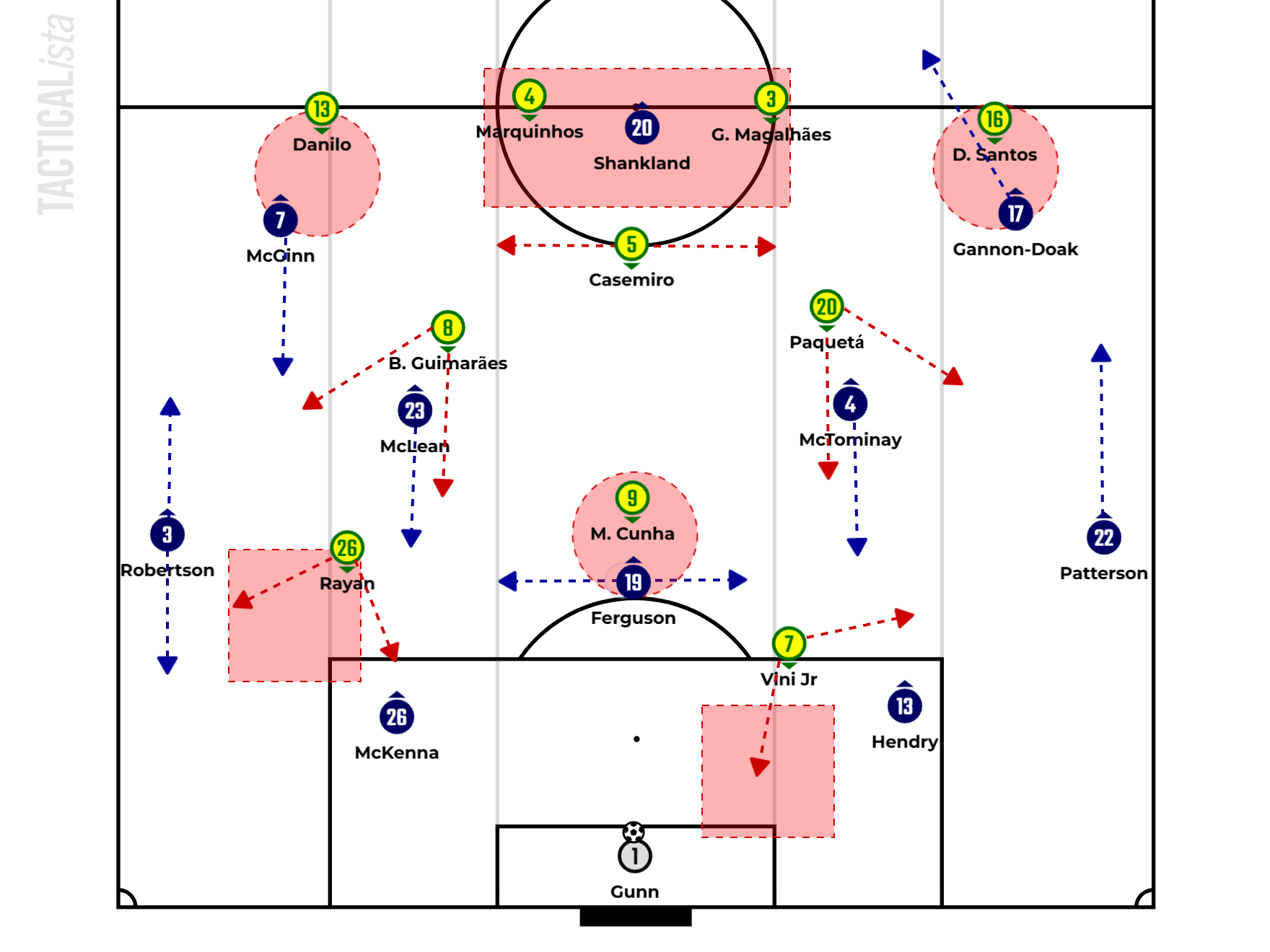
Brazil defending in a high block with man-oriented marking, closing Scotland’s first passing lanes.
Scotland’s build-up from the back struggled bad against a Brazil side that barely needed to apply an intense high press. Instead, the midfielders followed opponents within their zones, while the wingers focused on blocking passing lanes and limiting goalkeeper Gunn’s options. The Brazilian fullbacks concentrated on individual matchups against Scotland’s wide players, while Shankland was completely boxed in by the centre-backs and Casemiro.
Brazil’s three midfielders matched Scotland’s three midfielders. Bruno Guimarães, on the right, tracked McLean’s movements, while Paquetá followed McTominay on the left (their assignments were briefly inverted during the first goal). Whenever the ball reached a fullback, one midfielder shifted wide to protect the second line while the opposite midfielder tucked inside. Matheus Cunha marked Ferguson individually. This structure completely shut down the central corridor of Scotland’s build-up.
Vinícius Júnior and Rayan initially engaged Scotland’s centre-backs, but their priority was cutting off passing lanes rather than pressing the ball. Vinícius screened the passing lane to Hendry, while Rayan blocked McKenna’s passing option towards Robertson, forcing Gunn into difficult decisions. It was precisely after a poorly oriented first touch from McKenna that Rayan dispossessed him and assisted Brazil’s opening goal.
Scotland nearly lost possession again immediately after the restart, as Brazil repeated the same pressing pattern. A few minutes later, Hendry drove forward before passing into McLean, whose return ball invited Vinícius Júnior to step in and win possession. Hendry then tripped Vinícius during the sequence that ended in Brazil’s goal. The referee ruled it a foul, although similar situations have rarely been overturned by VAR in this World Cup.
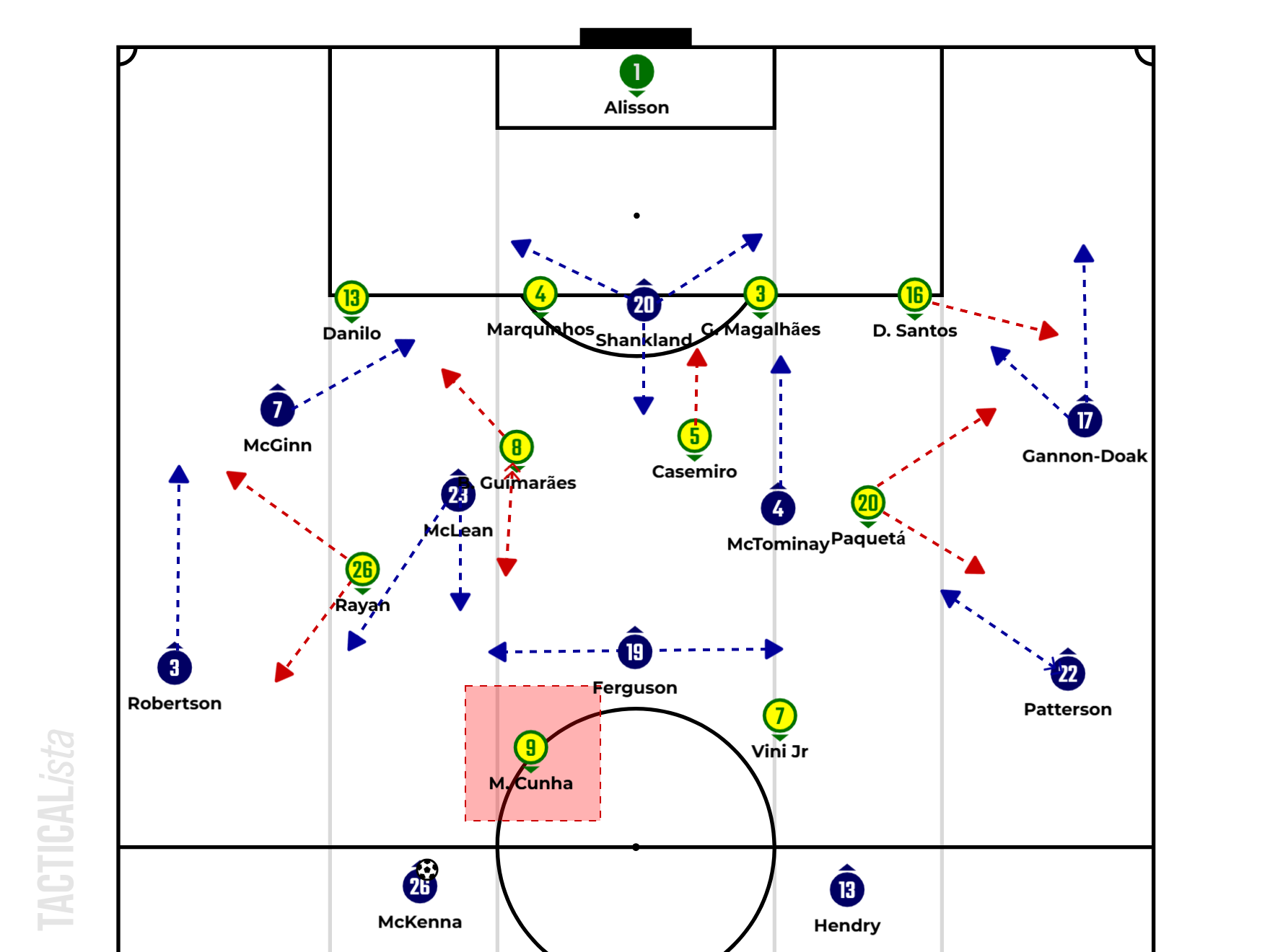
Scotland attacking from a 4-3-3 outline, with McGinn moving inside, against Brazil’s 4-4-2 shape.
The disallowed goal and the cooling break proved crucial in helping Scotland regain some confidence. In possession, they built from the back through their centre-backs. Ferguson positioned in the cover shadow of Brazil’s first defensive line, with Matheus Cunha mainly responsible for denying him the passing lane.
Right fullback Patterson initially held the width but inverted into holding midfield whenever Scotland attacked down the left. His movement aimed to drag Paquetá inside and isolate Gannon-Doak against Douglas Santos on the opposite flank. On the left, Robertson advanced by the touchline while McLean dropped wider as a passing option, allowing McGinn to drift into the half-spaces and even become an aerial target.
McTominay constantly rotated his positioning, dropping into build-up, arriving in the box to attack crosses and taking part in positional rotations. Meanwhile, Shankland occupied the penalty area but also dropped between the lines to provide support behind Brazil’s midfield. Scotland’s biggest problem, however, was Brazil’s excellent protection of the central corridor. Bruno Guimarães and Casemiro controlled the middle while also providing cover out wide. Bruno protected one half-space, Paquetá the other, Casemiro dropped into the defensive line to create numerical equality inside the box. Rayan tracked Robertson along the flank.
Scotland’s crosses, one of their main attacking weapons, never truly worked, and when it happened, Alisson saved. As Gabriel Magalhães dominated aerially throughout the match. Their long diagonal switches towards Gannon-Doak on the right wing were also completely neutralised by Douglas Santos in another outstanding defensive performance by Brazil.
At the other end, Vinícius Júnior doubled Brazil’s lead by converting Bruno Guimarães’ cross after Matheus Cunha recovered possession immediately following Brazil’s counter-press.
Ancelotti’s Brazil has found its identity
Against Haiti, Carlo Ancelotti’s Brazil already looked close to finding its ideal starting XI, featuring no fixed number nine and three midfielders. Against Scotland, the team’s identity—which Ancelotti himself insists does not exist because of his adaptability and flexibility—became much clearer. His mobile “diamond 4-4-2”, essentially a 4-3-1-2 formation built around combinational play, was exactly the kind of structure many Brazilian supporters and tactical enthusiasts had been calling for.
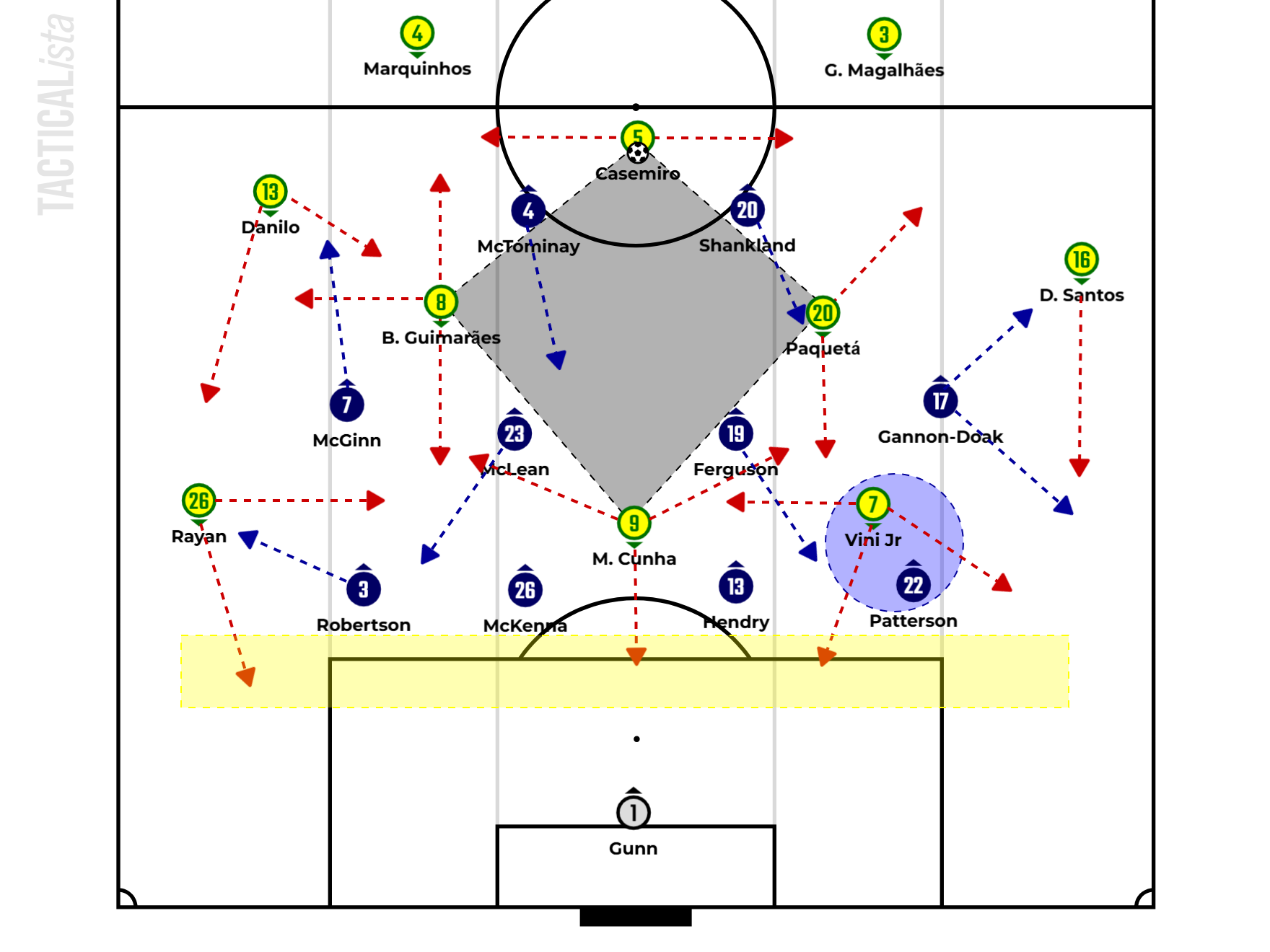
Brazil’s attacking structure in a 4-3-1-2 shape, with Matheus Cunha as a false nine and asymmetrical fullbacks and wingers, against Scotland’s 4-4-2 formation.
If there were still any doubts, Ancelotti once again used the diamond 4-4-2 as his tactical solution to field an extra midfielder while maximising Vinícius Júnior’s qualities. Through functional/relational attacking patterns built around combinational play, particularly by the flanks, alongside the vertical movements of the wingers and fullbacks, Ancelotti’s side seems to have found itself as the World Cup has progressed (exactly what the legendary coach had promised). To understand how Brazil plays, it’s necessary to check each player’s role.
Danilo is a builder fullback who often behaves like a third center back, moving centrally into midfield while still capable of advancing down the right whenever Rayan drifts inside. Douglas Santos operates as a wide left fullback, providing support for Vinícius Júnior. He can attack either the inside or outside corridor, or remain at the base of a passing diamond alongside Vinícius, Matheus Cunha and Paquetá. Casemiro serves as the holding midfielder, initiating the build-up alongside the centre-backs.
Paquetá and Bruno Guimarães perform similar functions despite possessing different qualities. Their understanding, developed since their days together at Lyon, continues to complement one another. Paquetá tends to drop deeper on the left to receive facing play and look for long passes, but he can also attack the half-space or offer support between the lines. Bruno Guimarães drops and drifts wide to assist the build-up and combination play before making late runs into the box from the opposite side whenever Brazil attacks down the left.
Matheus Cunha operates as a genuine false nine. He constantly drops behind the opposition midfield, drifts towards both flanks to combine with teammates, attracts defenders and still attacks the penalty area to finish moves. He performs as both Brazil’s number ten and number nine simultaneously. Vinícius Júnior and Rayan enjoy complete freedom to either hold the width or drift inside and attack space as they see fit. Both possess outstanding ability to run behind the last line, beat defenders individually and finish chances.
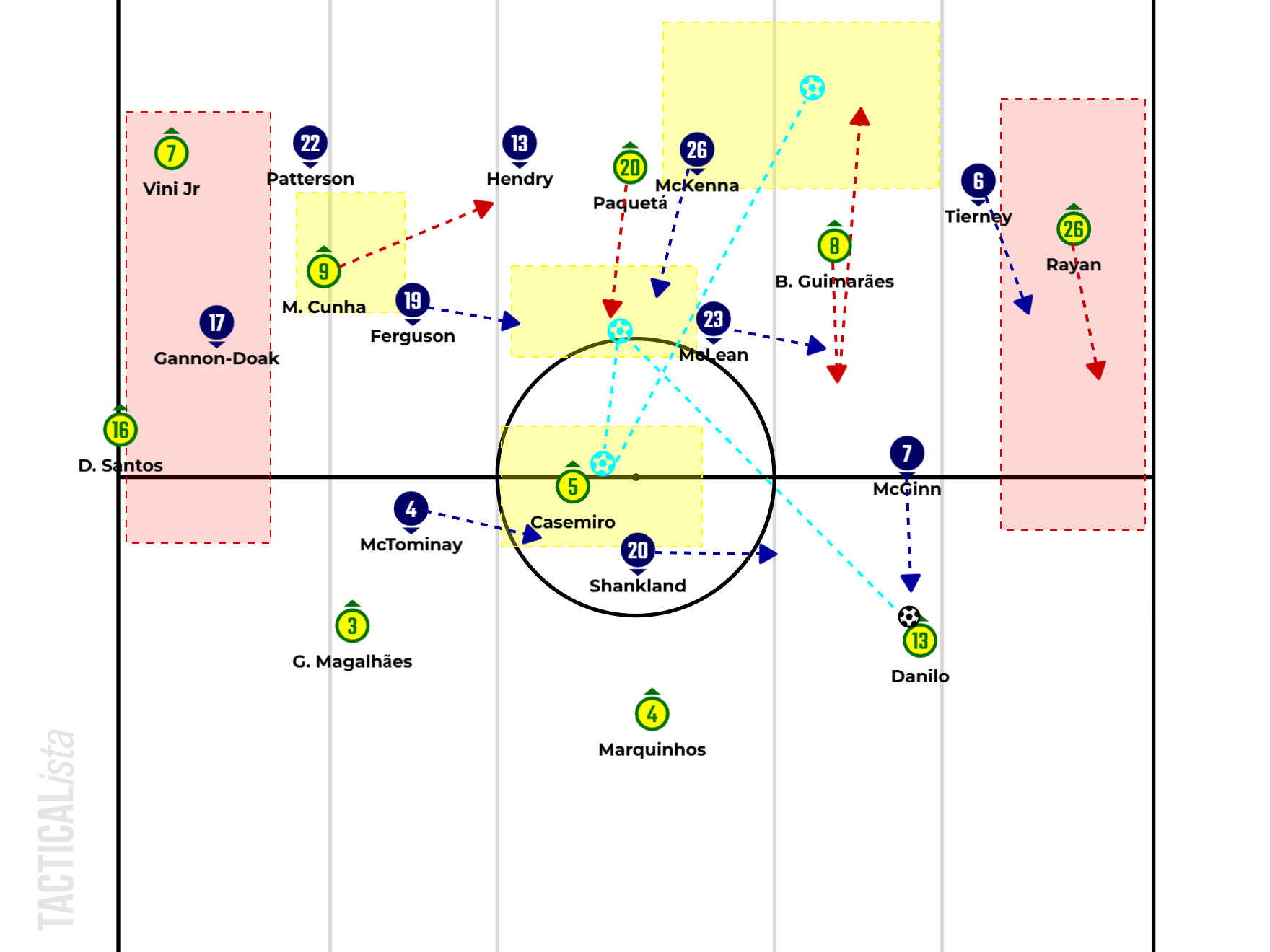
Brazil’s third goal: an attack through the center using a third-man combination during Scotland’s defensive shift.
Although the structure is designed to maximise Vinícius Júnior, and most of Brazil’s best attacks and goals have come through him, making him one of the World Cup’s leading goalscorers, the team is by no means dependent on him. Brazil’s third goal perfectly illustrates that. The move developed through the center using a frontal third-man combination, taking advantage of Scotland’s defensive shift, Brazil’s partial positional rotations and the Scottish players’ blind-side positioning. In this sequence, Vinícius simply acts as a decoy.
The move begins with Brazil attempting to attack by the left, prompting Scotland to shift its 4-4-2 defensive block towards that side. Instead of forcing the attack, Brazil quickly recycles possession until Danilo drops alongside the center-backs, creating a 3+1 build-up structure. At that moment, Matheus Cunha had drifted towards the left to form a combination, allowing Paquetá to advance into the central lane while Bruno Guimarães occupied the opposite half-space.
Recognising the situation, Brazil circulates the ball and Scotland shifts its defensive block across once again. McGinn steps forward to press Danilo, while Shankland attempts to block the passing lane into Casemiro. Bruno Guimarães drops to offer support, drawing McLean across with him. In doing so, McLean leaves space in his cover shadow, allowing Paquetá to drop and receive from Danilo as the second man in a sequence designed to free Casemiro (third-man) behind Scotland’s first defensive line.
Paquetá’s supporting movement attracted McKenna out of position, opening a large gap. Casemiro, now acting as the third man with an open angle to pass, immediately plays an excellent forward pass into Bruno Guimarães. Bruno exploits the space created by Paquetá’s movement through a well-timed counter-movement before advancing. Meanwhile, Matheus Cunha uses Ferguson’s cover shadow to make a diagonal run across the width of the pitch, receiving Bruno’s perfectly weighted pass to score Brazil’s third. And what about the wingers? Their role was to pin Scotland’s back line and maintain its horizontal spacing throughout the move.
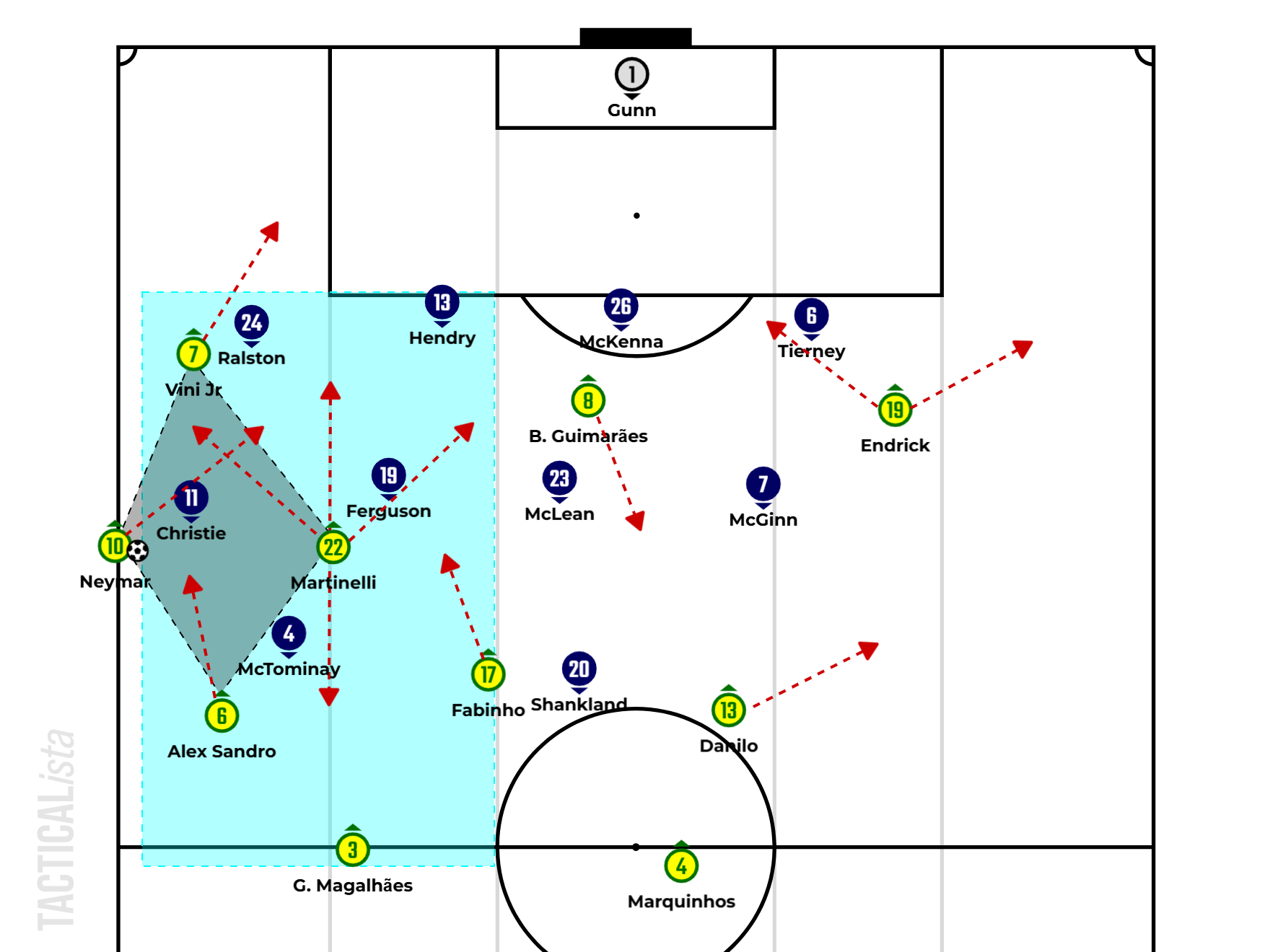
The closing stages with Neymar on the pitch, participating in a functional/relational attacking sequence built around combinational play down the left.
Early in the second half, Robertson went off injured and was replaced by Tierney, while Scotland also reshuffled the right side by introducing Christie and Ralston. Later, Brazil took the opportunity to rest Douglas Santos, Casemiro, Matheus Cunha, Paquetá and Rayan, with Alex Sandro, Fabinho, Neymar, Martinelli and Endrick entering in their respective roles.
Neymar immediately became Brazil’s main connector in possession and was constantly sought by his teammates. Although he neither scored nor assisted and is still working his way back to full match fitness, he displayed excellent chemistry with Vinícius Júnior and created three chances, the highest by any player coming off the bench in a World Cup match since 2006.
Neymar may no longer possess the explosiveness of his younger years, but his genius can still help Brazil unlock defenses. This was the perfect match to restore the confidence of Brazil’s number ten, who could become an important option later in the tournament. Ancelotti handled both the emotion surrounding Neymar’s return and the public’s expectations brilliantly by giving meaningful minutes to both him and Endrick.
Takeaways
Both 3-0 victories give Brazil considerable momentum heading into the knockout stages. Beyond the team’s individual quality, Ancelotti’s side has shown an increasingly rich tactical repertoire and impressive defensive solidity, conceding only once, a counter-attacking goal, in three matches. The entire defensive unit, especially Alisson, the defensive midfielders, has been consistently tested throughout the group stage. By finishing first, Brazil will finally face Japan in a World Cup knockout match after the Japanese were eliminated just before meeting Brazil in both 2018 and 2022.
Scotland didn’t enter the group with particularly high expectations, but few anticipated such a disappointing campaign. Their chances of progressing as one of the best third-placed teams now appear extremely slim after the 3-0 defeat to Brazil left them with a heavily negative goal difference. They also managed to score only once against a Haiti side that conceded at least three goals in every match and finished bottom of the group. Morocco, meanwhile, advanced and will face the Netherlands in the next round.
Use the arrows to scroll through all available match plots. Click to enlarge. Check the match plots page for plots of other matches.


Comments