Canada – Morocco: Setpieces And Transitions Paved The Road For Morocco To The Quarter Final (0-3)
Wide traps and a compact medium block from Canada restricted the Morocco national team and made Mohamed Ouahbi’s side look short of solutions. Setpieces proved once again effective in unlocking games, as Ounahi’s low strike changed the course of the story. After that event, Morocco resorted to transitions, exposing Canada’s subpar rest defense in counterattacks.
Tactical analysis and match report by Achraf Lamdarhri.
We decided to make this article free to read. If you want to support our work, consider taking a subscription.
In injury time, Stephen Eustáquio collected a rebound at the edge of the box and fired a low shot toward the left bottom of the South African net. That goal presented a special moment for the Canadians. It was their ticket to the round of 16 in the World Cup, marking an unprecedented and euphoric event in their history. Canada’s path brought them against another national team that wrote an impressive story in the previous version of the World Cup in Qatar. Morocco was the dark horse in 2022. This time, Mohamed Ouahbi’s side has all the ingredients and qualities that put them among the tournament’s major forces.
Morocco upgraded the roster responsible for the brilliant achievement of the 2022 World Cup. Morocco’s national team is no longer reactive, retreating into a compact zonal block, waiting for the moment to pounce on and hurt opponents in transitions. They improved the in-possession phases, maintaining the transitional weapon. Eliminating the Netherlands in a Dutchy fashion confirmed that Morocco’s previous achievements were no fluke and that they are capable of dominating teams of elite quality.
Achraf Hakimi started at right back, and Noussair Mazraoui slotted on the left, whereas Redouane Halhal replaced Chadi Riad due to injury and partnered with Issa Diop at the heart of the defense. Ayyoub Bouaddi and Neil El Aynaoui kept their places in the pivot. Brahim Diaz and Bilal El Khannouss hugged the touchlines on paper, with Azzedine Ounahi operating behind Ismael Saibari.
Jesse Marsch made three changes to the lineup that started against South Africa. Alistair Johnston and Richie Laryea maintained their positions as fullbacks. Derek Cornelius made way for Luc de Fougerolles to join Moïse Bombito in the middle of the defense. Niko Sigur replaced Nathan Saliba in midfield, joining Stephen Eustáquio in the pivot. Tajon Buchanan acted as a right winger, and Ali Ahmed got the nod over Liam Millar on the left. Jonathan David and Tani Oluwaseyi kept leading the Canadian attack.
Canada’s wide traps in a 4-4-2 medium block
Canada sat in a 4-4-2 medium block, setting up wide traps for regains to transition or turn over. Moroccan center-backs were unmarked, having the time on the ball. Canada’s front two monitored Bouaddi and El Aynaoui. Once Morocco’s fullback received the ball, the opposite winger jumped diagonally from the half-space toward the wide channel, cutting off the out-in passing lane. Canada’s ball-side pivot shifted toward whoever operated down the inside channel from Morocco’s side, with the Canadian fullback stepping out on the same player. The far side pivot covered the central channel, and the opposite side winger narrowed toward Morocco’s attacking midfield with the fullback ready to pounce diagonally. Canada’s center-backs doubled up on Saibari.
On Morocco’s left side, Mazraoui tended to invert, leaving the flanks for Ounahi to dash into. That didn’t impact Canada’s setup, as Buchanan and Sigur managed Morocco’s position swap well. Canada stuck to the plan; Buchanan ran diagonally toward Ounahi with Sigur marking Mazraoui down the left half-space and Alistair Johnston following El Khannouss near the touchlines. Canada relied on intense jumps down the wide channels in order to capitalize on mistakes from the Moroccan side.
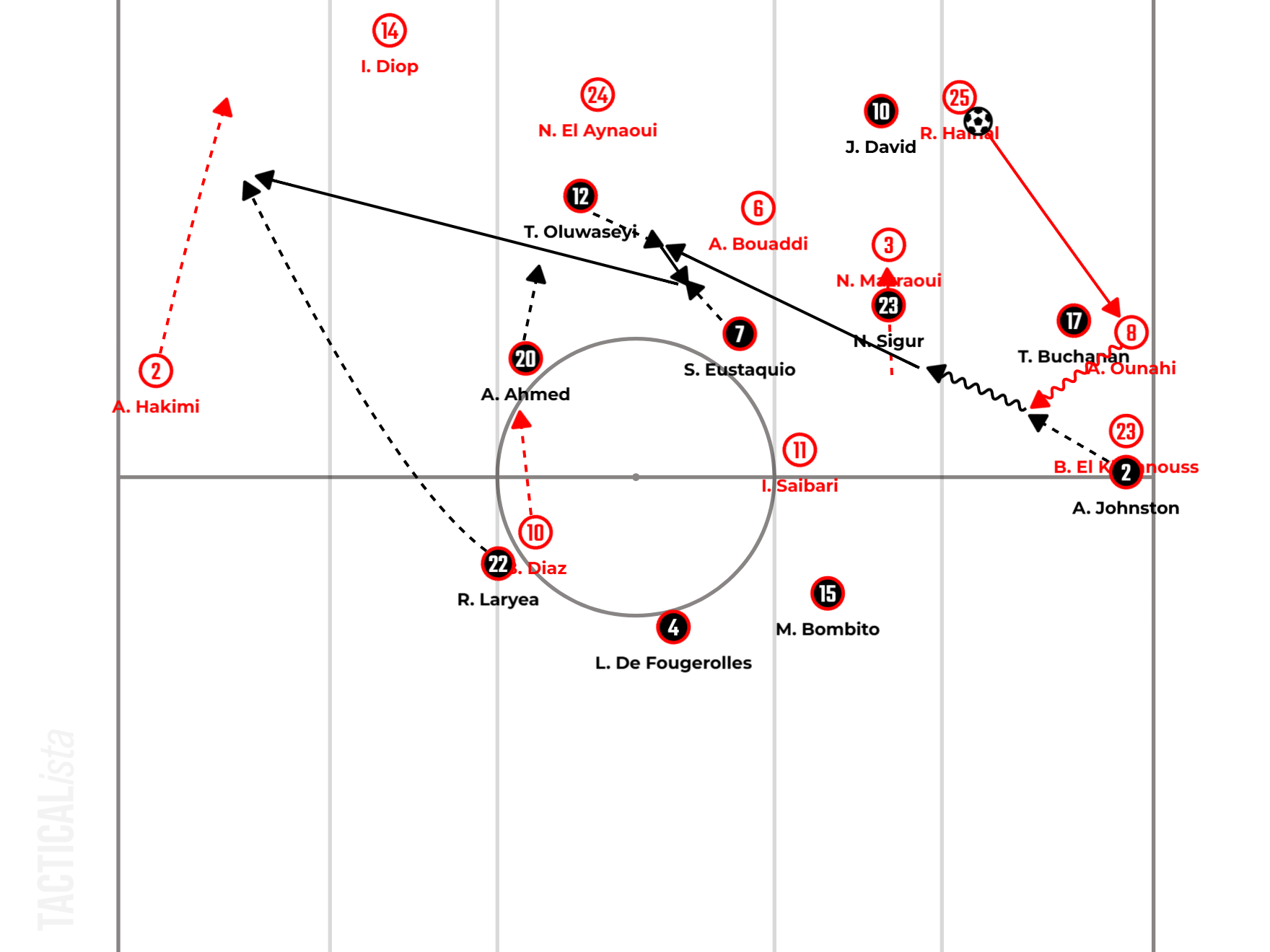
4th minute: As Ounahi receives from Halhal, Mazraoui moves slightly backward to drag Sigur with him, whereas El Khannouss pins Johnston wide. That gives room on the left half-space for Ounahi to carry the ball infield. However, Johnston anticipates Ounahi’s action, leaving his man and pouncing on the loose ball. Thanks to the lateral shift, Canada has numbers in the center to work out the transition. The Canadian team switches the play via short passes to the opposite side, allowing Morocco to retreat to a settled defensive shape.
Morocco appeared to have a solution to Canada’s 4-4-2 medium block. One minute later, Bouaddi quickly fed Mazraoui near the flanks. The latter tended to exploit the distance between him and Buchanan to pass the ball around to Saibari. The latter took advantage of El Khannouss dropping out, drawing Johnston with him to peel off wide. Saibari sprinted toward the left half-space, leaving Bombito in his wake. He kept cutting in, dribbling past de Fougerolles, but Bombito’s recovery run allowed him to stop the Moroccan striker.
Unlike the Moroccan national team that struggled to find inroads against Canada’s defensive unit, Jesse Marsch’s side figured out a route to infiltrate Morocco’s 4-4-2 medium block from their first settled possession sequence. Johnston tucked in to form a situational back three. Ahmed drifted infield, leaving room for Laryea to push on. As El Khannouss jumped on Johnston, David pulled wide behind El Khannouss, providing himself an option to walk around Morocco. Mazraoui couldn’t react as he took charge of Buchanan. So, El Aynaoui peeled off wide. Not only was the distance between El Aynaoui and David large, but he also vacated the right half-space for Eustáquio to offer an out-in access. David prodded that inside diagonal pass, whilst Buchanan tended to drive inside diagonally behind Mazraoui. Eustáquio slid the pass between Morocco’s left center-back and left back. Halhal immediately reacted with a sprint to clear the ball out.
Ounahi as a situational right back
As aforementioned, Ounahi tended to pull wide on both sides as a situational fullback. On the right side, he reacted to Hakimi’s position, as he dropped wide when Hakimi pushed on to pin the opposite left back. El Aynaoui and Bouaddi positioned behind the block; Canada’s double pivots held onto their places covering the central channel. To break down the front line, Ounahi attempted to carry inside and drew Ahmed and Oluwaseyi toward him. In the meantime, El Aynaoui sneaked behind Oluwaseyi’s blindside, which gave Ounahi the opportunity to slide the ball between his markers. El Aynaoui’s heavy touch whilst receiving on the half-turn enabled Eustáquio to step out on time on the right half-space. Hakimi’s close proximity allowed him to collect the loose ball and recycle.
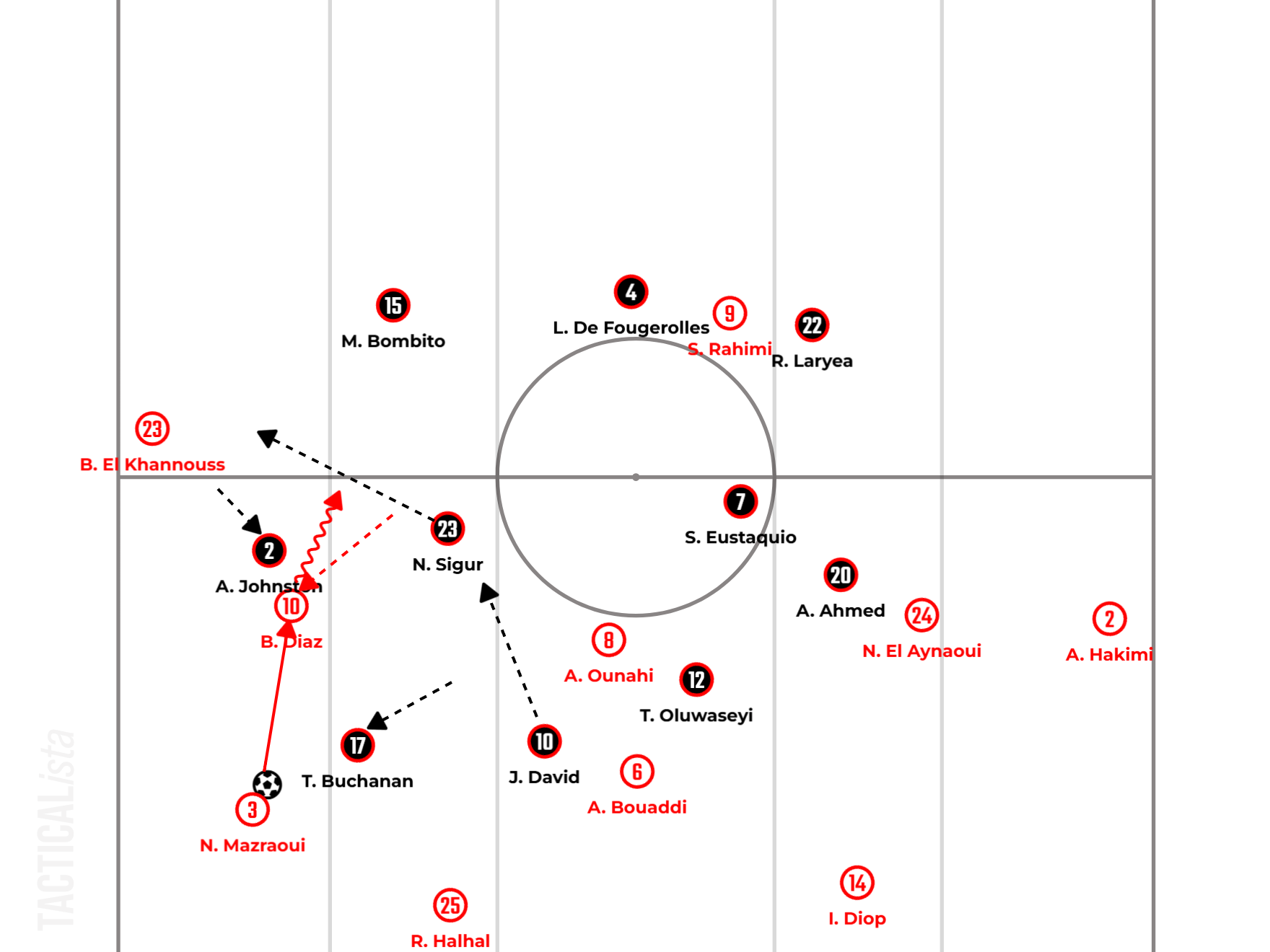
42nd minute: Morocco quickly works the ball toward Mazraoui, whereas Diaz shifts across. Due to the large distance during the lateral shuffle, Buchanan arrives late. Diaz takes a position in the large space between Buchanan and Johnston to receive. Canada’s right back steps up, whereas Sigur tends to peel off wide and take charge of El Khannouss. That vacates the left half-space for Diaz to nudge the ball around Johnston, skipping past him. Jonathan David has to quickly retreat and foul the Moroccan attacking midfielder.
In the second half, Ounahi kept dropping as a situational right back, with Hakimi up top to exploit the space behind Canada’s backline, relying on his runs. Ounahi, carrying across Ahmed, waiting for El Aynaoui to sneak behind Oluwaseyi, proved efficient at breaking down Canada’s front line. However, it is worth noting that Ounahi prodded the ball onto El Aynaoui down a small gap between Ahmed and Oluwaseyi. Two minutes into the second half, Ahmed intercepted Ounahi’s pass, and Canada turned over, working the ball between the backline and midfielders who operated behind Canada’s front line. Oluwaseyi picked up the ball, driving forward. Bouaddi instantly recovered, with the center-backs squeezing the space around David inside the box.
Setpieces unlock the game for Morocco
It took five minutes for Morocco to take the lead in the second half from an indirect free kick. Seconds before, Morocco exploited Canada’s defensive gaps when retreating from a quick goal kick. Hakimi glided a pass to Brahim Diaz, who took position behind Ahmed near the touchlines. Diaz spotted Rahimi’s run between de Fougerolles and Laryea, peeling off wide and galloping forward before getting fouled by Canada’s center-back on the right. With El Aynaoui, Halhal, Diop, and Rahimi pushing and pinning Johnston, Laryea, and Sigur, Ounahi was able to withdraw at the edge of the box, receive Hakimi’s cutback free kick, and whip the ball toward the bottom right of the net.
The momentum swung in favor of the Moroccans. With the urgency to equalize, Canada pressed aggressively high up the pitch. Five minutes after Morocco’s first goal, Canada jumped from their 4-4-2 medium block to a man-marking fashion toward Morocco’s right side. To avoid the wide trap, Issa Diop would try to break down Canada’s lines via a pass to Brahim Diaz, who dropped in down the inside channel. Laryea quickly got tight, dispossessing Diaz and picking out Oluwaseyi around the box. Bouaddi quickly retreated, collecting Oluwaseyi’s cutback to initiate the counterattack. El Aynaoui took the loose ball and found Hakimi near the touchline. The PSG right back slid a diagonal pass behind Sigur for Morocco to attack in a four-versus-four situation. Diaz released Rahimi between the center-backs. Rahimi penetrated the box and looked to cut back to Brahim Diaz. However, Bombati blocked off the pass.
Mohamed Ouahbi brought on Sofyan Amrabat and Chemsdine Talbi to replace Ayyoub Bouaddi and Bilal El Khannouss, whereas Jesse Marsch took off Tani Oluwaseyi for Cyle Larin. Amrabat’s introduction gave Morocco a fresh air in midfield, adding more progression using his passing range. A minute after the substitution, Morocco recycled, inviting Canada to press high up the pitch. After receiving Bono’s pass, Issa Diop, operating wide, squared the pass to Amrabat, whose side-on orientation enabled him to break down Canada’s lines and access Hakimi near the flanks. The latter, with Brahim Diaz, overloaded Laryea. Hakimi sent the ball down to Rahimi, who instantly set off Diaz down the right half-space. Morocco attacked Canada’s box, having the numerical advantage. However, Diaz’s cutback into Hakimi was blocked off by Bombito.
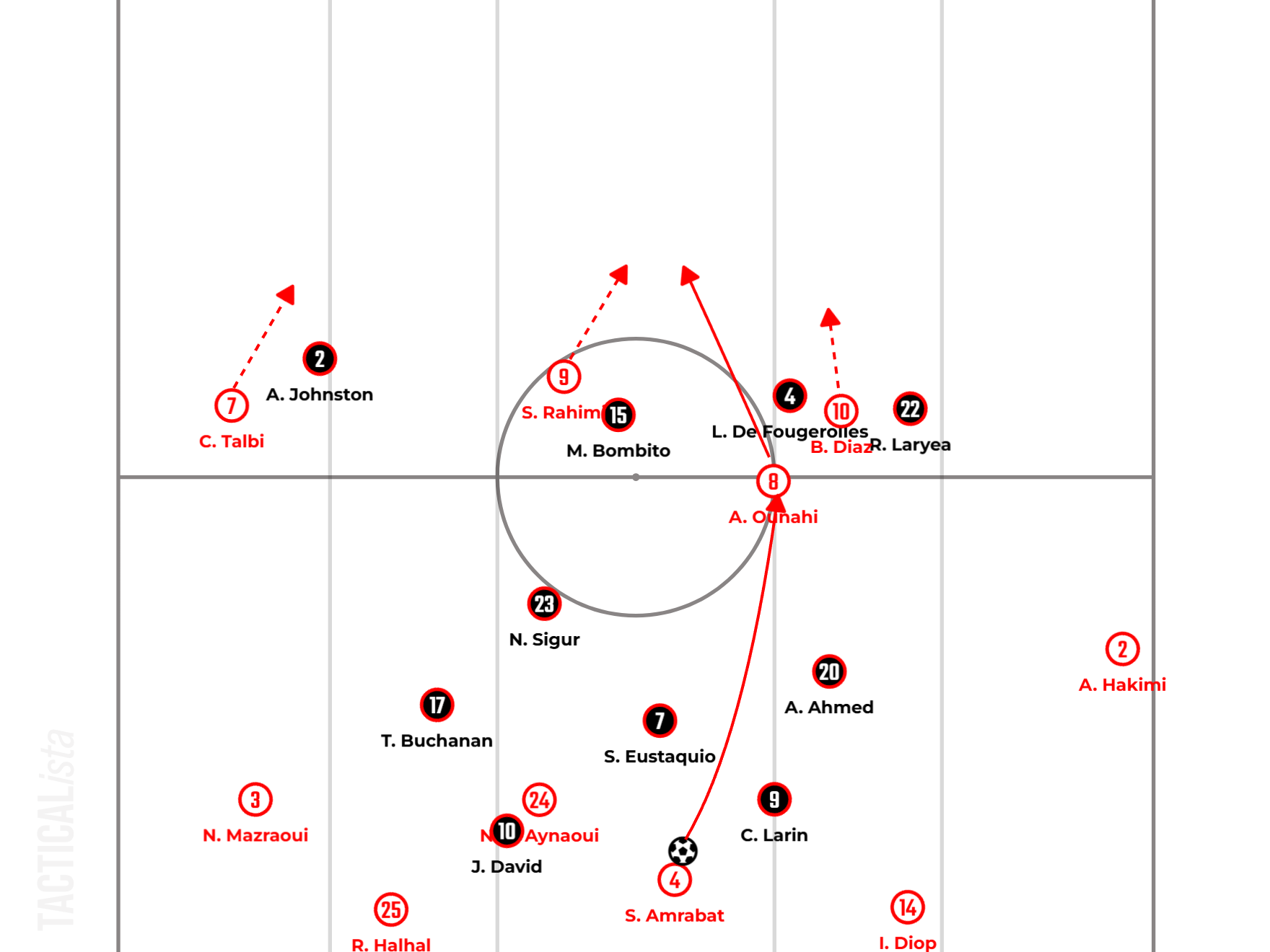
65th minute: By dropping back, Amrabat faces the play and slices Canada’s defense open, accessing Ounahi between the lines. Ounahi spots Rahimi surging forward behind Bombito, who disturbs the Moroccan striker, preventing him from continuing upward.
Morocco exposed Canada’s rest defense to capitalize on counterattacks
Nearing the end, Canada committed numbers across the front line. Sigur stepped back alongside the center-backs. So, Canada’s rest defense was composed of the situational back three and Eustáquio. With nine minutes left of the original time, de Fougerolles carried the ball from the center to the right flank, and he attempted to release Johnston between Talbi and Mazraoui. The former, with a good anticipative sense, intercepted the pass and bombed forward between de Fougerolles and Eustáquio. Rahimi, Diaz, and Ounahi outnumbered Sigur and Bombito throughout the counterattack. Talbi galloped the length of the pitch before setting off Brahim Diaz on the right half-space. Meanwhile, Shaffelburg recovered and joined Sigur to double up on Diaz inside the box. The latter noticed Ounahi being free around the penalty area. The Moroccan midfielder fired Diaz’s assist into the top right of the net.
Canada was more direct on the ball, using the flanks to work out attacks. Leaving only the center-backs as a rest defense structure and distant from the attacking pack was a double-edged sword. Rahimi, Ounahi, and Diaz found themselves in numerical superiority every time Morocco regained possession and looked to counter. Two minutes after Morocco’s second goal, Bono collected Johnston’s cross and immediately delivered the ball to Ounahi in the gap between the center-backs and the rest of Canada’s attack. Morocco scampered forward in a three-versus-two situation. Brahim Diaz drifted infield to distract de Fougerolles and clear the way for Ounahi to carry forward. The latter crossed the ball to Rahimi, who operated around Bombito. From a central position inside the box, Rahimi headed the ball into the crossbar.
Morocco capitalized on Canada’s gap in transitions to nip the game in the bud. The last minute of injury time saw Halhal and El Aynaoui swarm around Promise in the center. Halhal cleared the ball toward Rahimi. De Fougerolles stepped out, and El Mourabet collected the loose ball. Canada’s advanced fullbacks cost them as Brahim Diaz found himself roaming free around Bombito. Rahimi and Diaz overloaded Canada’s center-back. Diaz provided his fourth assist in the tournament for Rahimi to score his second goal in the World Cup.
Takeaways
For the first time in their history, Morocco qualified for the second quarter-final of the World Cup. Canada’s game presented a real challenge for Mohamed Ouahbi’s side. Jesse Marsch’s team set up a compact 4-4-2 medium block, closing down the center, trapping the Moroccans near the flanks, and seizing the opportunity for a turnover from a high regain. Morocco’s in-possession phases lacked versatility. Canada appeared to manage Morocco’s runs beyond the backline well until Ounahi scored from an indirect free kick. The events of the match swung in Morocco’s favor, as Canada was forced to have more possession, whereas Ouahbi’s side exposed Marsch’s team’s frailties in counterattacks.
Use the arrows to scroll through all available match plots. Click to enlarge.
Check the match plots page for plots of other matches.