
Netherlands – Morocco: Morocco Out-Dutch The Dutch (1-1, 2-3 On Penalties)
The shoe was on the other foot during the Netherlands-Morocco match. The Moroccans played a Dutch game, whereas the Netherlands adopted Morocco’s playing style from the 2022 World Cup. Verbruggen’s brilliance, Cody Gakpo’s finishing, and Issa Diop’s late header sent the game to one of the craziest shootouts in this World Cup’s long history.
Tactical analysis and match report by Achraf Lamdarhri.
We decided to make this article free to read. If you want to support our work, consider taking a subscription.
Morocco finishing second and the Netherlands topping their group paved the way for both national teams to face each other in the round of 32 of the World Cup. The feeling was that the clash was supposed to take place in the advanced stages of the competition, given the history of the Netherlands and the Moroccan side’s last World Cup performance, which transcended them.
Mohamed Ouahbi returned to the lineup that started the Brazil and Scotland game. Achraf Hakimi started on the right, and Noussair Mazraoui slotted on the left, whereas Issa Diop and Chadi Riad sat at the heart of the defense. Ayyoub Bouaddi joined Neil El Aynaoui in the pivot. Brahim Diaz and Bilal El Khannouss hugged the touchlines on paper, with Ounahi and Saibari having the license to roam.
Ronald Koeman changed into a back three, where Nathan Aké sat alongside Virgil Van Dijk and Jan Paul van Hecke. Micky van de Ven and Denzel Dumfries got some chalk on their boots as wingbacks. Ryan Gravenberch partnered with Frenkie De Jong at the pivot. Cody Gakpo and Crysencio Summerville operated behind Brian Brobbey.
Toothless in-possession game from the Dutch; the Moroccans look for a runner beyond
Morocco retreated to their usual 4-4-2 medium block, in which Saibari and Ounahi stayed close to each other and cut off the passing lanes between the Netherlands’ back three and the double pivot of De Jong and Gravenberch. Morocco’s ball-side wide midfielder took charge of the Netherlands’ ball-side wingback, with the far-side wide midfielder tucking inside. Morocco’s ball-side pivot tended to jump on his counterpart pivot, with the far-side pivot dropping to cover the central channel. Hakimi and Mazraoui remained inside to keep tabs on the attacking midfielders, with the center-backs doubling up on Brobbey.
On the Netherlands’ left side, Brahim Diaz tended to jump on Nathan Aké, handing Van de Ven to Hakimi. Ryan Gravenberch spotted the space behind Diaz to sneak into. However, Saibari tracked him back, and Bouaddi tilted toward the right to offer support. Issa Diop pulled wide, following Cody Gakpo, who darted toward the flanks, following Van de Ven’s deeper movements toward the halfway line. Netherlands worked the ball down the flank to Gakpo; however, Issa Diop established tight contact, halting him near the touchline.
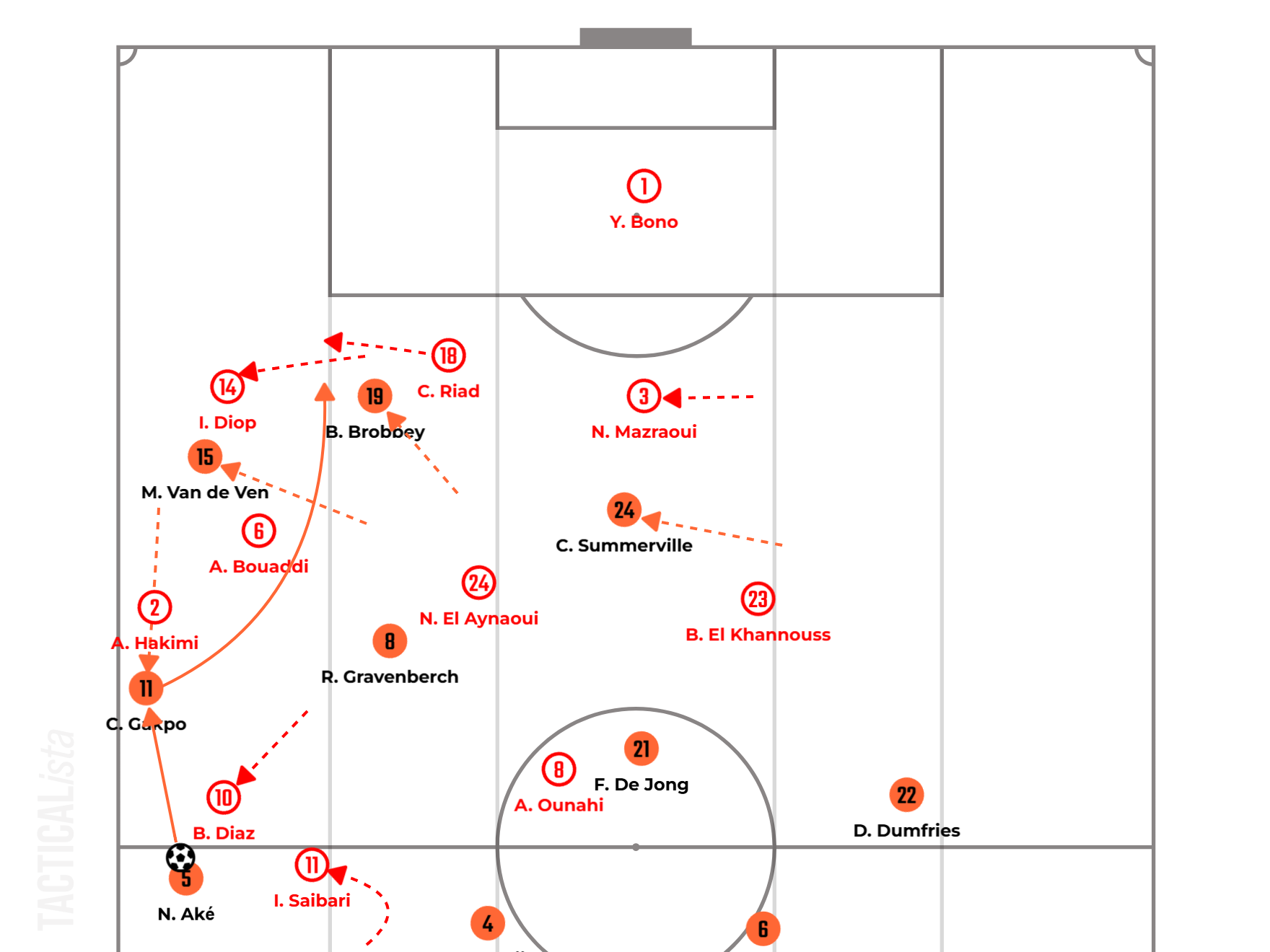
2nd minute: As Nathan Aké pulls wide, Brahim Diaz steps out. Van de Ven operating infield allows Gakpo to drop out near the flanks. Morocco’s block shifts across, reacting to the Dutch national team tilting toward the left side. As Van de Ven hugs the flanks, Issa Diop peels off wide. As a response, Brobbey aims to attack the gap between the Moroccan center-backs in order to meet Gakpo’s out-in pass. Chadi Riad successfully wipes the danger away.
On the other side, the Netherlands withdrew to defend in a 5-4-1 low/medium block. In possession, El Aynaoui stepped back, splitting Riad and Diop. Ounahi joined Diaz and Hakimi on the right side, acting as a situational right back. Morocco looked to manipulate the Dutch team’s backline to release a runner behind. As Ounahi stepped back, Brahim Diaz advanced and pinned Nathan Aké down the right half-space. That provided Hakimi with the license to run beyond Van de Ven. Ounahi took advantage of Gakpo’s passive reaction to clip the ball over the top into the space behind the Netherlands’ backline. However, Hakimi overhit the cross.
Morocco committed numbers behind the Netherlands’ defensive unit. With no pressure applied from the Dutch double pivots on El Aynaoui and Bouaddi, Brobbey was left overloaded, so the Moroccan center-backs had no trouble accessing one of the pivots. In other words, Brobbey would block off the passing lane into one of the Moroccan pivots, whereas the other pivot would show for the ball, generating an alternative for the ball holder. Morocco would ignore going through and looked to capitalize on the space and time the ball holder had to ping passes over the top for runners behind the Netherlands’ advanced defensive line.
As time elapsed, the Netherlands figured out inroads to cut through Morocco. Koeman’s team would rely on backward passes to bait the Moroccan national team forward. Additionally, Van Hecke and Aké would peel off wide to increase the distance with Morocco’s narrow front two. As the ball rolled across the Dutch backline toward Van Hecke, Ounahi had to cover a large distance between the Netherlands’ right center-back and De Jong. With time and space near the flanks, Van Hecke would slide an out-in pass to Gravenberch, who resorted to his tricks, going against El Aynaoui’s momentum to dribble past him and generating space around the Moroccan midfielder to clip the ball behind for Summerville, who caught offside running beyond Mazraoui.
Ninety minutes in, the Moroccan national team came close to opening the score from an outswinging corner. The Netherlands flooded the front post zone with eight outfield players, with De Jong and Gakpo at the front, with the former positioning near the byline and the latter operating at the edge of the six-yard box. In front of the goalkeeper, Aké marked Diop, and ahead, Van de Ven acted zonally in the center. Between De Jong-Gakpo and Aké-Van de Ven, Dumfries, Gravenberch, Van Dijk, and Van Hecke monitored El Khannous, Riad, and Saibari. Around the penalty area, El Aynaoui and Diaz overloaded Brobbey. As Hakimi raised his hands, signaling his readiness to take the corner, Brahim Diaz darted around toward the free far post zone, and El Khannouss dragged De Jong across to allow El Aynaoui to come from behind toward the near post with momentum and head the outswinging delivery on target. Verbruggen’s quick reaction saved the shot.
Gaps between Riad and Mazraoui, Morocco’s threat from setpieces
Both teams looked short of solutions. Morocco had no alternative but to keep looking for a runner behind the Dutch backline, whereas the Netherlands was forced to work the ball around Morocco’s 4-4-2 low block. Virgil Van Dijk tended to take the initiative, pulling off one of his diagonal long passes to Dumfries near the touchlines. The latter benefited from El Khannouss and Mazraoui’s inside positions to control the knockdown. Morocco’s pair would ignore Summerville and dart toward Dumfries, which led to the appearance of a gap between Riad and Mazraoui for the Netherlands’ right attacking midfielder to exploit. El Khannouss quickly recovered, offering support to Riad.
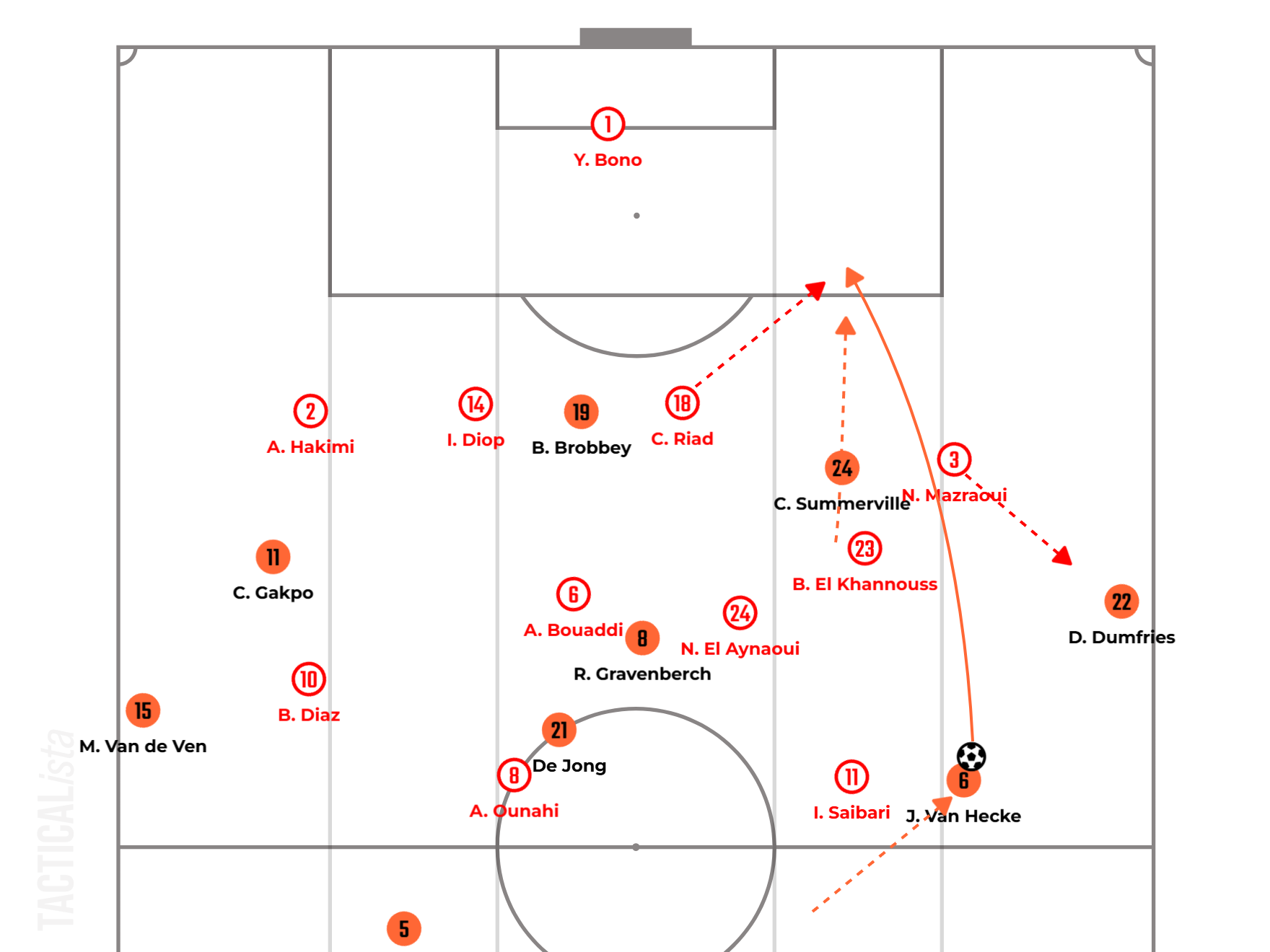
42nd minute: Morocco’s front two operating narrow and close to De Jong means that Netherlands wide center-backs have the space around to advance. Van Hecke carries the ball around Morocco’s front line. Meanwhile, Dumfries securing width tends to pull out Mazraoui and stretch the gap between the latter and Riad for Summerville to exploit. However, the latter’s first touch and Riad’s quick collapse prevent the Dutch team from generating a threat.
Nearing the end of added time in the first half, Morocco had the opportunity to score from an indirect free kick. Summerville acted as a single wall. Gravenberch waited inside the box close to Summerville in case of a short delivery toward Bouaddi. At the edge of the six-yard box, the Netherlands committed six zonal players, with Aké and Brobbey ahead marking Diop and El Aynaoui. As Hakimi readied to deliver the outswinging cross toward the far post, Riad, Diop, and El Aynaoui darted toward the front post, dragging Van Hecke and Van Dijk with them, which left Dumfries and Van de Ven in numerical parity with Diaz and Saibari. The latter crept between the Dutch pair to meet the ball around the far post zone. However, he failed to make contact with it, letting it pass across his body.
Morocco’s wide play
The start of the second half was no different from the first one. The Netherlands stuck to the 5-4-1 low block. Morocco appeared to navigate their attacks down the left side. Mazraoui pushed on near the flanks, with Ounahi and Diaz joining the crew on the left. That generated a wide numerical parity, which the Moroccans broke down due to late jumps from the Dutch defenders. As Mazraoui prodded the ball onto Ounahi, breaking down the midfield line, Van Hecke and Dumfries’ passive reaction enabled Ounahi and El Khannouss to combine between the lines, bypassing the Netherlands’ right wingback and center-back. Van Dijk swept behind his teammates to face Ounahi, whereas Morocco attacked the box in a three-versus-three situation. Brahim Diaz dummied his intention to receive Ounahi’s square pass, letting it roll toward Hakimi at the edge of the box. Meanwhile, Saibari’s forward run pushed Aké and Van de Ven deeper, which allowed Hakimi to lay the ball off for Bouaddi to shoot. However, the eighteen-year-old blasted the ball over.
Mohamed Ouahbi’s team leveraged the left side to drag the Dutch team across in order to expose the gaps during the lateral shift of the Netherlands when working the ball across to the opposite side. As the ball moved across, Ounahi withdrew toward the right to pull out Gakpo and expand the distance between him and De Jong. That provided the ball holder with direct access to the space between the lines. Similarly to the left side, the Netherlands matched their counterparts in numbers. However, Morocco’s right half-space rotations and off-ball movements allowed them to stretch Koeman’s team laterally, creating a gap between Van Dijk and Aké inside the box for Brahim Diaz to receive Ounahi’s pass. However, Aké, Van Dijk, Gravenberch, and De Jong immediately squeezed the space around Diaz.
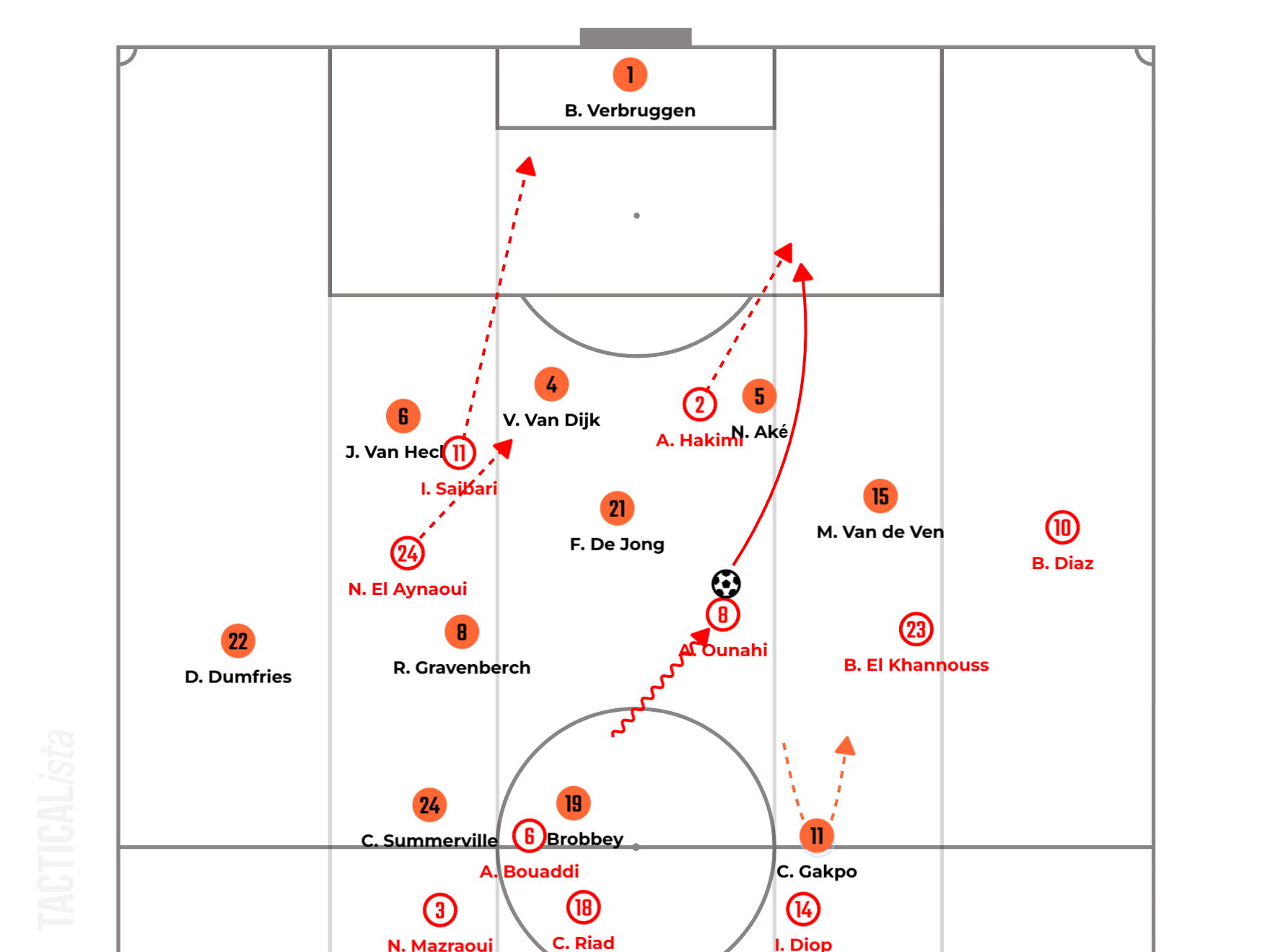
51st minute: After Aké intercepts Ounahi’s pass, Gakpo, Brobbey, and Summerville attempt to attack the space for the transition. However, Morocco’s 3+2 rest defense shape enables them to tighten the central area, winning the knockdown and exploiting the space vacated by Gakpo. After joining the duel zone, Ounahi collects the ball, driving up the field and releasing Hakimi behind Aké. Whereas Saibari is in a free space to receive the square pass and El Aynaoui arrives late around the penalty area, Hakimi opts for smashing the ball into the woodwork.
The fine margins are what matter in the knockout stages. In a moment of slow retreat to a low block, the Netherlands cut comfortably through Morocco’s unit. Ryan Gravenberch stepping around Morocco’s block kept El Aynaoui tilted toward the Netherlands’ right side. The Moroccan midfielder pointed out with his hands for Bouaddi to pick up Summerville, who roamed centrally near the halfway line. The latter took a position diagonally between Morocco’s double pivots, far enough from El Aynaoui’s retreat and Bouaddi’s step-out. Summerville scampered forward, dribbling past Bouaddi and working the ball toward Gakpo, who curled his pass toward the far post zone where Brobbey and Dumfries functioned around Mazraoui and El Khannouss. At the edge of the box, Gravenberch collected Mazraoui’s clearance, looking for a shot that found a Moroccan blockade.
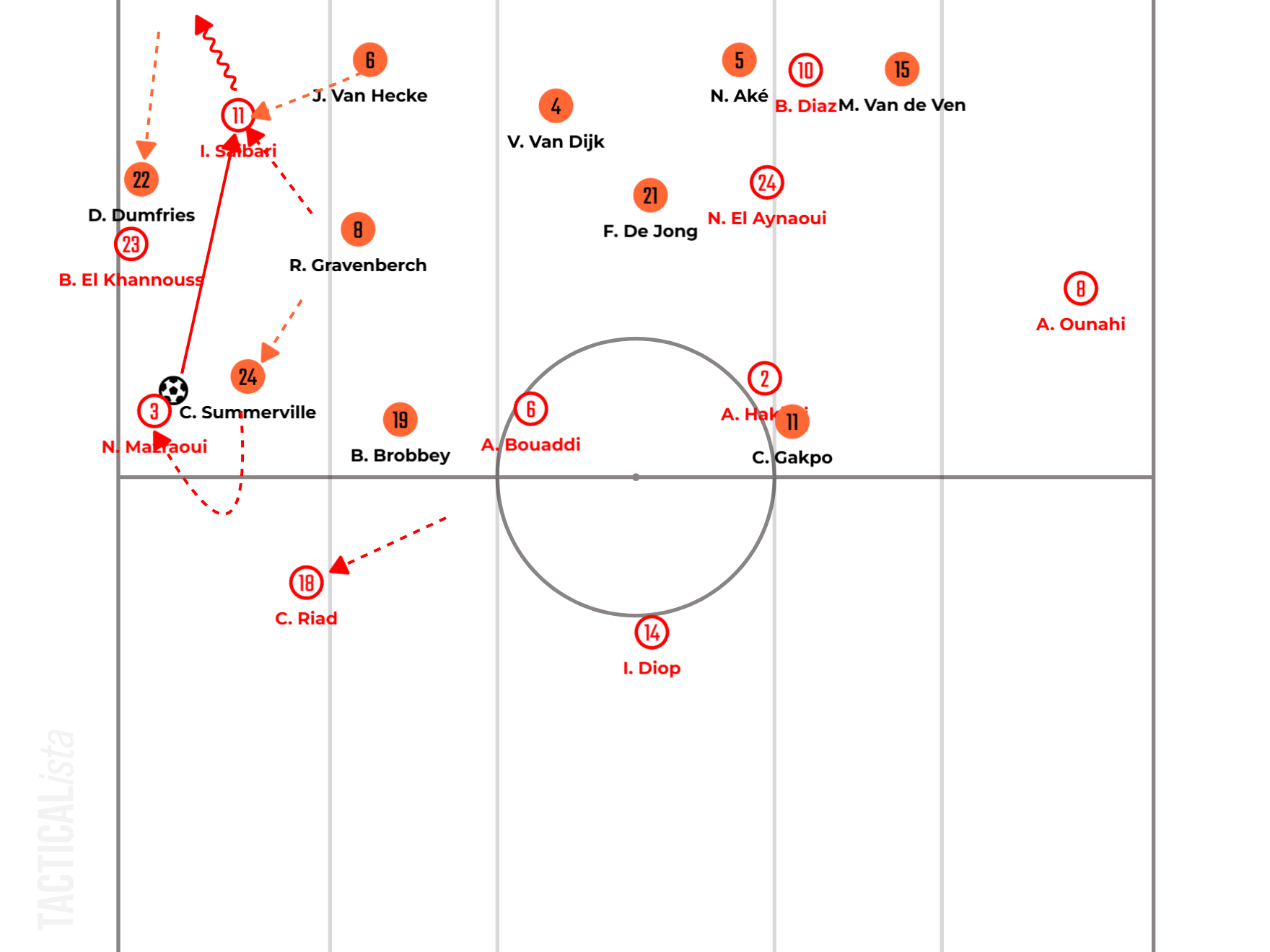
60th minute: The Moroccan national team keeps creating danger from the wide channels. Half an hour gone, Mazraoui withdraws slightly behind the halfway line to bait Summerville forward. That evacuates the flanks for El Khannouss to drop in and pull out Dumfries, which allows Saibari to peel off wide. Mazraoui slides the line-breaking pass, which Saibari receives, dribbles past Van Hecke, and scampers toward the cutback zone. Netherlands commits numbers in the box, and Virgil Van Dijk blocks off Saibari’s delivery toward the near post zone.
Substitutions contribute to extending the game to extra time
After the hydration break, Ronald Koeman brought in Teun Koopmeiners and Wout Weghorst to replace Nathan Aké and Brian Brobbey. Seconds after the substitution, Verbruggen launched a long ball toward Weghorst. Chadi Riad was late in stepping out, with Bouaddi behind in time when retreating. Riad’s jump paved the road for Summerville to attack the space behind the Moroccan center-back to pick up Weghorst’s service. Mazraoui’s recovery run and Diop’s sweeping behind were not enough to stop Summerville from assisting Gakpo’s goal.
Both head coaches’ substitutions bore fruit. The first minute of injury time saw Morocco work the ball to the left side. Salah-Eddine, tucking in, pinned Summerville inside. Chemsdine Talbi retreated a bit, distancing himself from Dumfries. He cut in and curled an inswinging cross toward the central area at the edge of the six-yard box, where Diop headed the ball home, extending the game to extra time.
The Netherlands dropped to defend in a 5-4-1 low block, giving up possession to the Moroccan side. Five minutes into the extra time, El Mourabet and El Aynaoui overloaded Weghorst, working the ball around him to Salah-Eddine. Morocco’s positioning generated space inside for Talbi to drift infield. To elaborate, El Aynaoui and Salah-Eddine would pull out Summerville and Timber, whereas Saibari and Rahimi pinned Van Hecke and Van Dijk. As a result, Talbi would nudge the ball around Dumfries, accessing the space between the lines and feeding Saibari. The latter slid a through ball between Van Hecke and Van Dijk to Rahimi, who faked his shot to skip past Koopmeiners. Rahimi worked out a space to pull off an effort; however, Verbruggen upset the Moroccan side.
Morocco dominated possession for the majority of extra time. However, risk aversion prevailed, as Ouahbi’s side kept working the ball around the Netherlands 5-4-1 low block, without finding an entry to dangerous situations. Towards the end, Morocco tended to replicate the same dynamics that led to the equalizer, trying to get Talbi in a position to deliver inswinging crosses to the box. Nonetheless, the Dutch center-backs cleared the Moroccan’s crosses. The game went to a penalty shootout.
The Netherlands relied on Verbruggen’s brilliant form during the game, whereas the Moroccans counted on Bono’s experience and recent memories of such events. Teun Koopmeiners struck his spot-kick into the bottom right-hand corner, then Neil El Aynaoui hit the woodwork, giving the Dutch team hope. Immediately, Kluivert upset his teammates after stuttering and sending the ball toward the base of the left post. Drama was guaranteed as Verbruggen saved Rahimi’s shot before the ball wriggled under his body, pivoting into his foot and continuing home. Weghorst and Talbi successfully took their penalties. Quentin Timber shot the ball wide, whereas Achraf Hakimi sent it to the same spot as Kluivert did. Summerville took his turn and chose the top of the left side of the net. However, Bono’s early sidestepping allowed him to save the ball, giving Saibari the chance to secure the ticket to the next round. He converted, dropping the curtain on a long game.
Takeaways
At the end, everyone was taken aback by the Netherlands’ starting lineup and performance. Morocco’s head coach, Mohamed Ouahbi, stated, “When we saw it, we knew they wanted to defend, so we needed to adapt… I’m not sure what the opposing coach might say or not, but I really didn’t expect this kind of low block.” He completed describing what people normally expected from the Dutch national team: “They’re the Netherlands; they like to have the ball. I saw this type of play as a form of respect.” The roles were reversed. The Netherlands retreated; Morocco dominated possession, and Verbruggen put in a fantastic performance between the posts. However, it was not enough, as other parts were missing to fulfill the mission.
Use the arrows to scroll through all available match plots. Click to enlarge.
Check the match plots page for plots of other matches.


Comments