
Grêmio – Corinthians: Diniz’s side shine defensively in comeback victory (1-3)
On Matchday 18, the Brasileirão featured its final matches before the World Cup break. Away from home, Corinthians came from behind to defeat Grêmio in a match filled with mistakes, where Fernando Diniz’s team stood out for their defensive performance. The final result reshaped the lower part of the table and could prove important when Brazilian football returns in July.
Tactical analysis and match report by Marcus Arboés.
Luís Castro’s Grêmio are neither a particularly attractive nor a particularly consistent football team. They win matches and compete well, but often go through negative fluctuations. Despite that, they will have two players at the World Cup (Weverton and Balbuena), both unavailable for the weekend match, in addition to several injured players such as Pavón, Marlon and backup goalkeeper Gabriel Grando. This led to the debut of 22-year-old goalkeeper Thiago Beltrame. Alongside him, the Portuguese coach selected a defensive line featuring Marcos Rocha, Wagner Leonardo and youngsters Viery and Pedro Gabriel; Arthur Melo (on loan from Juventus) and Leonel Perez formed the midfield double pivot; the attacking quartet consisted of strikers Carlos Vinícius (former Fulham) and Braithwaite (former Barcelona), with youngster Gabriel Mec on the left wing and Tetê on the right.
Besides a few injury absences, Fernando Diniz was unable to count on Lingard, who was unavailable for personal reasons, and Memphis Depay, who had been called up by the Netherlands for the World Cup. Seeking a second consecutive victory to move further away from the relegation zone, the team lined up with: Hugo Souza in goal; Matheuzinho and Matheus Bidu at fullback; Gabriel Paulista (former Valencia) and Gustavo Henrique completing the defense; André and Raniele as holding midfielders, forming the midfield alongside Breno Bidon and Argentine star Rodrigo Garro; in attack, Kaio César (former Al Hilal) played wide on the right wing, while target man Yuri Alberto, who recently expressed his desire to leave the club amid criticism from supporters, completed the starting eleven.
Corinthians’ defensive standout performance
Right at the beginning of the match, Grêmio enjoyed more effective possession and managed to score through a counterattack led by Gabriel Mec, setting the tone for a first half full of build-up mistakes from both sides. Corinthians’ errors were mostly individual, since Grêmio’s medium-high block was poorly coordinated, while Grêmio’s mistakes came not only from execution but also because of Corinthians’ well-organized high pressing.
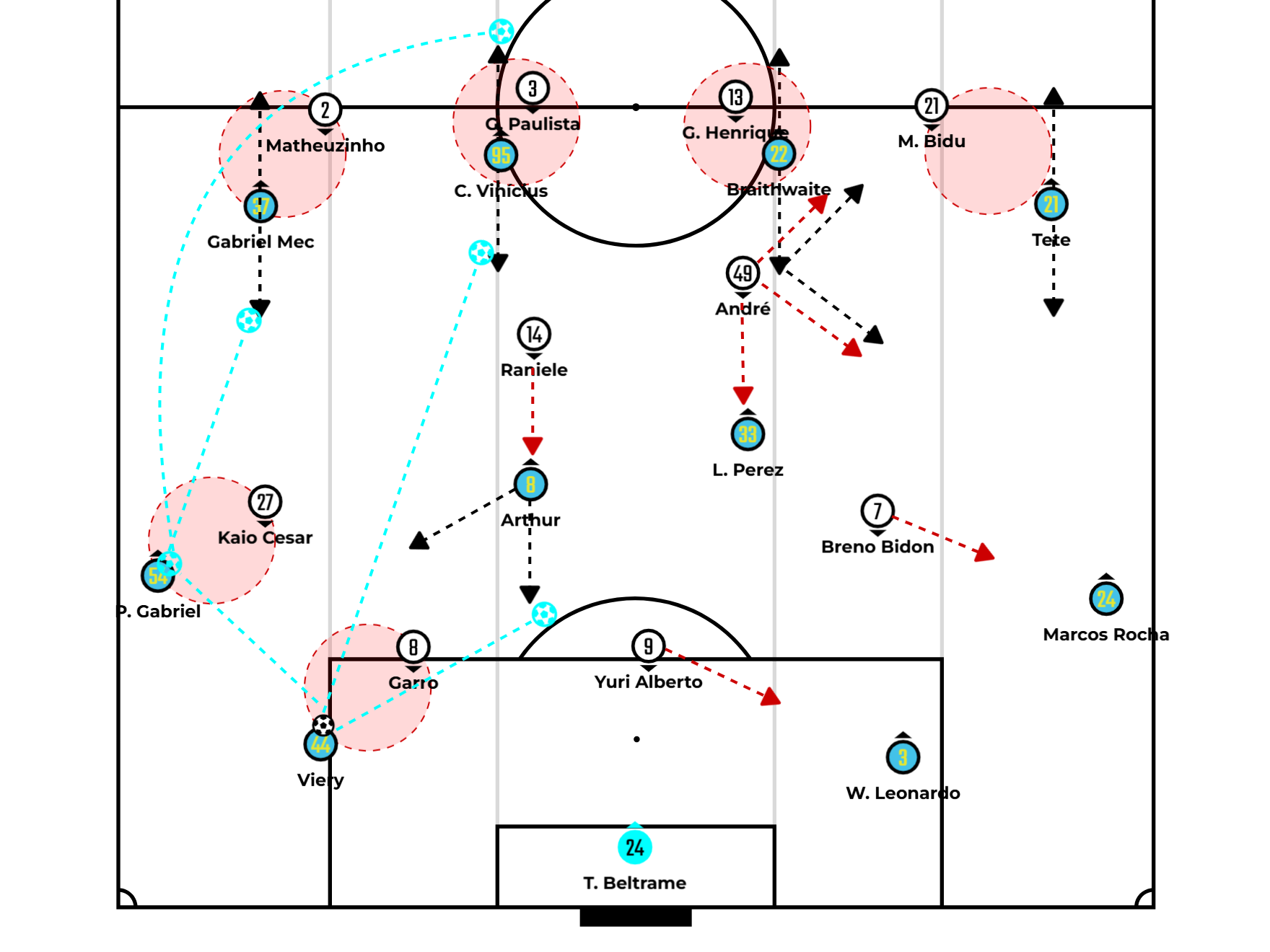
Grêmio’s long build-up in a 4-2-4 shape, pressured by Corinthians’ high block in a 4-4-2 formation.
Grêmio’s control, in their final home match before the World Cup break, lasted only for the opening 15 minutes at most. Besides making good use of counterattacks, such as the move that led to Gabriel Mec’s goal, the first half revolved around Grêmio’s attempts to build from deep and stretch the game toward their attacking quartet through support movements dropping deeper and runs in behind the last line, all from a positional 4-2-4 shape.
The center backs initiated the build-up, using the fullbacks as support options so they could receive with open body angles and look for ground passes or long balls toward the four attacking players. If the fullbacks were unavailable, Arthur positioned himself in the shadow of the first pressing line to create an advantage during the build-up. The attackers either dropped to receive from the back four and connect with teammates in the other channels or looked to break in behind Corinthians’ last defensive line, which defended through almost mirrored man-oriented references.
Fernando Diniz became globally recognized for his chaotic relational/functional style of football. We have already discussed characteristics that make his football attractive, such as the overloaded flank and the use of attraction through positional freedom. However, since winning the historic Libertadores Cup with Fluminense in 2023, his teams have been marked by several defensive issues. Since his spell at Vasco last year, though, his model has shown improvement, especially in high-block defending.
His high press with man-oriented references is not carried out in the conventional way. Around the world, there is a tendency to push one midfielder forward to create a 4-1-3-2 shape in high pressing situations, covering the central space. Unlike this almost global pattern, Diniz’s team applies man-oriented references with relatively short tracking runs in a 4-4-2 outline, with the wingers marking the fullbacks and the midfielders protecting central spaces. In this match, the formations mirrored each other, and Arthur initially appeared to have some freedom until André and the Corinthians midfielders properly adjusted their marking on him.
At this stage of the match, André has become a key figure, despite perhaps not being the player supporters expected to see as a starter before the coaching change. Besides neutralizing Perez during Grêmio’s build-up, the young midfielder covered important spaces during marking-reference switches, following Braithwaite when he dropped either behind Matheus Bidu or into midfield. Together with Raniele, he provides significant defensive security to a system that, in theory, leaves the team exposed.
It’s true that “Dinizismo” has almost chronic defensive issues, one of them being the level of exposure created by a system without fixed positions, which is exactly how Grêmio scored through a quick counterattack. Because players operate close together, the model demands extremely effective counterpressing. Although Corinthians struggled in possession, what kept them in the match was their reaction after losing the ball, winning many duels for second balls and loose balls. Following a poorly cleared defensive action by Grêmio, André scored a brilliant long-range goal.
If you fall into Diniz’s trap, you will be punished
The statement above is simply true. Fernando Diniz’s teams, regardless of the players involved or the level of competition, create traps that are extremely difficult to overcome when the system clicks. Their attack is based on relational/functional football, already explained in previous analyses, where players do not operate in fixed positional zones and instead create overwhelming numerical superiority around the ball, with total freedom and apparent chaos. However, this chaos is organized and follows a pattern designed to attract and manipulate opponents asymmetrically.
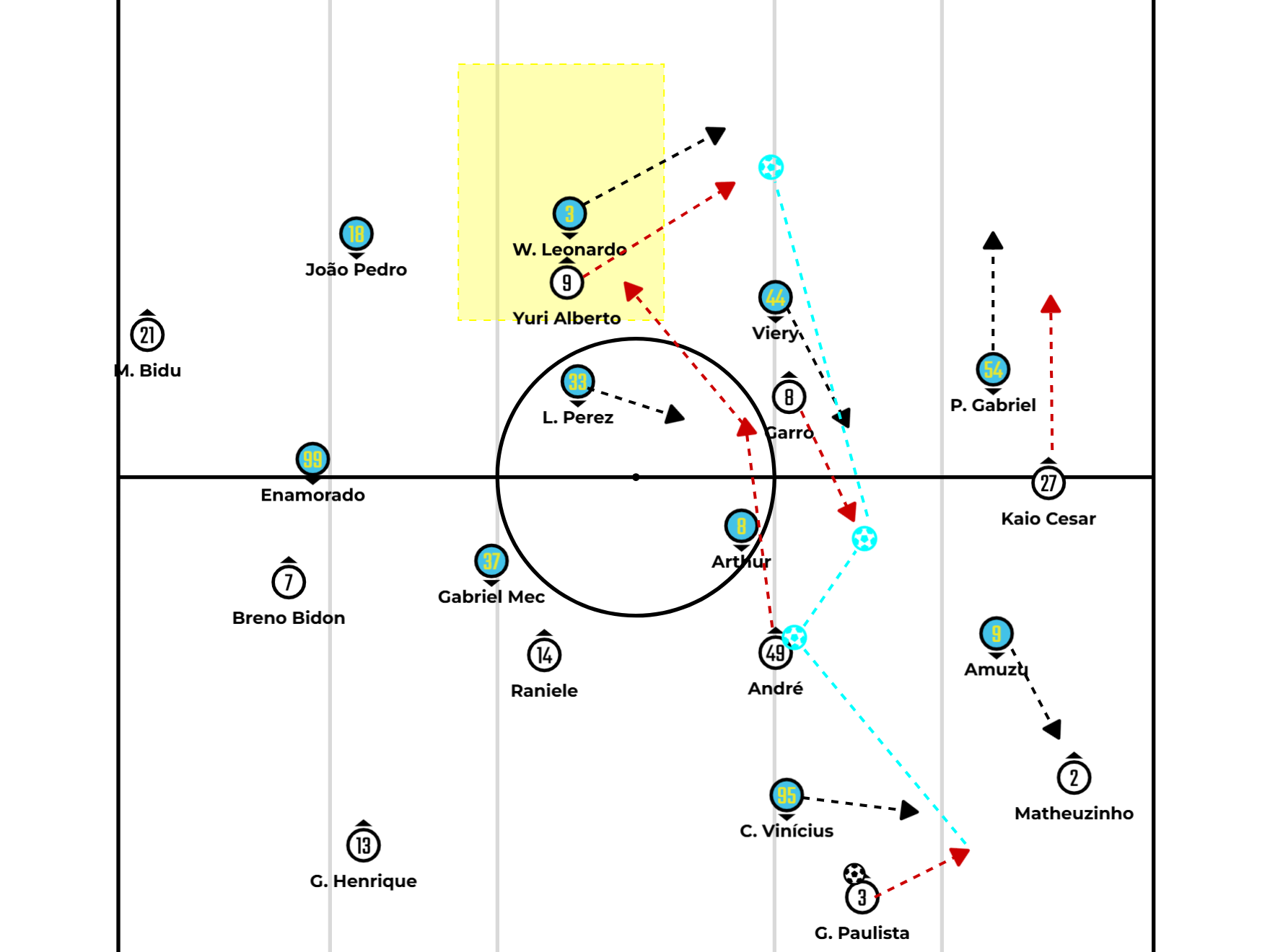
The sequence leading to Corinthians’ second goal, using quick and vertical passing combinations to exploit Grêmio’s defensive disorganization.
During the first half, Grêmio defended in a 4-4-1-1 low block and a 4-1-3-2 shape when pressing high, due to having two strikers on the pitch. Early in the second half, the coach was forced into three changes: João Pedro replaced Marcos Rocha at right fullback; Enamorado came on for Tetê to add more physical duels and second-ball presence, which worked; after conceding, they changed shape again by replacing Braithwaite with Amuzu, seeking to use two wingers with Gabriel Mec operating centrally. The effect was positive almost immediately, particularly between the eighth and tenth minutes of the second half.
The defensive structure, already somewhat stretched and fragile in the first half, often relying on opponent passing errors and poor decision-making, became even more disconnected from its references. After all, defending a team whose attacking players rarely occupy fixed positions is extremely confusing. At the moment of the goal, even in a medium block, it’s difficult to define Grêmio’s exact defensive system. In that brief moment of relaxation, Corinthians delivered a masterclass in manipulating defensive references.
Gabriel Paulista shortened the distance toward the right side to create a passing angle, moving away from Carlos Vinícius’ marking. This also allowed Corinthians’ midfielders to execute their offensive balancing movement, with André receiving possession. Arthur stepped out to pressure André’s movement but was deceived as Rodrigo Garro drifted laterally into the space behind him. Garro also attracted midfielder Perez, who became confused without a clear reference, while center back Viery followed him all the way into midfield.
Garro controlled the ball, reacted quickly and found a pass to striker Yuri Alberto, who made a diagonal movement, dragging Wagner Leonardo into the space vacated by Viery. This movement was also essential in creating the decisive opening. Earlier in the sequence, after laying the ball off first time to Garro, André attacked the space vertically for a give-and-go but did not receive the return pass. As Perez moved centrally and Wagner Leonardo had to leave his position, the Corinthians midfielder changed direction diagonally to attack the newly created space, where Yuri Alberto found him to score the goal that completed the comeback.
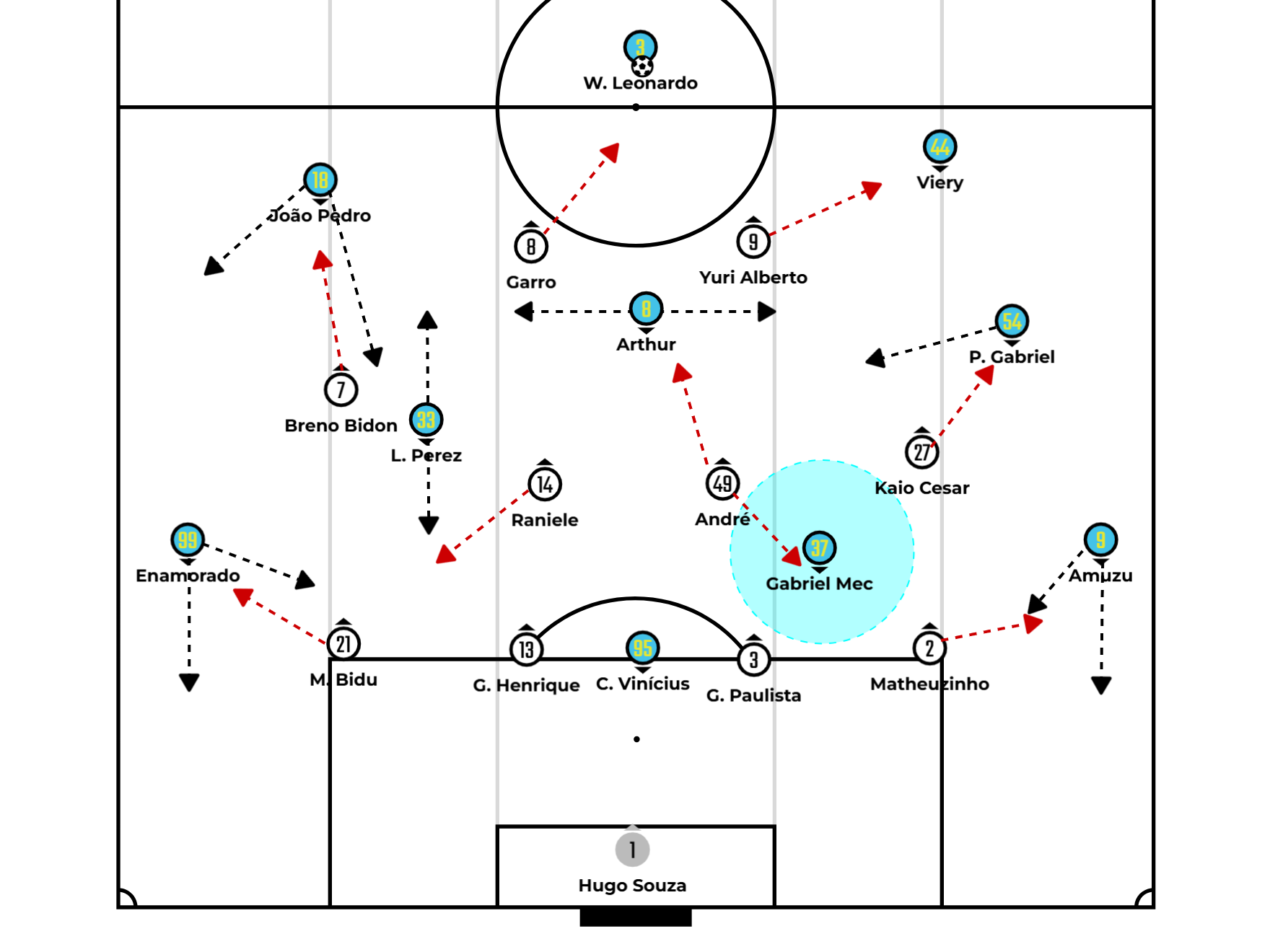
Grêmio’s attacking structure after the third goal, which remained until the goalkeeper’s red card.
After André’s second goal, Corinthians regained possession and found Kaio César, who produced an excellent individual action, combining with Yuri Alberto, who provided another assist despite being booed during the match, and scored a fantastic goal to set the final score. The goal completely shook Luís Castro’s Grêmio, who had to commit more players forward in search of a comeback.
As a result, the team began spending more time attacking in the opposition half. Starting from a 4-2-3-1 formation with two wingers and Gabriel Mec operating centrally, they transformed into a positional 3-2-5 outline, with slight variations depending on player movements. Viery moved wider on the left, while right fullback João Pedro formed part of the first line of three during the build-up, though he retained the freedom to attack the half-space or appear wide on the right. On the left, Pedro Gabriel started wide but moved inside alongside Arthur, forming the 3-2-5 shape.
Among the midfielders, Arthur Melo was responsible for centralizing the construction of attacks, while Perez varied his height to support either the other midfielder, the center backs or even make late runs into the box through the half-space. This allowed Enamorado and Amuzu to remain wide on the flanks. Gabriel Mec enjoyed greater freedom inside, though mainly operating from the left side. In fact, this positioning produced Grêmio’s best attack after the comeback, through a combination between him and Amuzu on the wing.
Defensively, Corinthians dropped into a 4-4-2 formation, where Kaio César and Breno Bidon followed the fullbacks regardless of their height or channel. Even so, they often had to recover almost all the way to the last defensive line. Among Corinthians’ midfielders, Raniele protected the central zone from the forward movements of Perez and João Pedro, while André alternated between pressing Arthur centrally and tracking Gabriel Mec between the lines.
Takeaways
Unable to create significant danger, Grêmio once again fell into Corinthians’ trap, which found Yuri Alberto free from a long ball. The danger forced young goalkeeper Thiago Beltrame, who was enjoying an excellent debut despite the scoreline, to commit a foul and receive a red card. The coach’s response was to remove Carlos Vinícius and introduce another debutant, teenage goalkeeper Menegon, the club’s fourth-choice goalkeeper. That completely slowed the game down and there were no more major moments afterward.
With the defeat, Grêmio began looking more downward than upward in the Brasileirão table, remaining on 21 points in the final position above the relegation zone. They will now cheer for goalkeeper Weverton and Brazil at the World Cup while waiting for the league’s return in July, when they will face Mirassol, a relegation-zone side currently showing signs of recovery.
Corinthians will also return in July against a relegation-zone team, Remo. However, while they started the round level on points with Grêmio, they now have 24 points and finally sit in the upper half of the table, having collected consecutive victories and moved away from danger. Although goalkeeper Hugo Souza lost his place in Brazil’s World Cup squad to Weverton, Corinthians supporters will still get to watch Memphis Depay represent the Netherlands.
Use the arrows to scroll through all available match plots. Click to enlarge. Check the match plots page for plots of other matches.


Comments