
Defensa Y Justicia – Gimnasia Mendoza: Defensa Proved To Be Too Strong For Gimnasia after Comfortable Win (2-0).
Defensa proved to be the superior side in every aspect of the game. Tactically, physically and in terms of effort, they were better than their opponent on the pitch. The first sixty minutes gave them a real edge to the game before they were able to hold on to their two goal lead. For Gimnasia, their players lacked enough quality to outmuscle Defensa in all phases of the game until it was too late.
Tactical analysis and match report by Ebuka Ogoegbunam.
Defensa y Justicia began the Clausura with four wins, two draws, and two losses in their first eight games, managing just one clean sheet. Despite a loss to Lanus last time out, they remain unbeaten at home this season and look to protect that record against Gimnasia Mendoza.
Gimnasia, meanwhile, have five wins from their opening eight Clausura matches, three clean sheets, and are unbeaten in their last four games, form that gives them a good chance to test Defensa’s home unbeaten streak
For Defensa y Justicia, Matias Borgogno started in goal behind a back line of Valentin Loza at right back, Damian Fernández and David Martinez in central defense, and Fernando Román on the left. In midfield, Santiago Sosa played alongside Cesar Perez, with David Barbona pushed higher as the attacking midfielder. Up front, Juan Gutiérrez, Jeremias Lucco, and Leandro Fernández formed the front three.
Gimnasia Mendoza lined up with César Rigamonti in goal, while Luciano Paredes, Diego Mondino, Ezequiel Muñoz, and Matías Recalde made up the defensive line from right to left. In midfield, Ulises Sánchez partnered with Fermín Antonini, with Esteban Fernández operating further forward. Luciano Cingolani, Facundo Lencioni and Ignacio Sabatini led the attack.
Defensa’s solutions in build up
Defensa set up in a 4-2-3-1 shape with the ball. Their fullbacks operated wide with the wingers operating both inside and outside, not committing to one position. Gimnasia defended in a 4-1-2-3 shape out of possession. They pressed with a plus one in the backline. Antonini was assigned to mark Barbona in the attacking midfielder, while the other midfielders were fully engaged. This led to Gimnasia pressing with one striker.
In build up, the 2v1 scenario in the first line of press allowed Defensa to have more of the ball with the striker failing to cover the two defenders and the goalkeeper’s passing lanes. At times, Sosa, who was one of the midfielders dropped into the first line in order to help the team circulate the ball more. This caused a 3v2 in build up as Sosa’s marker tracked his movements.
Defensa were very fluid in the middle of the pitch. The attacking midfielder, Barbona and Gutiérrez were used to help their team progress up the pitch, through their movements in the middle. They were often found in the central areas and used their technical ability to beat their man.
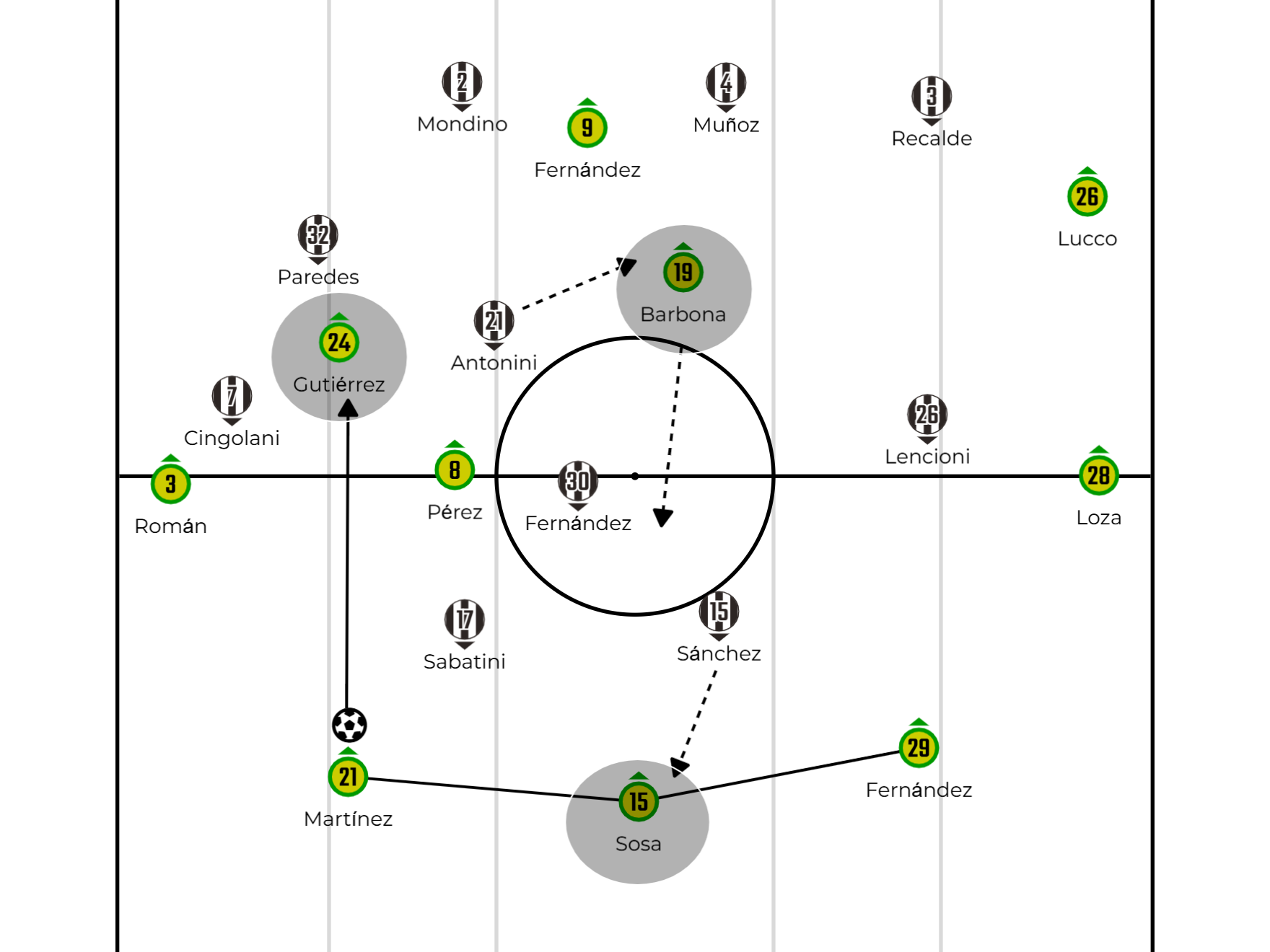
Defensa used their build up structure to create passing lanes for their central players to receive between the lines and attack.
Gimnasia preferred to resist pressing high under plain situations and used a trigger instead. This trigger was to use the striker to put pressure on the center back when these center backs turned to play through one side of the pitch. In this way, they can use the pitch to their advantage and match their opponent in a certain zone of the pitch.
During this trigger, the far side winger would jump to the far side center back which blocks any passing lane to the center backs. This forced Defensa to play completely on one side of the pitch with pressure. Defensa’s opposite fullbacks were left free as a result of this.
The Defensa center backs found a solution not long after to use the switch pass to play to the other side of the pitch. This helped Defensa beat Gimnasia’s zonal pressure.
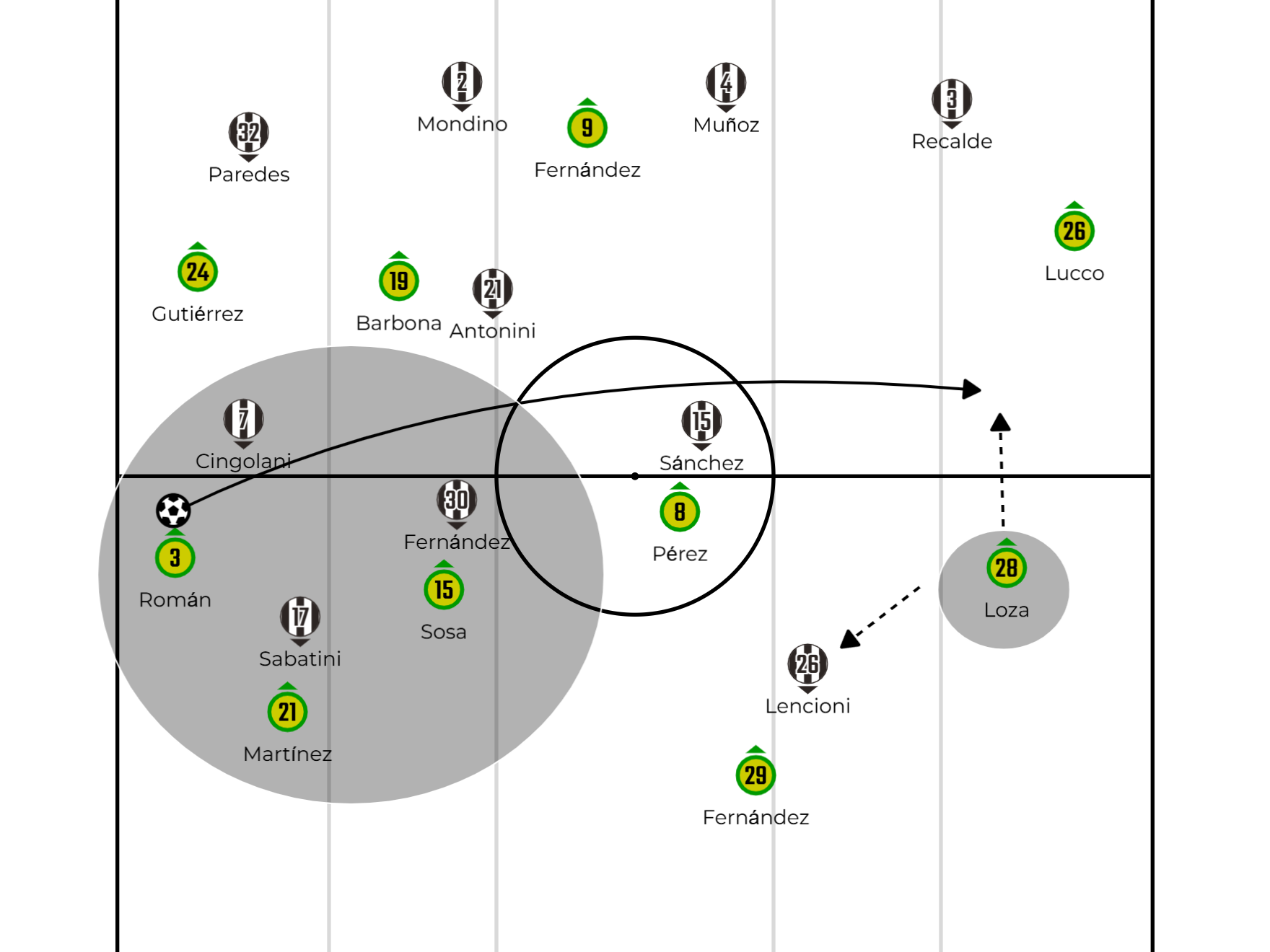
Defensa used the switch pass to find the opposite fullback to beat the zonal pressure.
Joy in wide areas for Defensa
Defensa used the wide areas to create chances most of their chances in the final third. The wingers and the fullbacks exploited the passive defending from the Gimnasia fullbacks out wide. Underlapping runs from both the fullbacks and the wingers got the team into wide areas. They were able to put crosses in the box and attack the box. This led to an offside a goal that was later disallowed after the Defensa fullback was caught slightly offside.
Defensa scored their opening goal in this fashion. They used underlapping runs from their winger, Gutiérrez gave room for a cross that found the head of Fernández. The opening goal showed the effect of these wide attacks and how Defensa profited from this.
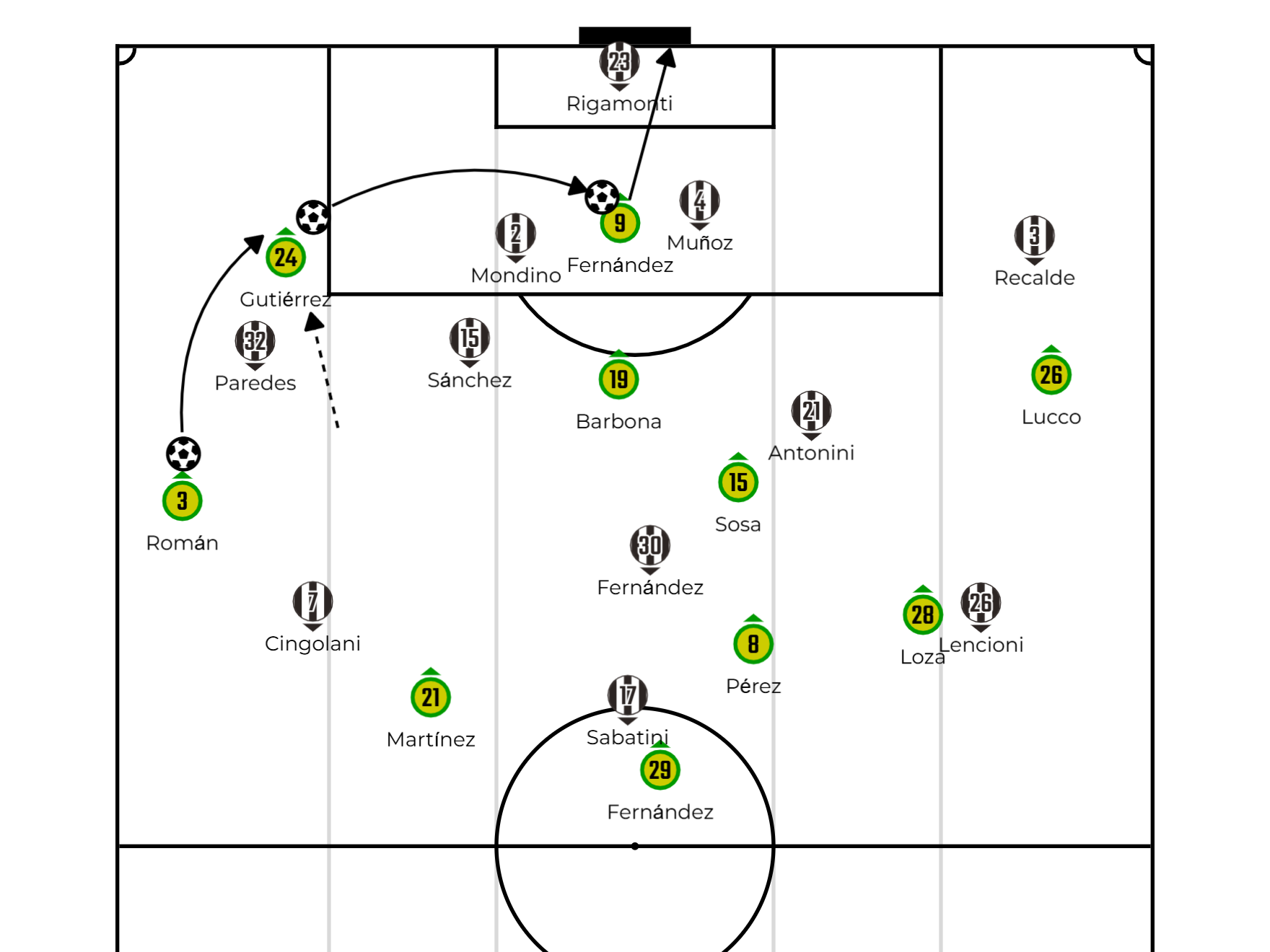
Defensa’s opening goal. Winger attacked the half space to cross the ball for Fernández.
On the ball, Gimnasia set up in a 4-2-3-1 shape. They were direct with the ball but struggled to find any openings especially in the first half. Defensa set up in a 4-1-2-3 shape without the ball, leaving Fernández alone to press the two center backs. The Defensa wingers marked the opposition fullbacks while the midfielders were locked onto their respective markers. Defensa also maintained a plus one in the defensive line.
Esteban Fernández of Gimnasia was key for his team on the ball. He was found in between the lines and his quality on the ball helped to get the team into the final third. However, they didn’t get these sequences much in the game and lacked rhythm in the final third.
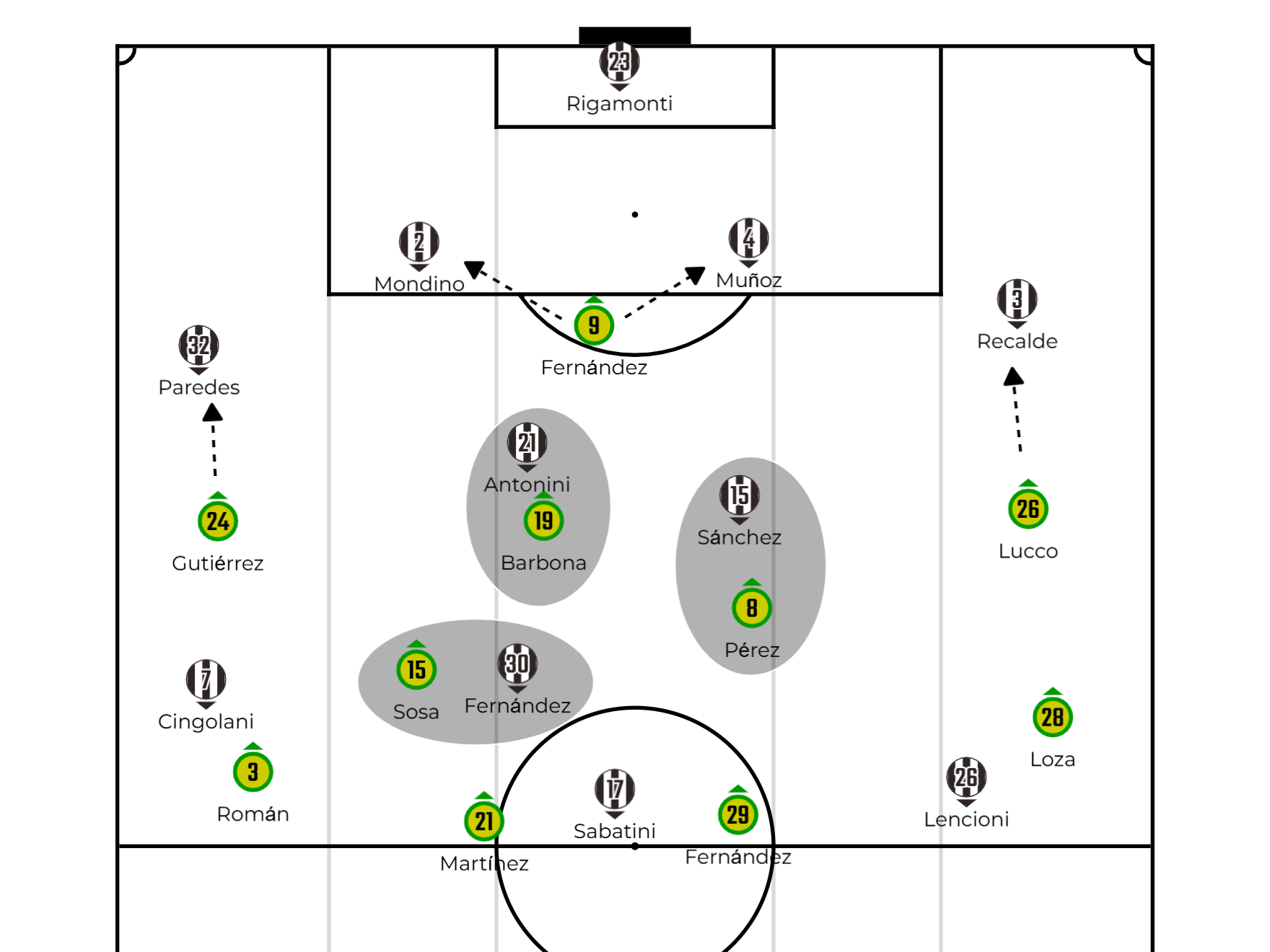
Defensa’s high press with a plus one in the defensive line.
Defensa’s midfield was much more intense and made it hard for Gimnasia to make much progressions with the ball. They won more duels and physically imposed themselves on their opponent. In possession, they lacked the intent and penetration into the final third and without the ball they were passive and found out in the first half.
A little too late
Defensa continued their pressure in the second half and got a second goal in transition. Perez drove from midfield in transition and found Barbona at the edge of the box. Barbona was able to beat the goalie from distance to put Defensa two goals ahead.
Defensa put themselves in a strong position by going 2–0 up, which made the game increasingly difficult for Gimnasia. After the second goal, Gimnasia changed their approach and became more aggressive out of possession, with their midfielders stepping up onto Defensa’s center backs to join the striker in the press. The aim was to force Defensa to play quicker during build-up, reduce their time on the ball, and create opportunities to regain possession higher up the pitch.
Defensa responded by dropping deeper and becoming more conservative, which allowed the momentum to gradually shift towards Gimnasia. The introduction of Agustín Módica, Matías Vargas, and Nahuel Barboza gave Gimnasia additional energy in the second half. All three came on in the 63rd minute, with Módica replacing Esteban Fernández, Vargas replacing Ulises Sánchez, and Barboza replacing Fermín Antonini.
Gimnasia also changed their attacking structure, moving into a 4-1-3-2, which gave them more attacking options and changed the way they pressed. The two strikers were able to put pressure on the Defensa center backs while the wingers shifted narrow defensively to cover the central spaces before pressing the fullback outwide.
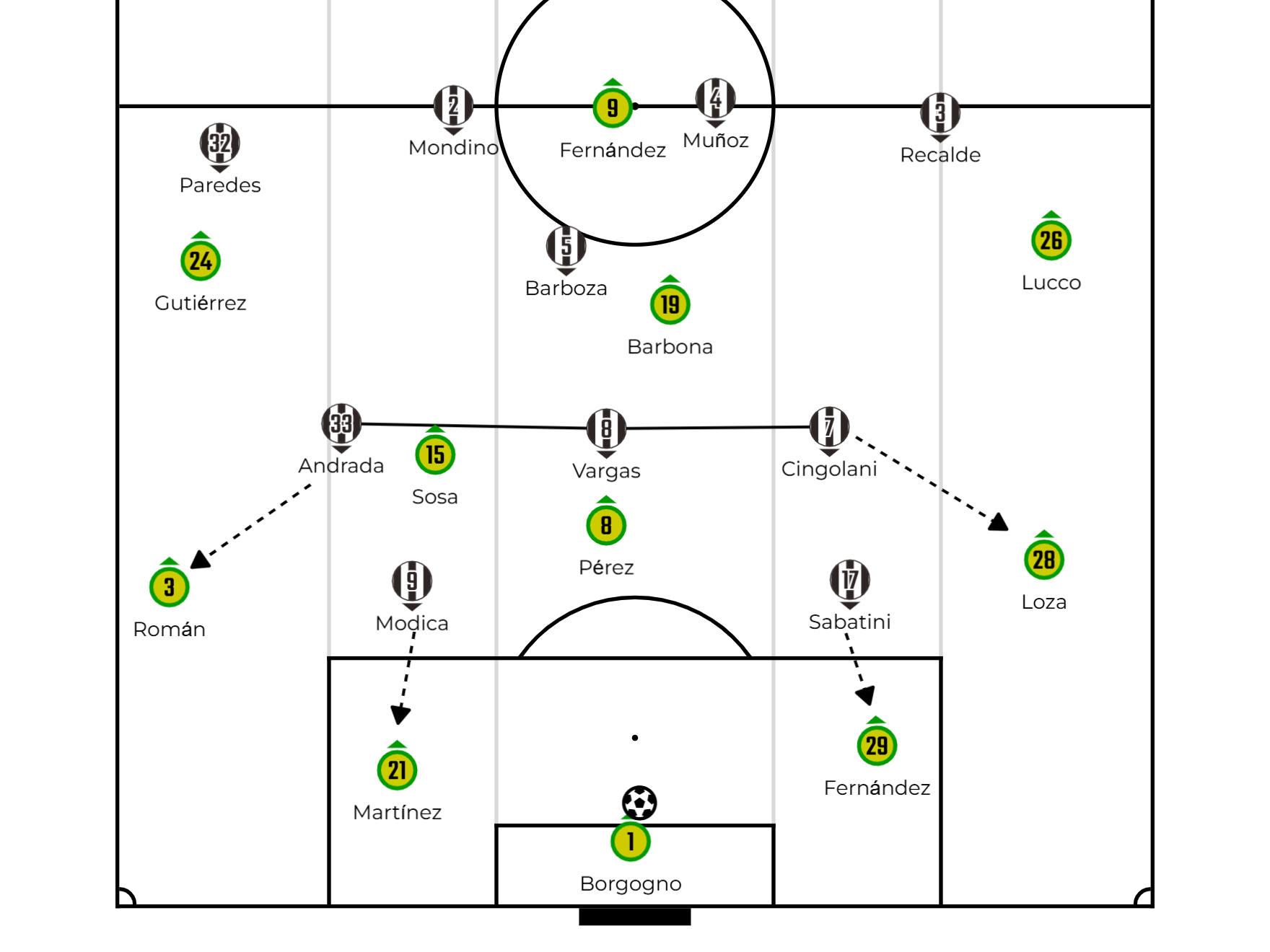
Gimnasia’s 4-1-3-2 press after the second goal to put more pressure on the Defensa center backs.
This made Defensa play quicker and rely more on longer balls, rather than the controlled build-up we saw earlier in the game. Gimnasia were able to find their fullbacks more consistently and attack through the wide areas, but they lacked sufficient intent and quality in the final third.
Defensa’s center backs dealt well with many of these attacks, particularly when Gimnasia looked to progress into the final third. Their ability to defend the box and prevent Gimnasia from turning their increased possession and pressure into clear chances was ultimately key to Defensa maintaining their advantage and seeing out the 2–0 victory.
Takeaways
Defensa Y Justicia controlled the game for large periods, using their intensity, fluid build-up, and wide attacks to create opportunities and establish a 2–0 lead. Gimnasia struggled to find consistent openings, particularly in the first half, but improved after becoming more aggressive out of possession and switching to a 4-1-3-2.
Their increased pressure forced Defensa into quicker and longer build-up, while their substitutions added energy and helped them attack the wide areas. However, Gimnasia lacked quality and intent in the final third. Defensa’s center backs defended these attacks effectively, allowing them to protect their advantage and secure a 2–0 victory.


Comments