
Flamengo – Atlético Mineiro: Late goal keeps Flamengo alive in the race for the top of the Brasileirão (3-2)
The Brasileirão is approaching its conclusion, and every point becomes precious. Flamengo watched Palmeiras bounce back after the latest international break and were then eliminated from the Libertadores. Now, they are trying to gather their strength and make a final push for the Brazilian title. On Matchday 32, they faced a difficult opponent: Atlético-MG, who have been steadily improving. Despite dominating at home for large stretches, Flamengo only managed to win the game in the final minute, with a penalty. Until then, they had faced considerable difficulties against their opponents’ strategy.
Tactical analysis and match report by Marcus Arboés.
Leonardo Jardim’s Flamengo have made targeted changes to adjust the team. Some players have stood out, while others have had their workload managed, but the starting lineup has consistently been very strong. This time was no different. In the traditional 4-2-3-1 outline, Rossi was in goal, with Léo Ortiz and Léo Pereira as the center back pairing; Varela (Uruguay) at right fullback and Alex Sandro (former Brazil National Team) on the left; Pulgar and Jorginho (former Arsenal) formed the double pivot, with Arrascaeta (Uruguay) as the number ten; in attack, Pedro (Brazil) played centrally, Samuel Lino (former Atleti) on the left wing and Gonzalo Plata (Ecuador) on the right wing.
Argentine coach Eduardo Domínguez managed to progress in the Copa Sudamericana with Atlético Mineiro, and the team were also coming off a six-match unbeaten run in the Brasileirão, aiming to break into the upper part of the table. With an unconventional lineup, Atlético’s starting eleven was as follows: Gabriel Delfim in goal; Natanael and Renan Lodi (former Al-Hilal) at fullback; Lyanco and Vitão as the center back pairing; Alan Franco and Maycon as the double pivot; Preciado (Ecuador) and Bernard (former Everton) out wide; Victor Hugo as the attacking midfielder and Igor Gomes operating almost as a false nine.
Attack against defense can be deceptive
For most of the match, Flamengo, the home side, dominated possession and created attacking pressure and goalscoring opportunities. Atlético-MG, on the other hand, adopted a reactive approach, which proved effective at crucial moments and kept the game competitive. It could even be argued that, tactically, Eduardo Domínguez was the “better” coach in this battle of ideas. This was particularly clear in the opening minutes.
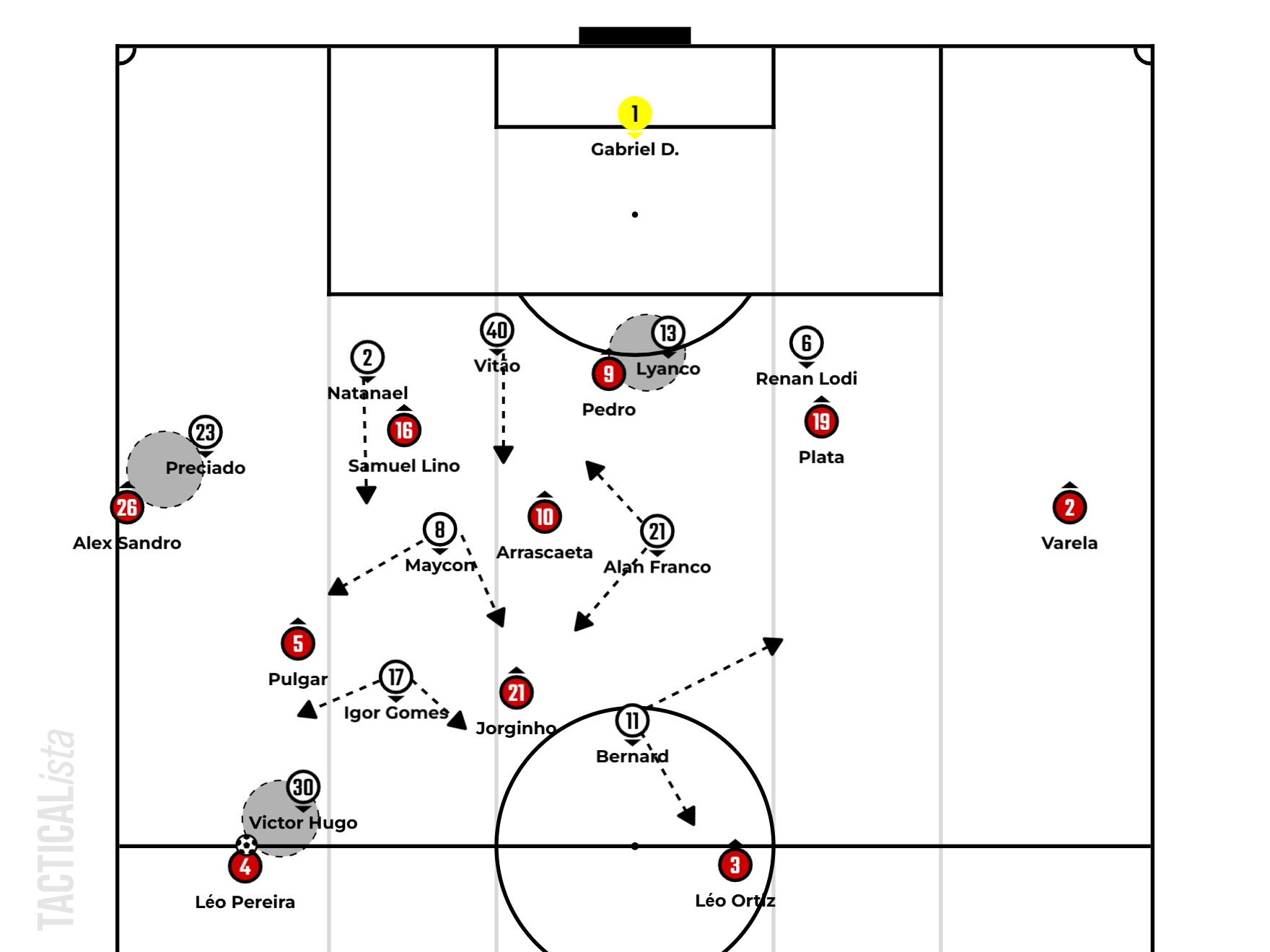
Atlético’s man-oriented marking structure, with a variable line of five defenders and a central defensive block.
Flamengo generally start from a 4-2-3-1 outline, but in practice they attack with at least five players on the last line. The fullbacks vary their positioning, the wingers alternate between moving inside and staying wide, while the double pivot coordinates the build-up, connecting the center backs with Arrascaeta, the number ten. The idea is always to attack through combinations, especially out wide and predominantly down the left flank, varying which players occupy each channel and constantly changing their positioning to draw the opposition’s marking and exploit the spaces created.
Atlético responded with a defensive organization that might initially have looked like a 4-3-3 or 4-3-1-2 formation, but it varied according to the players’ man-oriented marking assignments. Natanael, Vitão, Lyanco and Renan Lodi always formed the defensive line, which was completed either by Preciado, who tracked Alex Sandro individually, or by Alan Franco, who protected the last line from inside to allow Renan Lodi to mark Varela, or moved across himself to close down the flank. The idea was that, regardless of who occupied each zone, the opposition player would always be tracked.
As a result, Igor Gomes, Bernard, Victor Hugo and, further back, Maycon, alongside either Alan Franco or Preciado, formed a defensive block that congested the midfield. It became even more difficult for Arrascaeta, Lino and Plata to receive the ball comfortably and find space inside, because the last line also stepped out aggressively to press whoever received the ball behind the midfield line. In one such situation, Atlético managed to organize a counterattack led by Preciado, which resulted in the opening goal, finished by Bernard.
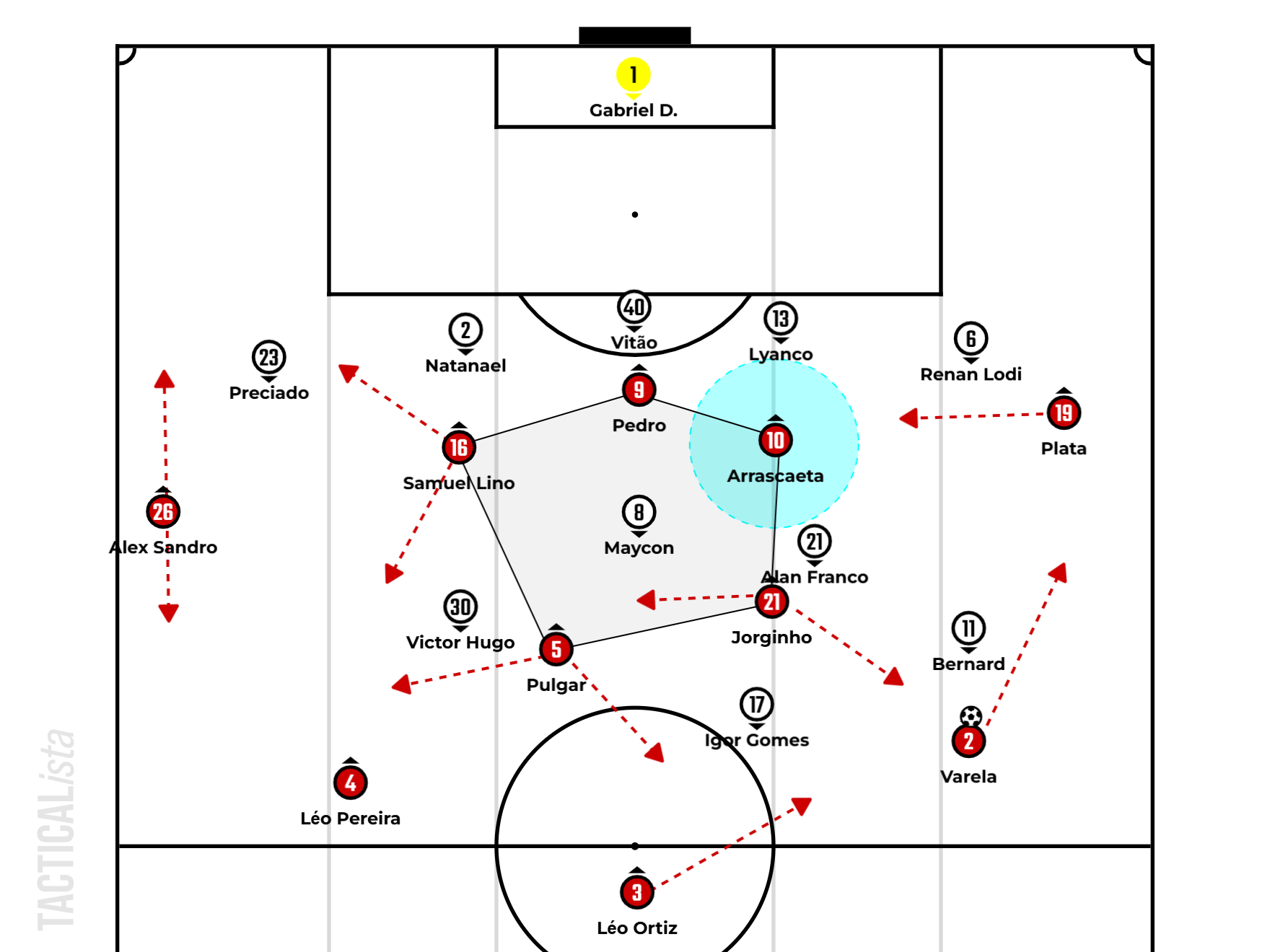
Flamengo’s attack, with a 3+2 build-up structure and five players concentrated inside.
After conceding the first goal, Flamengo remained dominant. They prevented Atlético from playing out from the back, recovered possession easily and gave them very little room to counterattack. In possession, Flamengo consistently created more dangerous situations, using combinations between three or four players or numerical superiority through the central channel as Atlético shifted defensively.
Alex Sandro and Varela varied their roles and positioning, staying wide to stretch the last line or dropping deeper to create numerical superiority in the build-up. The holding midfielders could also drop into the first line to build from the back, but they were constantly providing support at the base of the attack on whichever side the play was developing, with Jorginho positioned further forward than Pulgar. Arrascaeta operated in midfield as a free playmaker, moving wherever the attack was taking place.
Among the attackers, Pedro became isolated by the opposition defense, while the wingers, Samuel Lino and Gonzalo Plata, alternated between moving into the half-spaces and receiving the ball out wide, on their stronger foot, to carry it from outside to inside and look for a combination, pass or shot, freeing up the channel for the fullback to advance. However, they were consistently tracked very well through Atlético-MG’s man-oriented marking and covering movements. Then, at a moment when it did not even look as though an attack was developing, Plata received the ball on the right, carried it inside past two markers and took a long-range shot that almost looked like a cross, leveling the score.
It did not take long for Flamengo to turn the game around. Through post-loss pressure, the team recovered the ball in the attacking half while the opposition defense was slightly disorganized, and Arrascaeta scored the second goal through a quick combination attack.
Did Domínguez have a good plan?
The first half ended, and when the second began, only Leonardo Jardim made a change, bringing on Ayrton Lucas for Alex Sandro and making the left flank even more attack-minded. It seemed as though Flamengo were the team chasing the result. After all, they continued to create the best chances at the start of the second half. But if Domínguez had a plan, he was about to make three substitutions when Atlético-MG equalized.
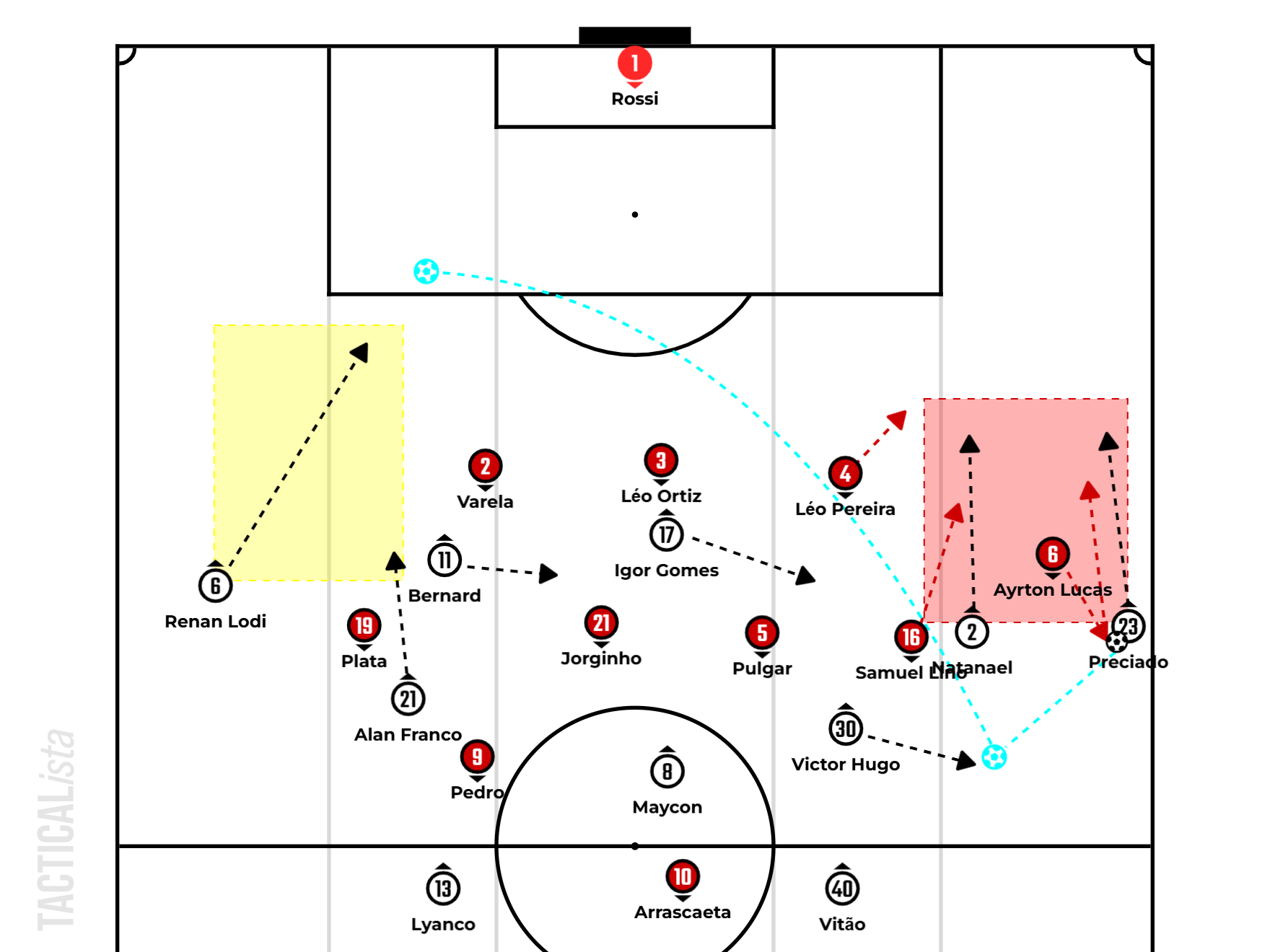
Atlético-MG’s goal, with a long diagonal pass to Renan Lodi, exploiting Flamengo’s defensive movement to drag the marking.
When Atlético had possession, which happened only occasionally, they were slow and did not seem to have many attacking patterns, being comfortably controlled by the opposition’s marking. But Flamengo made one mistake and conceded a simple goal that proved crucial to the course of the match. Preciado received the ball out wide. At that moment, Flamengo were defending in a 4-4-2 shape. Ayrton Lucas stepped out to press, and Natanael took advantage by making an overlapping run down that channel, dragging Samuel Lino’s marking with him and pushing the last line deeper alongside Léo Pereira.
Preciado played the ball back to Victor Hugo, who, thanks to Samuel Lino’s movement, was able to receive it unmarked, facing forward, away from Pulgar’s pressure and with a clear view of the pitch. With Ayrton advancing on the left, Flamengo’s last line shifted centrally. Since nobody moved closer to Victor Hugo on the right, three Atlético players gathered on the opposite side: Bernard moving inside, Franco attacking the space infield and Renan Lodi staying wide, behind everyone’s field of vision.
As Victor received the ball with the intention of playing a long pass, Bernard moved centrally and Alan Franco advanced, drawing the attention and marking of Plata and Varela. Renan Lodi exploited the space created in the blind spot of their field of vision and received an extremely precise long diagonal pass, allowing him to equalize without difficulty.
Was this planned? I would say yes, because the team had already rehearsed this movement once in the first half and tried to exploit the same opening at least one more time when the opportunity arose, using Victor Hugo as the playmaker. On that occasion, however, Flamengo managed to anticipate the move.
The final game scenario
Immediately after the goal, Domínguez made three changes: he brought on Reinier, changing the profile of the most advanced player; introduced Minda for Preciado, opting for a more attack-minded player; and brought Castaño (former River Plate) into midfield for Maycon, adding a more creative player. Leonardo Jardim’s first response was to bring on Carrascal for Plata, adding another technically gifted and creative advanced midfielder, and replace Pedro with Bruno Henrique as the striker, changing the profile and role of the position. Both sets of changes had an impact.
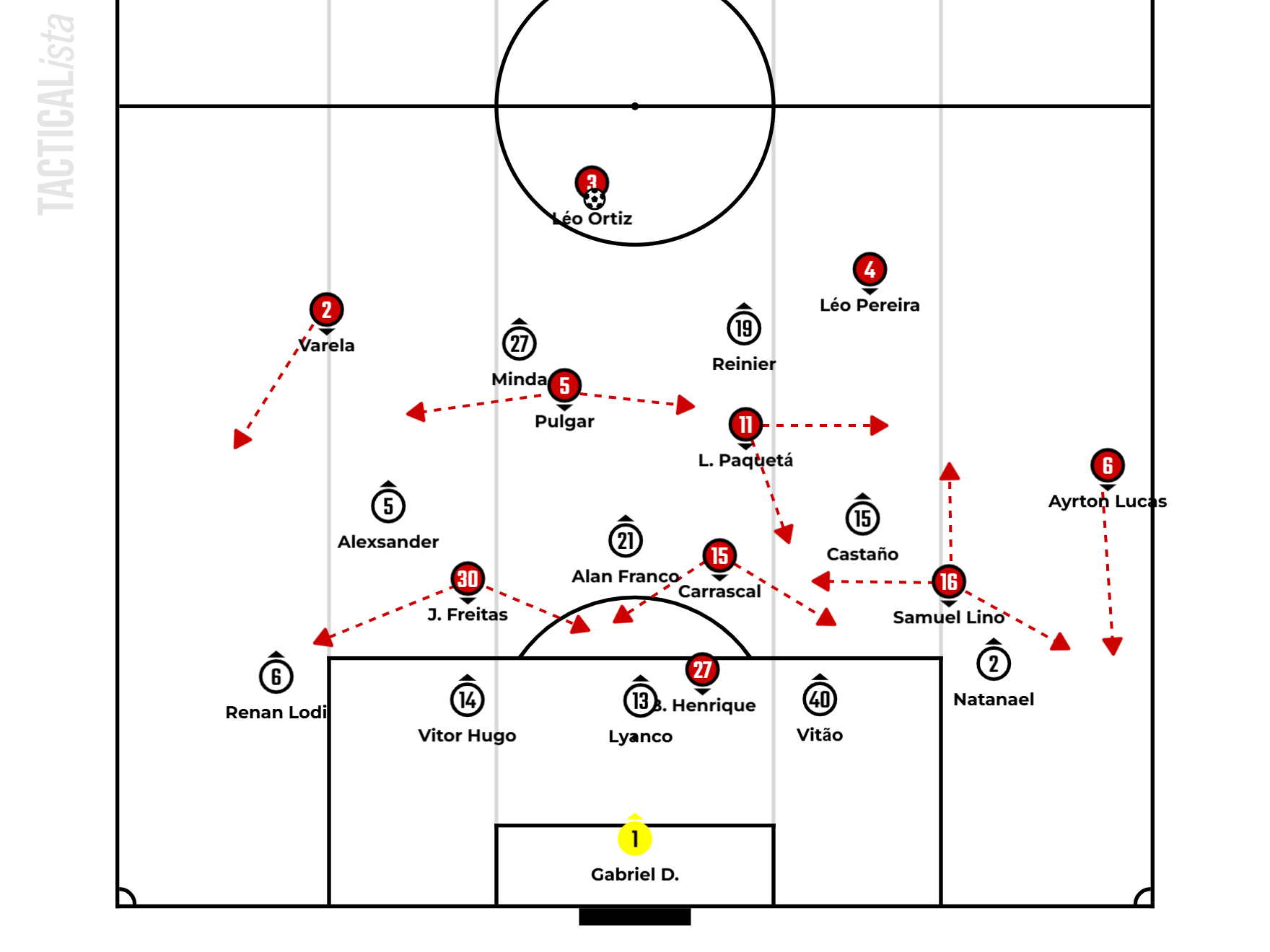
The final game scenario, with Atlético-MG defending in a 5-3-2 formation.
With Castaño’s introduction, Atlético-MG noticeably gained more tactical clarity in organizing their attacks, with him consistently acting as the reference point in the build-up. Flamengo began to have less possession, less control of midfield and faced more attacks from their opponents, but they had open space to exploit Bruno Henrique’s main strength. He even came close to scoring a beautiful header.
The game became more open, chaotic and, above all, vertical. Later, Flamengo’s coach decided to make the team even more attack-minded, bringing on Lucas Paquetá for Jorginho and young Joaquín Freitas for Arrascaeta. With Carrascal generating considerable attacking volume and creating advantages through the middle, Atlético-MG gradually found themselves pinned back.
Domínguez’s final response was to close down his team. He brought on Vitor Hugo to create a line of three natural center backs alongside the two wingbacks, pushed Minda forward to play alongside Reinier and introduced another holding midfielder, Alexsander. The team therefore continued defending in the same 5-3-2 formation, but now with a more fixed structure, noticeably fewer positional rotations and players better suited to those roles.
Did it work? Only until the very final minute of the match, when Flamengo won a penalty, converted by Carrascal to secure the victory for the home side.
Takeaways
With this heroic victory, Flamengo remained at the top of the table, bouncing back from their elimination and gaining renewed momentum in the final push for the Brasileirão title, especially since Palmeiras are showing no signs of slowing down and also won their match. With 70 points, they face Vasco in the midweek round, one of their biggest rivals, who are working hard to avoid relegation and currently sit four points clear of the relegation zone.
Atlético-MG, on the other hand, finally lost after a long unbeaten run. The work has been good, and the strategy made sense, but their opponents were a very strong team playing with the support of their home crowd. Atlético had even managed to get close to the Brasileirão’s top five, but have now stalled on 50 points. A victory would have brought them closer to Cruzeiro, their biggest rivals in Brazil, who will be their next opponents on Matchday 33.
Use the arrows to scroll through all available match plots. Click to enlarge. Check the match plots page for plots of other matches.