France – Italy: A Tale Of Two Center-Backs (1-1)
Not many games can be defined by the different acts opposing center-backs can partake in. Jérémy Jacquet dominated whenever he had to defend in front of him, whilst France only found spaces in the second half when Alessandro Bastoni defended in wider spots. A piece of free-kick magic got them in front, only for the Italian to hold the last laugh.
Tactical analysis and match report by Joel Parker.
We decided to make this article free to read. If you want to support our work, consider taking a subscription.
The blend of cultures, rich history and hair or teeth-whitening treatments makes Türkiye one of the most popular destinations for tourists amongst three continents. The national teams of France and Italy made their travels also in search of stylistic improvements.
Zinédine Zidane treads a similar line to his predecessor, giving his star-studded squad the keys to perform at their own accord, within a basic structure. This is designed so that predetermined movements do not get in the way, but much like Didier Deschamps water-carrying behind Zizou in ’98, there is now more emphasis for France to control the game with the ball now that he has taken charge. The result: two consecutive 1-0 victories. Türkiye and Belgium ran close games but two of the leading performers from the World Cup had turned up, Kylian Mbappé (now injured for the rest of the international break) and Michael Olisie.
A poor performance in Rome saw even less enthusiasm for Roberto Mancini’s return to the Italian job. Then the trip to Türkiye happened, and Mancini’s locks started to look wavier. The attack was led by the Esposito brothers, Giacomo Raspadori moved inward from the right and the Italian attack found a new lease of life in narrow spaces. Michael Kayode finally got his debut cap at right fullback and crashed the back post. A 4-1 win has rekindled the effective work that Mancini put down in his first tenure. Luciano Spalletti had used a convincing win in Paris, back in 2024, to engineer some excitement. Now Mancini was looking to do the same.
Zidane made five changes to the team that beat Belgium. Adrien Truffert and Dayot Upamecano came into the defense, Adrien Rabiot also came in on the left side of the midfield, whilst Olise and Ousmane Dembélé were also drafted back into the attack.
Mancini showed faith to the team that won in Bursa. Raspadori picked up a thigh injury, so Moise Kean returned to his role on the wing, this time on the left side. The rest of the lineup remained unchanged.
The counterpress and straitJacquet
Territory was established from the first phases as the French were able to pin the Italians deep in their own half. Mancini’s team were set in their medium-to-low block and France got possession into high areas of the field, most notably through to Désiré Doué on the left and Olisie on the right. When possession was lost, France were more than comfortable in leaving a ‘-1’ laterally to keep a ‘+1’ in the defensive line, and with fast counterpressing movements towards the ball, they forced Italy to try and connect as quick as possible.
To keep them pinned onto one side, Dembélé made sure to jump into the spaces between the center-backs, almost a trademark of his by this point. In turn, Rabiot and Cherki could also move from far side to ball side, to compress the space further. When Cherki stepped up towards Alessandro Bastoni, Rabiot jumped towards Sandro Tonali and the man-to-man was triggered as Jérémy Jacquet moved onto Nicolò Fagioli, to stop the two-versus-one opening on Lucas Da Cunha. If the ball was in a tighter space in the channel, then France gambled on keeping the numerical inferiority around Da Cunha/far side winger to keep the overload on Francesco Pio Esposito.
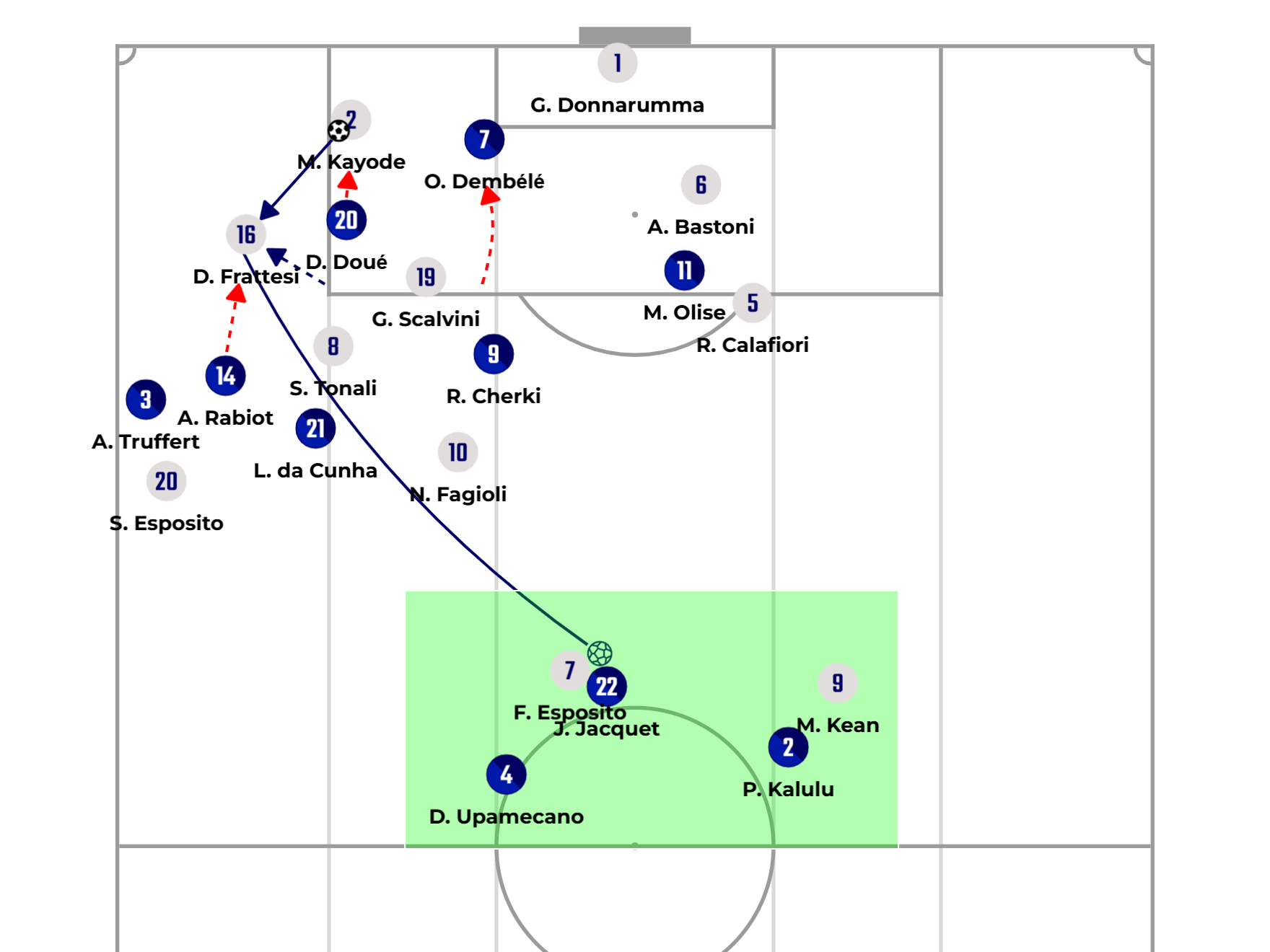
3rd minute: Counterpress from France. From the turnover, Frattesi passed back to Kayode and this triggered the movements from two PSG attackers. Doué moved to Kayode, Dembélé moved between the center-backs and Rabiot jumped towards Frattesi after Kayode returned the ball to him. Doué curved his press and hassled Frattesi, whose long ball was competed for and won by Jacquet.
With attacks more fixed onto France’s left side, at the start of the game, Frattesi and Tonali were the two midfielders Italy turned towards, to try and retain/escape the counterpressure. Perhaps Fagioli in one of these pockets could have provided cleaner exits and given an extra runner on Esposito and Kean. Even if Italy had better dynamics, they had a difficult challenge in trying to get around Jacquet, whose defensive work when stepping up/defending in front of him was excellent throughout the game.
Ironically, the one time that Italy could break through would create one of the game’s best chances. On the left side, Fagioli had moved between the center-backs and more space drew open as they were more cautious to aggressively jump onto Riccardo Calafiori/Bastoni. Gianluigi Donnarumma knocked the ball over the lines, Frattesi knocked it to Francesco Esposito, he knocked it to Kean and Frattesi would switch play to Sebastiano Esposito. Kayode underlapped and squared across goal, only for Kean to put it straight towards a diving Mike Maignan.
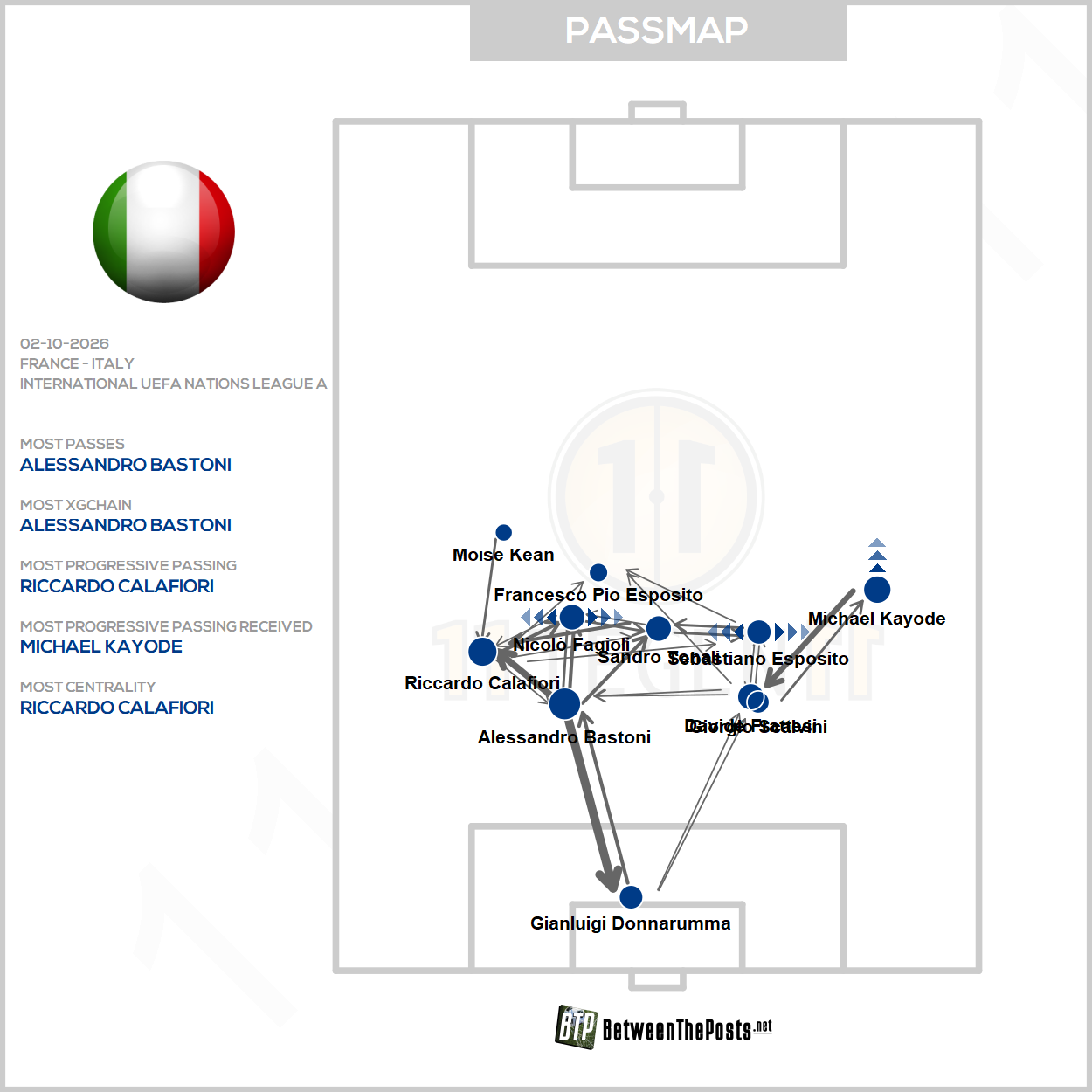
A very deep Italian pass-map, whose top receiver of progressive passes was the right fullback, Michael Kayode.
No Cherkish delight
The French had been proactive in their out-of-possession phase; it was in possession where their limitations became clear. Both fullbacks, Pierre Kalulu and Truffert, were comfortable in making runs ahead of the attackers and down the channels, but France got into too many situations where their players were outside of the block.
Their possession plan had a couple of reference points. On the left, Rabiot constantly dropped next to Da Cunha, which encouraged Doué or Dembélé to move into halfspace pockets and Truffert to make the overlapping run. Alternatively, the diagonal pass to Doué would be made, and the inside run would come from Truffert or Rabiot. On the opposite flank, Olise and Kalulu shared a similar dynamic, although Olise had more license to work laterally, all whilst Cherki had plenty of engagement with possession but only in front of the midfielders and not behind them. Despite some fluid positioning, France were stale when circulating possession.
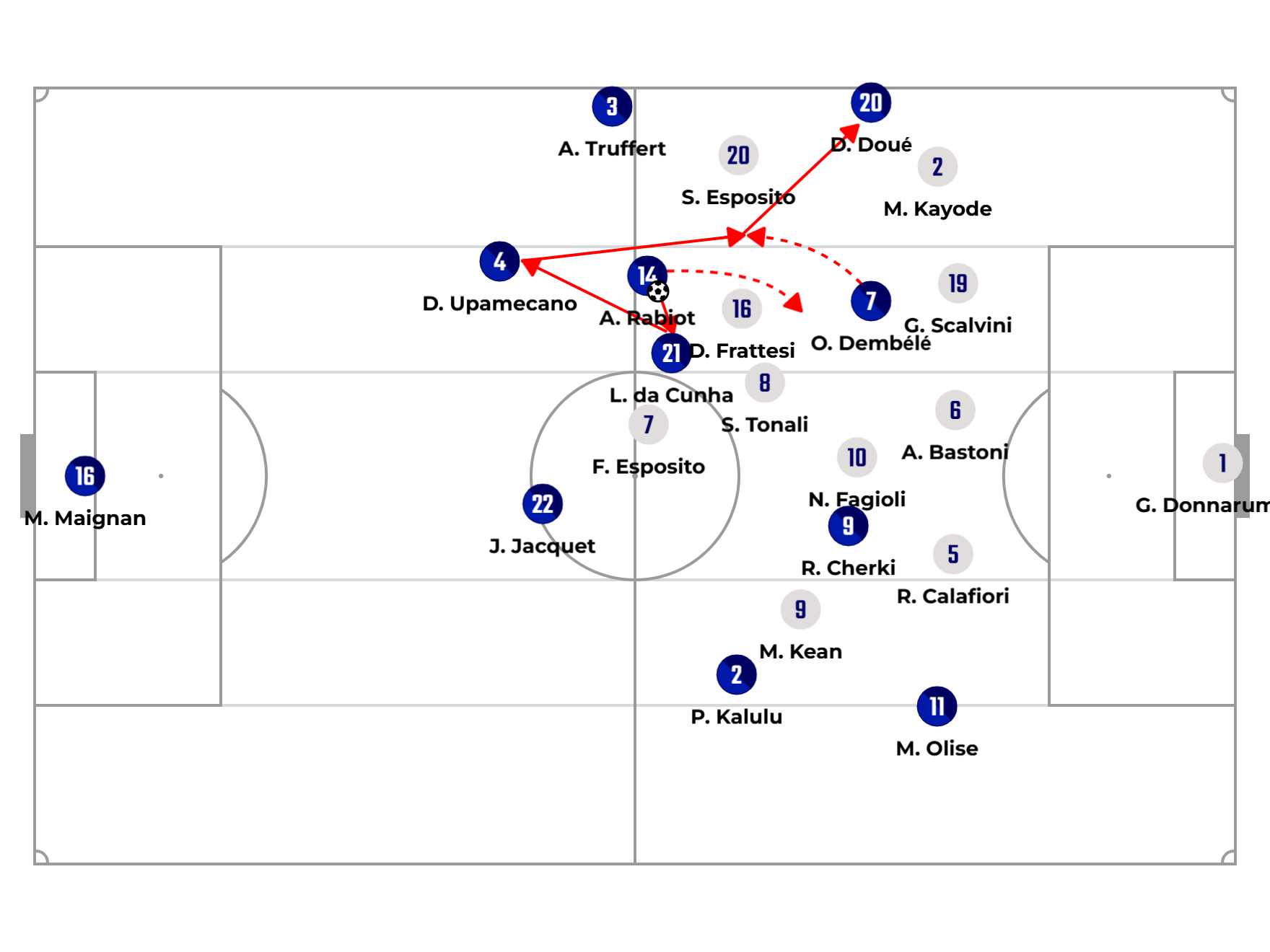
10th minute: Fluid French positions, without much probing. Rabiot dropped to collect possession from Truffert and made a run ahead of the ball once he passed to Da Cunha. The ball circulated back to Upamecano, only for Dembélé to open the passing lane by moving between Esposito and Frattesi. The pass to Doué could be made, but with Dembélé dropping back between midfielders, and Rabiot being tracked by Frattesi and Scalvini, this leaves France still on the outside of the block.
Being on the outside, this created a tempo that could not pull the defensive block apart; too many touches would be taken in these areas. Furthermore, the dynamics between fullback and winger meant that France could not attack in three-man combinations. As one sat in the halfspace, or in a narrower spot, the other would hold width. This meant that there were not many occasions where France could attack using double width, especially on the right side where Olise often had to make a move or engage with a player if it was to invite movements from teammates around him.
Additionally, this was a medium and low block that was a lot better organized. Italy kept the 4-1-4-1 formation, which had big gaps open around its midfield in the game against Belgium. In this fixture, Tonali was moving upwards from the single pivot, so that there would not be a player scanning behind the pressing midfielder. This made Italy appear in a 4-5-1 shape, but Tonali’s attraction towards the ball had a good effect because it left Fagioli on Rayan Cherki, rather than Fagioli moving towards possession on the opposite side and the distances for the two midfielders becoming larger to defend. When Doué dropped inwards, Sebastiano Esposito dropped to cover Truffert and Kayode could still occupy the winger in a different zone.
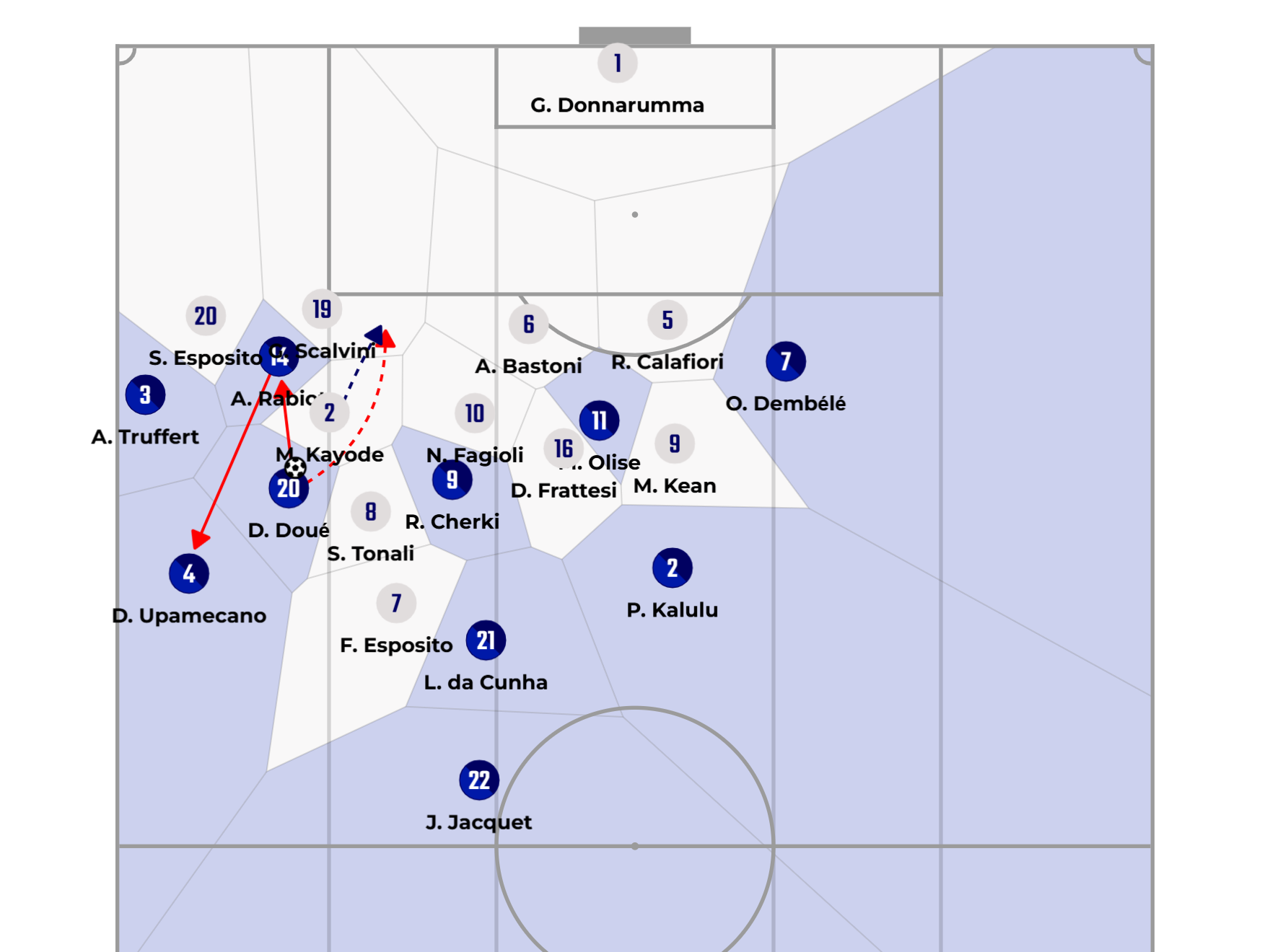
23rd minute: More organized Italian defending. In this phase, Doué tried to manipulate the defense by making a run inward, only to be tracked by Kayode and Rabiot passed back to Upamecano as Italy made sure that Kayode, Scalvini and Tonali still faced outwards and did not allow France to move on the inside.
As a result, France were creatively absent despite an insanely high technical level on the pitch and the territory they had established. Zidane’s team did not surpass 0.25 Expected Goals in the first period from eight attempts made. Italy produced another close chance when Rabiot loosely gave possession away in his own half and Upamecano hooked the ball away from Francesco Esposito for a throw-in. One of Kayode’s high deliveries created panic but Frattesi’s effort deflected just wide.
Bastoni blindside makes Olise magic
France took more control of the ground duels in the second period, as a more vertical game started to open. Zidane started to test just how far Bastoni was willing to man-mark his target and made runs into the areas that opened in the defensive line. Without a lot of pressure on the ball, Italy showed that they could be vulnerable: a couple of minutes into the second half and Bastoni followed Cherki towards the halfway line, only for Upamecano to put a high ball towards Rabiot, who sprinted between Kayode and Scalvini. Doué cut inside as the Italian defense reset; a low save was made by Donnarumma, but the second one against Dembélé’s rebound spared blushes, for the time being at least.
A few minutes later, Olise was the next player to see what he could create against a similar dynamic. This was against the final third, as the Bayern attacker used double movements and jumped in front of Bastoni to get him onto the bait. This saw Jacquet split the lines, and Olise flicked the ball towards the box, only for Cherki to be brought down by Fagioli, just outside the area, as he was about to sprint into Bastoni’s blind side. A cheap free-kick to give away, but one with brutal consequences. Cherki teed Olise, and his set-piece was inch-perfect, hitting the inside of the crossbar and bouncing up into the roof of the net.
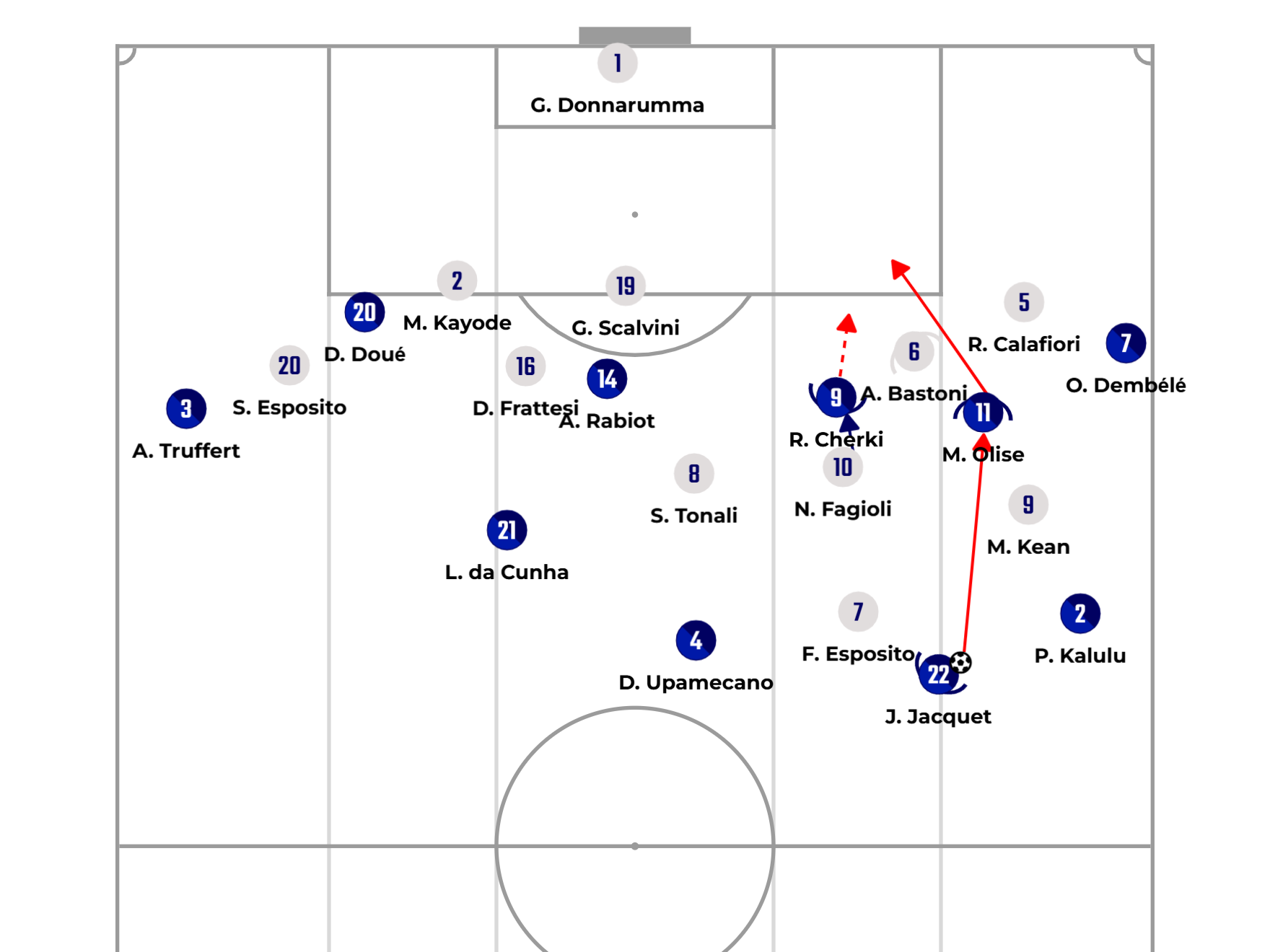
53rd minute: Buildup to France free kick. Smart orientation from France to manipulate Bastoni’s blindside. Disguised pass from Jacquet did not alert Kean to block the passing lane and Olise moved away from Bastoni to encourage him to take another step out. As this happened, Cherki was already oriented towards the blind side and Fagioli made a reactive call to the threat, rather than already getting goal side.
Zidane’s team continued to tease, even if the bombardment of quality chances did not come (although Donnarumma would still be tested). Next would be Dembélé, whose diagonal occupation encouraged deep runs to come from Cherki or Olise to appear inside, when Dembélé carried from deep and Bastoni would be occupied by Cherki.
With these dynamics in place, a more vertical game did appear but not enough to open clear cut chances for France, only for them to enhance the control, on the ball, that they had established. However, cracks did start to appear after Frattesi was given a second chance to get the ball out to Calafiori, against French counterpressure. Italy circulated, and a long ball into the box from Bastoni found Sebastiano Esposito (who had swapped flanks by this point). A low pass into Kean could not be diverted towards goal.
Bastoni blindside is a double-edged sword
France could not quite find the creative formula around the final third yet had the momentum to this point. Mancini looked for answers, Francesco Esposito was replaced by Antonio Vergara, Kean now the striker, and Tonali off for Nicolò Barella. From a long ball, an awkward headed back pass was lapped up by Vergara, only to be beaten by a recovering Upamecano, to a loud applause from the Stade de France.
However, the sequence would not end there, and a poor pass from Rabiot invited pressure once more. The touch from Da Cunha was heavy, and Bastoni hunted him down in the final third, to sprint through on goal. His shot would deflect off Jacquet, but it was enough for Italy to grab an equalizer.
From there, both teams had phases in which a winner was close. Rabiot tested Donnarumma almost instantly after the goal, another low save.
The final ten minutes saw an abundance of chances that could have fallen either way. First there was another Kean chance, this time from a throw-ins second phase and a dipped cross by Vergara forced a dipped header from Kean, one that was tipped away from Maignan. Then fellow substitute Eduardo Camavinga forced the theatrics out of Donnarumma, with a powerful shot from outside the box. The better of the chances fell to Barella when Vergara’s cutback deflected into the Inter midfielder’s path, off-balance and the shot did not test the keeper. Camavinga forced another save from the Italian captain going into the ninety, whilst Upamecano was sent off a few minutes from the final whistle.
Takeaways
A peculiar game in which the course of the match told one story, whilst the quality in the shots told another. The appointment of Zidane does not stray far from the path that Deschamps had laid out. After fourteen years, it would be difficult for such imagery to wash off, even at a national team level. But can we expect Zidane to complement the stacked attack at his disposal? Time will tell, but our only key evidence is that his Real Madrid teams already had a well-oiled machine in Toni Kroos and Luka Modrić, who could act as an entire buildup unit in their own right. France has a way to go in establishing their own version.
Mancini seeks a solution to a similar issue. Italy has the midfielders to invade the space but not control the buildup, with the exception of Barella. Responsibility now falls to Calafiori, and it is telling that in the two matches he has played, Italy has struggled to find a way for his roaming abilities to come into flight. This is a team that can still be fluid but bears a lot of scars.
Use the arrows to scroll through all available match plots. Click to enlarge.
Check the match plots page for plots of other matches.