
Lazio – Internazionale: Is Chivu Already Surpassing Inzaghi’s Legacy? A Tactical Masterclass in the Coppa Italia Final (0-2)
After another intensely tactical encounter at the Stadio Olimpico, Internazionale once again demonstrated their superiority over Lazio, securing a composed 2–0 victory in the 2025/26 Coppa Italia Final and completing a domestic double under Cristian Chivu. Building directly on the momentum generated from their recent 3–0 Serie A victory over the Biancocelesti less than a week earlier, Inter entered the final with clear psychological confidence, greater collective clarity, and a far more stable structural identity both in possession and during defensive transitions. Lazio, meanwhile, arrived hoping to adjust the weaknesses exposed during the league meeting, yet many of the same tactical problems remained evident throughout the evening, particularly their difficulties managing Inter’s vertical transitions, protecting wide spaces after possession losses, and maintaining compactness during defensive rotations.
Tactical analysis and match report by Mustafa Hassan.
We decided to make this article free to read. If you want to support our work, consider taking a subscription.
Lazio, under Marco Ianni in place of the suspended Sarri, again deployed a 4-3-3 structure aimed at preserving central compactness while attempting to slow Inter’s vertical progression through the middle third. However, unlike the recent league defeat, Lazio introduced five changes to the starting XI in an effort to increase physical balance and defensive stability. Edoardo Motta operated behind a back four of Marušić, Mario Gila, Romagnoli and Nuno Tavares, with the defensive line instructed to remain narrower and less aggressive during wide pressing situations. In midfield, Toma Bašić, Patric and Kenneth Taylor formed the central trio, replacing much of the previous match’s midfield dynamic in search of greater defensive control and improved circulation under pressure.
Ahead of them, Gustav Isaksen and Mattia Zaccagni provided the width and transitional running from the flanks, while Tijjani Noslin operated centrally as the primary reference point in attack. Compared to the league meeting, Lazio’s front line carried slightly more direct running capacity, the overall structure still struggled to cope with Inter’s coordinated pressing and rapid counter-pressing sequences. Much like the previous encounter, Lazio frequently found themselves disconnected between midfield and defence whenever possession was lost in advanced zones, allowing Inter to repeatedly access dangerous spaces during transitional phases.
Internazionale, meanwhile, retained the core tactical framework that had overwhelmed Lazio in Serie A, with Chivu making only three changes, primarily within midfield, while preserving the structural continuity that has become central to Inter’s late-season dominance. Josep Martínez started behind a back three of Bisseck, Manuel Akanji and Bastoni, a highly athletic and positionally disciplined defensive unit capable of defending large spaces while maintaining aggressive ball progression from deeper zones. Dumfries and Dimarco operated as advanced wing-backs, once again stretching Lazio horizontally and forcing continuous defensive adjustments across the width of the pitch.
In the midfield, Barella, Zieliński and Sučić maintained Inter’s technical security and vertical passing rhythm. Their movement between the lines consistently destabilised Lazio’s midfield compactness, particularly during rotations towards the left half-space. Up front, Thuram and Lautaro Martínez once again formed the attacking partnership, reproducing the same mobility, pressing intensity and transitional threat that had proven decisive days earlier. Lautaro, in particular, remained central to Inter’s attacking structure, combining intelligent movement with relentless occupation of defensive blind spots as Inter controlled the final with remarkable authority and tactical composure.
Inter’s Positional Control
One of the clearest indicators of Inter’s control throughout the final was their overwhelming superiority in possession circulation, completing nearly twice as many passes as Lazio while maintaining constant territorial pressure inside the opposition half. Chivu’s side achieved this through an extremely refined positional structure designed to maximise passing access around the ball at all times. During the first phase, particularly when Manuel Akanji carried possession through the central channels, Inter immediately formed an aggressive attacking shape across Lazio’s defensive line.
On the right side, Nicolò Barella held the width extremely high near the edge of the final third, despite nominally operating as a central midfielder, while Marcus Thuram occupied the central channel closer to the penalty area. Simultaneously, Lautaro Martínez positioned himself within the opposite half-space, constantly attacking blind-side spaces between Lazio’s centre-backs. Dumfries frequently abandoned the touchline and attacked the inside-right channel near the box, allowing Barella to remain the primary width provider on the right flank.
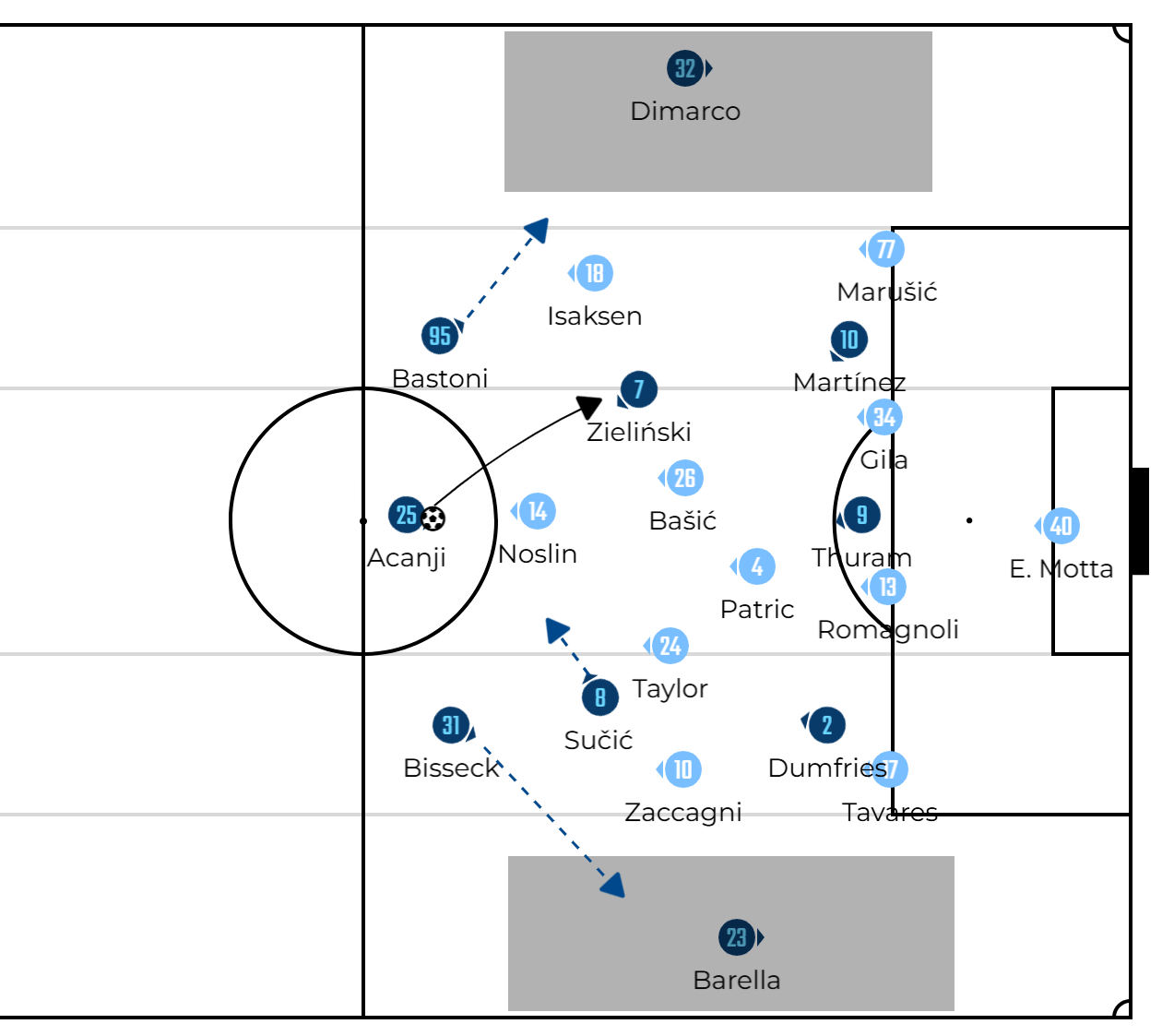
Inter’s positional occupation during build-up: Barella maintains width on the right touchline, Dumfries attacks the half-space, while Lautaro and Thuram collapse centrally to create multiple passing options around the ball and sustain territorial dominance.
Crucially, once possession was directed towards either wide area, the two nearest interior attackers immediately collapsed towards the ball-carrier, ensuring multiple short passing connections around the zone. This created constant numerical superiority near possession, allowed Inter to sustain attacks without losing structure, and prevented Lazio from ever stabilising defensively.
Inter’s Wide Rotations
Another major component of Inter’s attacking development came through their highly coordinated wide rotations, particularly down the right flank, where Chivu’s side repeatedly manipulated Lazio’s defensive references to open central access near the penalty area. Whenever possession was directed towards the right side, Inter immediately created an overload around the wide zone through staggered positional movements involving Barella, Dumfries and Thuram. Barella maintained an extremely wide position close to the touchline, stretching Lazio’s defensive block horizontally and forcing the entire back line to expand towards the flank.
Inside him, Dumfries attacked the right half-space, but crucially curved his movement outward towards the channel in order to drag Romagnoli away from the centre and destabilise Lazio’s defensive spacing. Simultaneously, Thuram occupied the interior lane between full-back and centre-back, attracting Mario Gila deeper towards the same side and further increasing the structural separation between Lazio’s central defenders.
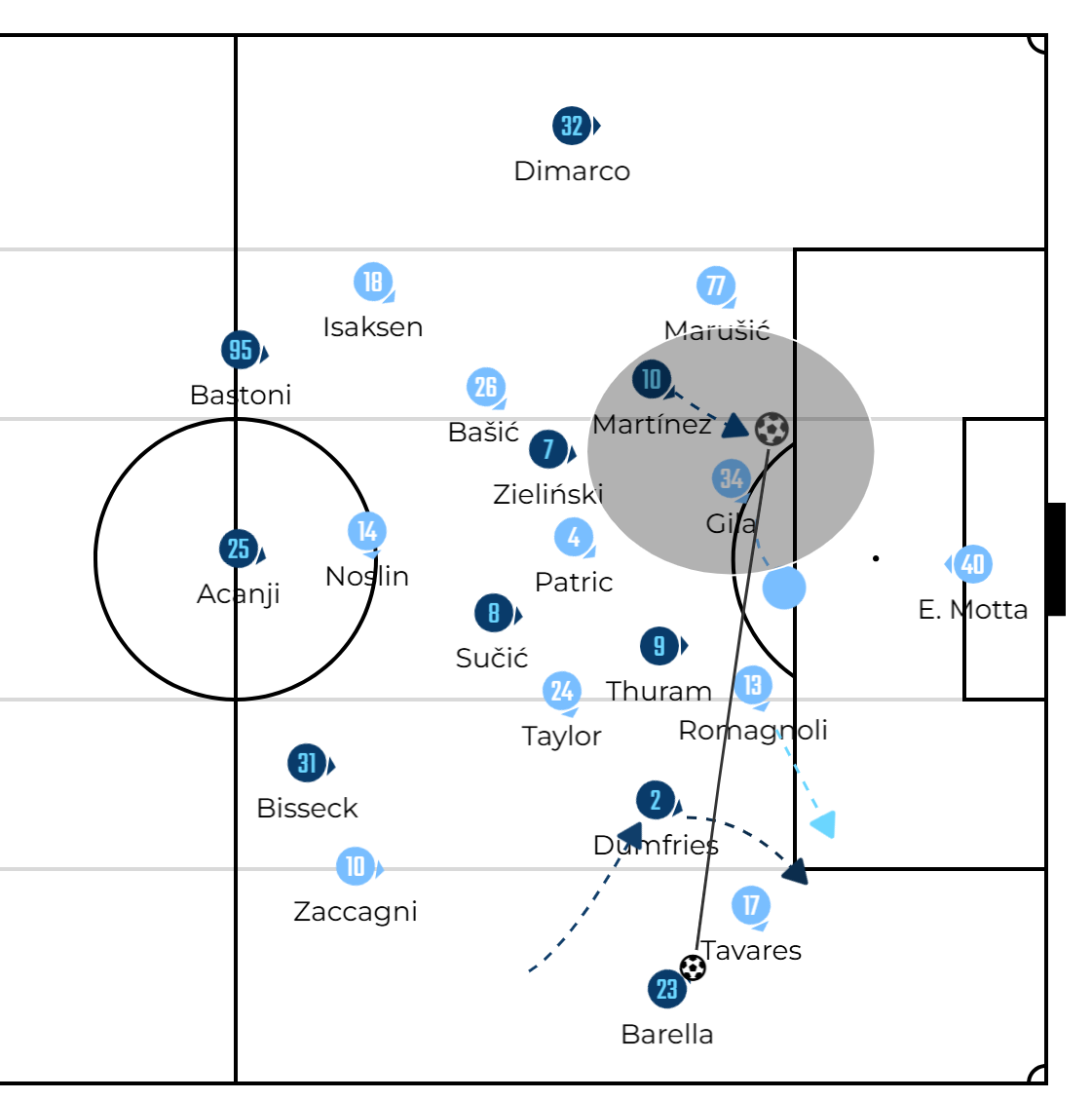
Inter’s right-sided overload: Barella stretches the width, Dumfries curves outward from the half-space, and Thuram attracts Gila inside, creating the central gap that Lautaro Martínez attacks near the penalty area.
These coordinated rotations ultimately created a vacant central corridor near the edge of the penalty area, which Lautaro Martínez consistently targeted through delayed movements into the free zone. The entire mechanism was designed to isolate Lautaro against reduced defensive coverage inside the most dangerous central spaces.
Lazio’s Persistent Transitional Collapse
One of Lazio’s biggest unresolved issues from the previous league defeat remained their defensive instability during transitional phases, a weakness Inter exploited repeatedly once again in the final. During attacking transitions, Inter consistently advanced through a right-sided structure involving Barella and Dumfries, with Thuram and Lautaro Martínez immediately joining the overload around the ball.
The problem for Lazio came from their excessive ball-oriented defensive reactions. Romagnoli and Taylor were both dragged aggressively towards the right side in an attempt to contain the overload, while Gila also shifted across to provide additional cover near the same zone. Even Tavares frequently collapsed towards the ball-side, leaving Lazio with four defenders converging around only two or three Inter players near the flank.
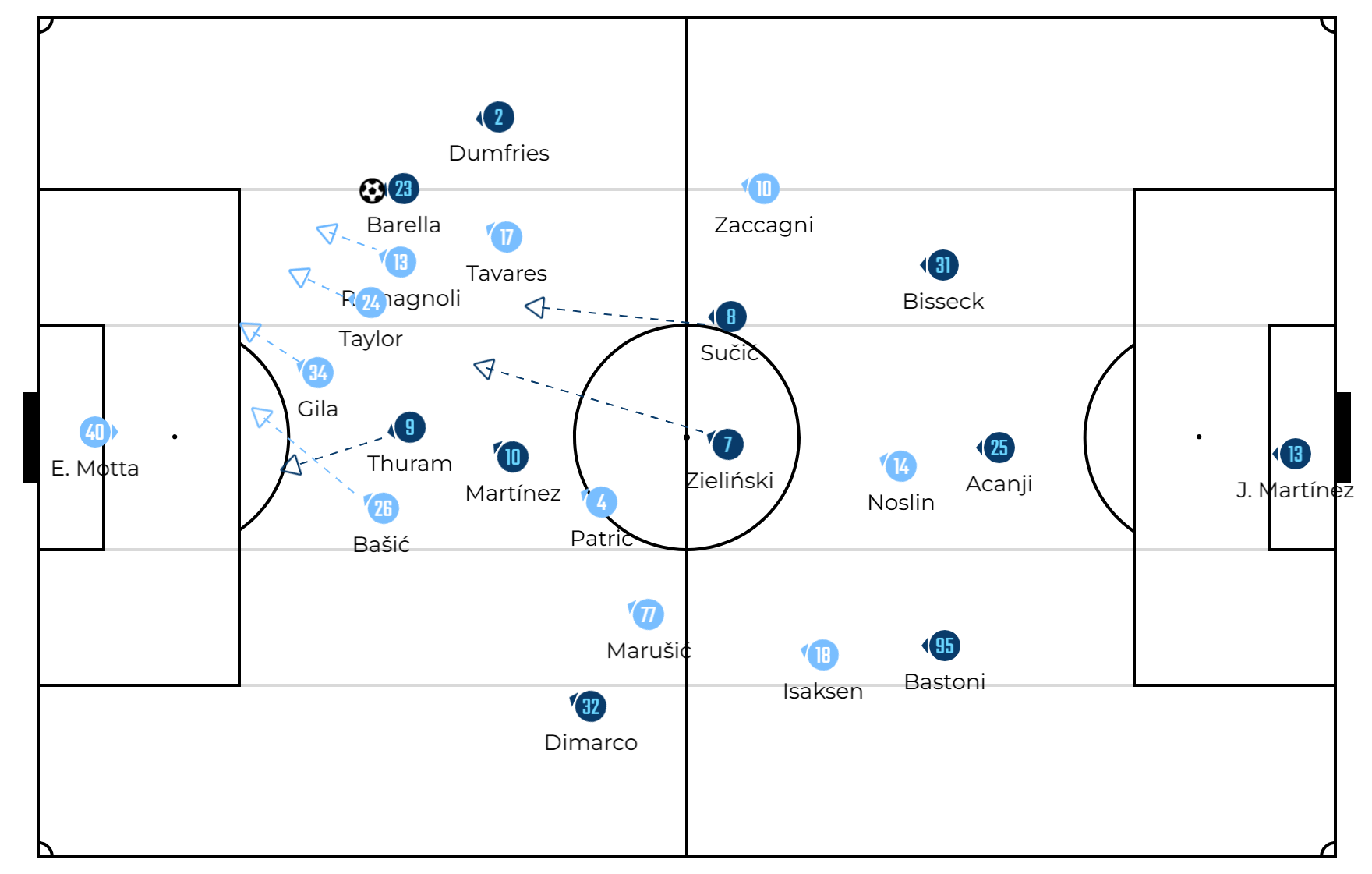
Lazio’s transition collapse: four defenders are dragged towards Inter’s right-sided overload, leaving free attackers unmarked near the edge of the penalty area during defensive transitions.
As a consequence, the far side and central edge of the penalty area were repeatedly left exposed with minimal defensive occupation. Rather than protecting spaces, Lazio’s defensive line simply chased the ball collectively, allowing Inter’s free attackers to arrive unmarked around the box and generate dangerous situations through simple transitional combinations.
Inter’s Intelligent Pressing Against Lazio’s Build-Up
Lazio attempted to construct possession through a five-player build-up structure designed to create stability across the first two phases. Tavares held the width on the left side, Romagnoli operated centrally, while Gila positioned himself inside the right half-space as the far-side outlet. Ahead of them, Taylor and Patric formed the second line of circulation to support progression through midfield.
Inter, however, responded with an extremely intelligent pressing scheme focused on isolating Lazio’s distant free man. When Lazio initiated build-up from the left side, Thuram pressed Tavares aggressively, Lautaro screened Romagnoli through the central channel, while Dumfries followed Taylor in the second line. Barella simultaneously tracked Patric near the ball-side central lane, ensuring compact numerical pressure around possession.
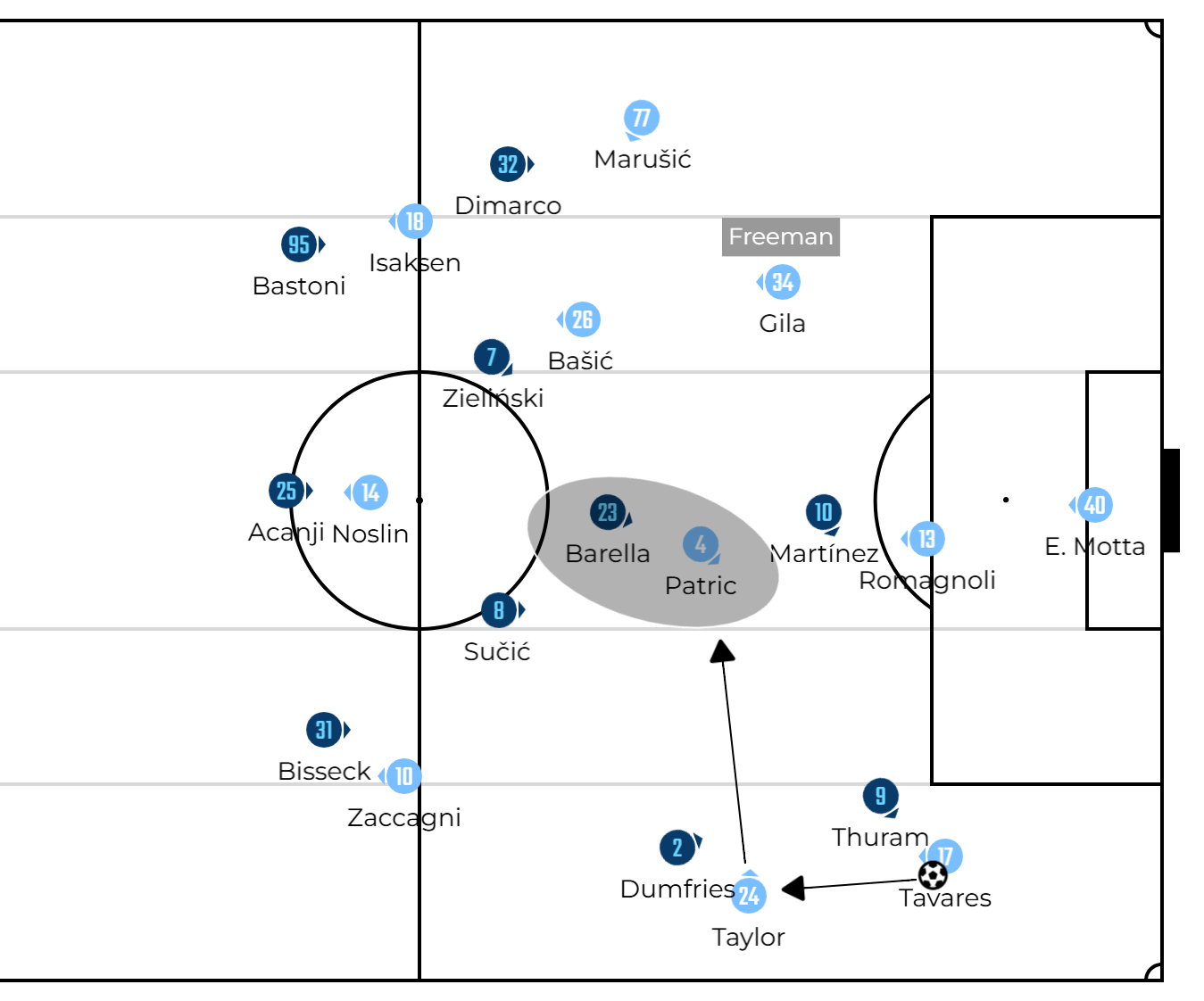
Inter’s pressing trap: Lazio’s near-side options are aggressively marked while Gila is intentionally left free on the far side, forcing predictable lateral switches that Inter repeatedly intercepts.
Inter intentionally left Gila free on the far side, knowing the only available escape route would become a long horizontal switch towards the right half-space. These slow lateral passes were repeatedly anticipated and intercepted by Inter, completely disrupting Lazio’s circulation rhythm and collapsing their build-up structure under pressure.
Takeaways
Inter’s dominance once again came from their superior positional structure, coordinated wide rotations and intelligent pressing organisation under Cristian Chivu. The Nerazzurri consistently manipulated Lazio’s defensive references through overloads, half-space occupation and aggressive transitional attacks.
Lazio, despite several structural adjustments from the previous meeting, continued to suffer from the same defensive issues during transitions and wide defensive rotations. Their excessive ball-oriented reactions repeatedly exposed central spaces around the penalty area.
Inter’s pressing traps against Lazio’s five-player build-up further exposed the hosts’ inability to progress cleanly under pressure, allowing Chivu’s side to fully control both territory and rhythm throughout the final with remarkable tactical maturity.


Comments