
Liverpool – Arsenal: Gunners Weather The Storm At Anfield (0-1)
Arsenal were able to create an advantage against the Liverpool press early in the game, and went ahead from their own high press. After this, they were forced to sit deep against a high-energy Liverpool side who were unable to find the breakthrough despite pushing Arsenal’s defense to the limit.
Tactical analysis and match report by Josh Manley.
We decided to make this article free to read. If you want to support our work, consider taking a subscription.
Liverpool came into this game on a relatively strong run of form, having only lost one game so far this season and won their last five games consecutively. There has been optimism at Anfield that their attacking talents are starting to build a good understanding on the pitch.
Despite EFL Cup defeat in midweek, Arsenal have also been quite consistent this season, aside from their defeat away at Brighton. They came into this game with the league’s strongest defensive record so far, being one of the few sides to have conceded less than a goal per game.
Liverpool lined up in a 4-2-3-1 shape here, with a back four of Ronald Araújo, Jérémy Jacquet, Virgil van Dijk, and Milos Kerkez. Alexis Mac Allister was joined in central midfield by Trey Nyoni, while Florian Wirtz was the number ten. Cody Gakpo and Bradley Barcola flanked Alexander Isak up front.
For Mikel Arteta, it was also a 4-2-3-1 formation with Jurriën Timber, Ezri Konsa, Gabriel Magalhães, and Riccardo Calafiori at the back. Declan Rice and Bruno Guimarães were the central midfielders while Noni Madueke, Martin Ødegaard, and Christos Tzolis supported Kai Havertz in attack.
Arsenal’s bright start
The opening twenty minutes or so is often one of the most challenging periods of the game for away teams at Anfield, but Arsenal were able to handle it very well in this case.
Against the man-to-man high press of Liverpool, Arteta had a particular plan that worked quite well initially in creating a midfield overload.
Mac Allister and Nyoni would jump forward to mark Rice and Guimarães in Liverpool’s press, with the expectation that van Dijk could then push forward into midfield to mark Ødegaard, who normally plays from Arsenal’s right halfspace, and would therefore be directly in front of van Dijk.
Instead, though, Ødegaard would depart from the right halfspace when Arsenal were building from the back, drifting over towards the left halfspace.
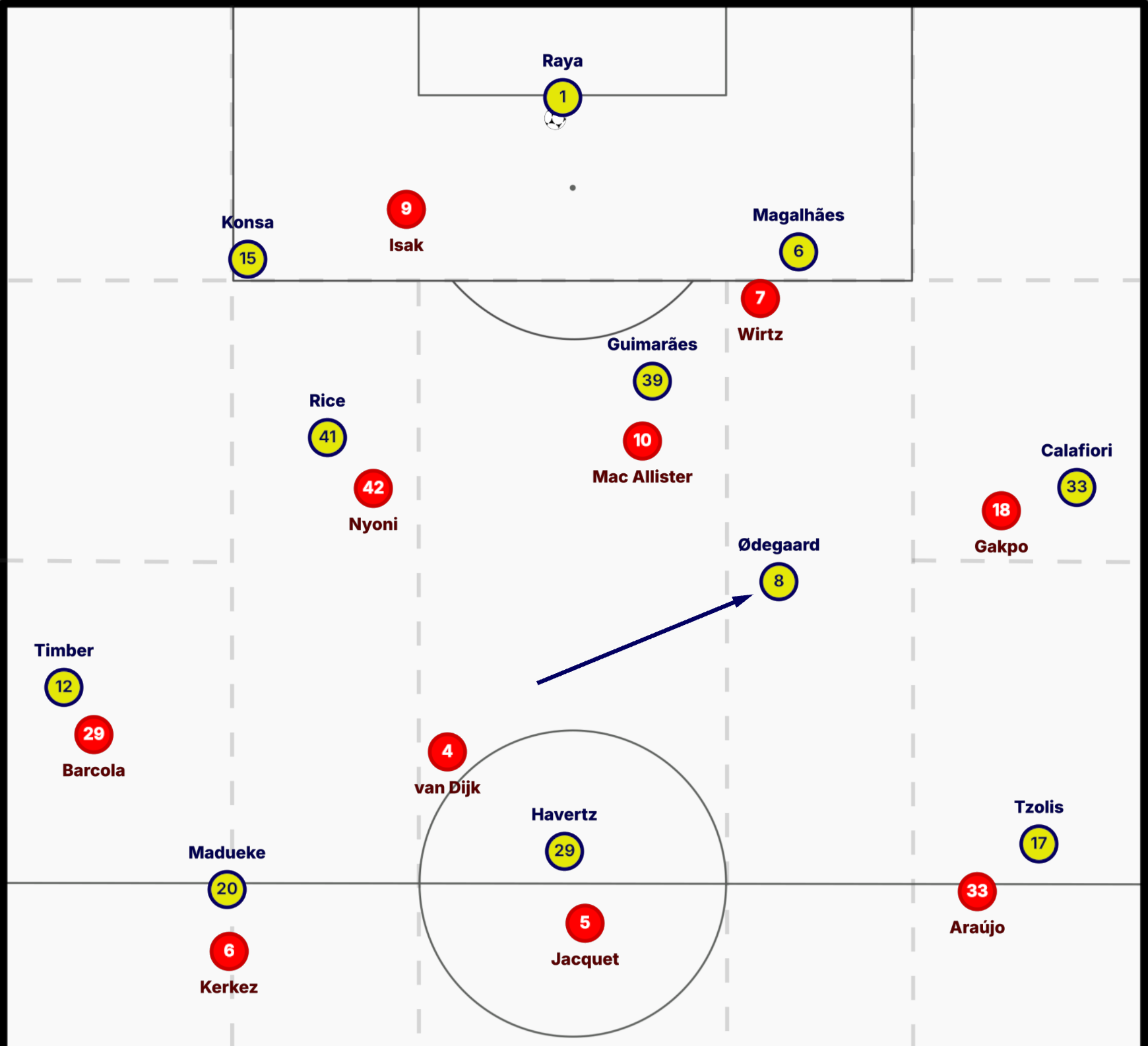
Arsenal’s solution against the Liverpool press.
This meant that van Dijk would have to travel further from his nominal position to mark him, crossing over with his center-back partner, which is quite unintuitive for central defenders, even if they’re comfortable pushing into midfield.
The theoretical alternative was for van Dijk and Jacquet to quickly coordinate a handover of Havertz so that the Frenchman could step out instead, but this would have been difficult to arrange in the flow of a match.
Therefore, for the first twenty minutes or so, Ødegaard was able to get free behind Liverpool’s midfield line.
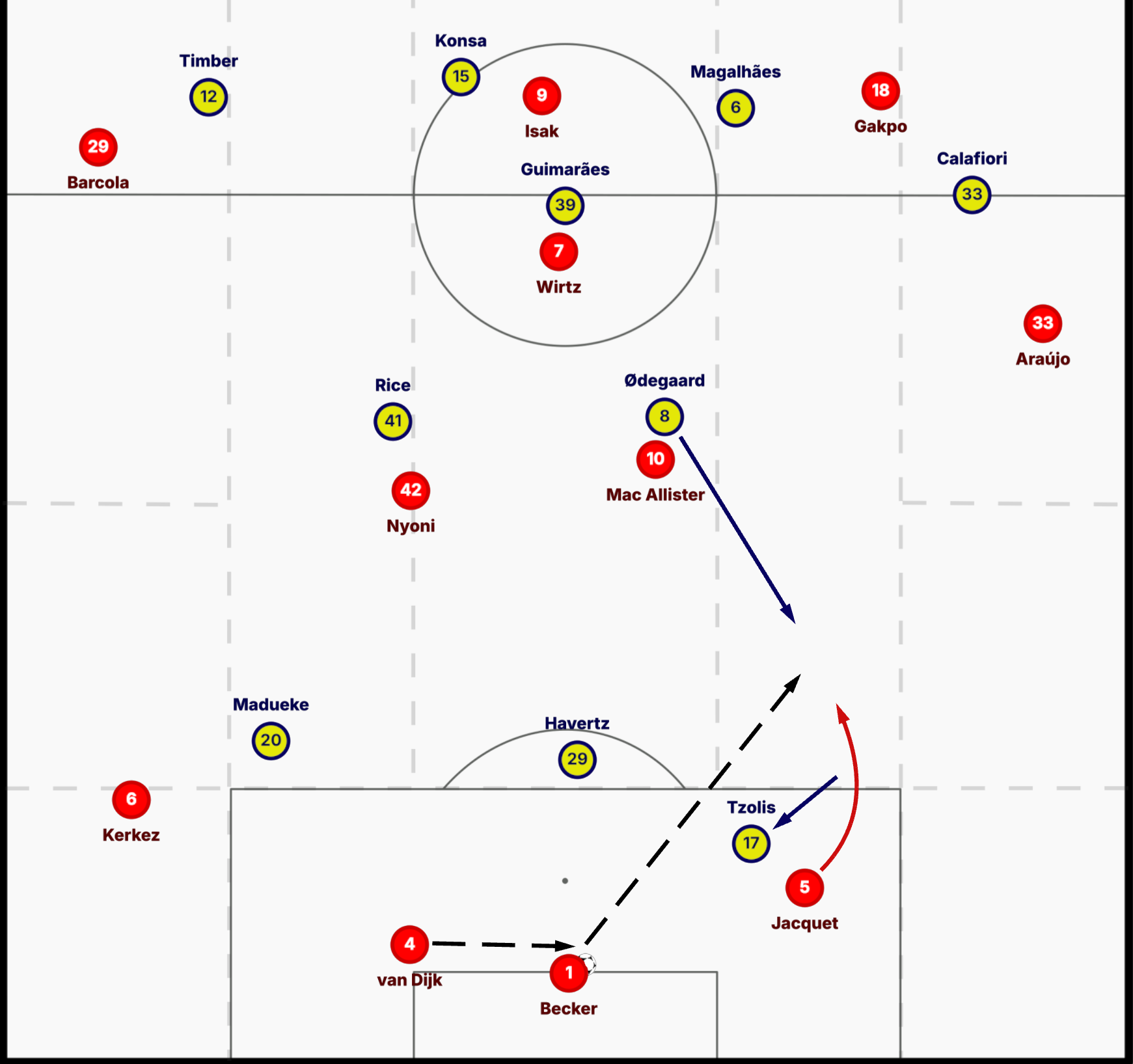
The high-pressing scene leading to Arsenal’s goal.
This was part of a wider trend of Arsenal being on top, which eventually culminated in them going ahead through Havertz after winning the ball back in a high press against Liverpool’s own buildup.
Liverpool’s resurgence
Although Liverpool were unable to get on the scoresheet, Andoni Iraola could hardly have hoped for his team to respond better to going behind.
The period of the game following Arsenal’s goal was one in which Liverpool were able to impose their chaotic playing style on the game. They were direct and they played at a high tempo. Crosses were thrown into Arsenal’s box and Liverpool counterpressed relentlessly.
Arsenal defended in a low 4-4-2 shape with both strikers dropping deep, close to the midfield.
Against this, Nyoni would usually drop between or beside the center-backs for Liverpool, while Mac Allister played slightly higher, usually just in front of Arsenal’s midfield line with freedom to run beyond.
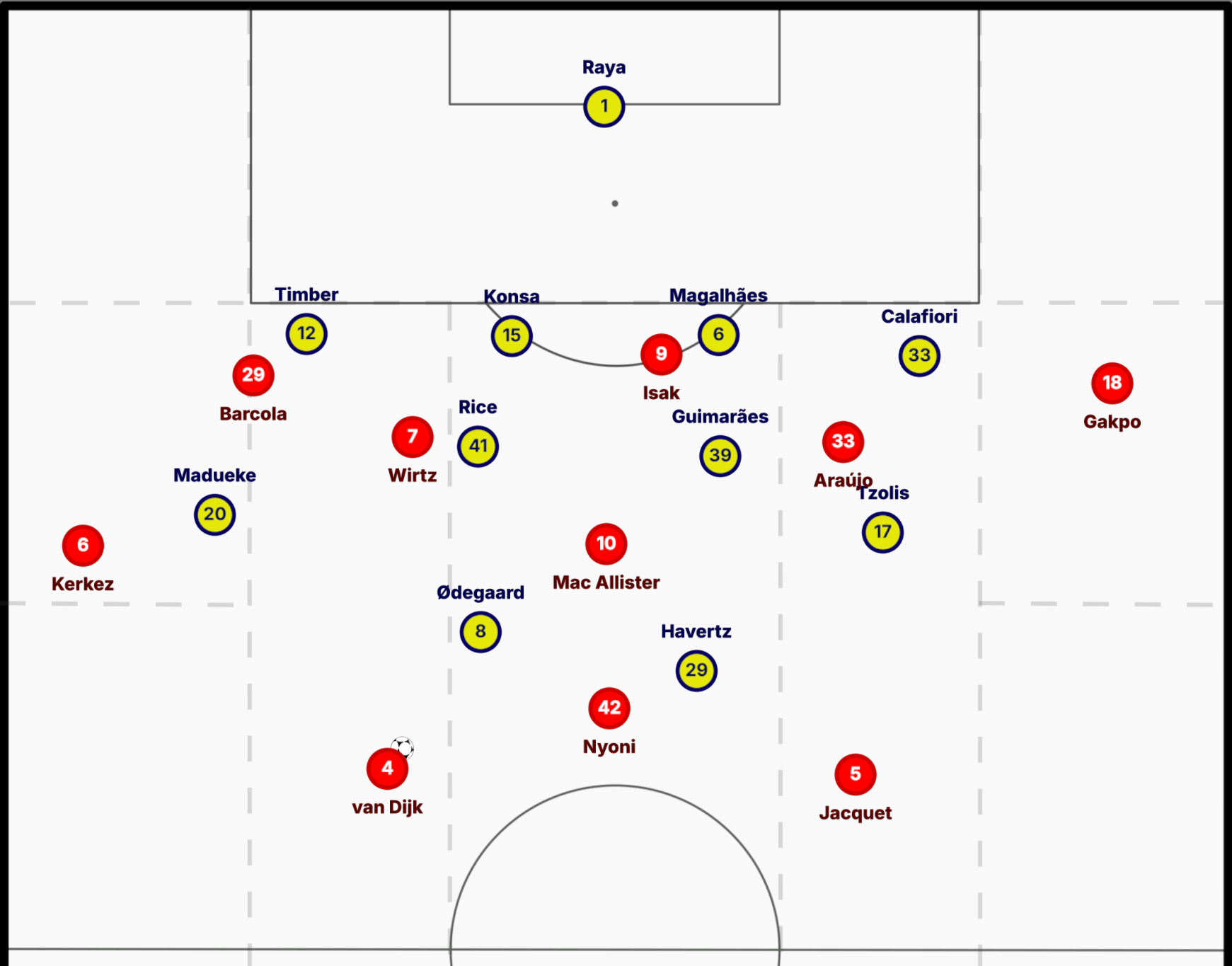
Liverpool’s attacking shape.
Araújo started from right back but had freedom to make runs into more attacking positions in the right halfspace in order to add his height to Liverpool’s crossing threat. Gakpo therefore often stayed wider on the right.
On the left, Kerkez was a threat with his crossing, providing overlaps to Barcola, who could then indent. Much of Liverpool’s threat came from this side. Wirtz meanwhile played from the number ten position with freedom to roam to either halfspace.
Liverpool were able to tighten up their press and force Arsenal long more often too, which resulted in more possession for Iraola’s side.
Arsenal did have a clear plan for going long, sending Timber into higher positions on the right and targeting him for aerial duels, but Liverpool were generally able to sweep up these long balls.
Arsenal hold on to win
Liverpool continued to have the majority of possession in the second half too, and Arsenal’s attacking threat in the second half was relatively small.
The exception to the general pattern in the second half was a ten-minute spell after the hour mark where Arsenal were able to settle the game down and have a few calm possession phases.
As the game drew towards its end, though, Arsenal were dropping deep with their initial 4-4-2 shape dropping into back five variations at times with the wide midfielders dropping off.
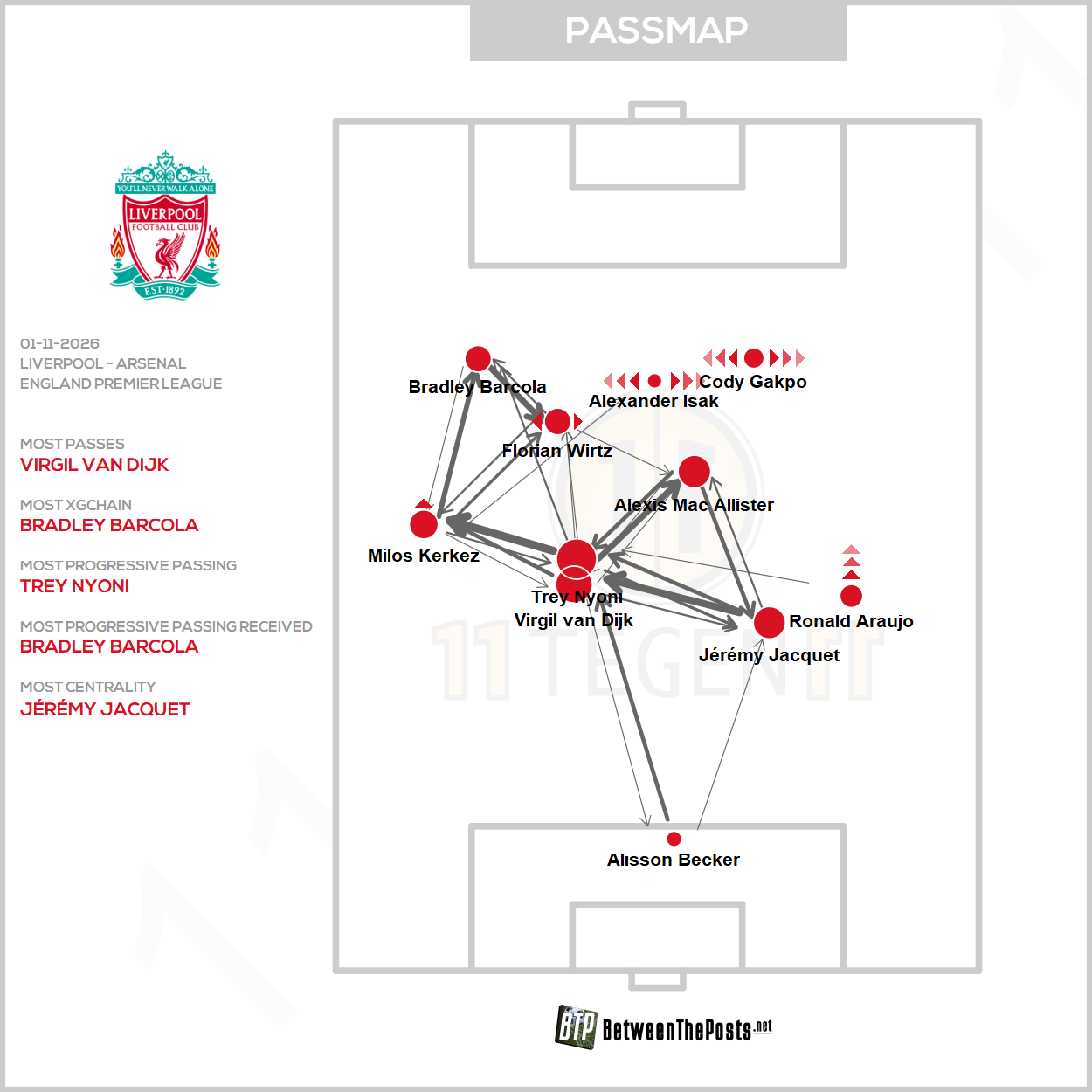
Much of Liverpool’s attacking threat came down the left side.
Both sides made changes in midfield, with Iraola bringing Dominik Szoboszlai in for Nyoni to try and add some creativity, while Arteta replaced Guimarães with Myles Lewis-Skelly.
Rio Ngumoha also replaced Gakpo shortly afterwards, adding a different dribbling threat from the right side, which had offered less than the Liverpool left side until this point.
The introduction of Ngumoha was probably a contributing factor to Arteta’s later decision to replace Tzolis with Piero Hincapié, who slotted in at left back while Calafiori moved to left midfield.
In reality though, Calafiori often ended up becoming left wing-back in a five, and his role was to help double up against Nguomha on this side.
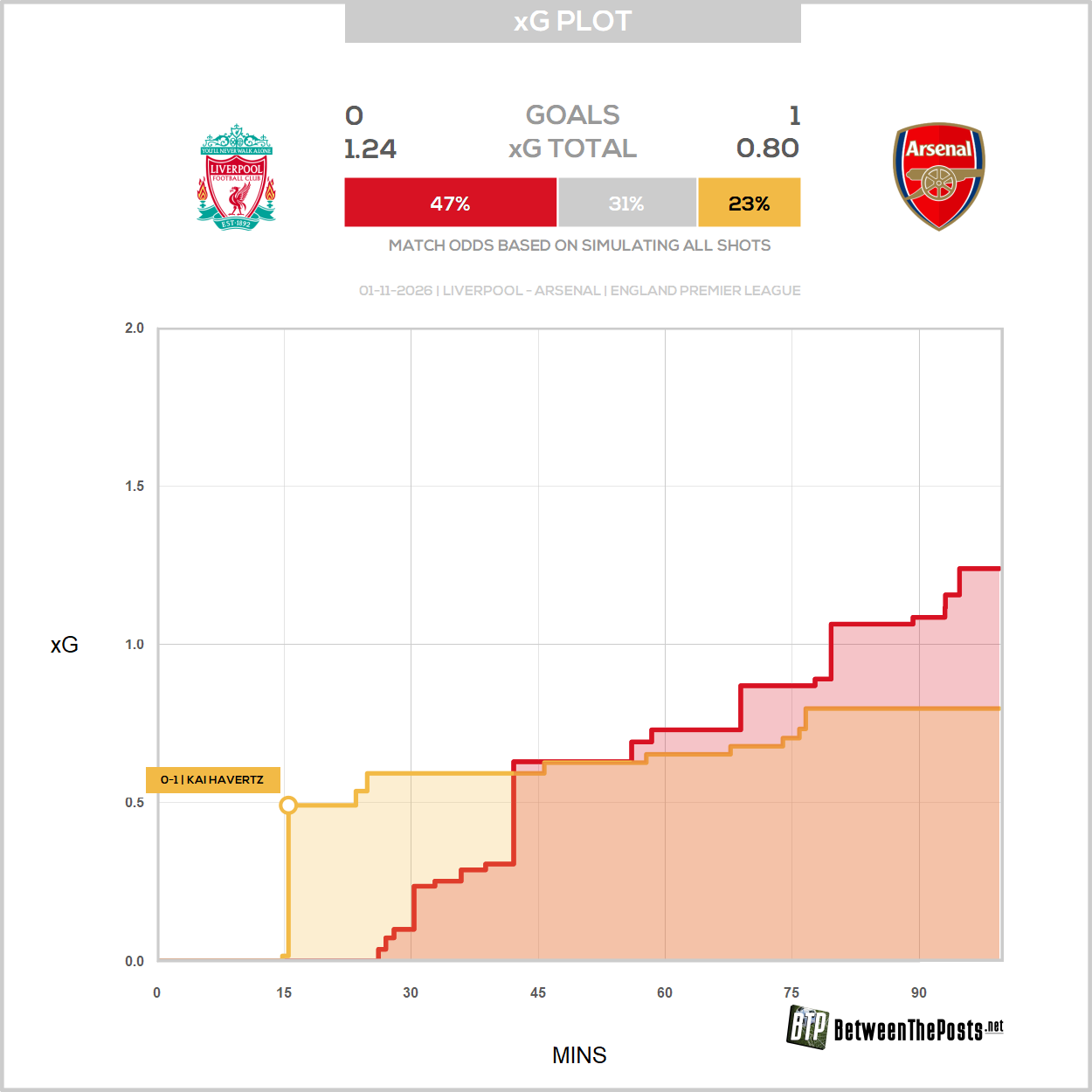
Despite Liverpool pushing Arsenal’s defence hard, they actually didn’t manage a shot on target until the ninetieth minute. Arsenal prevailed in the end, leaving them top of the table.
Takeaways
Liverpool didn’t quite get their press right in the first fifteen minutes, and gave away an avoidable goal against the Arsenal high press. After that, they gave a relatively strong performance, imposing their chaotic and high-tempo style on the game, but were unable to convert that into a goal.
Arsenal display in the early stages was a trademark demonstration of control. They created superiority in midfield against Liverpool’s press, and went ahead through their own high pressing game. After that, it was less controlled, and they did give away some chances. They were able to slow the tempo a little in the second half though, and eventually secured the three points.
Use the arrows to scroll through all available match plots. Click to enlarge.
Check the match plots page for plots of other matches.