
Manchester City – Paris Saint-Germain: Game of Two Halves in Champions League Slugfest (2-4)
Paris Saint-Germain looked to sweep Manchester City aside with a display of Champagne football. Everything looked to be going well for the reigning Champions League winners, as they stormed to a 3-0 lead in the first half. However, Enzo Maresca’s changes would shift the momentum of the game.
Tactical analysis and match report by Nick Hartland.
We decided to make this article free to read. If you want to support our work, consider taking a subscription.
Manchester City were thankful for the end of an international break, where the footballing community were lasered in on the club following an announcement from the Premier League that an independent commission had found them guilty of all charges related to a serious breach of the Premier League’s financial rules over a nine-year period. City have appealed the decision. Speculation over what will happen next was rife, but in the here and now, the club ticked along, defeating Liverpool 3-0 on the weekend.
Paris Saint-Germain would likely have hoped to avoid playing City so soon after the announcement. While they have not been accused of any wrongdoing – apart from their historic breaches of UEFA’s financial fair play – there was perhaps a fear within some supporters that they would be tarred with the same brush due to them also being owned by a Gulf state. Like City, PSG won over the weekend, dispatching newly promoted Le Mans 3-1.
Enzo Maresca lined his City side up in a 4-2-3-1 shape. Gianluigi Donnarumma was in goal behind a backline consisting of Joško Gvardiol, Marc Guéhi, Rúben Dias, and Abdukodir Khusanov. Elliot Anderson and Enzo Fernández made up the double pivot. On the wings, Jérémy Doku and Antoine Semenyo, with Rayan Cherki in the middle. Up front, Erling Haaland.
No surprises with Luis Enrique’s 4-3-3 formation. In goal, Matvei Safonov. The back four was Nuno Mendes, Willian Pacho, Marquinhos, and Achraf Hakimi. In the midfield, Fabián Ruiz, Vitinha, and Warren Zaïre-Emery. In attack, Désiré Doué, Ousmane Dembélé, and Maghnes Akliouche made up the fluid frontline.
End-to-end transitions
For all Maresca and Luis Enrique’s love for mesmeric passing football, this was going to be a battle better defined by how the two teams played without the ball. It was a clash of two similar out-of-possession systems, as the two teams harried and pressed one another in man-oriented approaches. From the early exchanges, the game was stretched and played at a frenetic pace, with frequent transitions and counterpressing creating an open game.
City would hit the woodwork inadvertently in the 12th minute when Cherki’s corner delivery was pushed onto the crossbar by Safonov. The rebound fell to Semenyo, but the winger couldn’t keep his shot down, with the ball going out for a goal kick. Neither goalkeeper in the opening minutes wanted to invite the opposition into an advanced defensive shape by building possession out from the back; instead they opted to kick it into midfield.
PSG would in a roundabout way open the scoring following this goal kick. A firefight in the middle of the park would eventually lead to PSG reluctantly building from the back. City went to press man-to-man. PSG rotated fluidly to try and cause havoc in City’s system, and it worked as a lapse in concentration from Cherki opened up a free man, allowing PSG to bypass the pressure and attack the backline.
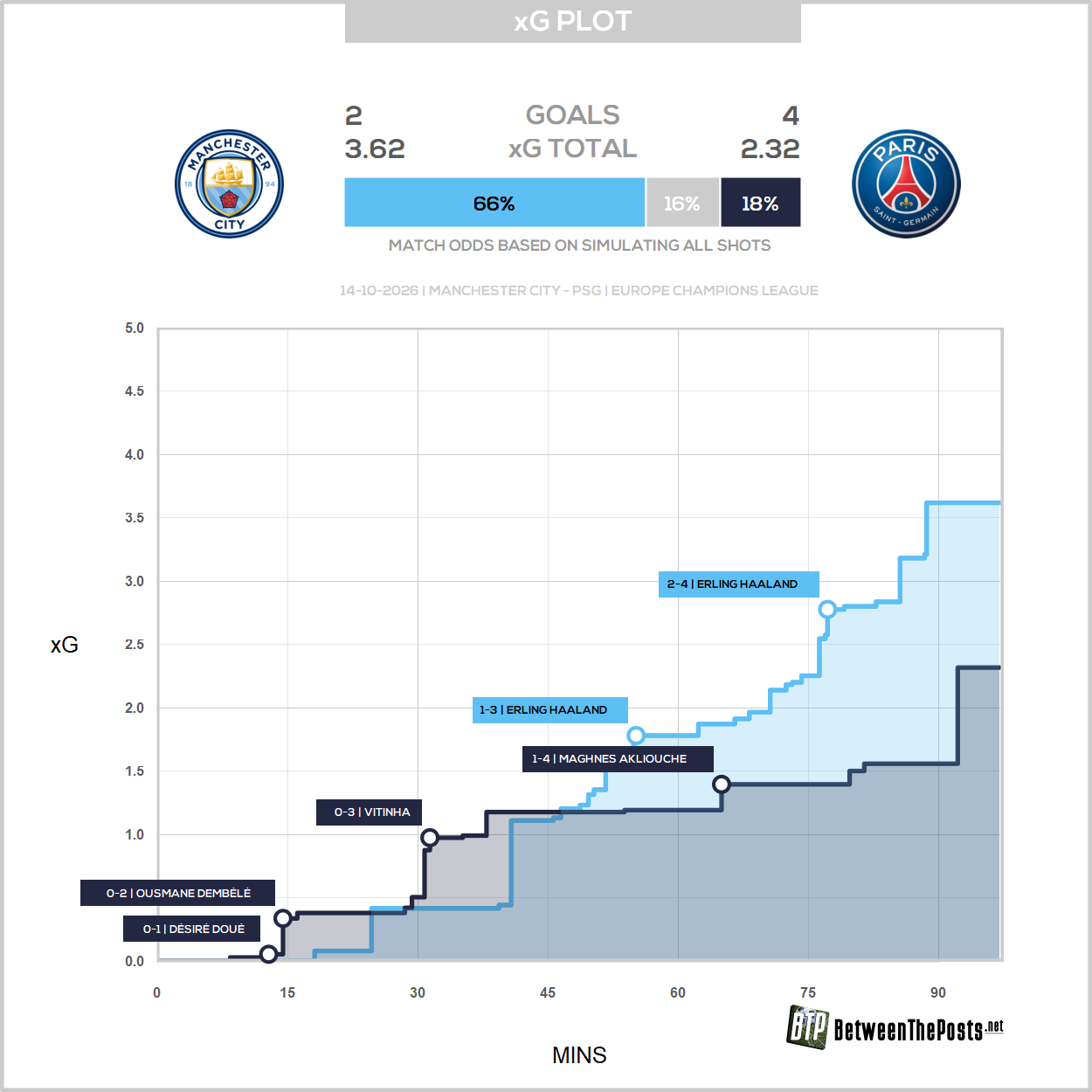
From there, the opener would come from a moment of sublime finishing from Doué, who fired a cushioned shot from outside the box to give his side the lead in the 13th minute. Two minutes later, Dembélé would make it two off a header following a glorious lobbed one-two with Doué – it was like two tennis players rallying over the net. For PSG, it was par for the course against English opposition, where they’ve made fast starts routine.
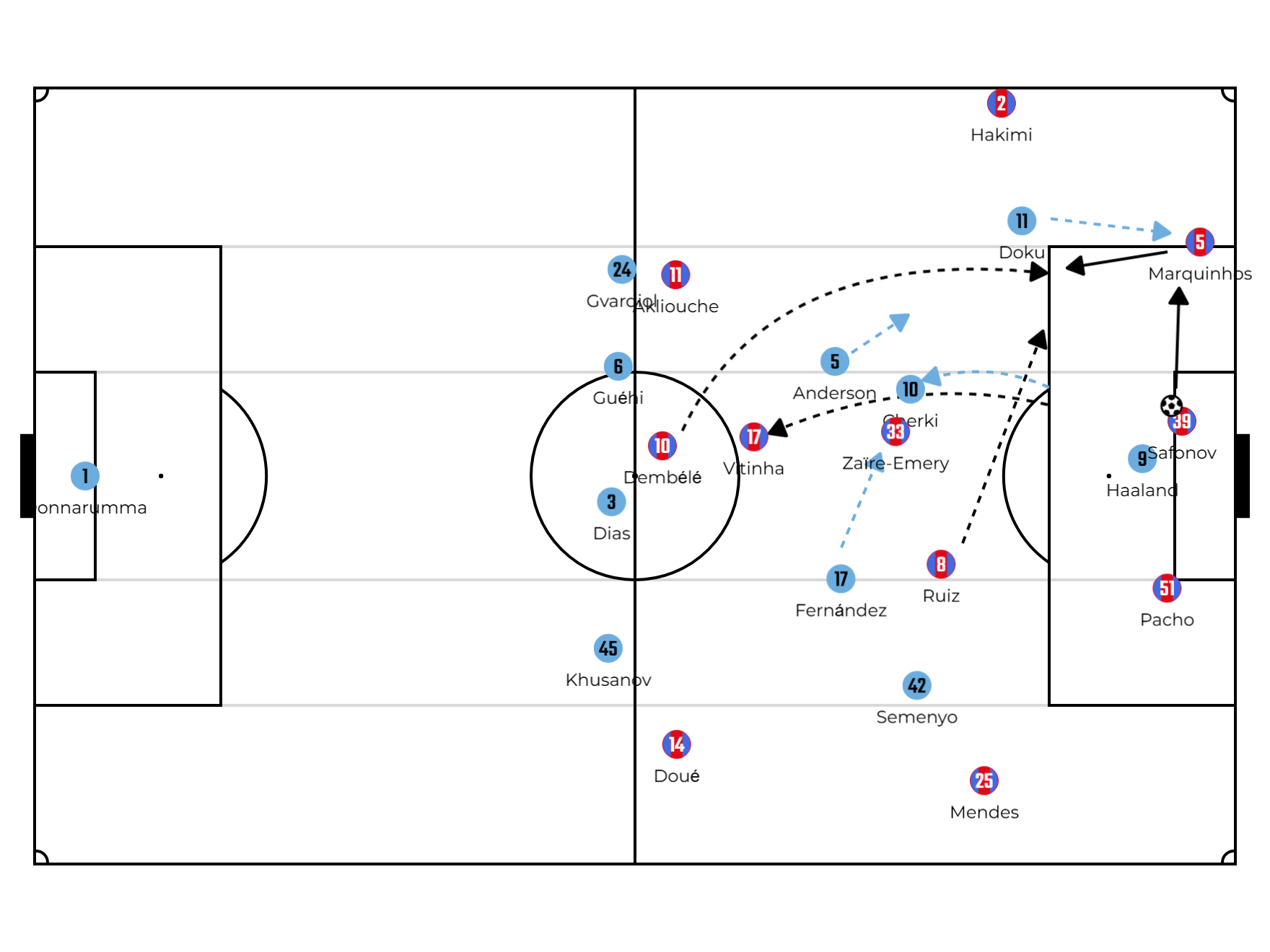
13th minute: PSG build from the back. Vitinha and Dembélé rotate. Cherki follows Vitinha’s run, but then gives up and blocks the lane into Zaïre-Emery. This forces Anderson off his assignment. Fernández then makes the run across to try and free up Cherki to press Ruiz. However, Ruiz is left untracked.
City collapse
Following the second goal, City looked to build from Donnarumma picking a short option more frequently. They wanted to quickly play through PSG’s pressure. However, their midfield was frequently caught in traps and forced to turn over possession, allowing Les Parisiens to launch quick counters at worst and take control of the ball at best. The byproduct of City’s change was, ironically, that they began to have less control of the game.
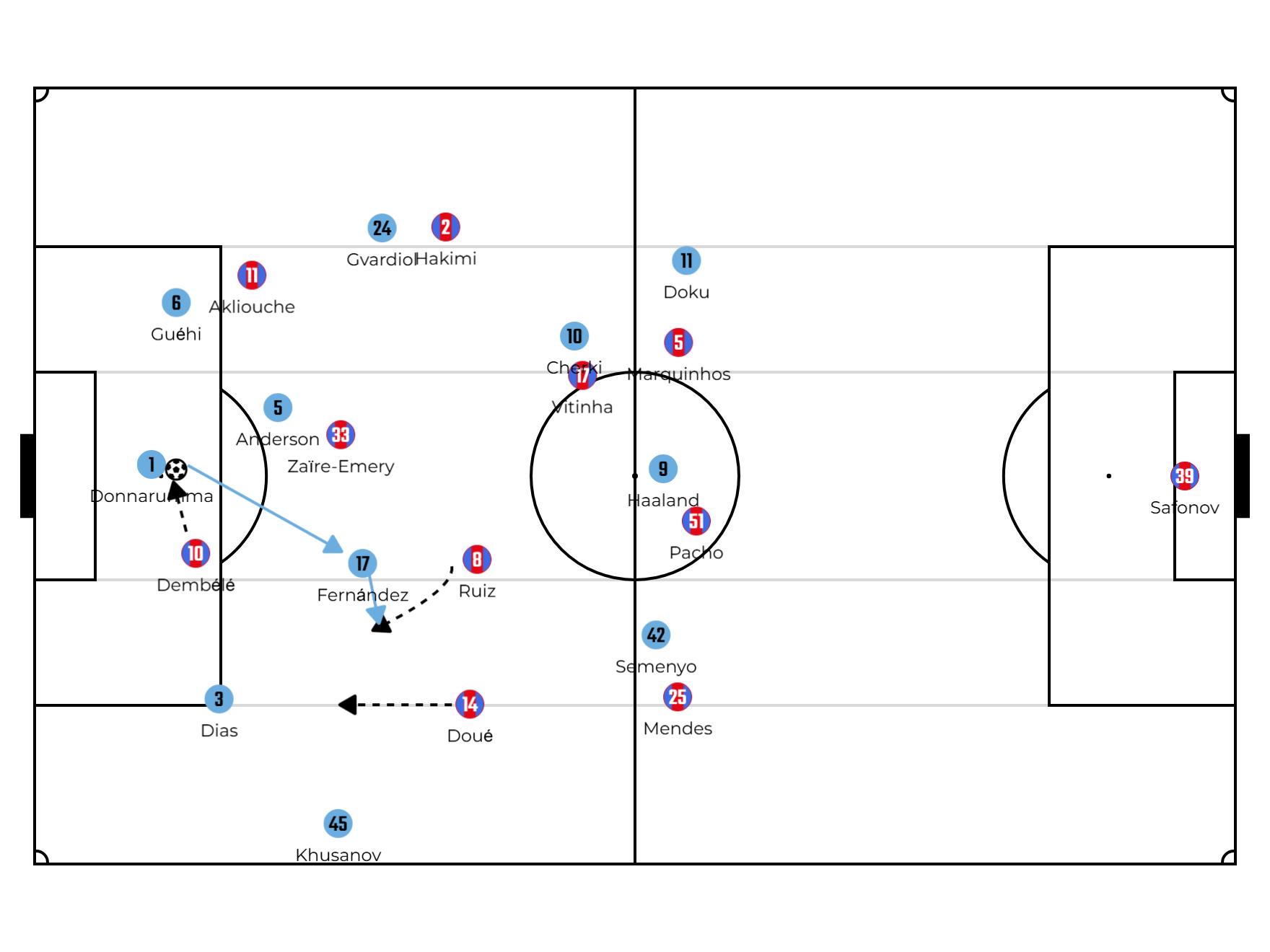
17th minute: Manchester City play the ball short through Donnarumma. PSG press to create a turnover. You can see the way that PSG man-mark the midfield. Fernández is given a bit of space in the middle to create an inside pressing trap when he tries to play the ball wide to Khusanov.
Furthermore, it forced them in the minutes after conceding their second goal to more frequently drop into their deeper zonal shape, which in turn allowed PSG to move the ball more easily as City waited for Haaland to pick his moment and press a poor pass. The problem was that it often allowed Vitinha free rein to drift around the pitch, slipping into pockets of space unbothered. There is a truism: if you stop Vitinha, you stop PSG.
Perhaps that’s easier said than done, but the selection of Cherki was not helping the team address this matter. When City pressed high, Cherki often wouldn’t track the midfielder’s runs, and in the zonal shape, Vitinha knew to sit outside the block just on the edge of City’s trigger. The difference then was that PSG very rarely made a mistake without the ball, and were suffocating in the way they followed City’s midfield.
In the 31st minute, PSG should have made it three, when Hakimi popped up in the number nine role. The right-back headed the ball beyond Donnarumma, but he would be denied by the post. A minute later, PSG would deliver on their promise with Vitinha finding the back of the net following a swashbuckling bit of passing play.
Maresca had seen enough
City needed to show something different in the second half. Maresca wasted no time in the break, making some sweeping alterations with a triple change. Cherki, Doku, and Dias were replaced by Ayyoub Bouaddi, Iliman Ndiaye, and Matheus Nunes. Bouaddi slotted into the double pivot alongside Anderson, which allowed Fernández to push into Cherki’s role. Ndiaye was a straight swap on the left with Doku, while Nunes went into the right-back role, meaning Khusanov could take up a spot in the center of the defense.
Perhaps the most impactful of the changes was Bouaddi. His vision with the ball and ability to play out of pressure was immediately on display, while Fernández was able to provide more threat out of possession higher up the pitch. This meant that the center of the park was no longer a battlefield that City were losing, but instead they were able to control the ball far better and create more meaningful links with their attack.
In part, they were helped by a game state which didn’t encourage quite as much intensity from Les Parisiens. In essence, their visitors had already done the hard work in the first half, and their appetite for continuing at the same intensity was waning. City were able to carve out several good chances at the start of the second half, with Haaland giving them a bit of hope over an unlikely comeback in the 53rd minute when he opened the scoring for City.
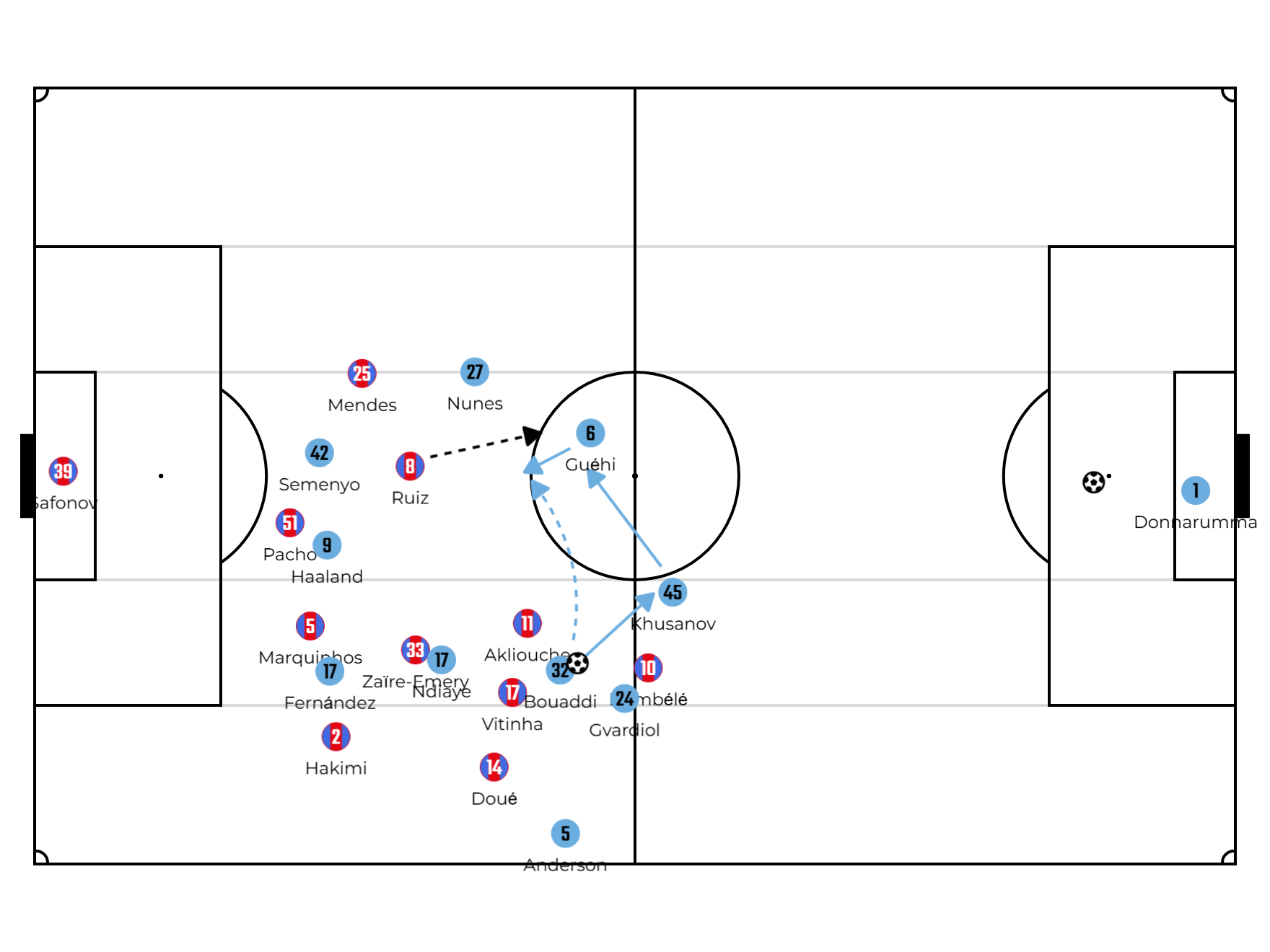
49th minute: Bouaddi plays out of pressure. Giving City the ability to absorb and bypass PSG’s out-of-possession approach.
A final push falls short
Chance after chance began to fall to City, but on the whole, they were wasteful with the opportunities they were beginning to carve out. It was against the run of play that the next goal would be scored. From outside the box, Akliouche decided to chance his luck and fire off a speculative effort. Donnarumma looked to save it, but the spin on the ball sent it in a looping arc over the goal line.
Haaland would halve the deficit in the 75th minute following a lovely bit of sustained pressure out of possession from his teammates. Bouaddi pressed high and then was in place to receive the ball down the left wing. He spotted Haaland for the cutback, and the striker fired home. City never let their heads drop as they sensed blood, but couldn’t do anything more to further their cause.
PSG would be given one last opportunity to put the game out of sight as they played increasingly on the counter. Mendes was brought down in the box by Nunes in the 87th minute. To call it a soft decision would be an understatement, and some sense of justice was done when Ferran Torres fired low and off-center for Donnarumma to easily snatch.
Takeaways
The damage had been done in a bruising first half. City had got their set-up wrong and were punished. Their adjustments in the second half were excellent, but the finishing meant that they could never take advantage of PSG’s inability to raise their levels under pressure. In the end, City would be disappointed to come away from this game with a defeat.
PSG’s focus definitely slipped after the first half. It’ll be a concern for Luis Enrique that his squad weren’t able to do anything to prevent the momentum from shifting in City’s favor in the second half. It’s been a theme for the manager this season that his squad is surprisingly (for the level of investment) lacking a little depth. Either he starts the A-team and they do well but are weakened by the bench, or he starts the B-team and has to rely on the A-team rescuing the result.

Comments