
Palmeiras – Corinthians: Palmeiras dominate a broken Corinthians in the derby (4-1)
In the race for the top of the Brasileirão table, Palmeiras thrashed Corinthians, who are in crisis, have suffered several consecutive Brasileirão defeats, sacked Fernando Diniz, are under a transfer ban and have even hired Seedorf, who has not worked as a team’s head coach since 2019, when he managed the Cameroon National Team. On Matchday 30, Giay stood out and played an important role in dominating a derby that exposed all of Corinthians’ weaknesses.
Tactical analysis and match report by Marcus Arboés.
After the break for Brazil National Team friendlies, Abel Ferreira had time to recover some players and readjust the team, which made the most of the rest period to improve and returned in outstanding form. The emphatic win over their biggest rivals came with a new ideal lineup in a 3-4-3 formation: Carlos Miguel (former Nottingham Forest) in goal; Murilo, Gustavo Gómez (Paraguay) and Barboza as the center back trio; Giay (Argentina) and Piquerez (Uruguay) as the fullbacks; Andreas Pereira (former Fulham) and Lucas Evangelista as midfielders; Jhon Arias (Colombia), Flaco López (Argentina) and Vitor Roque (former Barcelona) as the attacking trio. Practically a South American national team.
Political crisis, countless consecutive defeats, a disjointed team and a sacked coach. Corinthians are going through one of their worst periods in recent years, and William Batista, the youth team coach, was tasked with taking over on an interim basis and lifting the spirits of an unsettled squad before Seedorf took charge. He lined up a 4-4-2 outline: Hugo Souza (Brazil) in goal; Matheuzinho (Brazil), Gabriel Paulista (former Valencia), Gustavo Henrique and Matheus Bidu in the defensive line; Raniele, Carrillo (former Peru National Team), André and Breno Bidon (also Brazil) in midfield; Memphis Depay and Yuri Alberto as the striking partnership.
Palmeiras’ total dominance
Fernando Diniz’s tenure at Corinthians started well. We analyzed the team’s rapid defensive improvement from a tactical perspective here, but the side lost confidence amid a succession of injuries, internal problems and, eventually, defeats. He failed to reinvent the team, and whenever they created opportunities, the players made mistakes. Against Palmeiras, we saw an ineffective side that looked even more apathetic than before when it came to creating attacking moves. The defeat was deserved and emphatic, as Palmeiras managed to dominate without difficulty.
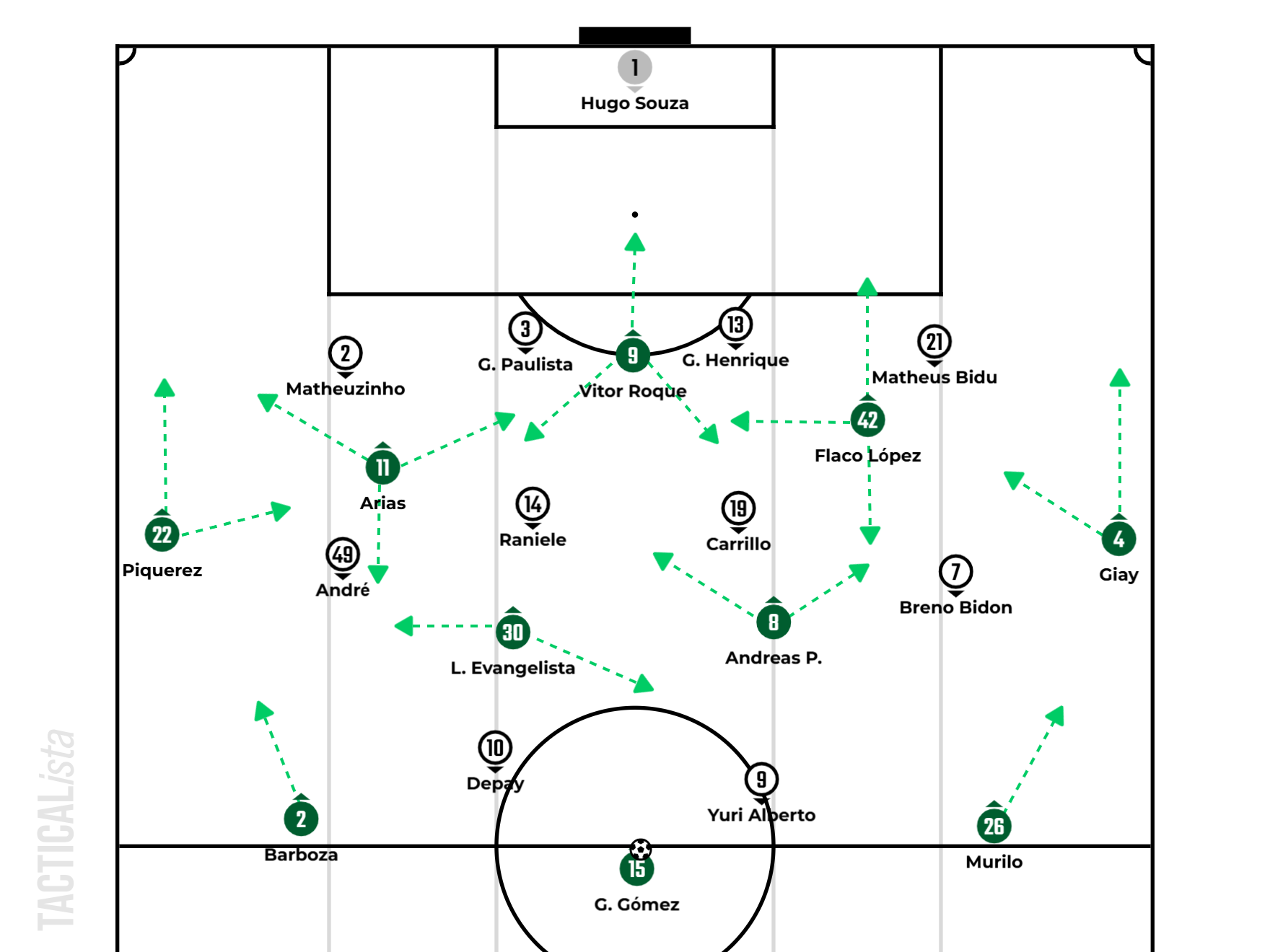
Palmeiras’ attack starting from a 3-4-3 shape against Corinthians’ defense in a 4-4-2 formation.
Palmeiras dominated the game both offensively and defensively, but the most important aspect to highlight was how they structured their possession in the opposition half through a vertical positional system. The use of three center backs who are not necessarily great ball-playing defenders was technically compensated for by having two central midfielders with strong build-up ability and the capacity to combine infield.
When Lucas Evangelista moved forward inside to create a passing lane, Andreas Pereira moved closer to the base of the play, and the opposite happened on the other side. Both midfielders consistently created numerical superiority out wide, bringing three or four players together without abandoning the positional structure. The fullbacks alternated between staying wide and attacking the inside channels to free up Arias and Flaco López to provide width. Both players helped with combinations between the lines and received the ball out wide to carry it inside, especially the Colombian.
Corinthians, on the other hand, defended in a 4-4-2 formation that focused heavily on closing the spaces between the two last lines, but struggled to protect the flanks. It took Palmeiras very little time to score the opener, with Barboza heading home. After that, the game became comfortable for the hosts, who prefer an approach in which they control the opposition’s options defensively before launching counterattacks.
The contrast between the fullbacks
The game was decided by a standout performance from Giay, the Argentina National Team right fullback, who scored twice and delivered an excellent defensive display. While Giay scored two goals, Matheus Bidu, Corinthians’ left fullback, made mistakes that led to two goals, highlighting the huge contrast in their direct duel on that side of the pitch.
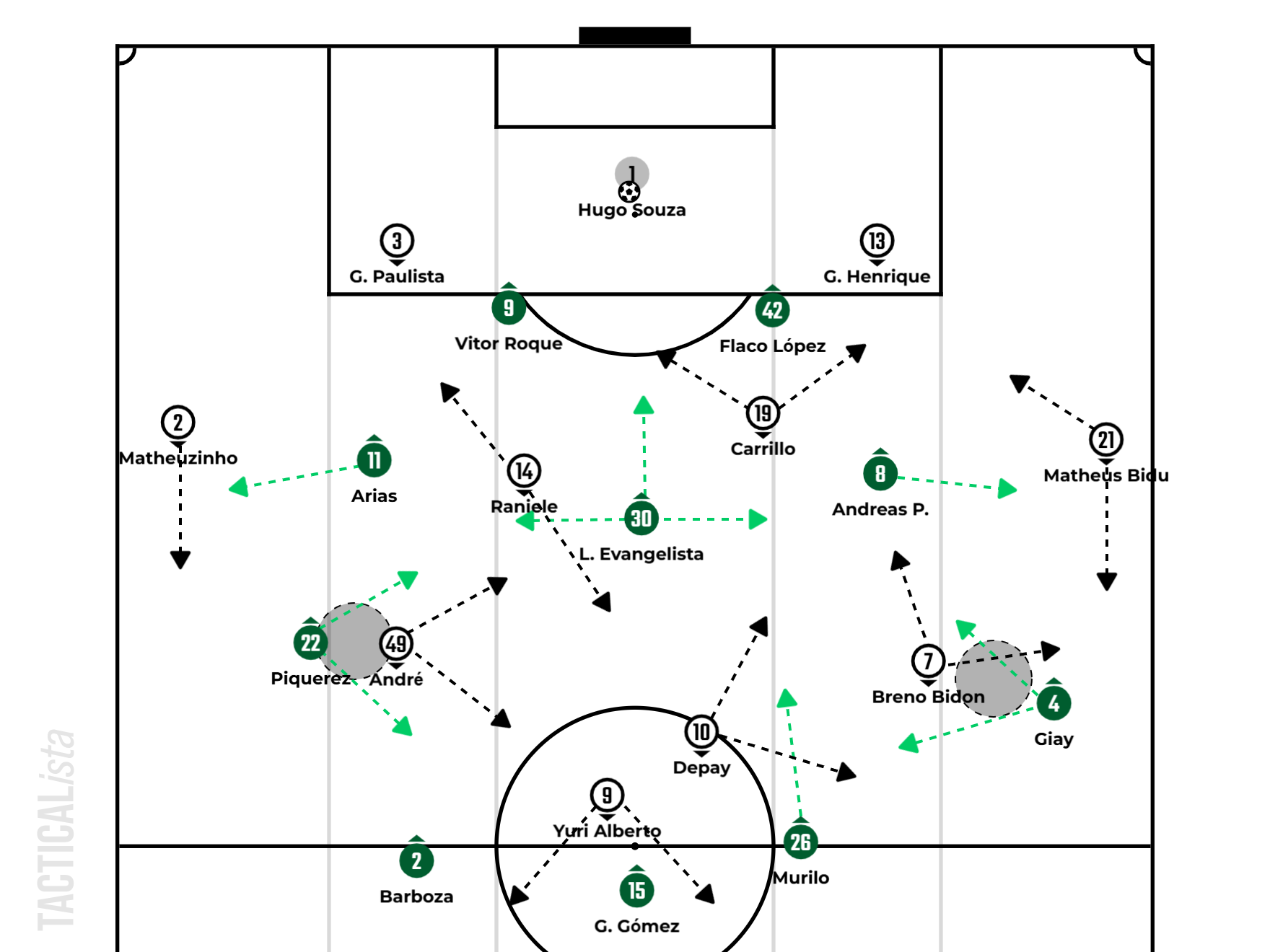
Palmeiras’ defensive structure in a high block with man-oriented marking.
Corinthians spent much of the game trying to build from the back, using their holding midfielders to connect Memphis Depay with the more advanced midfielders, or attempting to release Matheuzinho down the right and Yuri Alberto with long balls. None of this was effective, precisely because of Palmeiras’ strategy of defending in a high block through individual tracking.
Flaco and Vitor Roque formed the first line, while Arias, Lucas Evangelista and Andreas Pereira created a 5-3-2 shape, shifting across to deal with the fullbacks. However, if Corinthians intended to build through the middle, Giay and Piquerez tracked the opposition’s advanced midfielders inside with aggressive man-oriented marking. This meant the three center backs consistently had the advantage when marking Yuri Alberto and Memphis individually, allowing the third defender to provide cover.
Two of Palmeiras’ goals came from this pattern, with transitions following turnovers high up the pitch after intense pressing. On both occasions, Giay emerged as a surprise element on the right flank. For the second goal, after his attempted cross, Arias took a shot that Hugo Souza saved, but Matheus Bidu failed to protect the rebound, allowing Giay to anticipate him and score.
That wasn’t his only mistake. For the third goal, right after the second half began, a seemingly harmless cross caused him to get tangled up with the center back, and he headed the ball over his own goalkeeper and into the net. One of the most bizarre own goals ever seen in Brazilian football, a fitting representation of Corinthians’ situation.
The final scenario
With four goals scored, the game was effectively decided early, and a completely apathetic Corinthians tried to make targeted tactical changes, replacing the advanced midfielders with wingers. Palmeiras, meanwhile, did not alter their tactical structure with their substitutions.
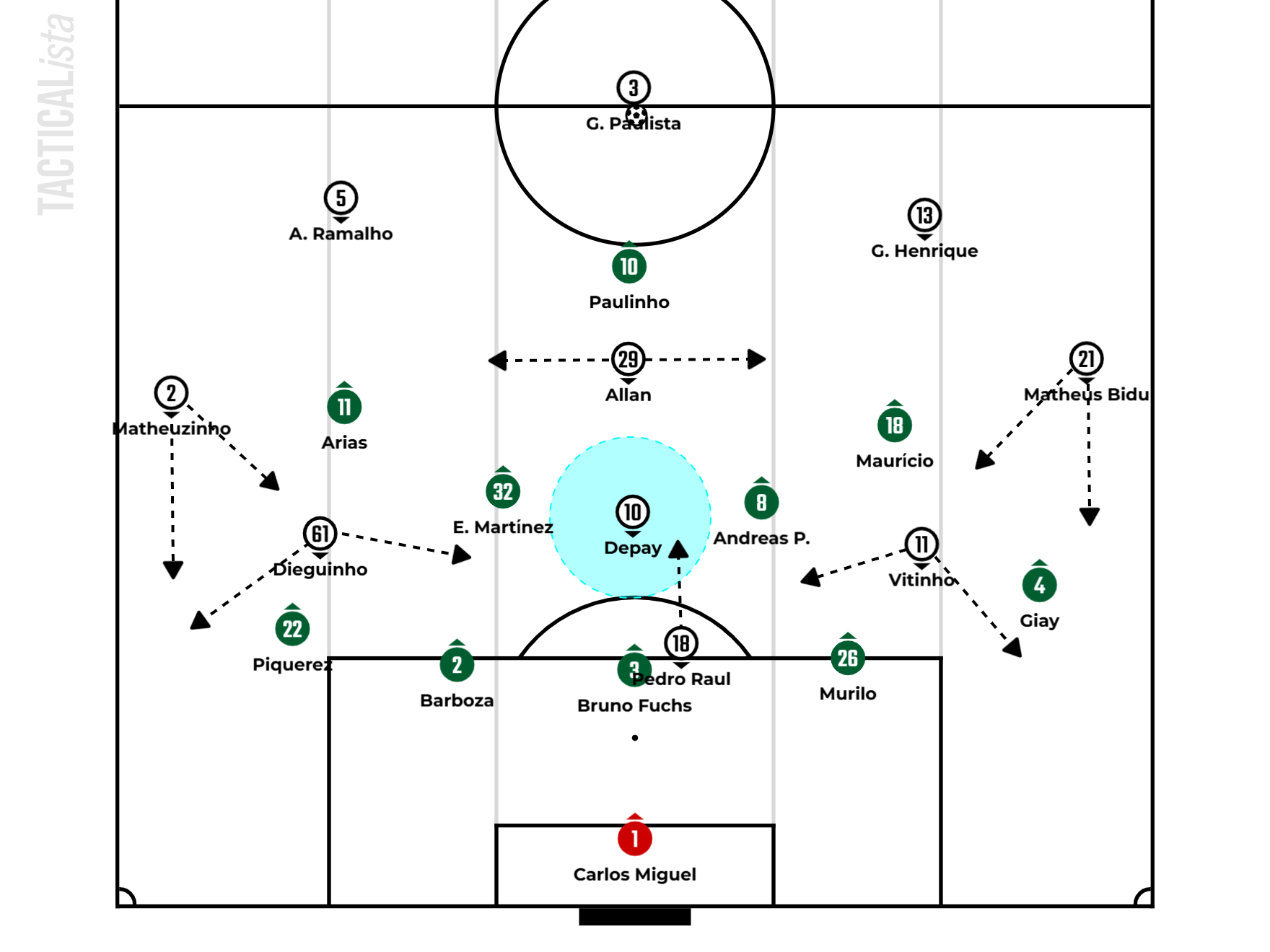
The final tactical scenario, with Corinthians attacking in a 3-1-6 formation and Palmeiras defending in a 5-4-1 shape.
Nothing worked. With an extra center back and just one holding midfielder, Corinthians began building up in a 3+1 structure, with the fullbacks pushing forward out wide and creating numerical superiority in the outside channels alongside the wingers. Memphis Depay continued drifting toward whichever flank the team was trying to attack, while Pedro Raul came on to try to score headers but barely received any crosses.
Corinthians could not create an advantage out wide because Palmeiras had an extended defensive line of five players and defended in a 5-4-1 shape, with the wingers working hard to track back. Late in the game, Paulinho (former Leverkusen) came on for Sosa, who had come on earlier but was forced off through injury, and ended up missing a penalty. The punishment, if we can even call it that, was a consolation goal, or not much of a consolation at all, from Gustavo Henrique following a corner.
Takeaways
During derby week, Palmeiras secured a convincing thrashing, putting their new ideal starting lineup to the test, with three center backs and a highly technical midfield. However, they failed to catch Flamengo, who beat Fluminense, the same opponent Palmeiras had defeated in midweek in the Copa Libertadores.
Corinthians’ crisis, on the other hand, was compounded by an emphatic defeat against their biggest rivals. Seedorf, returning to coaching after seven years, faces a difficult task in organizing the defense and rebuilding the confidence of a team whose self-esteem has been completely shattered and that cannot even sign reinforcements.
Use the arrows to scroll through all available match plots. Click to enlarge. Check the match plots page for plots of other matches.


Comments