
Palmeiras – Flamengo: The Brasileirão’s best game crowns the best attack in Brazil with its tenth title (1-1)
After a long race, Flamengo overtook Palmeiras, opened up a lead, and drew with them to consolidate their status as the competition’s best attack, with a goal from the Brasileirão’s best player. A tenth title seemed only a matter of time, but Palmeiras, who had gradually squandered a points advantage, put up a strong fight and delivered the best game of the championship in terms of technical quality, worthy of the two best teams in Brazil and South America.
Tactical analysis and match report by Marcus Arboés.
After keeping their Brasileirão title hopes alive, Abel Ferreira’s Palmeiras played very well, even without all their regular starters, as they are preserving some players for the Copa Libertadores and Copa do Brasil finals. The team therefore took the field in a 3-4-3 outline: Carlos Miguel in goal; Bruno Fuchs, Gustavo Gómez (Paraguay) and Benedetti as the defensive trio; Giay (Argentina) and Arthur Gabriel as the fullbacks; Marlon Freitas and Andreas Pereira (former Fulham) in midfield; and Jhon Arias (Colombia), Flaco López (Argentina) and Vitor Roque (former Barcelona) forming the attacking trio.
With Léo Pereira and Erick Pulgar suspended, the only bold decision by coach Leonardo Jardim was to leave Carrascal, the player in the best form in the country, on the bench. Flamengo therefore started with Argentine goalkeeper Rossi; Varela (Uruguay) at right fullback and Alex Sandro (former Juventus) on the left; Léo Ortiz and Danilo (former Brazil National Team) as the center-back pairing; Jorginho (former Arsenal) as the first holding midfielder, Lucas Paquetá (former West Ham) as the second holding midfielder, and De Arrascaeta (Uruguay) as the number ten, forming the midfield; up front, Gonzalo Plata (Ecuador) on the right wing, Samuel Lino (former Atleti) on the left, and Pedro (Brazil) as the number nine.
As you can see, both teams are packed with players who represent their National Teams. The best teams in Brazil.
A first half of high technical and physical quality
The first half of this great game featured 17 shots in total, many of them clear goal-scoring opportunities, in an electric encounter between two teams that attack quickly and use open spaces to move forward, each with its own style and different tactical systems. Palmeiras were the team that took the lead, making the most of their opportunity while also benefiting from a great performance by goalkeeper Carlos Miguel.
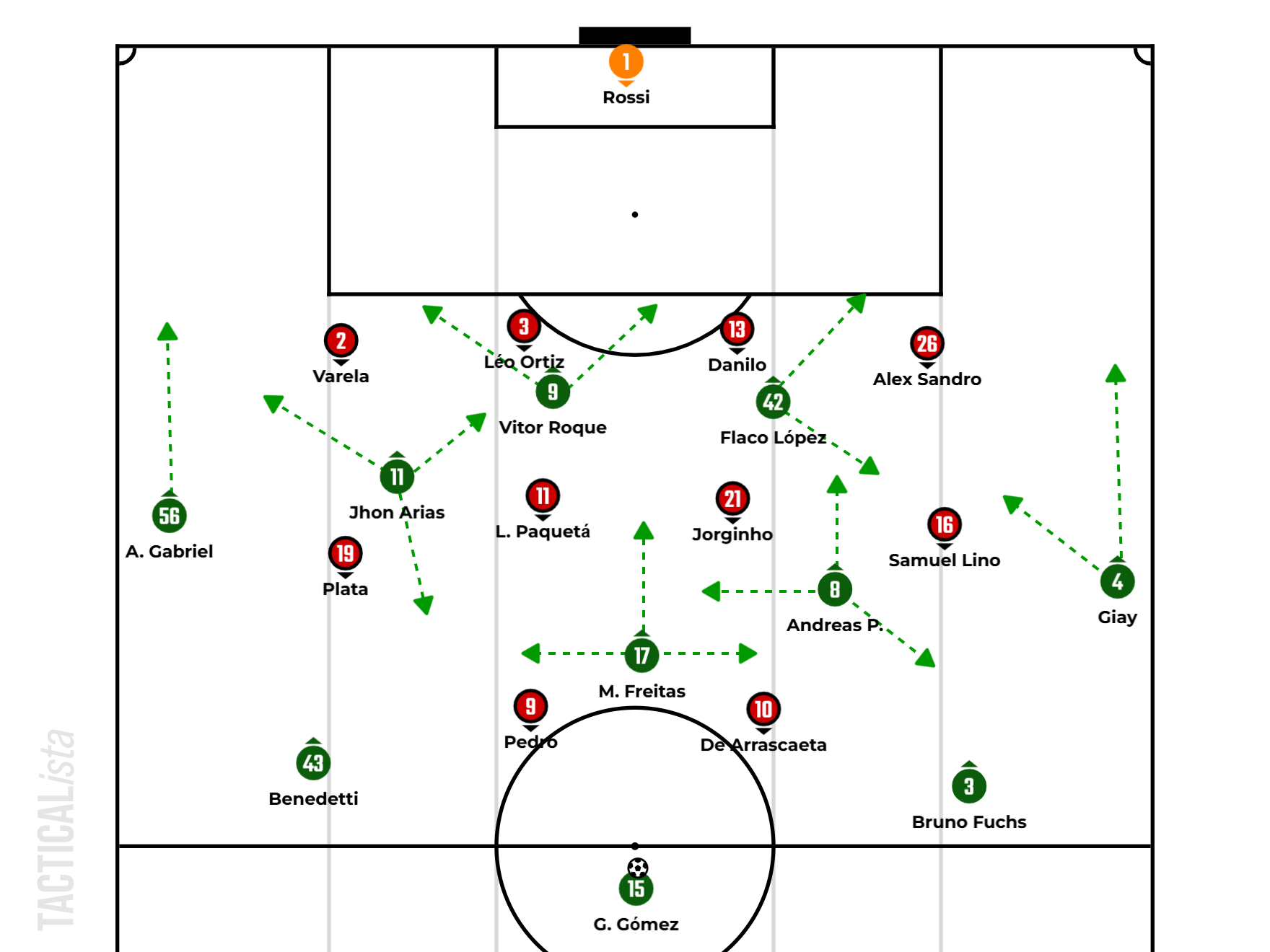
Palmeiras’ positional attack in a 3-4-3 shape against Flamengo’s zonal defense in a 4-4-2 formation.
The game started at a frantic pace, with chances for both sides, but Palmeiras were the first to find the net. The team had established itself by playing without wingers and with three center backs, recovered its form, and gradually accumulated points. In this game, the center backs initiated the build-up, with the fullbacks providing width and three players operating inside. Andreas and Marlon Freitas were the playmakers, varying their height and positioning; Arias operated as a false left winger, moving inside, while Vitor Roque and Flaco López formed the attacking duo in a 3-4-3 shape. Flamengo’s defense, meanwhile, was organized in a zonal 4-4-2 formation, pressing the ball carrier and closing down the central areas of the pitch.
For this reason, Palmeiras’ idea was quite simple: use the proximity of their midfielders to circulate the ball or play a long switch to the opposite flank, then attempt to cross into the box for the forwards or even Giay. In one such move, Andreas Pereira switched the play to Arthur Gabriel, who crossed into the box. The defense cleared the ball, Giay collected the rebound and delivered another cross. In the build-up to the goal, Flaco López attracted the defenders, allowing Arias, who is not particularly tall, to get ahead of his marker, jump and head the ball firmly into the net to make it 1-0.
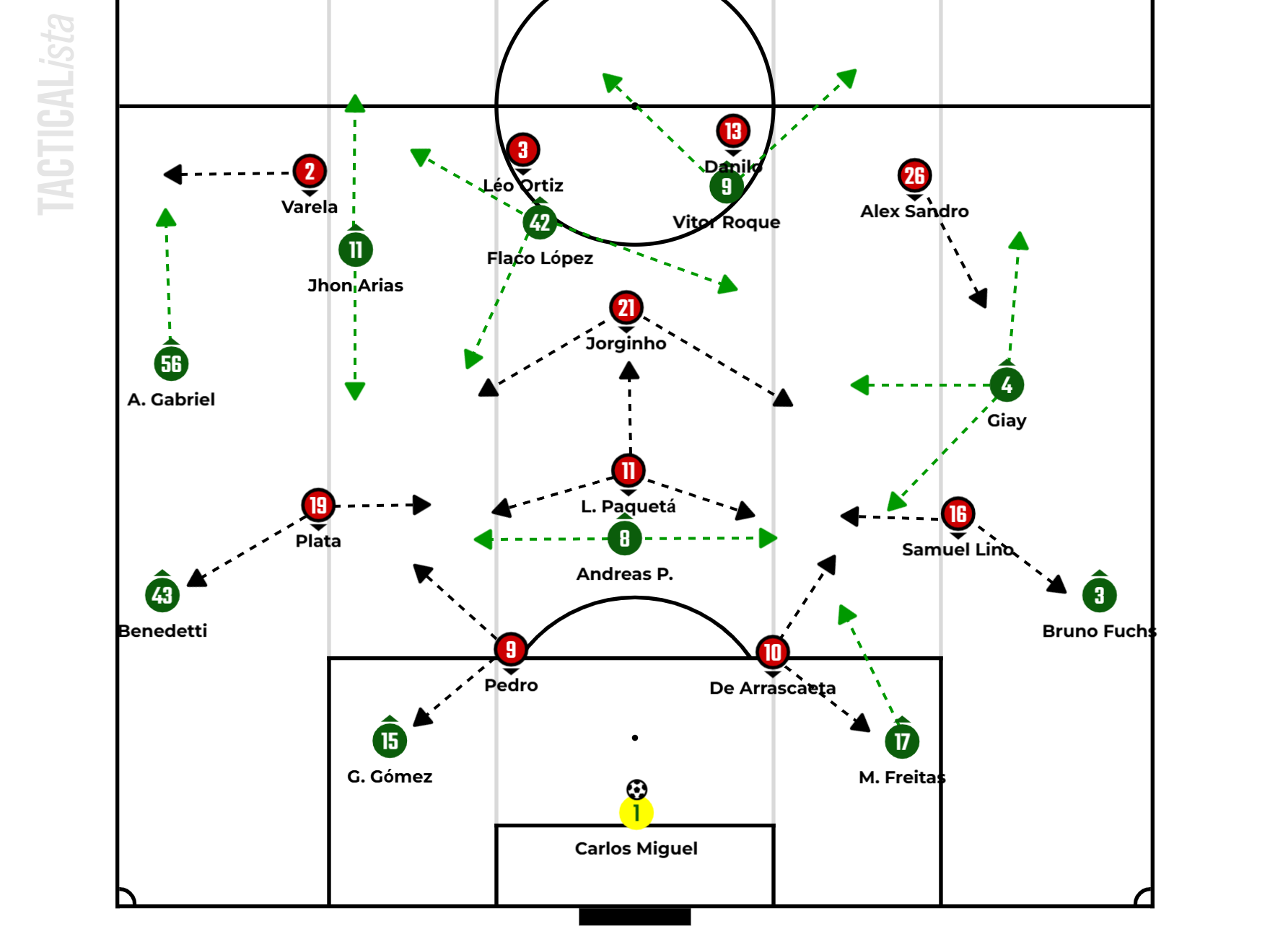
Palmeiras’ build-up in a 5-3-3 shape, using the goalkeeper to create a numerical advantage.
The main chances in the first half came from quick attacks, but as Flamengo generated attacking volume at great speed, Palmeiras often found themselves having to play out from the back while Flamengo pressed high with man-oriented marking. Palmeiras were comfortable attacking quickly with open space ahead of them, while Flamengo defended high up the pitch with intensity, just the way they prefer.
Two center backs moved wide towards the flanks, while Marlon Freitas dropped deep to form a very low line alongside goalkeeper Carlos Miguel, creating a numerical advantage against Flamengo’s first line of pressure. Andreas Pereira operated centrally, while Giay moved inside from the right, and Arias alternated between dropping deep and attacking space. Through triangular combinations and passes into supporting players ahead of the ball, Palmeiras tried to use Flaco López to create space for the forwards and for Arthur Gabriel to attack.
In Flamengo’s defense, Samuel Lino and Plata tracked the opposition fullbacks on the outside, while Paquetá marked Andreas Pereira individually. However, he also dropped back to cover potential forward runs from Jorginho during longer pressing movements, providing cover from the second line, especially when dealing with Arias. With the defense also using man-oriented marking, there was always a spare player, as Alex Sandro did not push forward as much. The defensive shape therefore resembled a 4-1-2-3 formation.
A portrait of the best attack in Brazil
Flamengo desperately wanted to celebrate this title. They tried to attack several times through their forwards, but were denied by decisive saves from Carlos Miguel, who was only left out of the latest Brazil National Team squad because Palmeiras are playing in two finals during this period of the year. In the second half, it took some time, but the team eventually found the net after making a few substitutions. The goal itself illustrates Flamengo’s identity. Understand why they scored more than…
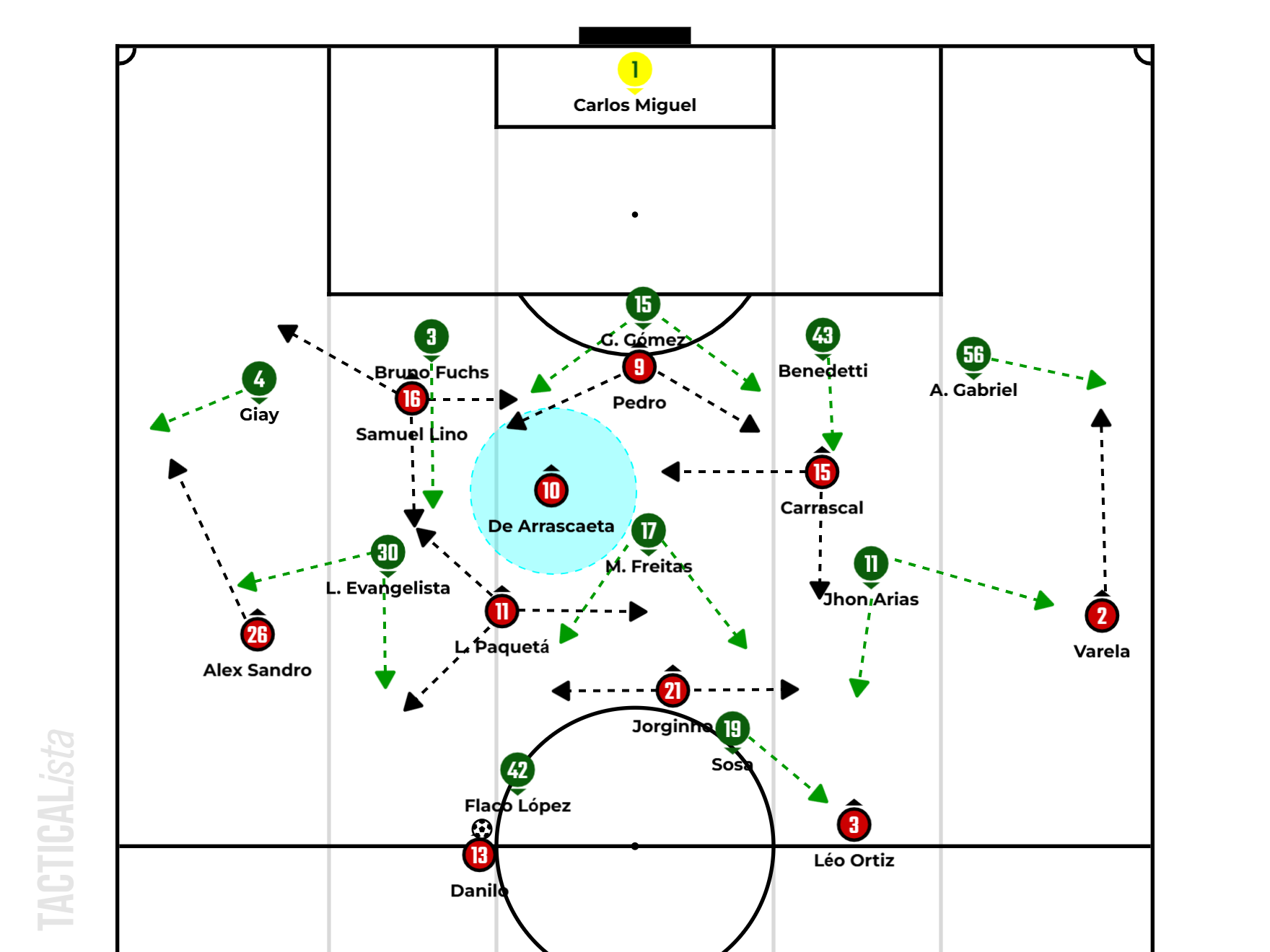
Flamengo’s relational/functional attack in a 4-2-3-1 outline against Palmeiras’ man-oriented marking defense in a 5-3-2 shape.
Leonardo Jardim’s Flamengo established themselves in an asymmetric 4-2-3-1 shape, with a more relational/functional style, rather than organizing their play around fixed positional zones on the pitch. The team’s attacking pattern involves movements designed to attract defenders and provide passing options for the ball carrier, manipulating the opposition’s defense and creating space. The center backs initiate the build-up, while the fullbacks occupy the wide channels, with one staying deeper whenever the other pushes forward.
In midfield, Jorginho plays as the first holding midfielder and Paquetá as the second, more creative midfielder. Both constantly drift towards the side on which the team is attacking. Arrascaeta drops deeper to dictate and orchestrate the play, enjoying complete positional freedom. The wingers, Samuel Lino and Plata, move further inside, sometimes even approaching the opposite side, but they have different characteristics: Lino is more skillful and attacks through combinations, while Plata is more powerful, holds up the ball with his back to goal more effectively and attracts more defenders, while also possessing considerable technical quality.
However, Plata was substituted early in the second half, when things were not working. Carrascal came on, having been one of the best players on the continent over the past few months. He is an attacking midfielder who also helps orchestrate the play centrally. Starting from the right, he likes to operate freely and contribute more to the build-up. Pedro also constantly provided supporting options ahead of the ball, holding up play on the side from which the team was attacking.
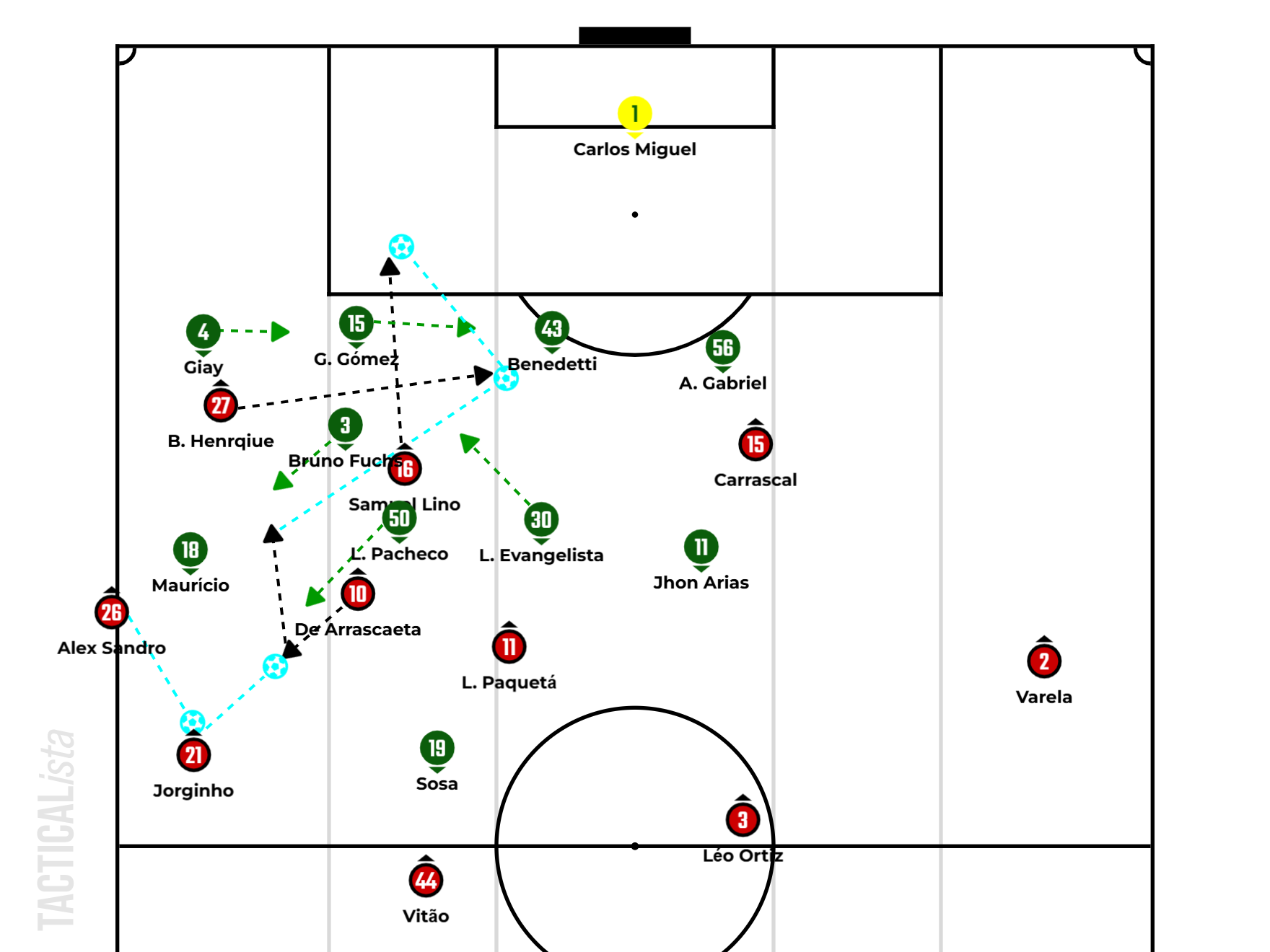
Flamengo’s goal, with Arrascaeta finding Bruno Henrique’s supporting run and allowing Samuel Lino to exploit the gap in the defense.
Throughout the year, Samuel Lino established himself as a star of the team, justifying the investment after facing criticism last year over the high transfer fee paid for him. He scored many goals while playing with greater freedom and moving inside, in a different role from the one he had under Filipe Luís. It had to be him scoring the title-winning goal, reinforcing his status as the team’s protagonist. The move makes it clear how Flamengo attack: quickly, with players close together, technical quality, and the ability to create gaps and exploit them.
The gap was created by a lapse in concentration from several players following a throw-in. Because Palmeiras use long individual marking assignments when defending, Bruno Fuchs was slow to recover his position and the back five became unbalanced. In addition to the space he left behind, the young Luís Pacheco hesitated, mistimed his movement and failed to mark Arrascaeta, while also allowing Samuel Lino to remain in his blind spot.
From the throw-in, Jorginho passed the ball to Arrascaeta, who dropped deep to escape Luís Pacheco’s marking. The midfielder was late to step out and press, but was beautifully beaten by a dribble. That move changed the entire dynamic of the situation and disrupted the defensive structure. Bruno Fuchs, who was recovering his position, stopped halfway and tried to block the play. At that moment, Bruno Henrique, who had been positioned wide on the wing, dragged the defense by moving from the outside in, shifting Palmeiras’ entire last line.
Arrascaeta played a diagonal pass through to Bruno Henrique, who had replaced Pedro. He held up the ball, which is not one of his main strengths, for Samuel Lino, who quickly attacked the space between two defenders. Lino was outside the field of vision of both Luís Pacheco and Bruno Fuchs, moved into the perfect position and scored.
After that, both Flamengo and Palmeiras had their chances, but the story of the title-winning game had already been written. Flamengo were deserved Brazilian champions, completing a remarkable run that erased Palmeiras’ substantial points advantage in the standings. They also won the title at the home of their rivals, the team that has shared dominance of Brazilian and South American football with them.
Takeaways
Palmeiras drew, but effectively lost at home and saw even their slim title hopes disappear. In the next round, they will face Chapecoense, who have already been relegated. After that, they will play the Copa Libertadores final against Argentina’s Estudiantes and, a week later, face Grêmio in the Copa do Brasil final. It has been an incredible year. It is difficult to maintain a points advantage while competing strongly in three competitions. This is one of the best Palmeiras teams in history.
Flamengo, deservedly, were crowned Brazilian champions. Flamengo fans have a strong football culture and are extremely demanding. They are celebrating the Brasileirão title, but they wanted to win everything and still feel the bitter frustration of being eliminated from the other competitions, especially the Libertadores. And despite winning the title, it is very likely that coach Leonardo Jardim will not remain in charge of the team next year. Their next fixture is against Coritiba, who are still looking to secure a place in a continental competition.
Use the arrows to scroll through all available match plots. Click to enlarge. Check the match plots page for plots of other matches.