

Panama – England: Bellingham’s New Role Pays Off For Tuchel (0-2)
Thomas Tuchel went with a slightly different structure in this game for England, moving away from the wing-oriented 4-3-3 shape into a 3-1-6 structure in possession. A key part of this was a freer role for Jude Bellingham, who repaid Tuchel with a goal and an assist to ensure England’s first place finish in the group.
Tactical analysis and match report by Josh Manley.
We decided to make this article free to read. If you want to support our work, consider taking a subscription.
After a positive first round showing against Croatia, England came back down to earth with a 0-0 draw against Ghana in which existing issues with breaking down low blocks surfaced.
Panama meanwhile knew that their World Cup exit was sealed after defeats against both Croatia and Ghana. They were playing for pride here, looking to pick up the country’s first-ever points in a World Cup game. Manager Thomas Christiansen lined them up in a 5-4-1 shape here with the intention of frustrating England, much as Ghana had.
Thomas Tuchel has had to face injury concerns this week, with Reece James seemingly the most serious and his return timeline uncertain. Declan Rice has also been carrying knocks and was not risked in this match against Panama.
So England lined up in their usual 4-3-3 shape with Jarell Quansah coming in as right back alongside Ezri Konsa, Marc Guéhi, and Nico O’Reilly. Elliot Anderson was the deepest midfielder, with Morgan Rogers and Jude Bellingham ahead of him. Bukayo Saka and Marcus Rashford were selected this time as the wingers to flank Harry Kane up front.
Attacking structure adjustments
Panama came into this match with the intention of not only sitting in a low block, but also attempting some higher pressing phases as well. This was apparent in the earlier parts of the first half.
Against this higher press, England showed similar structural elements to the ones seen against Croatia. The left central midfielder, in this case Bellingham, would drop alongside Anderson, while Kane dropped alongside the more advanced midfielder Rogers.
Along with this box midfield, England then had the wingers pushing up to run in behind, while the fullbacks held the width. Another notable element repeated from the Croatia game was the use of Jordan Pickford stepping into the defensive line once Panama had been pushed back into a mid block.
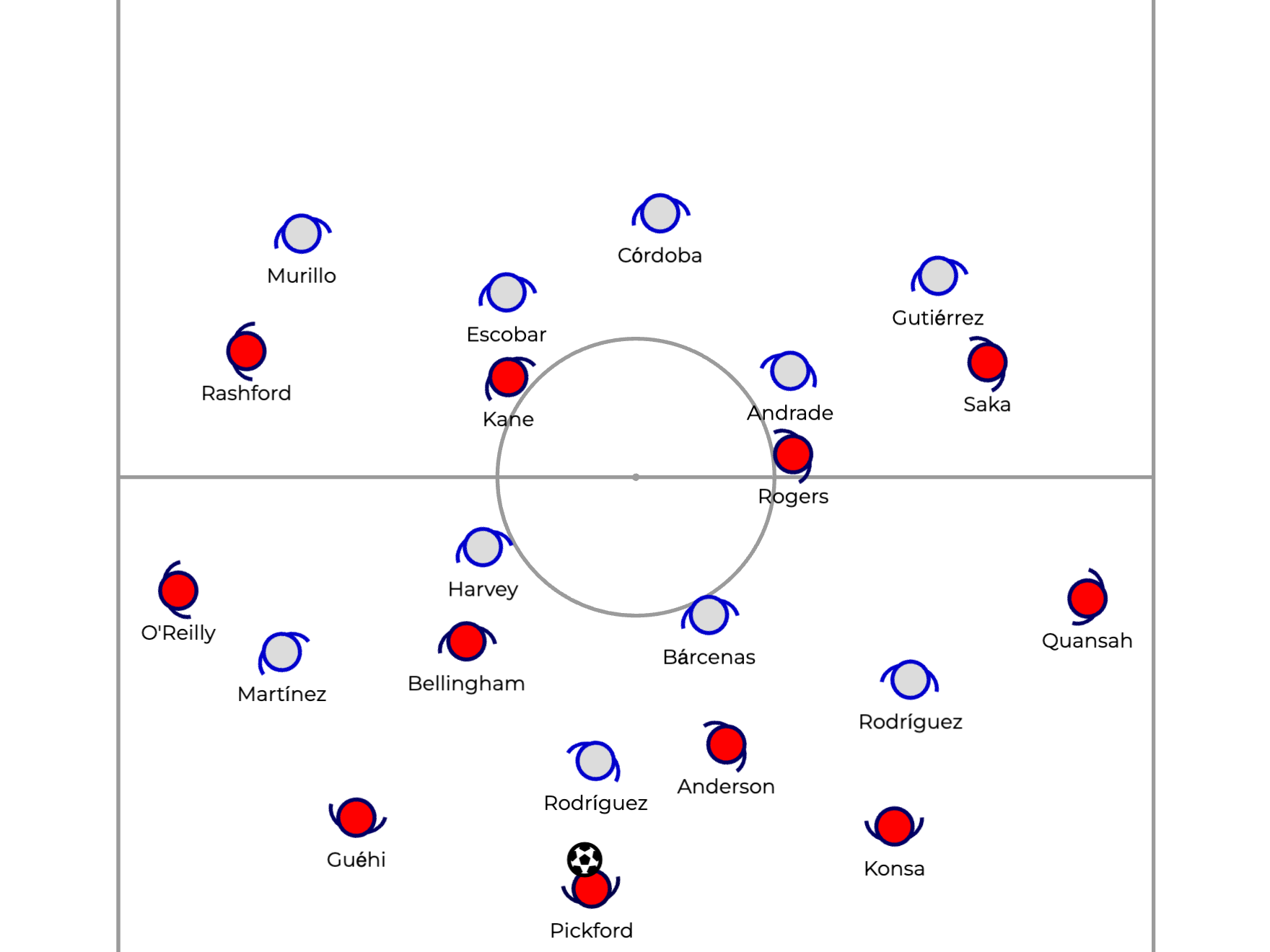
England’s deeper buildup with Pickford in the first line.
The phase where England’s structure was different from the previous games though was when attacking against Panama’s low or mid-low block. Instead of the 4-3-3 formation focused on wing rotations, it was here that England shifted more clearly into a back three, with Quansah becoming the third center-back.
O’Reilly would push up in the left halfspace to get between the lines, while Rashford and Saka held the width on each side. The key role in this shape was that of Bellingham. He had freedom to move between the two lines of the midfield unit – either starting alongside Anderson to get involved in deeper buildup or pushing up into a number ten position. More often, he chose the latter option.
England’s attacking shape was essentially a 3-2-5 or 3-1-6 formation then, depending on Bellingham’s chosen positioning. Bellingham was England’s main attacking threat throughout the game thanks to his wide range of movement off-the-ball plus his skill around the penalty box.
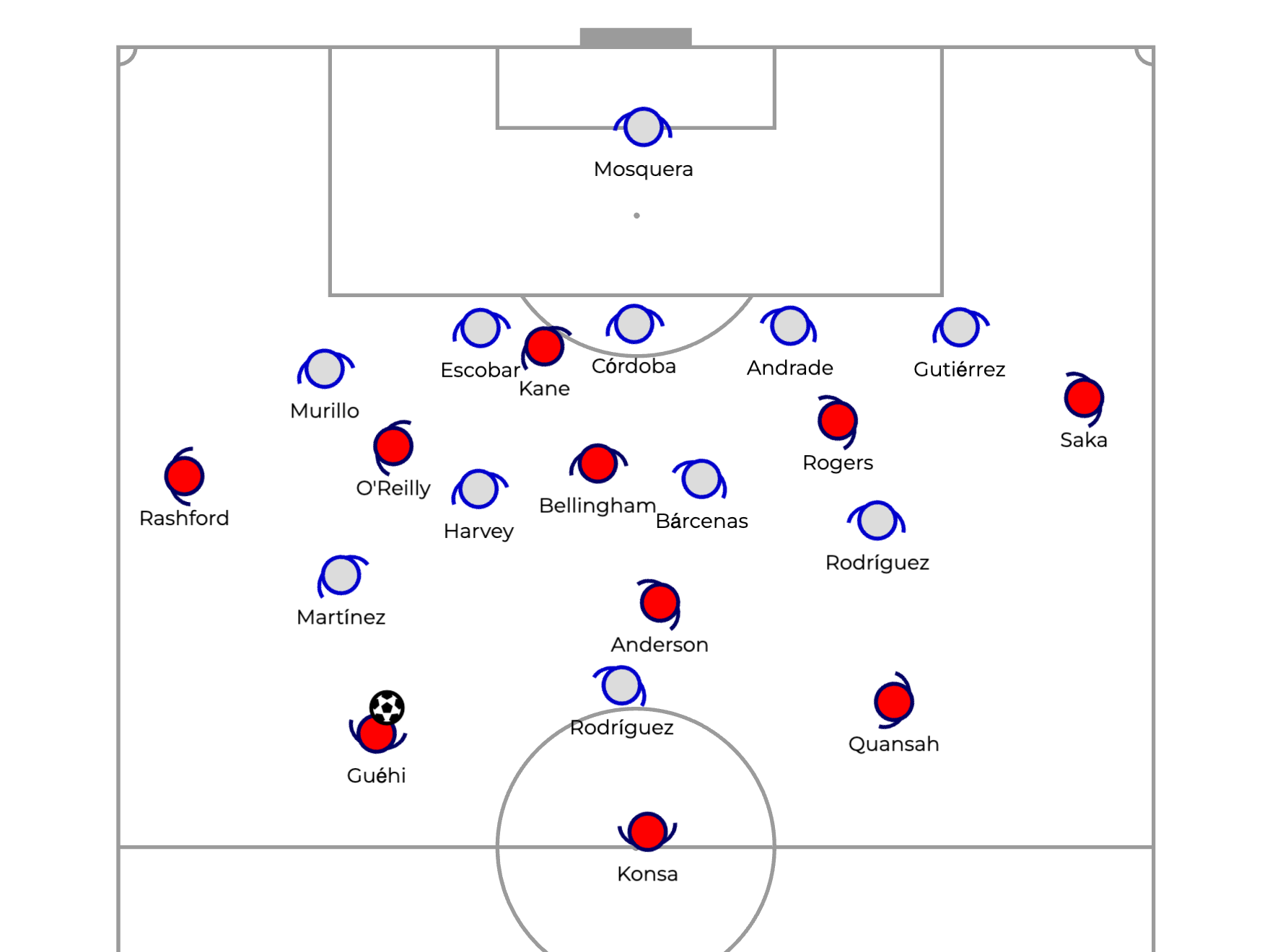
England’s 3-1-6 shape against Panama’s low block.
This new shape for England gave them greater occupation of the center of the pitch. There was still plenty of wing-focus, as there had been before, but the extra presence between the lines meant that there were more phases where they tried to fire line-breaking passes into the attacking midfield trio and combine centrally.
There was a focus on diagonality too. On the left, Rashford often looked to act as playmaker, receiving the ball to face inside as the attacking midfielders would make diagonal runs across the defensive line to try to disorganize the Panamanians.
Saka was also supplied with plenty of underlapping runs from Rogers. When England had the ball in wide areas, their penalty box presence was strong, with up to four relatively tall players able to make runs for crosses – Rogers, Bellingham, O’Reilly, and Kane, plus Rashford at the back post when crossing from the right.
Bellingham breaks the deadlock
Despite England’s escalating dominance and the positive signs shown, they still struggled to complete the final action to create clear chances in the first half.
England continued to build pressure though, and at the hour mark, they finally broke through. It was a goal of Bellingham’s making – his dart into the channel and stepover to beat the defender led to his subsequent cross being deflected out for a corner.
From that corner, it was Bellingham who was able to swing his left foot at Saka’s delivery, while holding off his marker, putting England 1-0 up.
With Panama now behind, they would surely need to push further up the pitch to try and press England, which would leave space in behind for England to exploit their strength – attacking into depth.
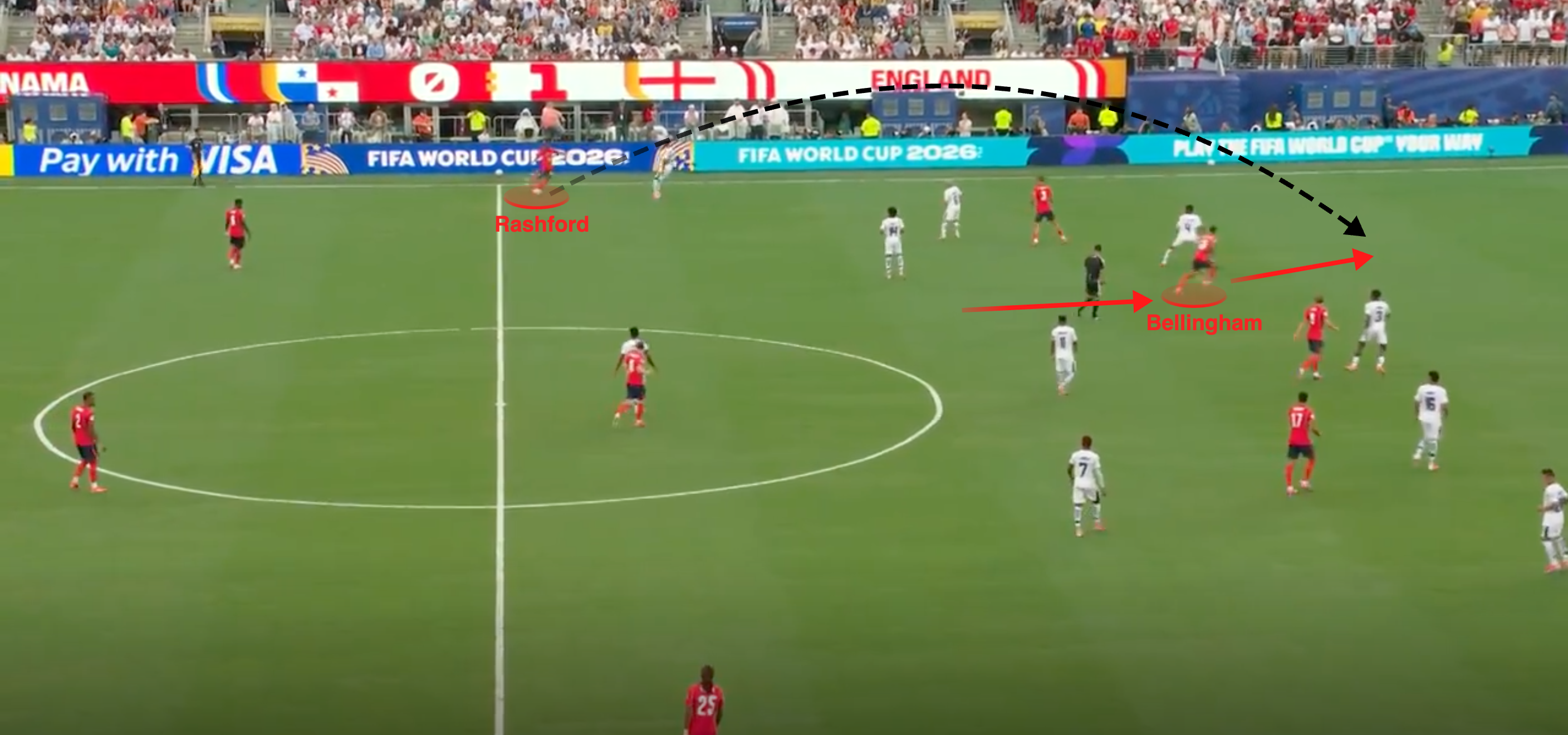
The buildup to England’s second goal.
Bellingham was able to demonstrate this notion almost immediately. As Panama tried to squeeze up into a mid block, Bellingham made the run in behind the defense to receive a lofted pass from Rashford providing the aforementioned diagonality from the left side.
The Real Madrid midfielder was able to work a yard of space and float a cross into Kane arriving into the box, making it 2-0. This effectively sealed the deal for England and Tuchel was able to make substitutes, resting the likes of Bellingham, Saka, and Kane ahead of the knockout stages.
Man-oriented defending
One more interesting insight that this game gave was into the extent of Tuchel’s commitment to a man-oriented defensive approach with this England team. Again, this had already been visible in the previous games, but it manifested itself in a new form here.
When Panama had the ball in their buildup phase, England would shift into a 3-4-3 shape to match their opponent’s shape. This was achieved through a defensively engaged role for Saka, who was required to track the forward runs of Panama’s left wing-back, thereby essentially becoming a right wing-back himself.
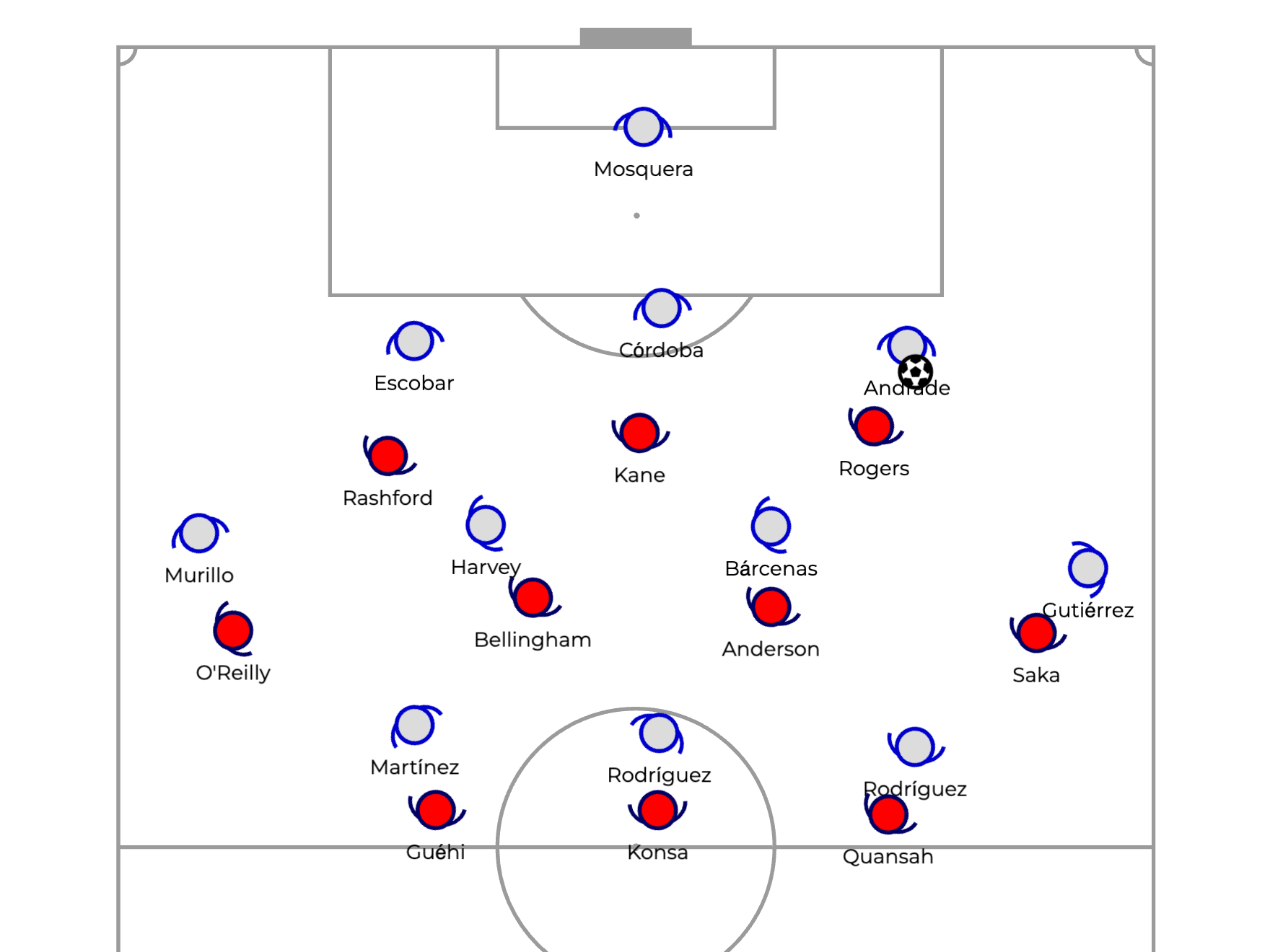
England’s man-oriented defending
Rogers would push up alongside Kane and Rashford in the front three to pressure the back three of Panama, as would O’Reilly onto the other wing-back.
Against a nominally weaker opponent, such defensive schemes allow England’s stronger players to dominate their individual duels to limit the opponent’s possession phases. It will be interesting to see if Tuchel sticks with this approach against the top teams, following the man-marking trend that was seen in the Champions League this season.
Takeaways
Panama defended stubbornly for a while but such a game is always an uphill battle with the gap in quality between the teams.
For England, Tuchel showed his willingness to tweak the structure on both sides of the ball. The 3-1-6 structure in attack gives an interesting new option in terms of attacking low blocks, which may be necessary in the Round of 32.
Match plots to be added shortly.



Comments