
Paris Saint-Germain – Barcelona: Injuries Dampen Parisians’ Rout of European Rivals (4-2)
Paris Saint-Germain hosted Barcelona in the Champions League’s glamour tie of the round. It’s fair to say that this was a game many people hoped would be an early preview of this season’s final. The two European giants play some of the most attractive football in the competition, and sparks would inevitably fly as two competing styles clashed.
Tactical analysis and match report by Nick Hartland.
We decided to make this article free to read. If you want to support our work, consider taking a subscription.
There’s no love lost between Paris Saint-Germain and Barcelona, as Jules Koundé once said of this matchup: “There’s a lot of history, and there’s also a lot which has gone on behind the scenes.” The two European heavyweights have created a very modern rivalry that transcends the usual definitions. Battles have more frequently been fought in the boardrooms, press conferences, courtrooms, and the transfer market than on the sporadic occasions they meet in the Champions League. However, that has done little to dim the flames of a mutual dislike.
PSG boss Luis Enrique went with his usual 4-3-3 shape against his former team. Matvei Safonov was in goal behind a backline consisting of Lucas Hernandez, Willian Pacho, Marquinhos, and Achraf Hakimi. In the middle, Fabián Ruiz, Vitinha, and João Neves. Up top, Khvicha Kvaratskhelia, Ousmane Dembélé, and Désiré Doué.
Hansi Flick looked to match PSG’s formation. In goal, Joan García, with his defense consisting of João Cancelo, Gerard Martín, Pau Cubarsí, and Xavi Espart. The midfield saw Pedri line up with Marc Bernal and Dani Olmo. That left Anthony Gordon, Raphinha, and Lamine Yamal to create the front three.
Warning signs for Barcelona
Like last week, when PSG dispatched Manchester City, Les Parisiens were faced with a daunting task in Europe. In France, they’re far more used to facing opposition that would be willing to sit back in a low block and let them dominate the ball. However, Barcelona would not come to the Parc des Princes expecting to merely survive, but to go toe-to-toe with the reigning European champions. They were, of course, arriving on the back of an eleven-game winning streak and believed Paris was as good a place as any to extend that to twelve.
In the opening exchanges, Barcelona were provided an early warning of the threat contained in going toe-to-toe with this PSG side. As expected, Les Parisiens pressed high in a man-to-man marking system. The aim was to disrupt Barcelona early on in their build-up and create turnovers close to goal where they could exploit any gaps formed as Barcelona shifted from their in-possession to out-of-possession shape. Ruiz would hit the post from outside the box off a high turnover in the second minute. The follow-up landed to Dembélé, who somehow couldn’t direct the rebound into the open net (albeit not that it would have counted, as he arrived from an offside position).
Three minutes later, PSG would again show the threat they possessed in transition. Neves swept up possession of a sloppy bit of play from Barcelona caused by PSG’s man-to-man pressure. The midfielder was then able to release Dembélé past the backline. A slight poor touch saw the striker lose some of his pace, allowing the Barcelona defense to recover numbers in the box, but he was still able to create a shot that forced García into a save.
Dembélé looked as if he was going to be a persistent threat against his former team. However, in the 20th minute he was substituted for Ferran Torres, following a run where he pulled up short clutching his hamstring. We wouldn’t know it at the time, but it was going to be an omen for what was to come in the second half for Les Parisiens.
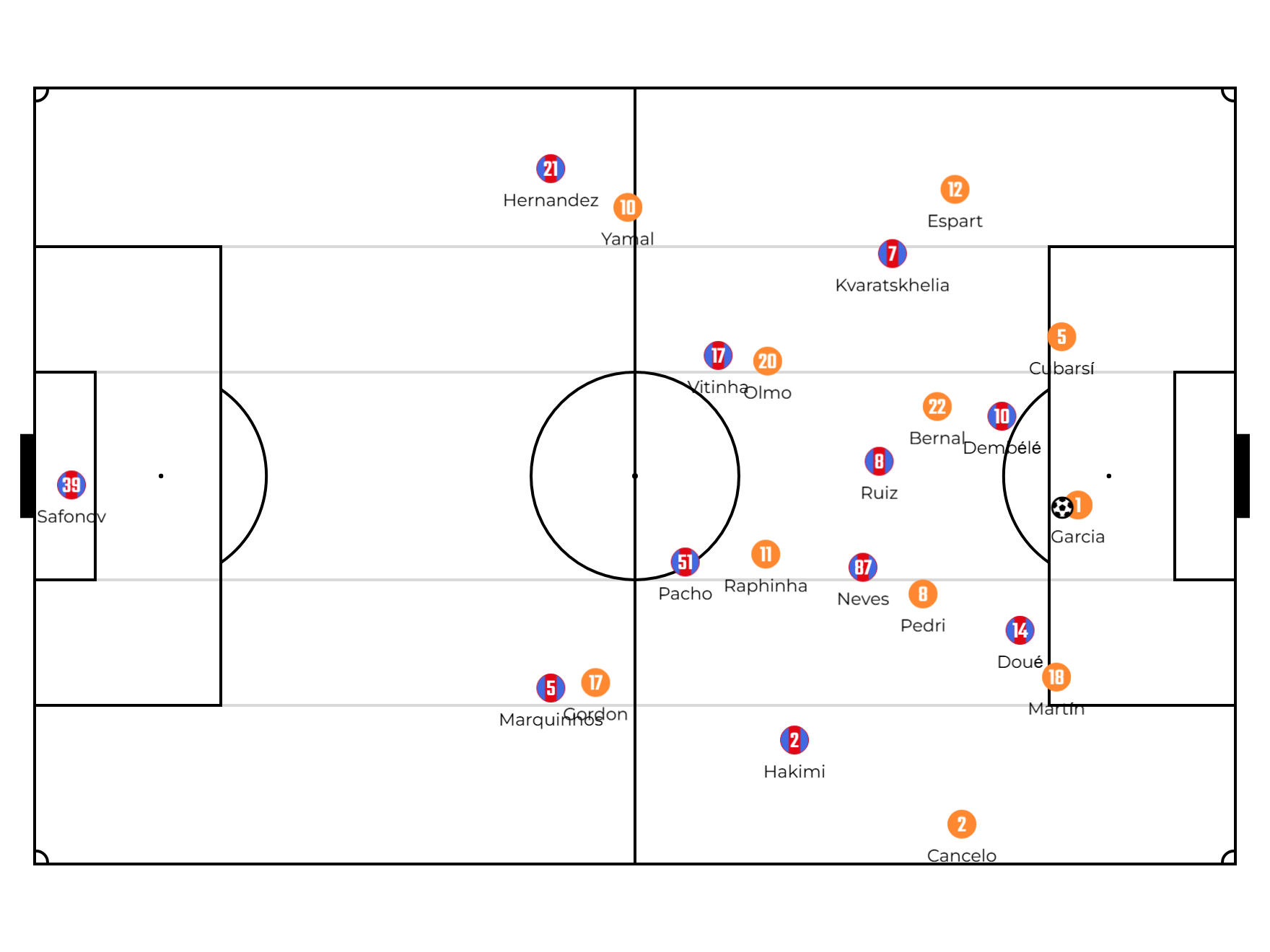
1st minute: Barcelona build from their goalkeeper. PSG set up their man-to-man marking system.
Flick’s plan
In the build-up phase, Flick wanted his side to bypass PSG’s press through a combination of diagonal passes and third-man runs. To do this, Barcelona stretched the pitch both vertically and horizontally. The aim was to manipulate PSG’s willingness to go man-to-man to create space in the middle of the pitch. One of the more effective ways they did this was when two of Barcelona’s midfield three dropped deep, encouraging their markers to stay tight. The third would join the front three and pin PSG into a back four (with Vitinha joining the center-backs plus Hernandez, while Hakimi took up a higher position). Barcelona kept their fullbacks low and wide, in areas where PSG were content to leave them space, so they could set up a pressing trap.
For this to work, it was necessary to move the ball with speed before PSG’s press could respond and close down passing lanes. The problem was that Barcelona looked as if they could only play at one pace. More often than not, they looked rushed when attempting to create these combinations, and sloppy errors cropped up. With PSG defending in a tight marking system, they were always in position to pounce on any loose ball. Barcelona would then respond with a counterpress. Meaning control of the ball, especially in the first half, resembled a game of table tennis, with possession pinging forwards and back.
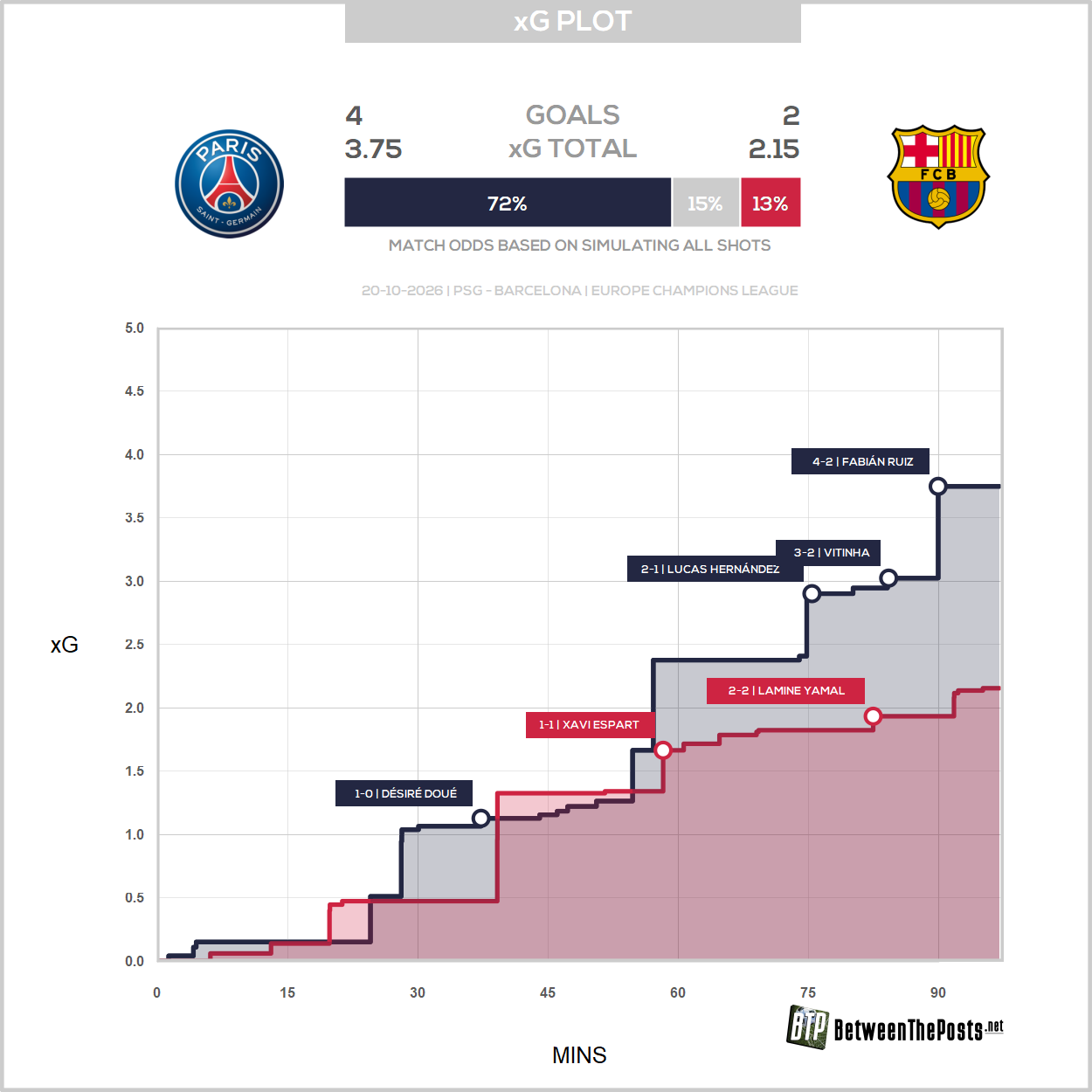
It was a game state that looked to suit PSG far better than their visitors, and they were carving out regular opportunities to threaten García’s goal. The former Espanyol goalkeeper looked to have a phenomenal first half, where he denied Les Parisiens some clear-cut opportunities to open the scoring. Funnily enough, it would be on one of the more unlikely efforts that PSG found the back of the net. Doué collected a loose ball on the edge of the area and then fired from distance past García.
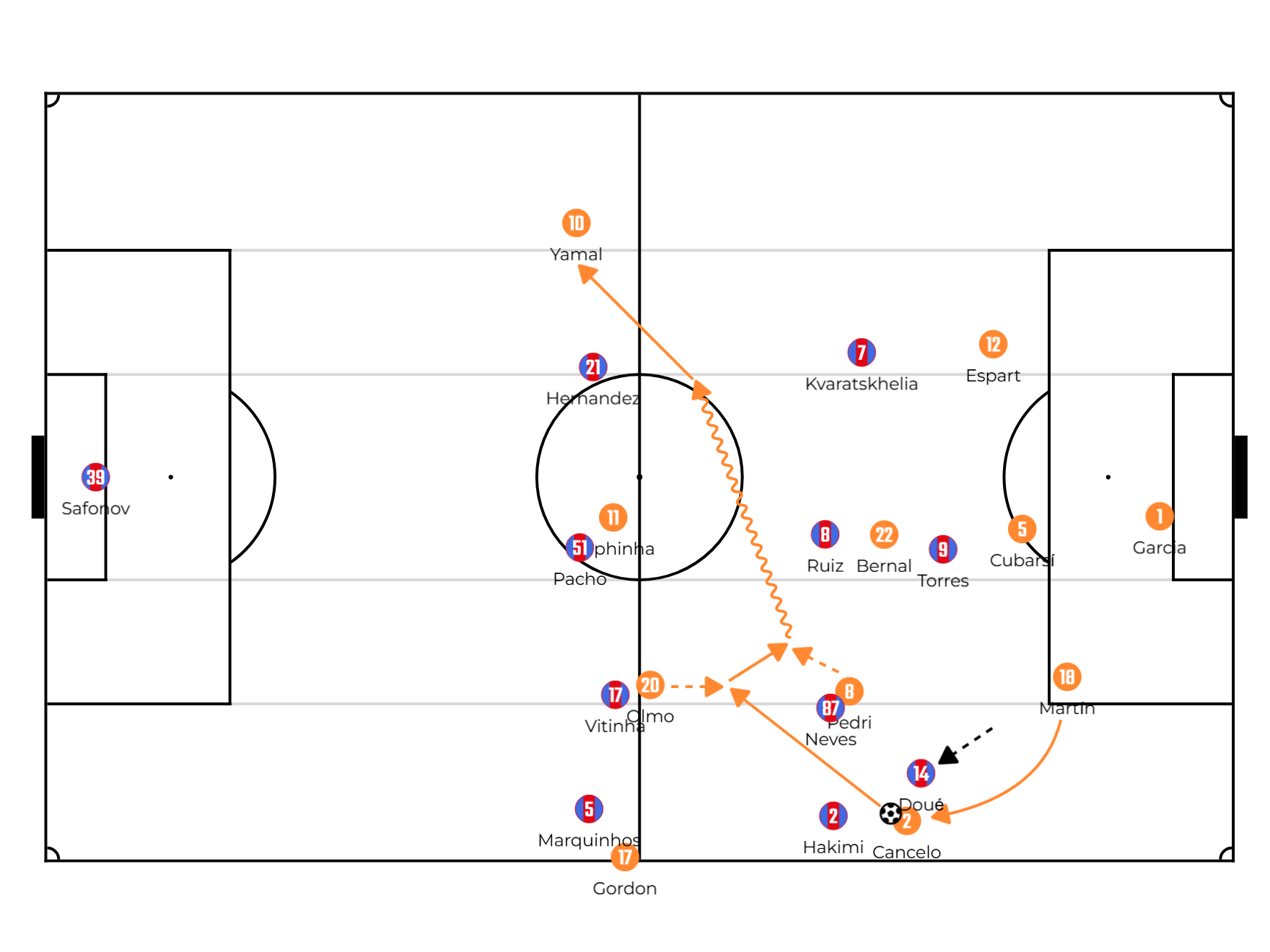
20th minute: Barcelona play through the PSG press. Barcelona stretch the pitch vertically and horizontally, creating space in the midfield. A diagonal to Olmo and a third-man run from Pedri slices through the press.
Barcelona shift
After half-time, Barcelona looked to control the ball for longer periods. When they were in their settled possession shape, they looked to dramatically reduce the gaps between players. The idea behind this was something we’ve seen from Flick this season, as Roger Bonet wrote in his excellent analysis of the Catalans, and it encouraged Barcelona to look for fluid and quick passing combinations through PSG’s deeper defensive shape.
There was, of course, a risk in this adjustment. Barcelona pushed higher up the pitch, which left space behind the defensive line for Les Parisiens to attack in transition. Barcelona believed that the shorter gaps would mitigate the danger, as they would have a more solid rest defense from which they could counterpress. There were again warning signs for the visitors when Kvaratskhelia broke into space, in an attack that should have been finished by Hakimi.
However, Barcelona would strike next. In the 55th minute, Espart would draw the sides level following a nursing run down the right-sided half-space. The goal was a testament to Flick’s subtle shift, as Barcelona’s in-possession shape encouraged fluid rotations that left gaps in PSG’s defensive shape, with Hernandez and Kvaratskhelia dragged out of position.
A couple of minutes later, PSG would be on the ropes when Kvaratskhelia and Marquinhos went down injured in the same play. Luis Enrique was forced into a double change with Illia Zabarnyi and Maghnes Akliouche coming on. Flick looked to take advantage of this and made a triple substitution, with Bernal, Pedri, and Raphinha benched for Rodri, Gavi, and Karim Adeyemi. Gordon moved into the number nine role, with Adeyemi given the left wing.
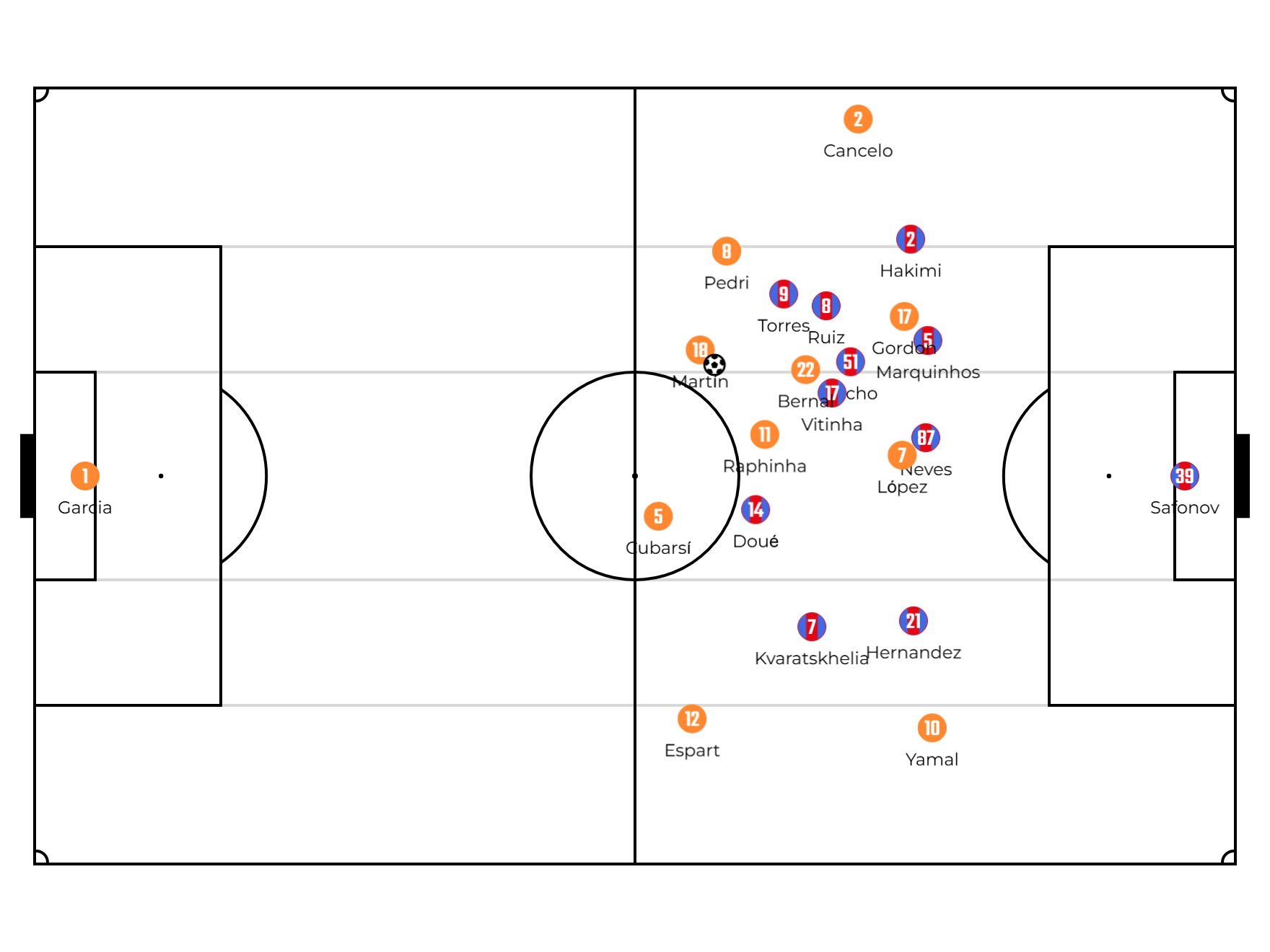
50th minute: Barcelona set-up in their in-possession shape. Lots of short connections, particularly in the center of the pitch. Note Raphinha’s movement deep, creating this very fluid structure.
PSG rescue result
Following the changes, Barcelona looked in control of the match. With it taking PSG a little while to regain their rhythm, and also their lead. PSG’s second of the evening would come from what had become a fairly rare period of sustained possession from the hosts (at least far more infrequent than in the first half).
PSG set up their usual on-ball structure, creating these wide triangles which looked to put a runner (often Hakimi) past the opposition fullback. Hakimi slipped past Barcelona’s backline and fed Torres, who could only hit the post. Barcelona cleared the rebound, but only out for a corner. From the set-piece, Hernandez would beat Gordon and smash a bullet header home in the 72nd minute.
Five minutes later, Barcelona would try to exploit the right half-space again, with Hernandez dragged out of position. Luis Enrique would respond almost immediately by taking off the left-back and putting on Warren Zaïre-Emery. It was a substitution that would lead directly to Barcelona equalizing as Yamal breezed past the center-midfielder-cum-left-back-cum-right-back to announce his presence in a match where he had been deathly quiet.
PSG responded almost immediately through Vitinha. The midfielder with a sublime piece of chest control plucked the ball out of the air, let it bounce, and then placed the ball home from outside the box. PSG wouldn’t let the occasion escape them and scored the fourth and final goal in the 87th minute, as Fabián Ruiz tapped home at the back post.
Takeaways
Three injuries to PSG’s squad will be the big black mark against this victory. Kvaratskhelia sustained an ACL tear, while Dembélé and Marquinhos are expected to be on the sidelines for at least a few weeks. The silver lining in the dark cloud will be that Les Parisiens responded well despite the setbacks with a strong finish to the game (something that was missing against Manchester City).
Barcelona suffered their own injury crisis coming into this game, so will likely not have too much sympathy for their European rivals. They did well despite a somewhat depleted first eleven. The late collapse will be frustrating for Flick, albeit, in fairness, the final scoreline felt a fair reflection of the game.


Comments