

AS Roma – Internazionale: Hexes, Hold-Ups And Third Man Habits (2-2)
Not many opponents bring an archetypal Inter performance to life quite like a Gasperini team. Roma rode these extreme game states in their favor when Manu Koné repeated the same trick, only for Internazionale to gain more control of the duels in the second half and hit the same combinations to deny a statement victory.
Tactical analysis and match report by Joel Parker.
We decided to make this article free to read. If you want to support our work, consider taking a subscription.
Déjà vu can arrive in many forms: whether that is an experience already lived through, dreamt of or previously felt. Once again, we are questioning the legitimacy of a title challenge led by Gasperini. Once again, it is the opponent of Internazionale who leads us to ask this question.
This is because the team that has inflicted the most torment on Gasperini has been Inter. Eight years have passed since a taste of victory over the team he once led for 89 days. There is a Cloughian edge to this story, molding an elite team out of the ashes (Atalanta) instead of joining another, but where Clough found the extra step with a league title (and two European Cups) with Nottingham Forest, Gasperini has sought for the Scudetto in the eternal city.
Like previous campaigns, there is a solid framework. Paulo Dybala is blooming on the sunset of his playing career, Donyell Malen picked up where he left off last season and Roma’s floor can be raised with more options/combinations in the attack. They have started the season with a bang, yet Inter had matched the perfect Serie A record, even with defensive frailties on display. Cristian Chivu’s team may have beaten Napoli and Udinese, but they went 2-0 behind in both fixtures.
Gasperini made just the single change, from the team that defeated Torino 2-0 last weekend. The young right wing-back Emanuele Lulli went off due to injury, so Wesley was reintroduced in that position and Nahuel Molina kept his place at left wing-back. Matías Soulé kept his spot on the left side of the attack.
Chivu made four changes to the team that beat Udinese 5-3 on Monday night. John Stones came off injured during that game, so Yann Bisseck came back in on the right side of the defense as Manuel Akanji shifted back into the center. Curtis Jones and Federico Dimarco also came back, whilst Lautaro Martínez returned to the attack.
Extremities within game states
Between teams with intense man-marking structures, games can pull open in unusual circumstances or create tensions that are irregular compared to a lot of football viewing experiences. Both teams filtered out their midfields in the process: Bryan Cristante and Manu Koné inserted themselves between defenders in possession; Piotr Zieliński dropped between Akanji and Bisseck in the first phase, Martínez also dropped with more frequency from the striker position.
In the first line of the attack, Inter wing-backs could also take up any lateral position to try and dislodge the man-marking scheme and create an extra attacker on a different side. On the flip side, losing possession whilst attempting to create these tensions, often moving up the pitch with third-man combinations, and space would be open on the second ball/turnover for the opposition to attack. In the process, this game constantly created many five-versus-fours or four-versus-fours without having to engage in a lot of sequences: these moments could be created from a quick throw by the goalkeeper, or a turnover in the middle that could trigger the defensive line to drop towards their own goal as quickly as possible. As a result, this game created an unusual back-and-forth between two of the best teams in one division: almost transitional with the amount of space available, but not always the tempo to match, even when a line had been broken.
The Roman diagonal
With this pattern established, the match can be defined by who utilized these second balls better. Inter still had escape routes when they had players up the pitch; Nicolò Barella was followed by Mario Hermoso into his own defensive third, so Marcus Thuram could move into the vacant space and play outwards to Andy Diouf in the same channel. However, Diouf’s eagerness to make the third man run from deep provided a different side to the coin. Sometimes he could catch Molina out, on other occasions, Molina recovered possession with Diouf out of position and the overload at the back post would be active when Molina switched towards his fellow Argentine, Paulo Dybala.
As a result, Roma had advantages in the first twenty-five minutes of the game. Koné delivered the first blow, after Soulé counterpressed Alessandro Bastoni and Molina recovered a loose ball as Diouf charged forward. Dybala was open across the final third, as Malen, Molina and Koné all crashed the back post. Molina headed the ball back into danger, and Koné fired in from close range, a shot too strong for Josep Martínez to handle.
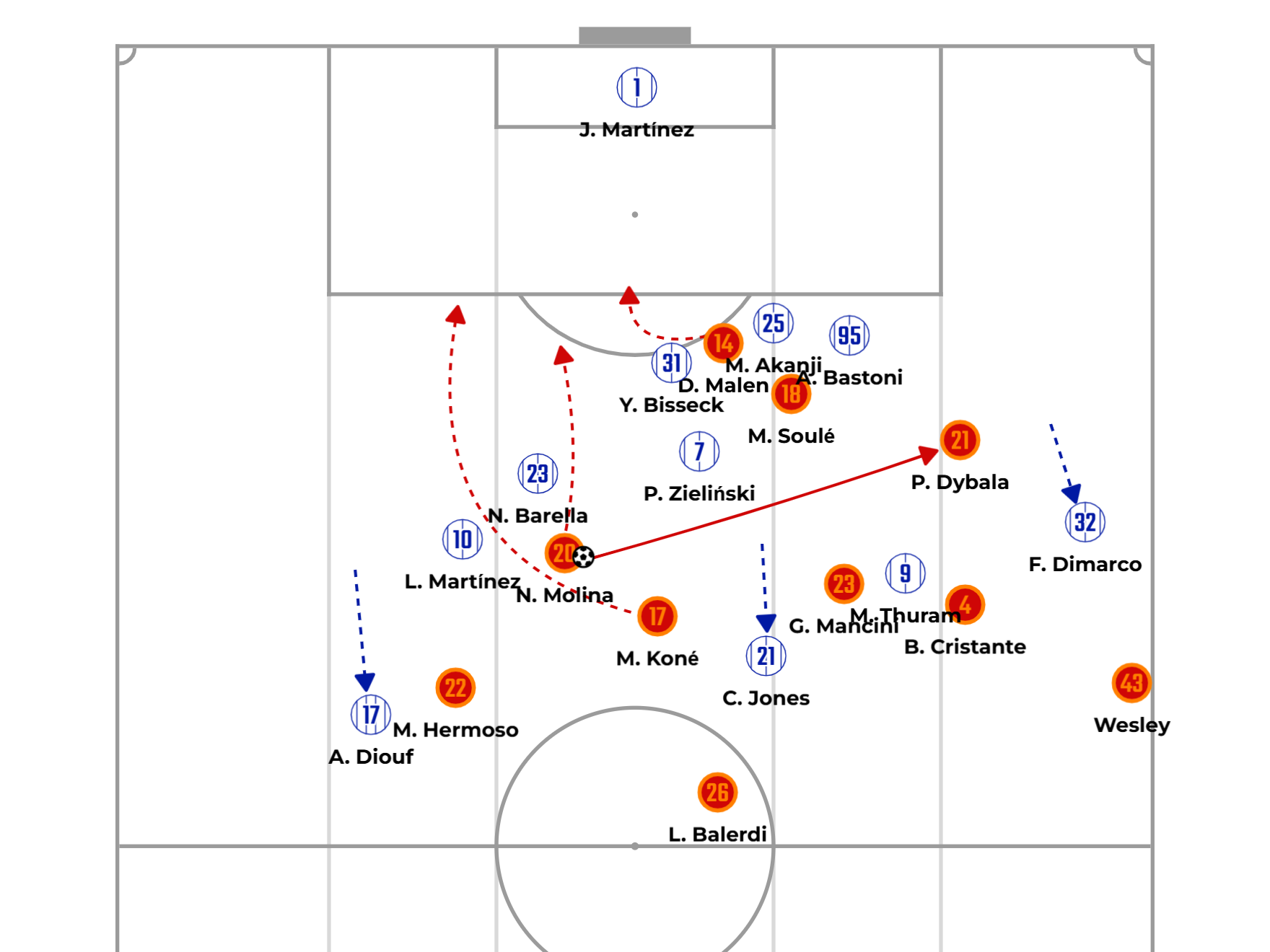
4th minute: Buildup to Roma’s first goal. From Soulé’s counterpress, both wing-backs and Jones had already committed to trying to attack on the Inter transition. As a result, the switch could be made to Dybala and Roma overloaded the far post with Diouf out of position, whilst the center-backs were occupied by Malen.
Roma nearly took advantage of a very similar diagonal, this time created down the opposite flank when Cristante picked up loose possession, with Jones and Dimarco beaten. Dybala moved laterally and with Diouf/Barella high, whilst Malen sprinted between Bisseck and Akanji, Soulé was free at the back post, but the pass was too strong and took the angle away. Dybala fired a shot over the crossbar after a botched clearance from Dimarco.
Nevertheless, early momentum belonged to the Romans despite some sharp vertical-to-bounce passes seeing Inter be able to transition the ball forward. When Inter reshaped into a more natural 5-3-2 defensive block, Roma’s ultra-wide setup in possession gave them three potential receivers outside the block. Soulé gave Diouf problems, as he was reliable at knocking the ball past the wing-back and sprinting around to beat him. Dybala obtained his own creative threat, not by take-ons but by cutting onto his stronger left foot; the center and switch were constantly open for slide-rule passes to filter in. A chance for Malen was created after Wesley carried possession against the last line, gave the ball back to Dybala, who slipped a pass through to Malen inside the box. His control created separation from Bastoni, only to not test the goalkeeper with the shot.
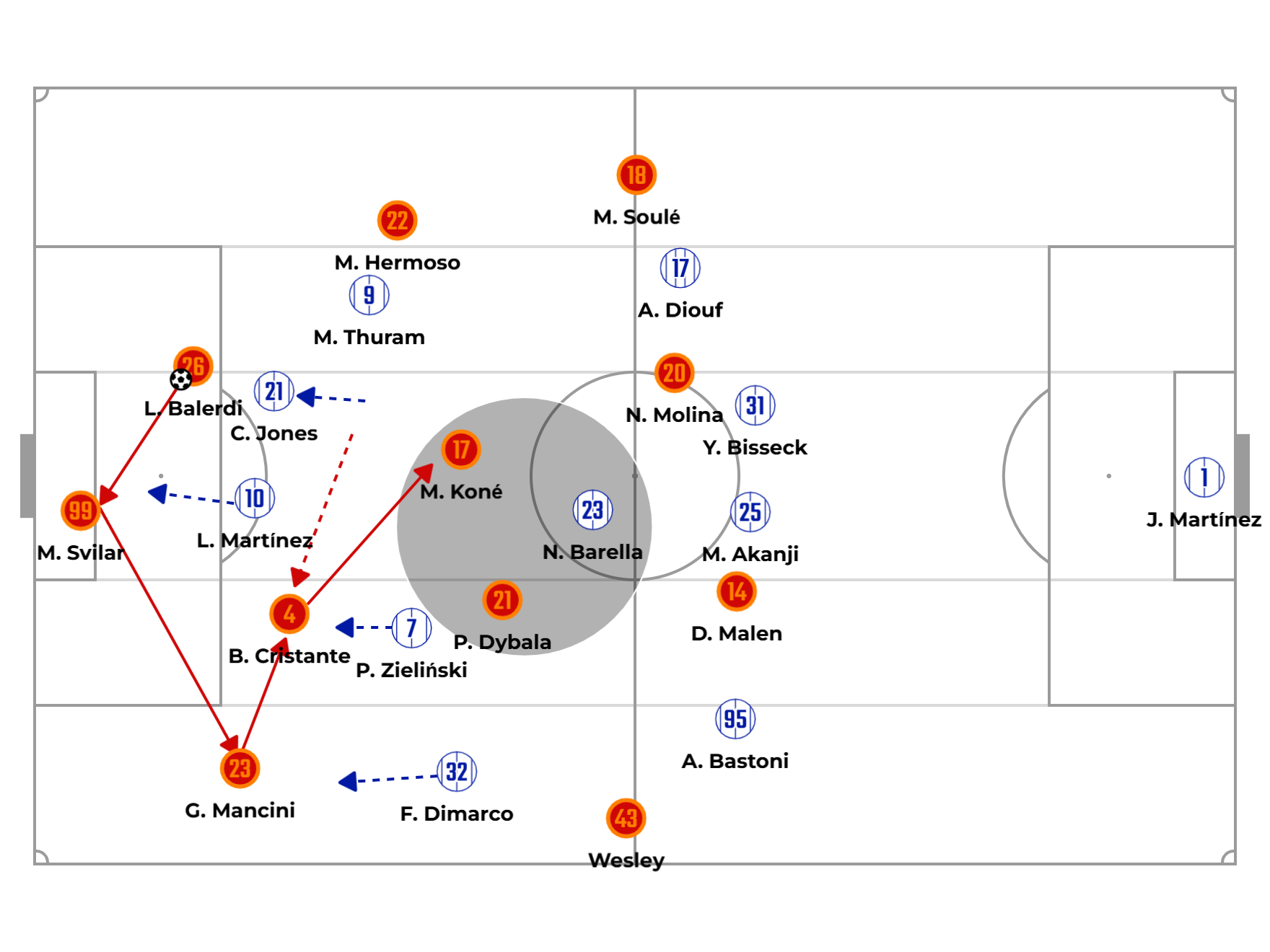
22nd minute: Roma’s deep buildup evading the Inter man-to-man. Jones jumped on Cristante’s pass back to Balerdi, but Svilar had the route outwards to Mancini. Dimarco had too much of a distance to cover, whilst Cristante made himself available in the pivot position, and an overload was created. Zieliński jumped towards the pivot, but Barella faced both Dybala and Koné between the lines.
When Inter switched into their man-to-man arrangement, moving up into the opposition half, Cristante and Koné moved into different lines. As a result, Dybala and Koné became the two players who could lead the transition. Jones followed Cristante’s pass back to the defenders, which opened a two-versus-one in the middle of the field and the same spaces to open, as they had done when Roma made turnovers in the opposition half. Six Roma shots to Inter’s zero in the first twenty-five minutes, but none quite as dangerous as the opener produced by Koné.
A second comes against the grain
After a strong start, the scale began to slide when progress down the right led to spaces opening for Inter’s left side to attack the box. First there was a quick throw-in after the ball went out from Josep Martínez’s boot into the right channel. Lautaro would take it quickly as Bisseck bulldozed his way into the halfspace and received behind the last line. An unnatural situation for the German, but he still forced a strong save out of Mile Svilar.
More phases of back-and-forth followed as central space was filtered out, before Inter produced one of the best opportunities of the game. Thuram held possession away from Gianluca Mancini and laid off for Barella before Dimarco put the ball across goal. Lautaro was perched at the back post and slid in with the goalkeeper out of the equation, only to put his shot over the crossbar.
Inter would not be swayed. After Molina slipped in possession, Diouf and Barella led the charge and Diouf poked the ball behind Hermoso’s counterpressure. Thuram would slip through but not shoot as he was ushered wider. Barella lofted a ball towards the back post before Svilar clattered with Jones in the duel.
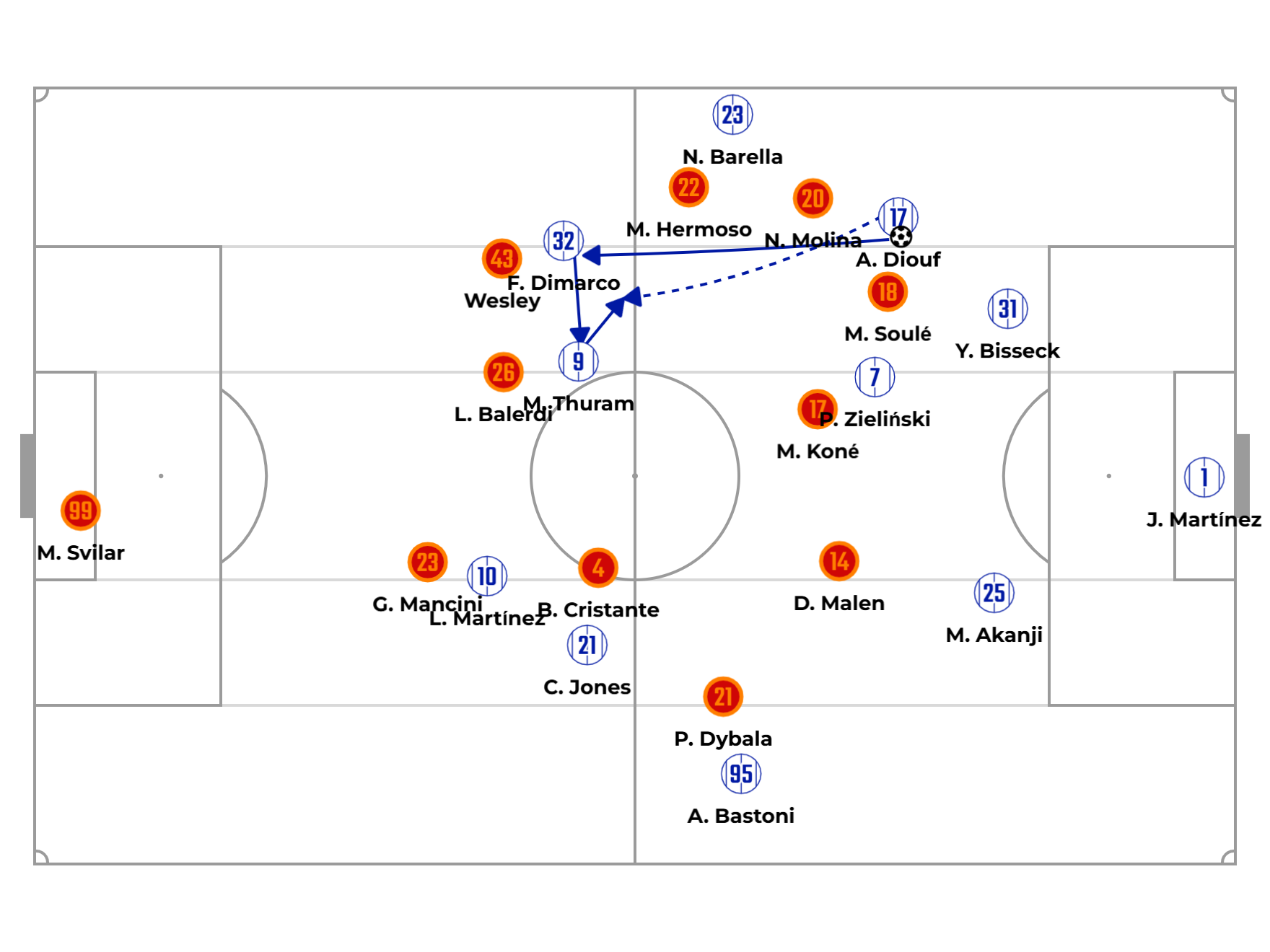
31st minute: Dimarco on the opposite flank to help connect Diouf’s third man run. Such was the intensity of Roma’s man-marking that Wesley had swapped flanks, but Inter could still access the space between Hermoso and Balerdi as Barella had moved outwards, and Thuram poked a pass back to Diouf.
Another chance followed after Dimarco had drifted onto the opposite flank, and Diouf met Thuram’s lay-off to play his fellow wing-back through. The cross reached the far side of the box, and Jones creatively flicked in Bastoni on the overlap, an acute attempt hitting the post in the process.
As these opportunities for Inter arose, the extremities within the game state also bubbled as Inter did not engage with as much circulation or rest defending, for that matter. As one attack finished, another would be sparked for Roma when the switch was made to the far side: this game was as much about winning the second ball on the long pass as it was about exploiting the center of the pitch being filtered out to disrupt the man-to-man.
With back-and-forth engaged, Roma took advantage after forcing Inter’s block deeper, Mancini able to carry possession forward after being available on the switch versus the 5-3-2 block. From there, the center-back moved into the center of the box even as Roma recirculated once more. Wesley tried to slalom inside on the one-two with Dybala, but Cristante was free to push a pass back to Dybala on the outside, open to cross into the box. Mancini and Koné evaded markers in the center, before Koné lifted the ball over the goalkeeper and in for Roma’s second, subject to VAR review.
Inter ignite the hex
Chivu did not make immediate changes to personnel, but there was a change to the channel that Inter chose to target. Thuram was stretching wider towards the left, targeting the outside and packing a punch on the early transition moments that Inter created. In the first thirty-eight seconds of the second half, Thuram pinched possession off Mancini and Lautaro moved the ball back into his path. Thuram made the cut back to the Argentine, whose run between Cristante and Hermoso was perfect to meet the ball and fire in at the far post.
Thuram was played through by Dimarco a couple of minutes later, before a tangle with Leonardo Balerdi inside the box. Thuram continued the move to no avail, although Inter could still apply a lot of pressure down this side of the pitch. If it would not come from direct transitions, Inter was still playing a lot more vertically than usual. Dimarco passing back to Bastoni, as the wing-back tucked inside and the center-back opened towards the touchline, had the same means to escape but also saw Dimarco join Jones in attacking Thuram’s lay-offs. It came as no surprise that Chivu’s first substitutions were to reinforce that side of the pitch: Jones and Dimarco were replaced by Petar Sučić and Carlos Augusto, and the benefits soon showed as Inter could produce rotations at a shorter distance upon entering the opposition half.
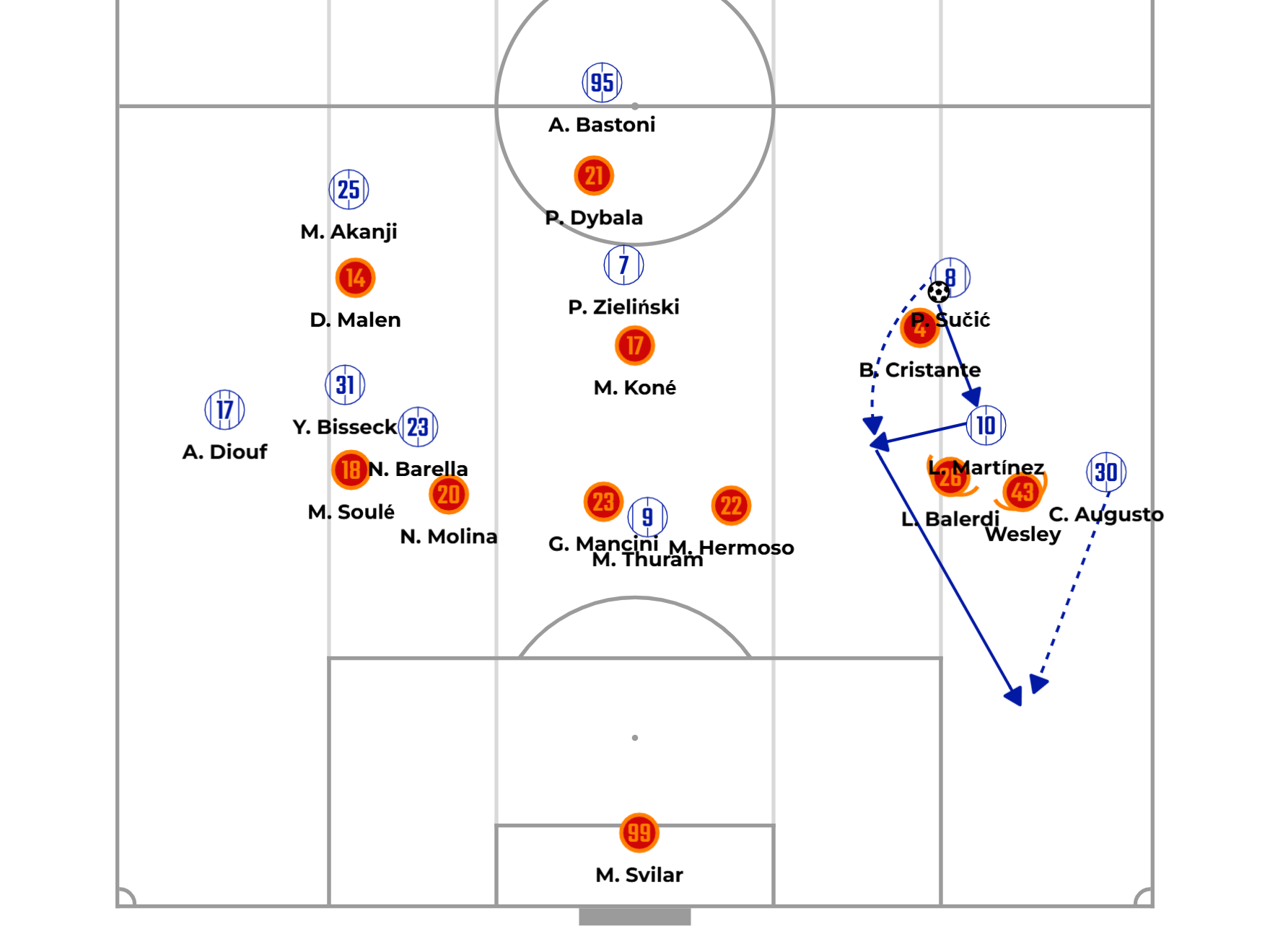
56th minute: Three-man combination to progress against the Roman block. As the ball recirculated to the left side, Sučić could move against the grain of Cristante’s outward pressure and combine with the one-two. With both Balerdi (the Roma center-backs had situationally switched in this phase) and Wesley occupied by Lautaro, Augusto could be played in behind and put a cross into the box.
The dynamics of the game had changed. Chivu’s team dominated the ground duels in the second half and Inter could now circulate with more frequency. Roma still approached in a compact man-to-man state, but now the wider stances of the strikers started to find players free inside of the Roma block: Lautaro occupying Wesley freed up the wing back on the touchline (Luis Henrique replaced Bastoni and became the wing-back just after the hour mark) or Thuram moving onto the wide right to overload the flank, which isolated the far side as Koné still jumped towards Zieliński.
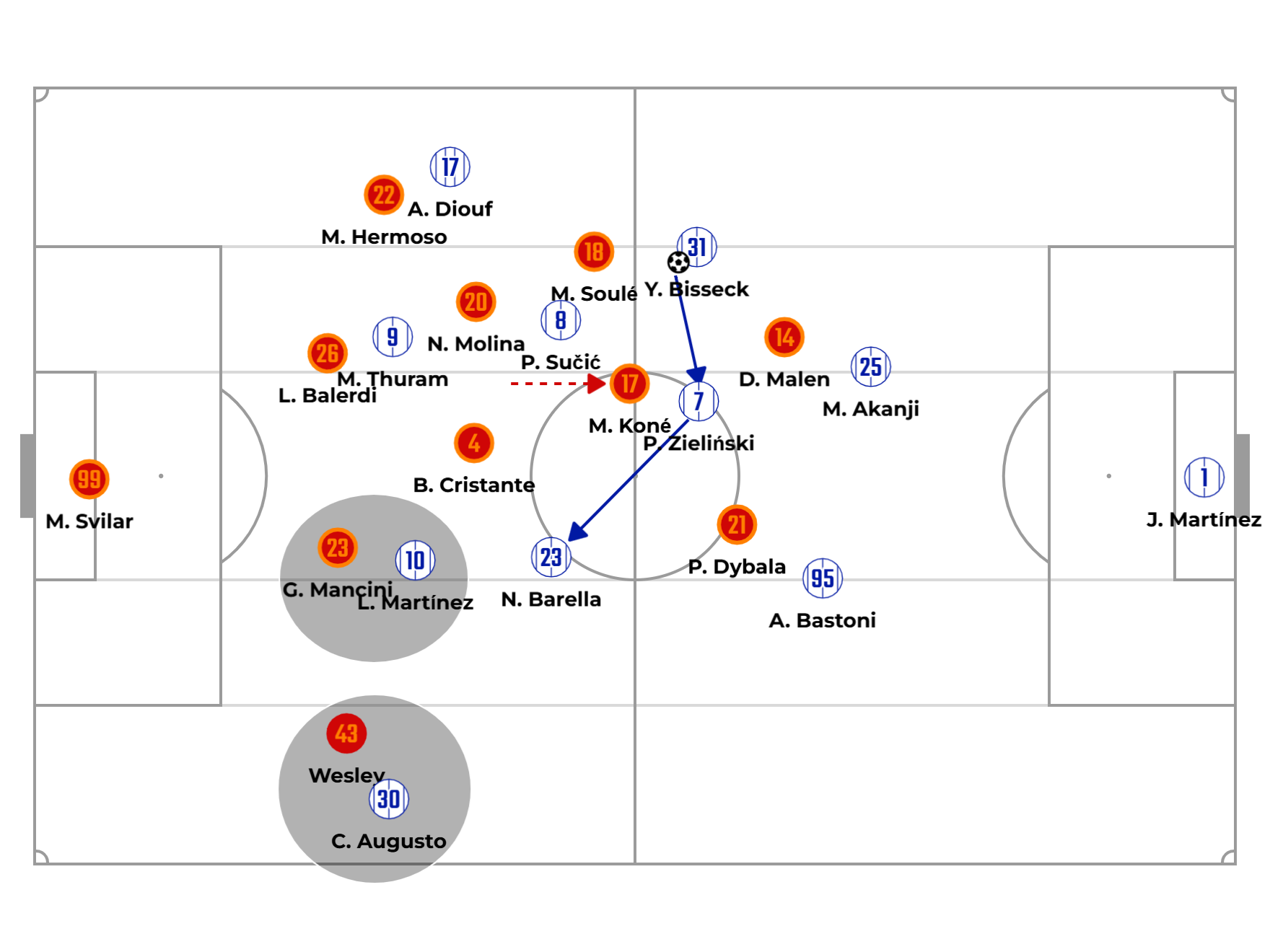
58th minute: Zieliński had Koné jumping onto him from the center-midfield position, but Inter could use this to their advantage. As he moved towards the Polish midfielder, space had opened diagonally towards Barella (who had situationally switched with Sučić) with Mancini and Wesley pinned, whilst Cristante could not apply direct pressure. Progress down the left was made, Thuram’s creative flick going wide from a low ball by Augusto.
Gasperini’s changes were more conservative. The triple substitution of Evan Ndicka, Devyne Rensch and Niccolò Pisilli did not address the gaps that appeared on the right side of the Roman block. Nevertheless, Roma still had the ability to work possession forward on the occasion and produced their only real chance in reestablishing the two-goal lead. From a corner, multiple jumpers could not divert towards goal, but Malen controlled and shot on the turn, denied by the face of Josep Martínez who could only make himself big from such a close range.
The game had reduced its tempo by this point. Both Roma and Inter started to have phases of circulation, as opposed to the constant offensive sequences that had been exchanged throughout. However, the momentum started to ramp up in Inter’s favor. From a corner, Thuram forced an excellent save out of Svilar and Lautaro hit the crossbar from the rebound. Offensive pressure was maintained as Barella recovered, and Henrique played the pass down the line towards Augusto for the cross. Bisseck poked it to Lautaro, who controlled it with the thigh before firing it in, a shot too much for Svilar to divert away.
Gasperini’s other substitutions had seen Balerdi forced off with an injury, Daniele Ghilardi replacing him, whilst he took off Hermoso for Konstantinos Koulierakis after the Inter equalizer. A different back three to the one that they started with, no offensive changes that could have provided a threat or substitutions that plugged the gaps that appeared in the midfield line. From the final chance to threaten the Inter goal, the champions countered and Thuram nearly caught a disoriented Svilar out, with a low shot from range that trickled just wide.
Takeaways
Denied his three-hundredth win in Serie A history, Gasperini is still incapable of breaking a curse that would have been symbolic of Roman intentions. Another layer of frustration is added when you consider that Roma had Inter where they wanted them, able to transition off a rest defense that was inactive and keeping Dybala high to influence attacks in the final third. After promising first-half phases, Roma are still without a victory against Inter on their turf and the question still lingers over the legitimacy of a title charge: away trips to Como and Napoli await them in October.
The point is more valuable to Inter, yet they can also be frustrated, not creating a vast number of chances despite the progressive route that had been established. There can also be cause for concern with the number of goals that they keep conceding. Five times in 2026, Inter have been trailing by two goals in Serie A, although they have won three and drawn two of those matches. Chivu has kept the wheels in motion but there are still issues that require fixing: they enter the international break level on points with the Capital clubs, Como could join them (yet to play at the time of writing) and even Cagliari just a point away after an electric start. A close group in terms of points, Inter is well ahead in terms of quality at its disposal.
Use the arrows to scroll through all available match plots. Click to enlarge.
Check the match plots page for plots of other matches.


Comments