São Paulo – Athletico: Former Best Young Futsal Player Leads a Comeback After Brasileirão Restart (1-2)
If you follow futsal, you’ve probably heard of a highly talented young Brazilian who ultimately failed to establish himself at the highest level of the sport. That was Leozinho, who switched to football and became a key player in Athletico Paranaense’s promotion campaign. In the first round after the Brasileirão resumed, he scored both goals in a comeback away win over São Paulo, lifting his team further up the table.
Tactical analysis and match report by Marcus Arboés.
São Paulo have gone through several crises over the past few years, especially in 2026. One solution the club found was to bring Dorival Júnior back as head coach, a specialist in stabilizing difficult situations and adapting to the squad at his disposal. Following the latest news that the club would receive a transfer ban, his mission was to get São Paulo back to winning ways. He lined up with Rafael in goal; Lucas Ramon and Wendell (former Porto) at fullback; Arboleda and Rafael Tolói (former Atalanta) as the centerback pairing; Pablo Maia, Bobadilla (Paraguay National Team) and Marcos Antônio (former Lazio) in midfield; and Artur, Luciano and Calleri leading the attack in an asymmetrical 4-3-3 outline. For this match, they were still without Lucas Moura (former PSG and Tottenham), who remains sidelined through injury.
Athletico Paranaense, meanwhile, have been one of the positive surprises in Brazilian football thanks to the solid work of head coach Odair Hellmann. Even with four absentees, he managed to make his team even more efficient heading into the remainder of the season. Veteran captain Santos started in goal; Arthur Dias, Aguirre and Esquível formed the back three; Gilberto (former Benfica) was given an opportunity at right fullback, while Mendoza, a natural winger, played at left fullback; Jadson partnered Luiz Gustavo (former Wolfsburg) in the double pivot, with the latter having recently left São Paulo after giving an interview in which he exposed several internal issues at the club. Up front, the team featured top scorer Viveros as the number nine, with João Cruz and Leozinho (former futsal player) operating in the inside channels.
São Paulo lost, but did they play well?
Following Crespo’s unexpected dismissal and Roger Machado’s disappointing spell amid internal institutional turmoil, São Paulo had struggled both to produce consistent results and to play well. Now, under Dorival, part of the fanbase expected at least a noticeable improvement, which did arrive after the World Cup break, although it was not enough to secure a home victory. In the first half, São Paulo were the dominant side and deserved to score the opening goal.
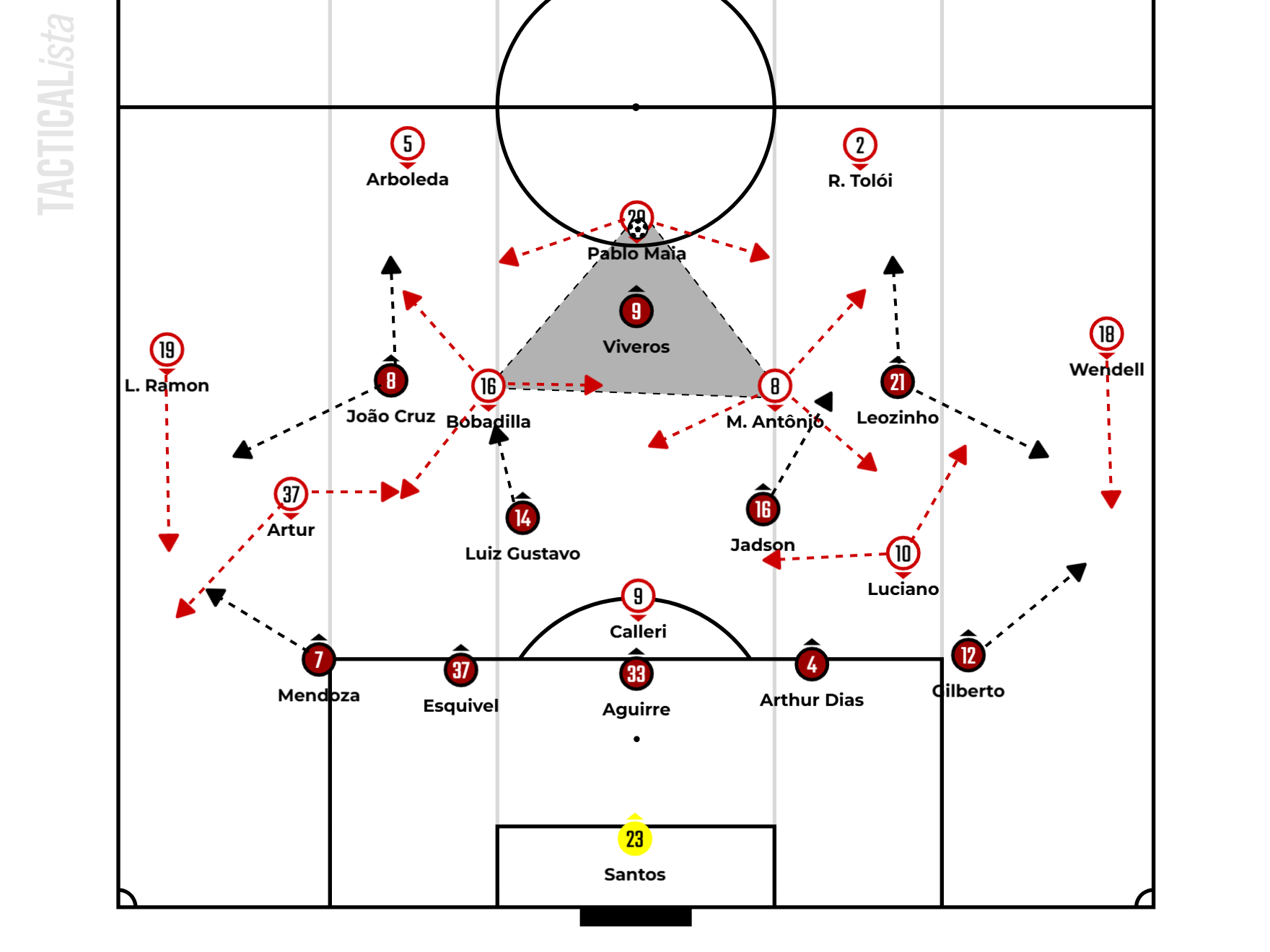
São Paulo attacking in an asymmetrical 4-3-3 shape, organized by the midfield trio, against Athletico’s 5-2-3/5-4-1 formation.
Playing at home, São Paulo managed to impose themselves and create more dangerous attacking situations, but they came up against a very solid Athletico defense. Dorival Júnior’s side lined up in a 4-3-3 outline with an asymmetrical attacking structure. Luciano operated as a second striker, Calleri as the target man and Artur as a versatile right winger. The team’s organization consistently flowed through the feet of two or three midfielders, with Pablo Maia usually initiating the build-up, Marcos Antônio acting as the playmaker and Bobadilla providing support. The three of them always shifted toward the side where São Paulo were trying to build the attack.
São Paulo looked to overload central areas or the flanks to find either the forwards or the overlapping fullbacks, who were positioned to finish the move. To stop that dominance, Odair set up his team in a 5-4-1 formation, with a deep back five that only stepped out to press once the ball reached the wide areas. Jadson and Luiz Gustavo tracked runners through the middle, while João Cruz, Viveros and Leozinho initiated the press during São Paulo’s build-up. Two of them would always drop back to help create double teams on the flanks, allowing the defensive structure to alternate between a 5-2-3 and a 5-4-1 shape.
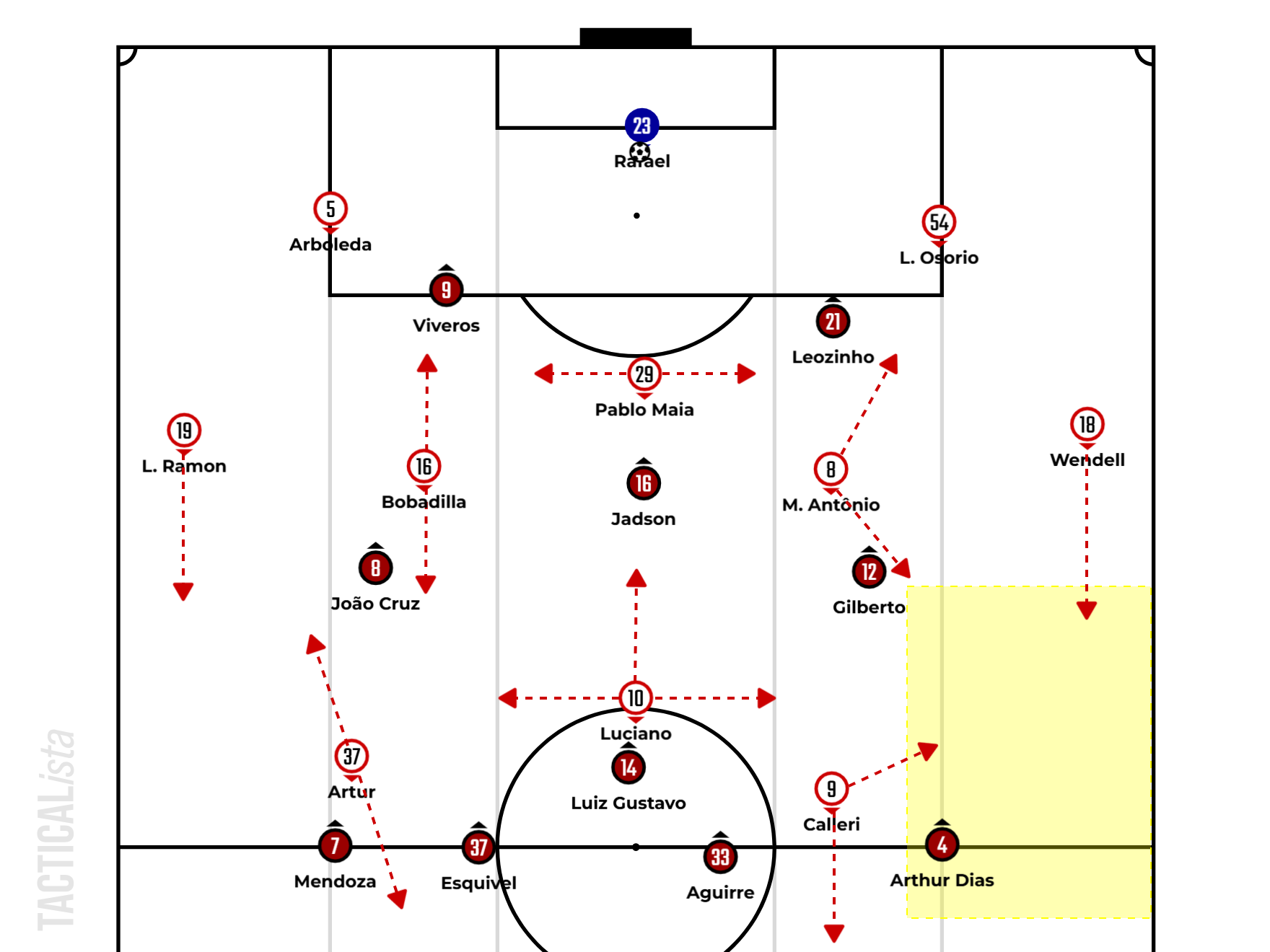
São Paulo’s build-up in a 4-3-1-2 shape.
If Athletico’s low-block defending was well coordinated, they looked vulnerable when pressing high. São Paulo’s build-up structure changed whenever they were pressed inside their own half. Pablo Maia positioned himself behind the first line of pressure, while Marcos Antônio and Bobadilla varied their heights to create numerical superiority, offer passing lanes for the defenders or attract markers. While Artur stayed wide on the right, Calleri drifted to the left and Luciano dropped as a number ten behind the opponent’s second defensive line.
Athletico pressed high in a 4-1-3-2. Leozinho formed the first line alongside Viveros, while João Cruz occupied the left side of the second line, with Jadson protecting the middle and Gilberto stepping out from right fullback to press Marcos Antônio. However, that reference became confusing. Since Luciano operated centrally, Luiz Gustavo stayed with him, and Gilberto’s movement to press Marcos Antônio left the flank exposed.
With Wendell attacking that space and Calleri drifting toward Arthur Dias, São Paulo progressed through the move that resulted in the free kick brilliantly converted by Artur to score the opening goal. Shortly afterward, another build-up sequence escaping through that side even led many supporters to call for Arthur Dias to be sent off. Athletico had to adjust their pressing, with Gilberto no longer stepping out to Marcos Antônio, Luiz Gustavo advancing through the middle instead, and one of the center backs picking up Luciano.
Leozinho’s impact, the Prince of Futsal
As previously mentioned, Leozinho was once named the world’s best young futsal player and was considered one of the sport’s brightest prospects. At the peak of his futsal career, he decided to switch to football, while many considered him crazy, pointing to the unsuccessful example of Falcão, the futsal legend who failed to establish himself in traditional football. He moved to Hercílio Luz, then Ituano, and during last year’s second division campaign made the leap to Athletico Paranaense, where he played an important role in the club’s promotion back to the Brasileirão.
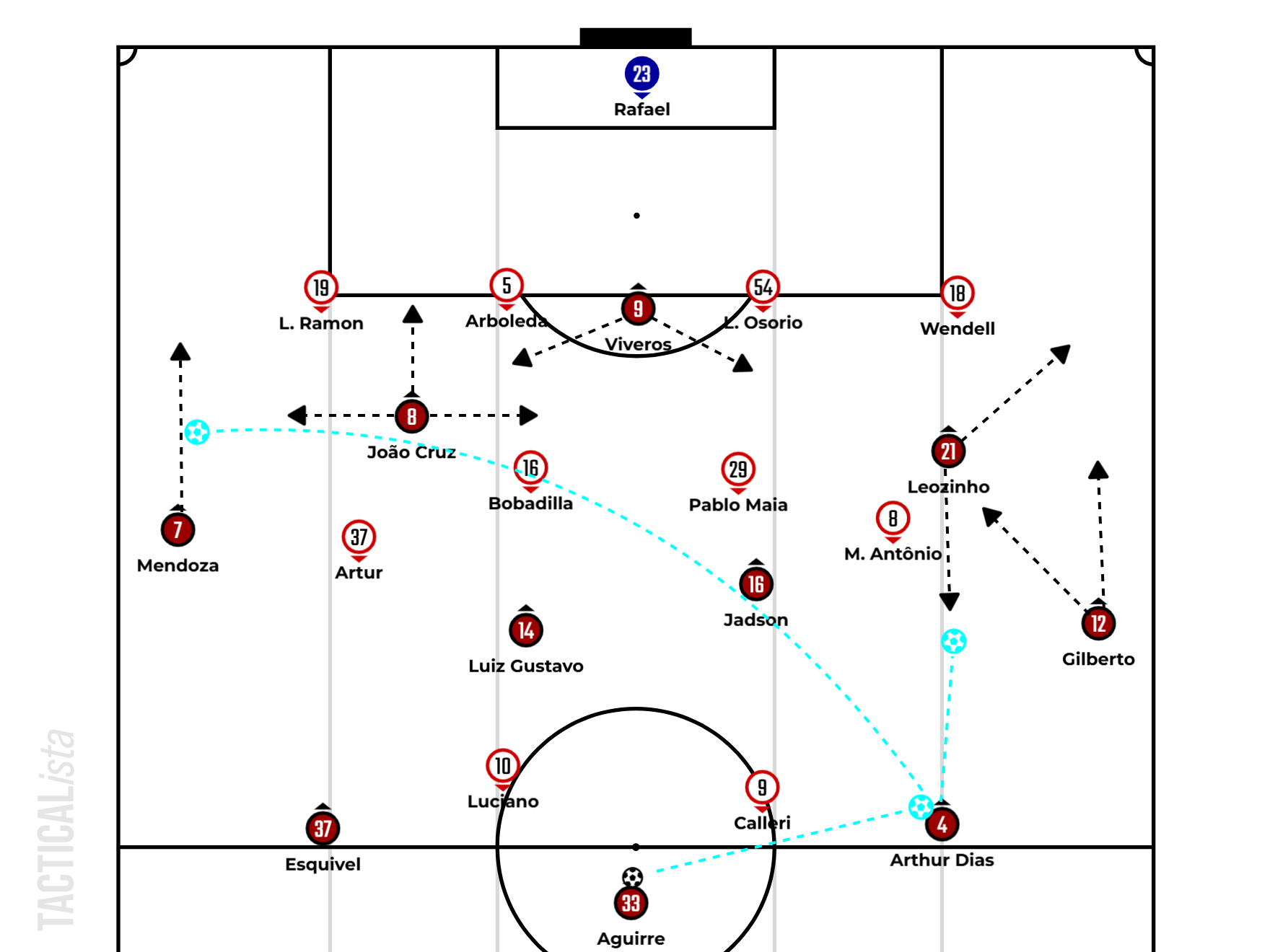
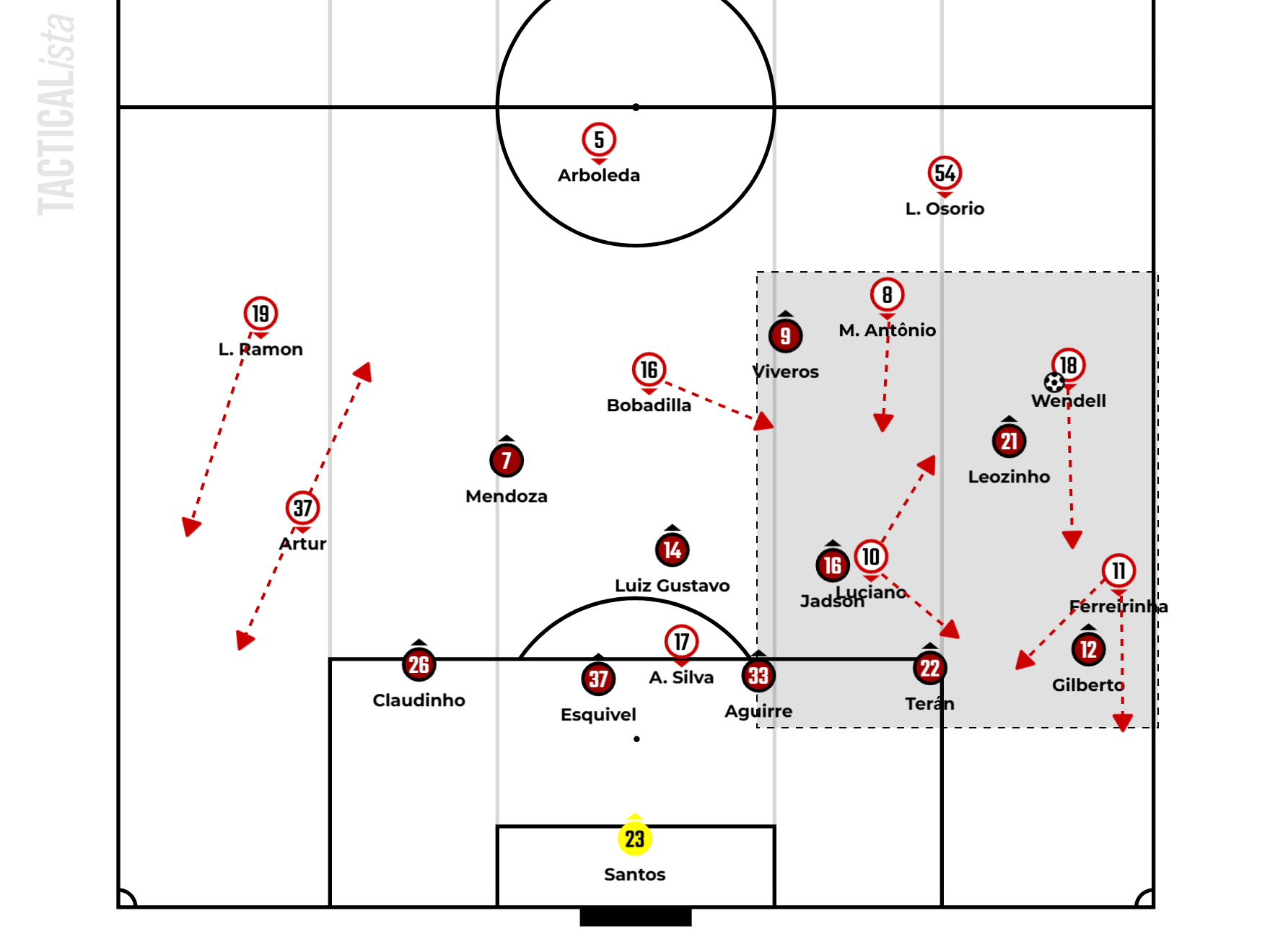
Athletico’s positional attack in a 3-4-2-1 formation, with Leozinho as the key player, against São Paulo’s 4-4-2 defense.
The Prince of Futsal, as he was known, still displays much of the skillset he developed on the futsal court, from his first touch to his ball carrying and his understanding of space. He starts as a right winger but enjoys the freedom to drop deeper, influence the build-up and vary both his position and height, acting as a free element within a more positional structure. That was also why the experienced right fullback Gilberto played such an important role, attacking space either inside or outside, or offering support at the base of the move, constantly adapting to the decisions of the disruptive former futsal player.
Against a São Paulo side defending in a low block, Athletico’s attacks were based on offensive circulation to draw the opposition’s defensive block before finding either Mendoza on one side or Leozinho on the other. During their limited attacking moments in the first half, they mostly attacked down the right. Whenever Arthur Dias did not switch play toward Mendoza on the opposite flank, Leozinho dropped deeper to begin the build-up and looked to combine either down the outside with Gilberto or through the middle using João Cruz’s movement between the lines or Viveros receiving with his back to goal.
Very little of it proved effective. In addition to the previously mentioned adjustment in the high press, Odair Hellmann made two more changes. Teran replaced Arthur Dias, who had come close to being sent off, while left fullback Claudinho came on for João Cruz, allowing Mendoza to move higher as the left winger. Those two substitutions addressed two of Athletico’s main defensive weaknesses from the first half while also increasing their threat in offensive transitions, with “Speed” Mendoza now leading the first line of pressure.
Athletico’s first goal, in fact, originated from a counterattack. Leozinho missed a clear chance, but seconds later reacted first to the loose ball after an aerial duel to score his first Brasileirão goal. A few minutes later, following a corner, the ball fell kindly for the Prince of Futsal, who struck it first time with tremendous power to complete the comeback. Just six minutes into the second half, Athletico had turned the match around thanks to Leozinho’s individual brilliance.
São Paulo switch to an asymmetrical 4-2-3-1 formation, now using two natural wingers and Luciano as the number ten.
São Paulo tried to respond, with Marcos Antônio emerging as their main chance creator, but they failed to convert the opportunities they produced. To push the team “further forward,” Dorival replaced his number nine, took off holding midfielder Pablo Maia and introduced left winger Ferreirinha, changing the tactical structure into an asymmetrical relational/functional 4-2-3-1 shape. The idea was to use the overloads created by the holding midfielders alongside Luciano on whichever side São Paulo attacked, looking to exploit numerical superiority down the channels since they couldn’t create it against Athletico’s last line.
The team improved, but something was still missing. Dorival then introduced Danielzinho, a deep-lying playmaker, in place of Bobadilla, as well as debutant right winger Victor Sá (former Krasnodar), looking for two more incisive players on the right side, as Lucas Ramon had almost been fulfilling that role already while Artur operated almost like a playmaking winger in the half-space.
With only a few adjustments, Odair managed to keep his team’s intensity high. Although São Paulo attempted ten shots in the second half, they failed to score and still saw Athletico create the more dangerous opportunities, coming close to extending their lead through counterattacks. Despite all of that, the hero of the match, Leozinho, was forced off injured midway through the second half, creating concern for Odair.
Takeaways
With another defeat, São Paulo’s poor run of results continues after the World Cup break. Dorival Júnior has still been unable to stabilize the team and restore the efficiency needed to win matches, even at home. After once sitting near the top of the Brasileirão table, São Paulo have now dropped to 12th place and will try to recover against Flamengo, one of the strongest teams in Brazil and South America, on Sunday.
Athletico were initially worried by Leozinho’s injury, but he has already returned to training normally and is available for next round’s match against Internacional, a club previously managed by Odair. With this comeback victory away to São Paulo, Athletico demonstrated the strength of their project and climbed to third place in the Brasileirão standings, behind only Flamengo and Palmeiras, benefiting from Fluminense and Bragantino drawing their match.
Use the arrows to scroll through all available match plots. Click to enlarge. Check the match plots page for plots of other matches.