
Vélez Sarsfield – Tigre: Drama Late on as Vélez clinch Victory over Fighting Tigre, Extending Their Unbeaten Run (3-2).
It was a brilliant showcase of attacking football with these two teams. Both teams implemented the same approach in all phases of the game but the players ultimately play the game on the pitch, not the coaches. Mirror tactics don’t always lead to the stalemate on the pitch. Vélez imposed themselves more but made structural changes later in the game that swung into the hands of Tigre. Tigre were able to gain momentum later on but took their foot off the gas after their equalizer.
Tactical analysis and match report by Ebuka Ogoegbunam.
Veles have four wins and five draws in their last nine games leaving them unbeaten in the Clausura so far. They’ve scored seven goals and conceded seven in nine matches which shows weakness defensively, but they haven’t failed to score in any of those games. Tigre, meanwhile, have four clean sheets this season, with slightly more stability at the back, but they’ve only managed one win in their last five and lost their last two against Gimnasia and Rosario Central. Tigre looked a touch more balanced defensively, but less consistent in getting results.
Vélez Sarsfield started with Tomás Marchiori in goal, with Joaquín García, Thiago Silvero, Lisandro Magallán, and Elías Gómez forming the back four. Rodrigo Aliendro and Lucas Robertone operated in midfield, while Matías Pellegrini, Manuel Lanzini, and Juan Cruz Policella played behind Ronaldo Martínez, who led the attack.
Tigre, meanwhile, had Felipe Zenobio in goal, protected by Valentín Moreno, Alan Barrionuevo, Juan Manuel Villalba, and Nahuel Banegas across the back line. Bruno Leyes sat in midfield alongside Jabes Saralegui. Tiago Serrago played on the right with Gonzalo Martínez in attacking midfield and Santiago López operating n the left. Ignacio Russo led the line up front.
Mirror setups
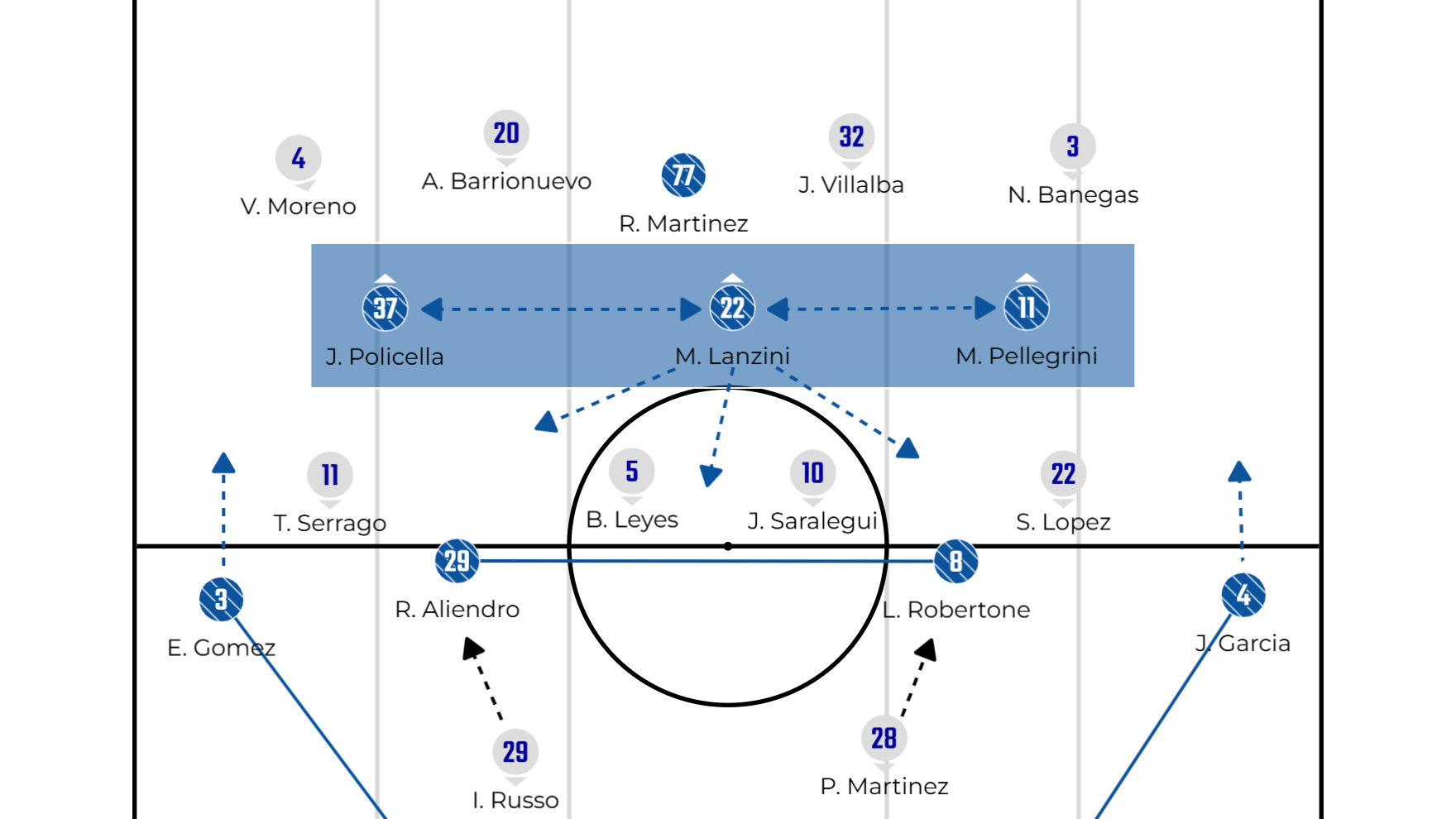
Vélez setup in a 4-2-3-1 shape with the ball. They used a 4-2 base with the fullbacks holding the width. The wingers operated inside like number tens and occupied spaces between the lines. Lanzini was the attacking midfielder who was allowed to drop into any zone and be the initiator in both deep and attacking phases.
One of the pivots could drop into the defensive line to form a back three, giving the fullbacks more license to push forward into attack in build up. This shaped Vélez to often transition from a 4-2 to a 3-1 base. The Vélez’s wingers were free to rotate with each other within the lines of the Tigre midfielders and center backs.
Vélez’s shape in possession; Fullbacks kept the width with the wingers inside rotating within the lines.
Tigre defensively were conservative and put pressure in timely moments. They sat in a 4-4-2 mid-block and when they put pressure, they transitioned a 4-1-3-2 high press. The attacking midfielder alongside the striker put pressure on Vélez’s two centre backs. The wingers covered central lanes before putting pressure on Vélez’s fullbacks.
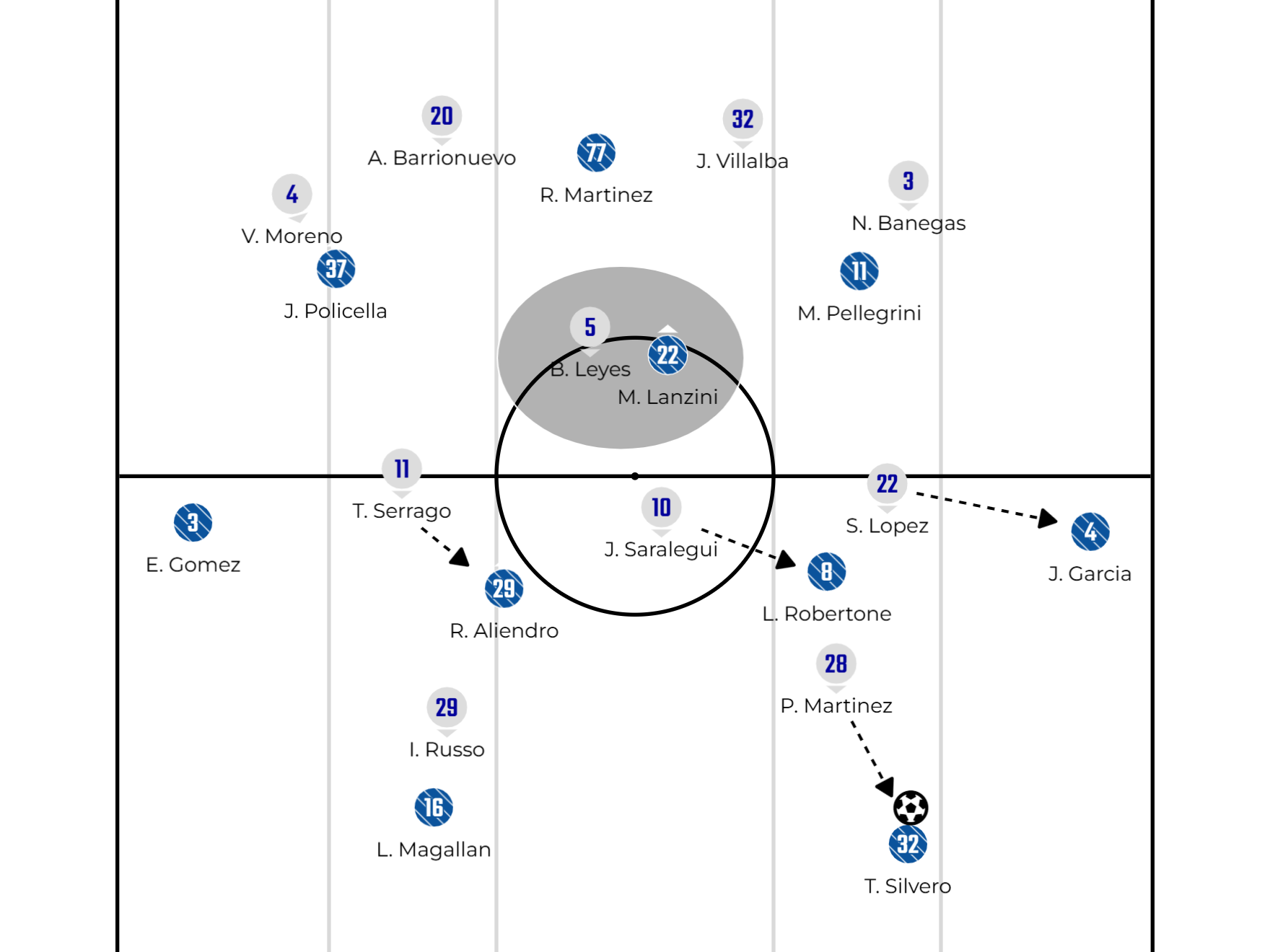
Tigre’s transition to a high press; Ball-side zonal pressure during Vélez’s build-up.
Tigre initially remained compact in their 4-4-2 shape and allowed Vélez’s center backs to have a lot of the ball. Vélez used this to keep possession with Lanzini dropping deep to help the team progress.
With the ball, Tigre set up in a similar shape with Vélez. Their fullbacks kept the width with their wingers inside. Vélez, similarly set up in a 4-1-3-2 high press. Lanzini and Ronaldo Martinez led the press with wingers inside covering the central lanes alongside the highest midfielder who was Robertone.
Vélez’s attacking proximity
Vélez gained control with their patient approach with the ball. Lanzini and Robertone were key to help the team progress. Vélez were able to control and attack with horizontal overloads. These overloads were caused by wingers, opposite and ball side, joining to overload one side of the pitch. Pellegrini was often drifting to the left side of the pitch as the right winger, to cause havoc and give his team an opening in the final third.
Vélez’s fullbacks held the width so the inside wingers were allowed to roam around and look for spaces in attack. They weren’t restricted to one zone in attack and this helped Vélez to find entries in attack. The winger’s freedom between the lines enabled combinations with the players in proximity.
This also helped Vélez in transitions. When they recovered the ball, they were able to attack with the players in proximity. They were able to link up and be a threat in transitions. Vélez’s first goal had the same principles of proximity in transition. When they recovered the ball from Tigre, they were able to attack and link up well in transition.
Pellegrini and Lanzini’s link up was enough to beat the counter press of Tigre. With the opposite winger, Policella, also narrow, he was close to the play giving Vélez more numbers in transition. Policella’s run gave Vélez numbers in transition and created space for Pellegrini to play in Ronaldo Martinez in behind the Tigre defence to score.
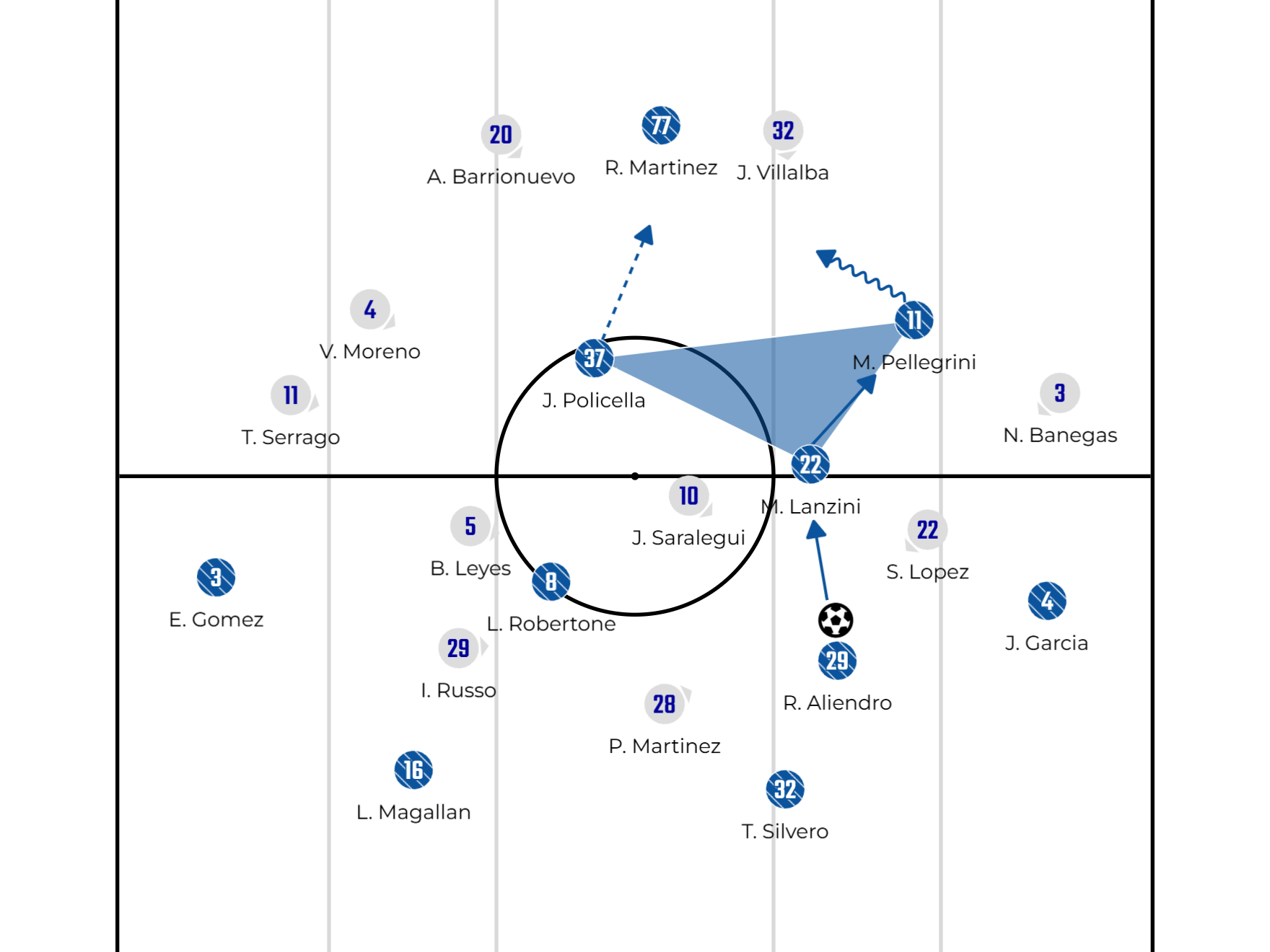
The build up to Vélez’s first goal. Proximity in transitions leading to effective combination and attacking sequence.
Tigre’s fight back
On the ball, Tigre used their wingers similarly to Vélez’s. They were given more freedom to roam across the front line and look for openings. Pity Martinez, the attacking midfielder was given the responsibility to drop deep and help the team progress. In the second half, they found more openings with their rotations as Vélez began to loosen up defensively.
Tigre took advantage of Vélez loose defending between the lines and equalized. Their goal showed fluidity between the attackers and the midfielders when combining in attack. The right winger, Serrago, drifted to the left hand side in the build up of the goal. Saralegui was able to find Pity Martinez between the lines and link up to play the striker in to score.
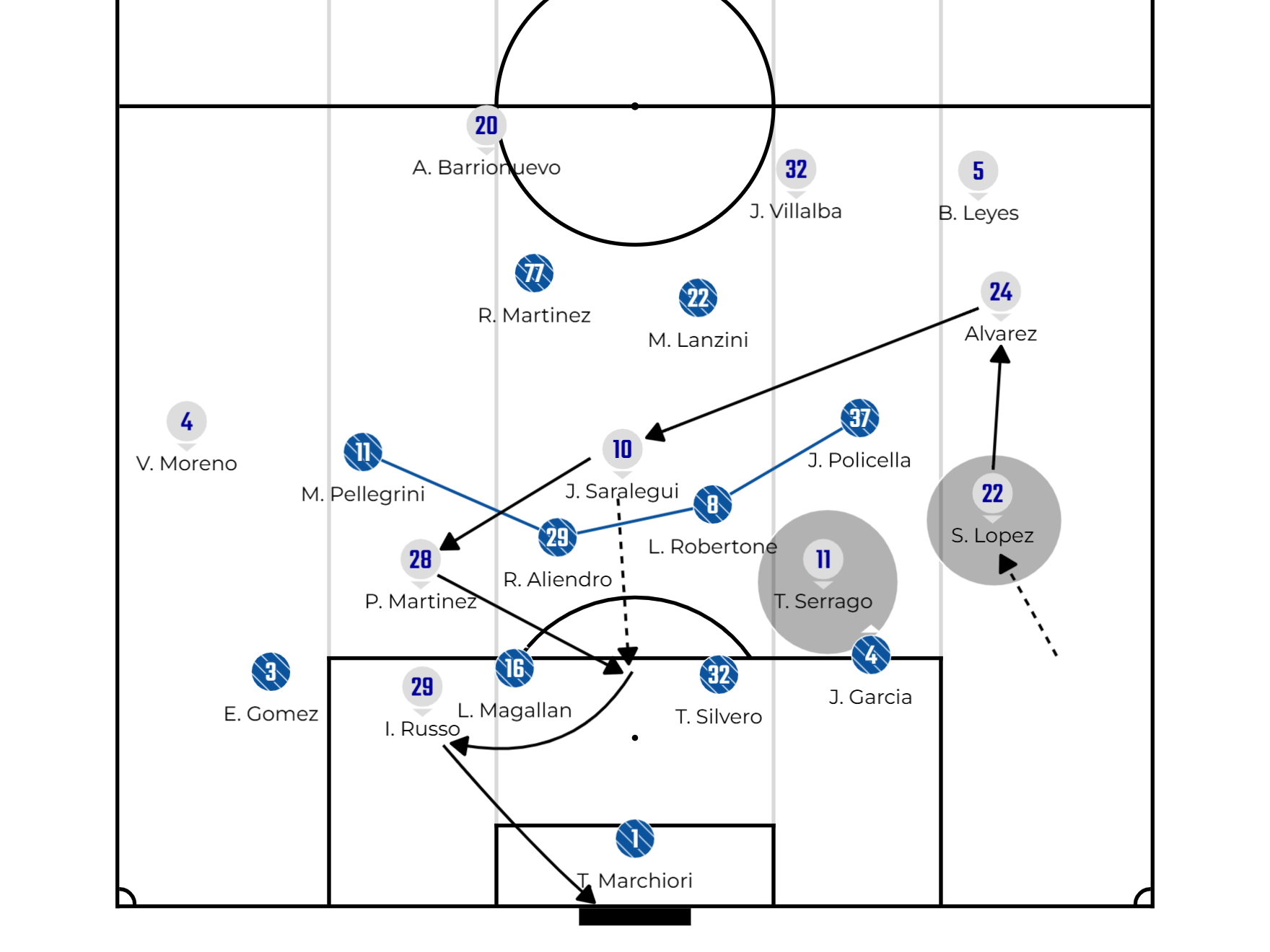
Tigre’s equalizer, Pity Martinez and Saralegui combined between the lines to play the striker in.
Vélez gained more urgency after Tigre’s equalizer. With the momentum gap reducing as the game went by, Tigre gained more confidence when going forward and changed their approach to win the game. Vélez made it easier for Tigre to progress when the wingers failed to keep an eye on the opponent’s fullbacks. Vélez’s pressing shape changed with the wingers putting pressure on the center backs, leaving the fullbacks free.
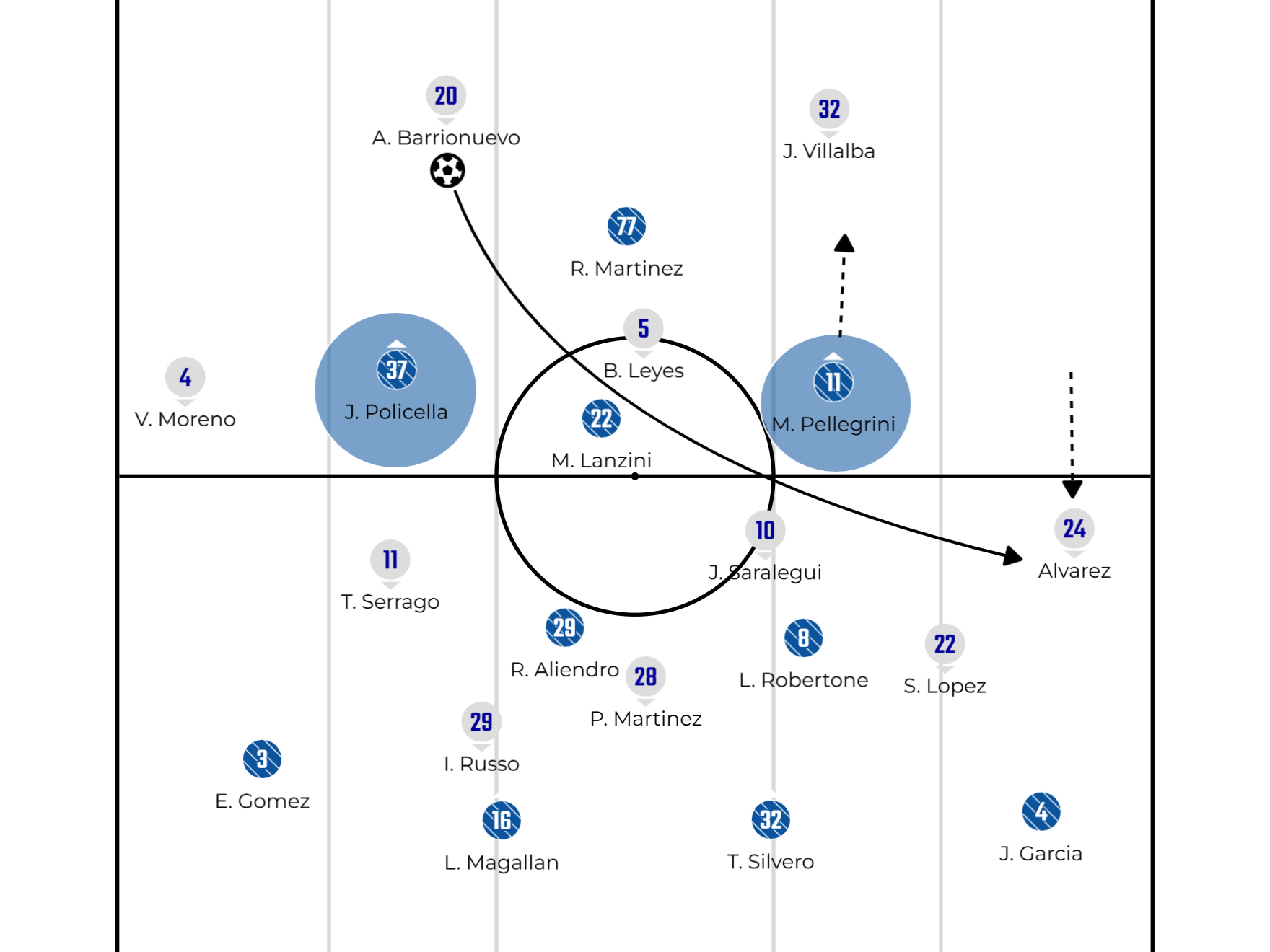
Pellegrini puts pressure on the center back, leaving the fullbacks free. Tigre are able to play long to the fullback and beat the pressure.
When Vélez put pressure, Tigre were able to find their fullbacks and advance up the pitch. Tigre attacked with numbers high on the pitch with intent to pile the pressure after their goal. However, Tigre left spaces in wide areas when their fullbacks were high up attacking and this allowed Vélez to have spaces in those areas when they transitioned higher up the pitch.
Vélez were able to score another goal through their proximity in attacking thirds. The understanding and combinations in attacking areas helped to take advantage of gaps in the final third. Gómez’s ball into the central area found the feet of Policella to finish after a dummy from Pellegrini, who was close to him.
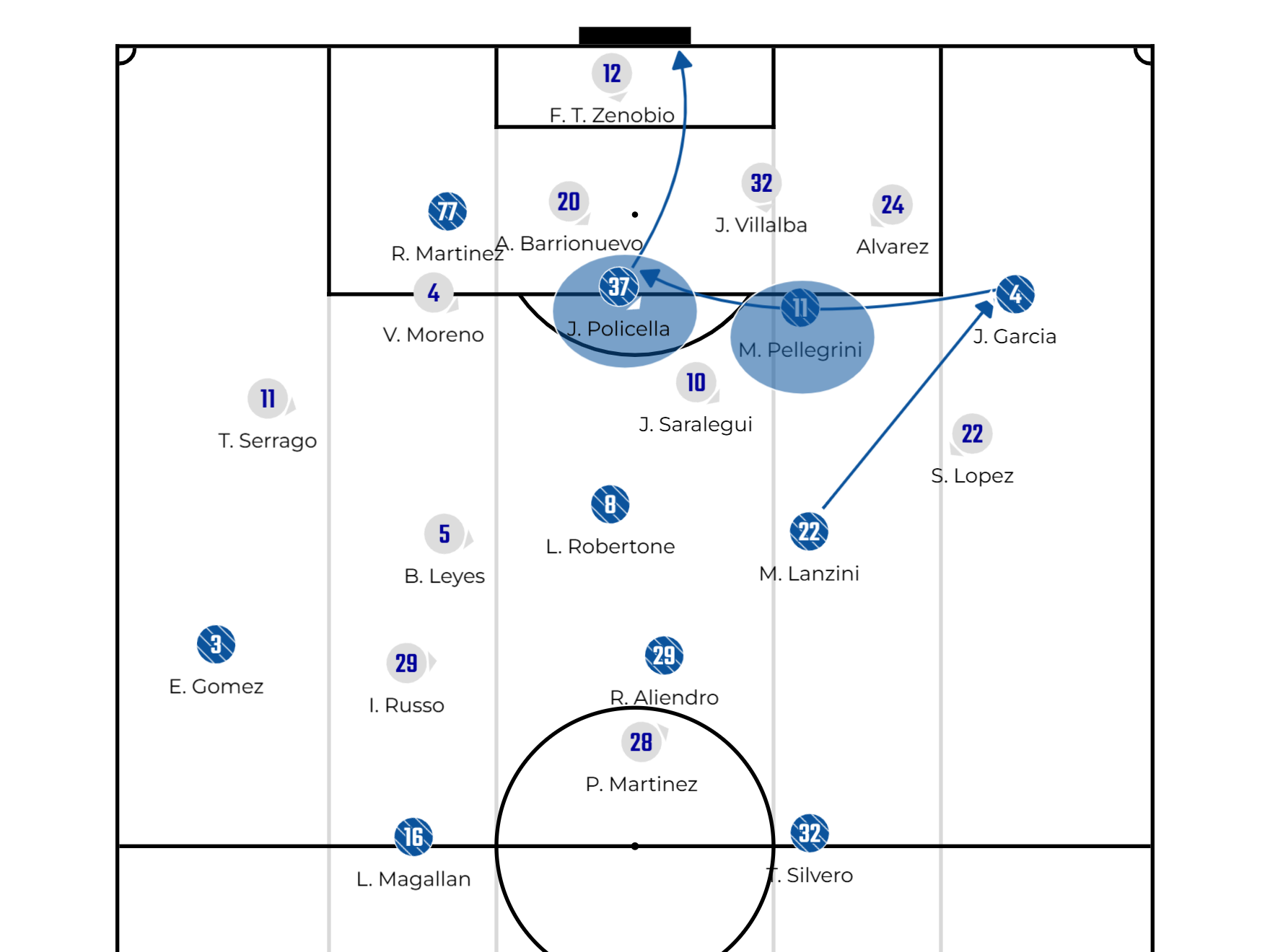
Vélez’s second goal; Pellegrini’s dummy deceived the Tigre defensive line to free up space for Policella to strike at goal.
Vélez regained the lead and looked to sustain it till the end of the game. Tigre continued to push forward. They made attacking substitutions and got their reward in the 86th minute of the game. Russo’s flicked on header found the substitute, Jeronimo Domina, who beat his defender to the ball to finish past the Vélez keeper. Tigre’s persistence paid off later in the game.
Unfortunately, they failed to hold their lead after Vélez scored not too long after. Vélez’s proximity came into effect again this time, with the substitute, Diego Alves finding Ronaldo Martinez in the box to score the winner late in the game.
Takeaways
Vélez Sarsfield defeated Tigre 3–2 in an entertaining match between two teams that used similar tactical approaches. Vélez controlled large periods through their fluid attacking structure and combinations between the lines, while Tigre grew into the game after Vélez became less secure defensively. Tigre’s attacking pressure produced two equalizers, but Vélez’s proximity and combinations in the final third ultimately helped them find the late winner. Vélez extend their unbeaten run to ten games sitting second in Group A of the Clausura.


Comments