
Spain – Argentina: La Roja Rise to the Top (1-0)
The two most successful nations of this decade in international football met to fight for the right to call themselves world champions. But only one outfit ever looked like taking the game to their opposition, and the toil from their dominant display was rewarded by a much-maligned figure.
Tactical analysis and match report by Emmanuel Adeyemi-Abere.
We decided to make this article free to read. If you want to support our work, consider taking a subscription.
Spain are still the standard bearers for successfully engineering a signature style in international football. Their passing played Austria, Portugal and Belgium off the park before the biggest feather in their camp came against the highly touted France in the final four. This team does not dazzle with the same dynamism from 2024, but they can constrict opponents with impressive efficiency. If they kept a clean sheet in the final, they would have conceded the fewest goals of any World Cup winning outfit.
Argentina are a worthy, battle-hardened opponent. Since the group stage, they have not wrapped up a single win before the 90th minute. A dogged unit that will die for the cause of consecrating their talisman’s legacy, they showed spells of spirit and quality against Cape Verde, Egypt, Switzerland and England to advance to this stage. Now, history is in sight: after back-to-back Copa América titles in 2021 and 2024, they could become the first country to win four successive major tournaments.
Lionel Scaloni switched three members of the lineup from the semi-final. Nahuel Molina made way for Gonzalo Montiel, who scored the winner in the 2022 World Cup final penalty shootout, to feature at right back. Giuliano Simeone stepped aside for Rodrigo de Paul to be one of the wide midfielders. Nico González got the other slot and Alexis Mac Allister moved next to Enzo Fernández, forcing Leandro Paredes to watch from the bench. Julián Alvarez and Lionel Messi made up the front two.
Unsurprisingly, Luis de la Fuente felt satisfied with the starting eleven from the semi-final. Having scored twice in the knockout stages, Pedro Porro has played himself into contention as the first choice right back instead of Marcos Llorente. Pau Cubarsí, Aymeric Laporte and Marc Cucurella completed the backline. Fabián Ruiz joined Rodri and Dani Olmo as midfield mainstays. Álex Baena banked the position on the left wing while Mikel Oyarzabal has operated upfront throughout the tournament.
Argentina allow Spain to settle
As a basis for their success, Spain have not failed to win the possession battle in any of their knockout stage fixtures in the tournament. They would remain faithful to their preferred plan in this showdown.
The first big opening of the clash saw an attempted through ball from Yamal deflect back into the path of the right winger, whose effort was blocked by Emiliano Martínez. However, the talismanic attacker was primarily pinned to wider areas of the pitch, and his impact in the final third was quite limited.
Instead, La Roja mainly found spaces to probe inside Argentina’s defensive setup. Messi moves more freely off the ball to the right of the frontline in their 4-4-2 formation, and Enzo could be encouraged into jumping out to engage as Rodri anchored himself deeper. A huge split emerged between the two central midfielders, and Spain signaled that they could engineer central access through the block.
The left sided rotations demonstrated the fluency seen in the earlier rounds of the knockout stages. Cucurella is comfortable underlapping Baena, but the winger would also sometimes wander into more central positions to connect with other red shirts. Fabián floated between high and low areas in the inside left channel, and Olmo would occasionally drop deeper to replace his role of support to Rodri.
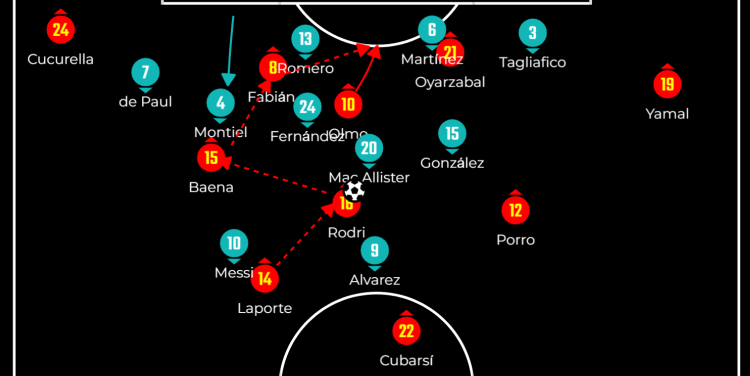
39th minute: offensive sequence from Spain. Messi moved towards Laporte and Rodri pivoted behind Alvarez to allow the ball circulation to continue. Baena then drops extremely deep towards the ball while Fabián fills the space behind Argentina’s midfield. Enzo elects to track Olmo, so Fabián is free between the lines, and his clever flick tries to find the onrushing Olmo, who runs off the shoulder of Enzo. However, the pass is a little out of Olmo’s reach and Oyarzabal strikes from the top of the box.
The Spaniards would end the first half in a familiar position. The growing presence of Rodri, as well as their calculated (and occasionally cynical) counterpressure, meant that the opposition struggled to break free from their cycle of dominance. On the other hand, without Yamal in his finest form or the quality of threat from Baena or Cucurella on the left flank, offensive potency was somewhat missing.
Enzo’s emotion spills over
Scaloni swapped two players in his lineup before the start of the second half. An injury for Lisandro Martínez meant Nicolás Otamendi offered up his services in central defense. An unenforced alteration saw the end of the Nico experiment in the midfield: Paredes played alongside Enzo as Mac Allister moved into Nico’s wide left position. Spain still dominated, beginning to turn to their reinforcements.
De la Fuente threw on Mikel Merino and Pedri into the midfield trio with Rodri while Nico Williams was introduced in place of Baena on the left flank. La Roja had trebled their shot output in the second half of regular time with Pedri particularly impressing through his trademark progressive qualities.
— li ve (@live2gu) July 20, 2026
The scoreline was still deadlocked at a stalemate, but a big moment tipped the tide further in favor of the Spaniards. Williams marauded forward on a breakaway, whacking a strike into the palms of Martínez. The ball worked its way backwards to Cubarsí, and Enzo barreled into the central defender. Cubarsí went flying in the air, and the referee did not hesitate to pull out a second yellow card to award the midfielder. As extra time beckoned, the reigning champions had gone down to ten men.
Ferran finds a way
The dogged defensive display from Argentina continued. Alvarez dropped deeper onto the left of the midfield in a 4-4-1 shape, then Marcos Senesi was sent on as a third central defender in a back five. Scaloni’s side still had not registered a single effort in the game, and the pressure was piling up.
Williams would waste a dangerous delivery from Pedri, then the winger watched a goal get chalked off for a foul on the goalkeeper. Merino made the next move, missing the mark with a close-range header. All of Spain’s control would count for naught if they could not make a moment count.
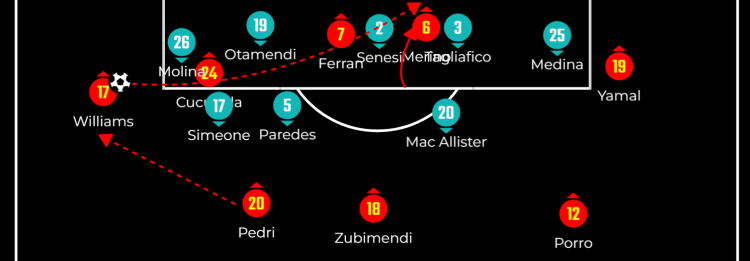
103rd minute: offensive sequence from Spain. With Williams stationed on the left, Spain had a dual threat on both flanks. He receives the ball from Pedri, pushes it onto a more positive angle, and sends a delivery into the penalty area. Ferran and Merino load the box, and the midfielder meets the ball.
Eventually, they wore down the Albiceleste. Yamal fed the ball back to Porro, who clipped a cross to the far post. Williams got free from Molina, steering a knockdown to Ferran. The substitute striker showed composure, slamming a shot into the roof of the net. His first goal of the World Cup came at the perfect moment, and his nation were now only fifteen minutes away from claiming the crown.
Even then, Argentina could not quite turn the screw. Their first strike of the game came in the 117th minute. Some Messi magic from the right wing would sprinkle quality on top of the relative dysfunction from long balls, but the Spaniards stood tall to wrap up a historic win in New Jersey.
Takeaways
Spain’s celebrations shall continue late into the night: they sealed the second World Cup title in their history, mimicking the achievement of the Golden Generation that scooped big honors in 2008 and 2010. Not unlike that team, defensive stability was the foundation for their success, keeping seven shutouts across their eight fixtures in the tournament. This side strangles the life out of games like no other opponent on the international stage, and they emerged as the deserved winners of the final.
Argentina’s antics were not finished at full time, bringing a bitter end to their attempt at a first successful World Cup title defense since 1962. From a footballing perspective, the Albiceleste were well matched against an opponent who could pop the ball around their pressure and had the intensity to suffocate their ideas in possession. But Scaloni’s side should still be applauded for their feats over the last five years, and he has done an excellent job if it is to be the end of the era of the two Lionels.
Use the arrows to scroll through all available match plots. Click to enlarge.
Check the match plots page for plots of other matches.


Comments