Fluminense – Palmeiras: Fluminense resurges after sacking coach and confirms Palmeiras’ poor form (3-2)
A few weeks ago, it would have been highly unlikely for Fluminense to have the mental strength to come from behind against the league leaders. The team was not poorly coached or bad in terms of its playing approach, but it clearly lacked confidence. This match, following Zubeldía’s dismissal, marked several resurgences for Fluminense and was another confirmation of Palmeiras’ poor form, which is being sustained by their positive points tally from the first half of the Brasileirão.
Tactical analysis and match report by Marcus Arboés.
Fluminense had one of the worst points returns among the Brasileirão teams after the World Cup. The dynamics within positional play and the patterns of what to do were noticeable, but the team did not seem to have the confidence or emotional repertoire to deal with the problems that arose during matches. For that reason, they dismissed Zubeldía and appointed Marcão on an interim basis, a club idol who works within the permanent coaching staff and youth development structure. Now, he is the head coach, but he stands out for developing strategies alongside Thiago Silva, who recently returned to play for Fluminense.
The starting lineup was a 4-2-3-1 formation, with legendary goalkeeper Fábio, the goalkeeper with the most official appearances in the world; Guga and Renê at fullback, Jemmes and Igor Rabello as the center backs, with Thiago Silva rested and the team also missing two other defenders; Martinelli and Hércules as the holding midfielders, forming the midfield alongside Ganso, the number ten and the team’s playmaker, who returned to the starting lineup and also took the captain’s armband; in attack, Canobbio (Uruguay National Team) played on the right wing, Soteldo (Venezuela) on the left and Hulk (former Porto and Brazil) as the target man, with John Kennedy unavailable due to a knee injury.
Palmeiras had few absences, with only Khellven missing among the regular starters. The problem behind their negative run of performances and results comes down to other issues that are difficult to pinpoint. With many high-quality players available, Abel Ferreira lined up Carlos Miguel in goal; Giay, Murilo, Gustavo Gómez (Paraguay National Team) and Piquerez in the back line; Andreas Pereira (former Fulham) and Marlon Freitas as the holding midfielders; Allan on the right, Jhon Arias (Colombia, former Fluminense) on the left, and the attacking duo of Vitor Roque (former Barcelona) and Flaco López (Argentina National Team).
The “new” Fluminense: football is simple
After the World Cup, Fluminense had yet to win a match. Following Zubeldía’s dismissal, who was not a bad coach and had his merits, the team had suffered a decline in morale. With Marcão, a historic club idol, the team recovered without needing to introduce any major changes. They did not sign anyone, promote youth players or make major changes to the players who had been starting. Beyond the change in the group’s morale and confidence, there was a notable structural tactical adjustment.
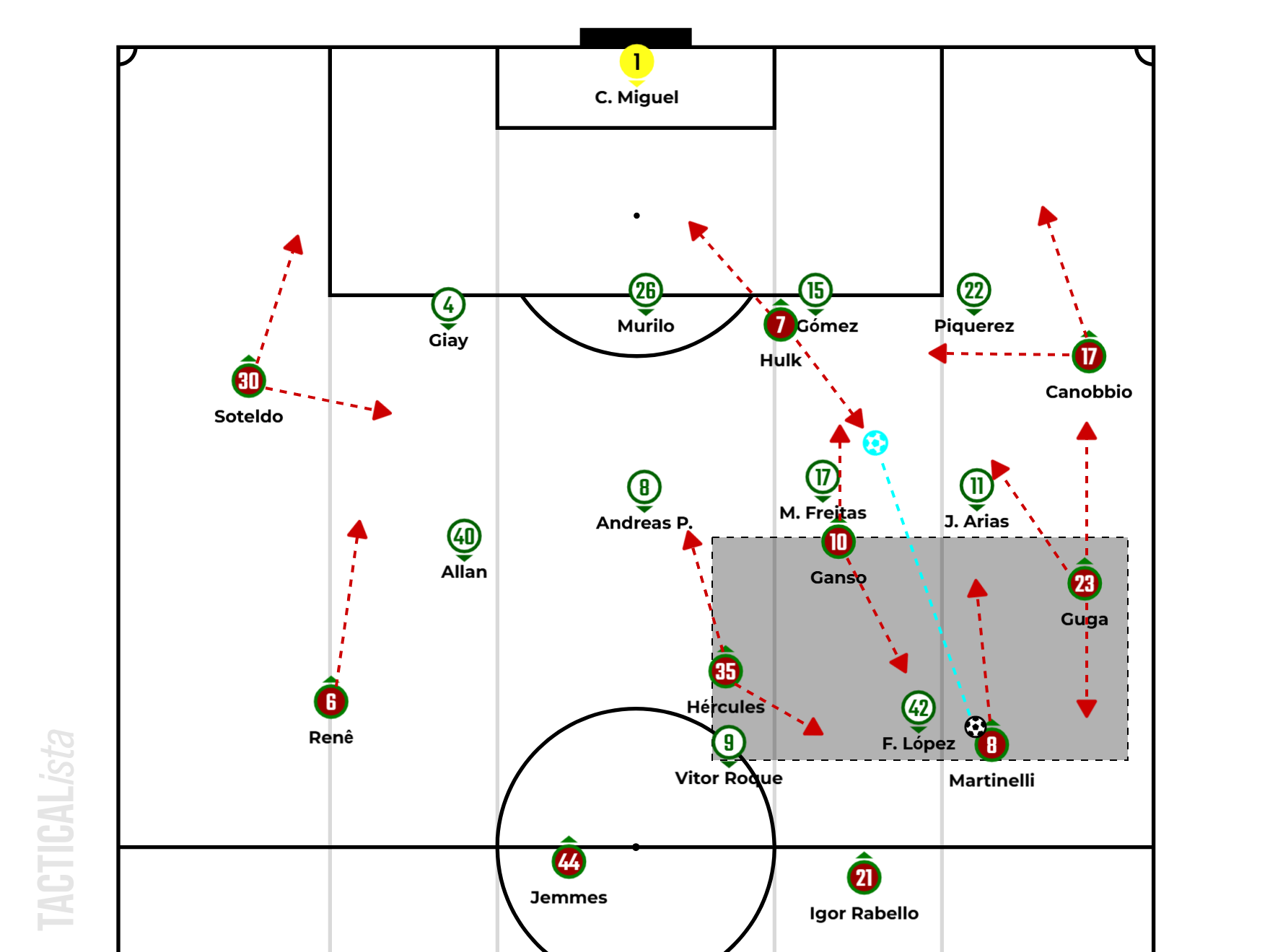
Fluminense’s relational/functional attack with the three midfielders at the base of the build-up, looking for forward support through close combinations.
Under Zubeldía, Fluminense attacked from a 4-2-3-1 or 4-3-3 formation that would become a 3-2-5 or 2-3-5 shape through positional organization, attacking through coordinated occupation of zones and channels, but with good mobility and clear positional dynamics. Now, Marcão has kept things simple within the club’s football culture, looking to give the players more freedom and encourage closer combinations, without relying as heavily on positional zonal organization. In addition, Zubeldía’s team had a “symmetry” of roles, pairing aggressive and physical wingers with technical fullbacks and varying their characteristics to maintain balance. That has changed.
As a general pattern, the team looked to gather players on one side of the pitch to make quick, forward progression. On the left, Soteldo is a more direct, dribbling-oriented winger, but during the build-up he contributes more by dropping to receive and help circulate the ball, while Renê is a more defensive and build-up-oriented fullback who supports inside without advancing too far. This led Fluminense to attack Palmeiras more frequently down the right side.
Martinelli and Ganso consistently acted as the team’s thermometers at the beginning of the build-up, with Hércules making underlapping runs, Canobbio starting from the right wing and Guga, the fullback, able to advance inside, outside or even act as a connector. With Hulk playing as a target man with his back to goal, Martinelli and Ganso looked for passes inside toward their supporting movements or used him as a decoy to progress precisely through these close combinations.
For much of the first half, Fluminense were considerably creative. This was directly linked to Ganso’s return to the starting lineup, one of the first “resurrections” produced by the change in the team. In the middle of the year, Ganso even began negotiations with other clubs because he was not being used much by Zubeldía, and when he did play, he had a role as a final third playmaker, operating closer to the box. Now, he has greater influence on the game and showed that he is not “retired,” as many had labeled him. As a result, Martinelli is no longer overloaded with the responsibility of organizing the team from deep.
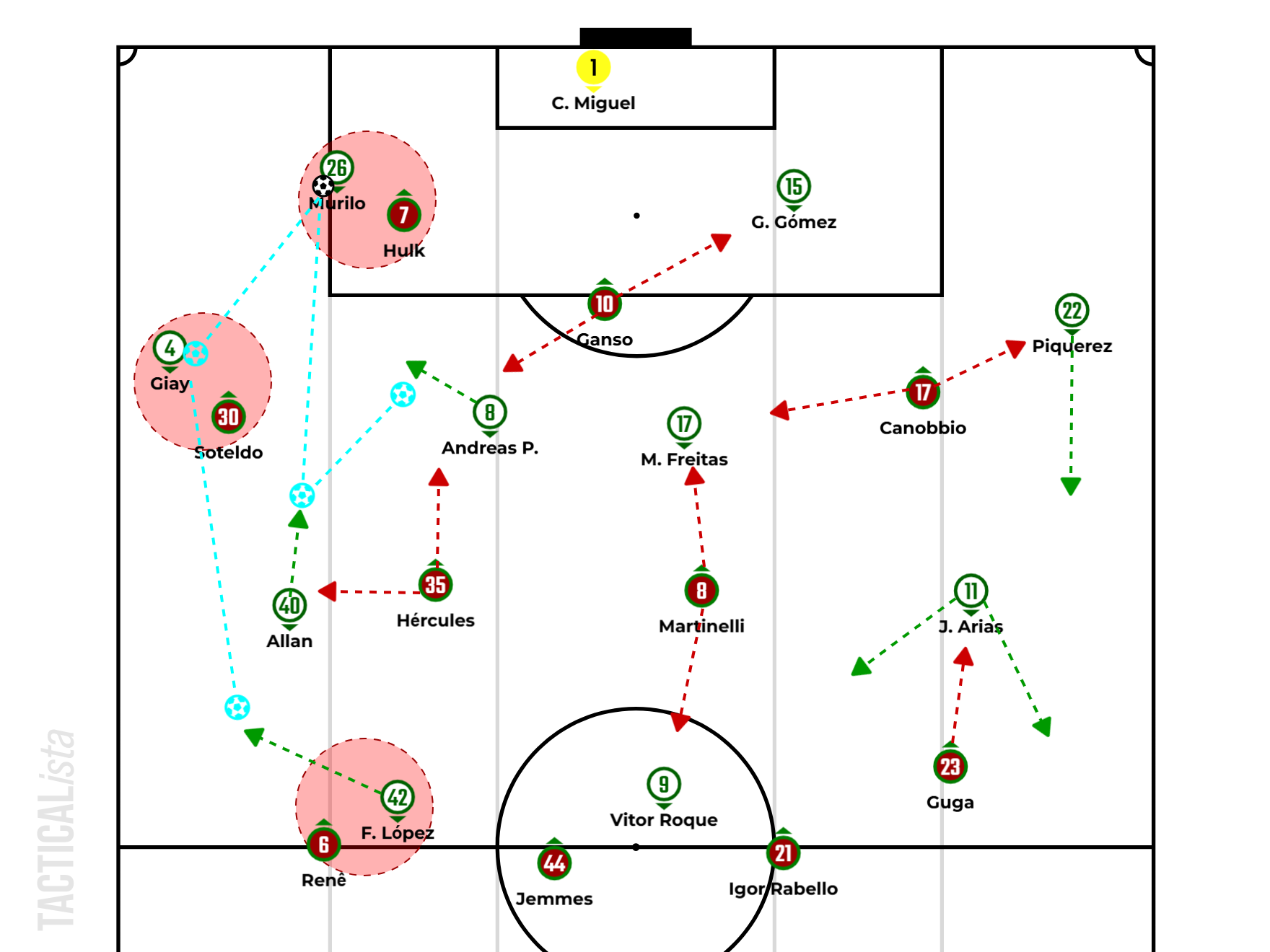
Palmeiras’ build-up looking for third man combinations against Fluminense’s high press using conditioned man-oriented marking in a 4-4-2 shape.
Although Fluminense were the better side at home, Palmeiras opened the scoring from a corner. After that, Fluminense pushed their defensive block higher to press. This may seem counterintuitive, precisely because the first line of pressure was supposed to consist of Hulk and Ganso, but the team managed to execute a high press that they had already been using for some time.
On the side where Palmeiras tried to build, either Hulk or Ganso made the first approach, while the other closed inside onto the holding midfielder in the first line. The winger on the opposite side tucked inside onto the other holding midfielder, meaning Fluminense’s midfielders did not need to step out onto Palmeiras’ midfielders. This allowed Fluminense’s defensive line to remain protected, while Hércules and Martinelli protected the space between the attacking line and the defenders. This significantly disrupted Palmeiras’ build-up, leaving them heavily reliant on direct play.
The second resurgence for the home side was Hulk, who had recently been booed off during a match. He scored a header from a Canobbio cross in a transition that began and ended with center back Igor Rabello, with Ganso directly involved as the controller of the attack’s tempo after Palmeiras were slow to recover their defensive shape. This and the disrupted build-up were just two more symptoms of the current problems affecting the league leaders.
Palmeiras’ poor form
What happened to the Palmeiras side that took a commanding lead at the top of the table before the World Cup? The answer lies in something that happens almost every time. Abel Ferreira’s long tenure has included spells of negative fluctuation, especially in terms of creativity, but this is still a team that is clinical when attacking the box and defending, with a high-level squad. The issue is that they are now showing clear defensive problems, exposing the team beyond their technical performance and also affecting their results.
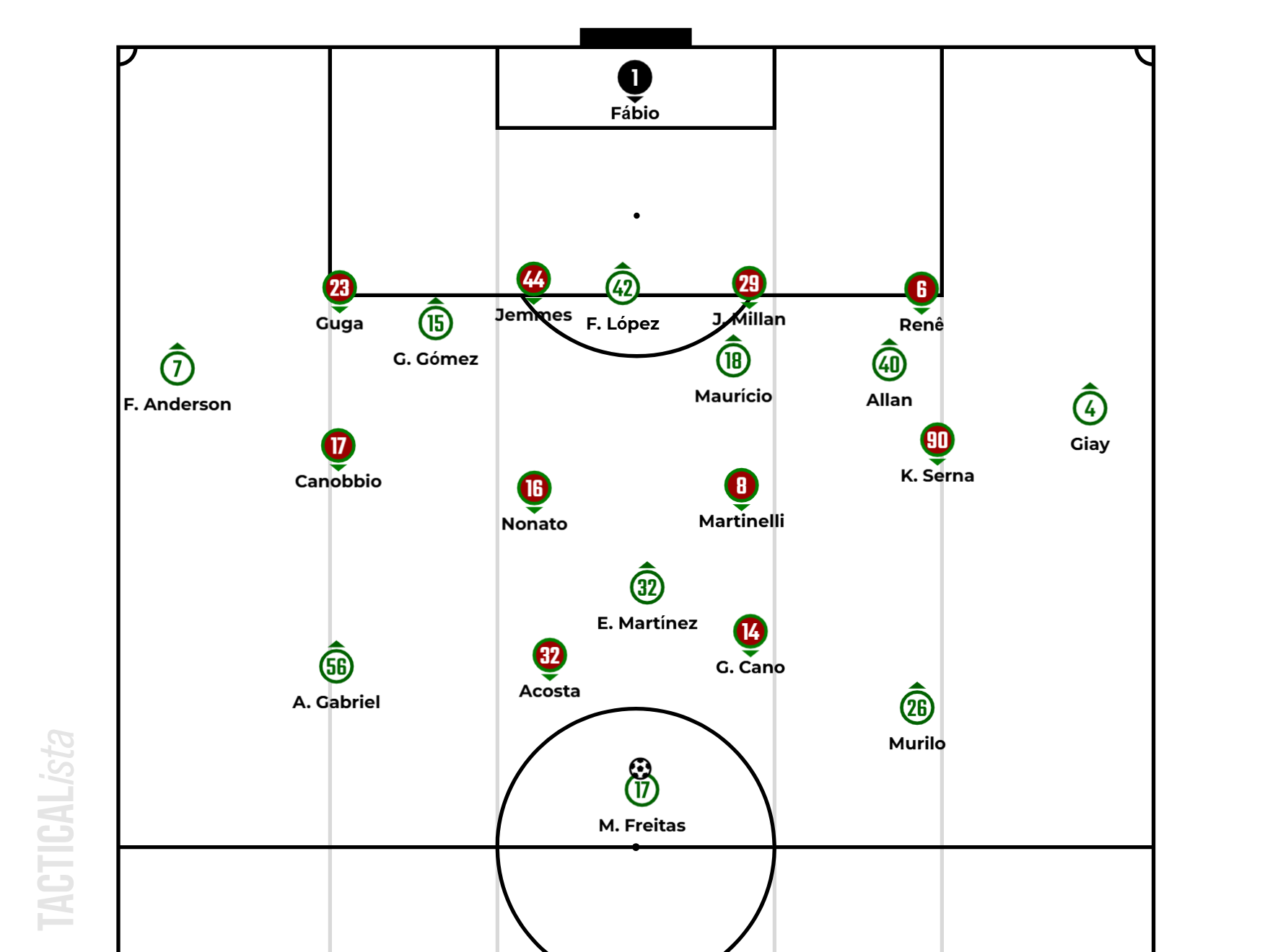
Palmeiras’ attacking structure in the second half, attacking almost in a 3-1-6 shape.
Throughout the second half, both teams made changes. With the team playing worse, Abel Ferreira brought on Sosa for Vitor Roque and then had to take him off through injury, replacing him with Felipe Anderson. Martínez replaced Andreas Pereira, Arthur Gabriel replaced Piquerez and Maurício took over Jhon Arias’ role, operating inside. At one point, Marlon Freitas started the build-up, looking for more direct forward or diagonal passes for someone to attempt a play down the right. Even Gustavo Gómez pushed forward as an attacker in the closing stages of the match.
It was clear that the team lacked the dynamism and confidence to attack, while Fluminense gave a masterclass in protecting the box, even with reserve center backs. Palmeiras’ second goal came from a Fluminense transition that failed, allowing Palmeiras to counterattack with a direct pass. Flaco López won the aerial duel in a vertical attack and found Maurício in the perfect space. After conceding, Fluminense did not lose their composure and pushed forward.
In this scenario, Marcão changed his personnel: Ganso and Hulk were replaced by Acosta and Cano; Serna came on for Soteldo and center back Millan replaced the injured Igor Rabello. Nonato also replaced Hércules. The team was not playing badly and did not make any structural changes, but the substitutions gave them more energy across all lines of the press.
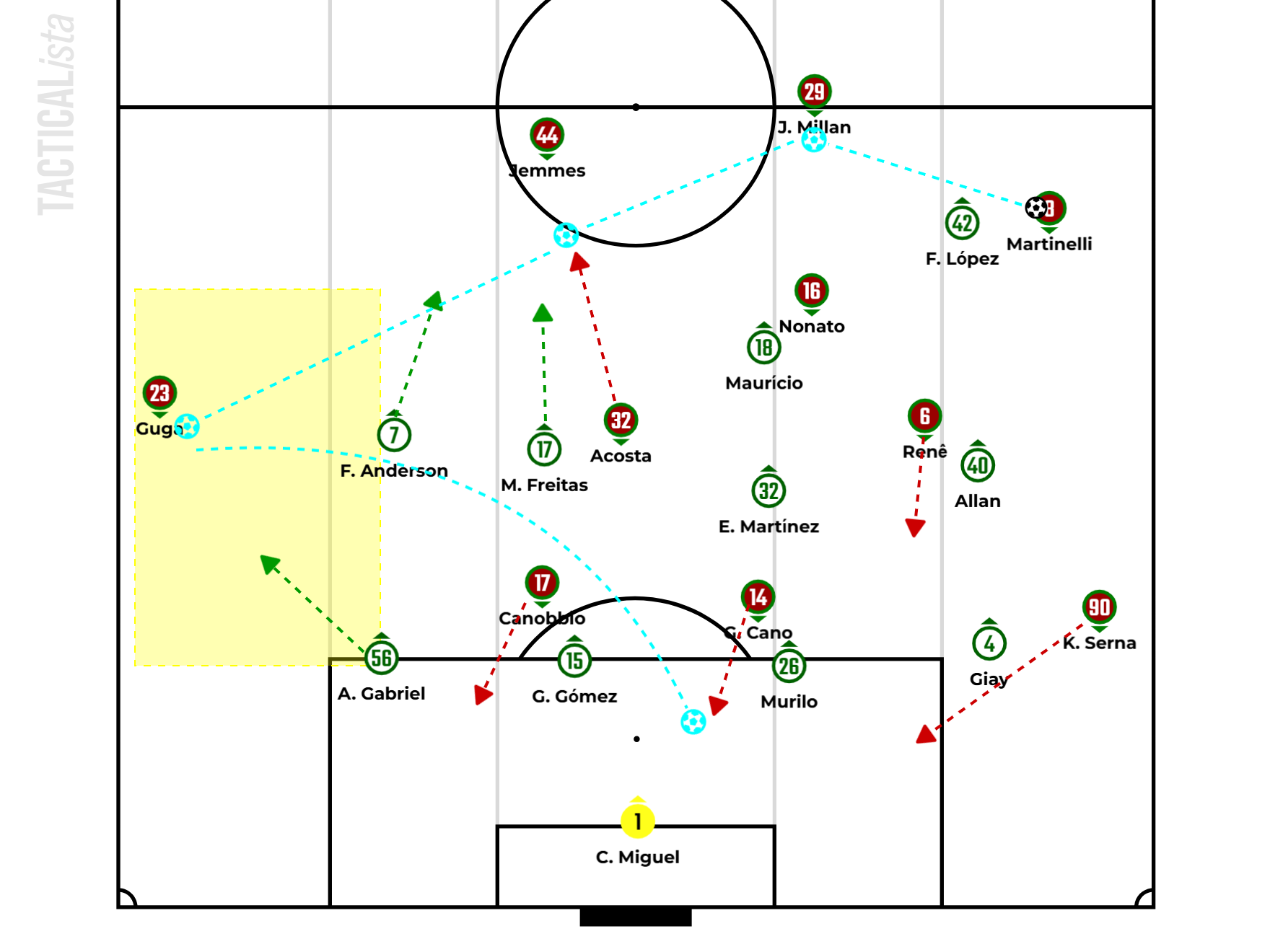
The situation leading to Fluminense’s equalizer, with Lucho Acosta dropping deeper and confusing Palmeiras’ defensive matchups.
Trailing in the match, Fluminense attacked through pendulum movements, struggling to find space while relying on movements from their midfield and attacking players and using close combinations to create openings. They managed to do so from time to time, but were not particularly effective. Palmeiras defended in a 4-4-2 with man-oriented marking, which caused their structure to become somewhat disorganized and confused when dealing with Fluminense’s attacking rotations.
In the build-up to the goal, Renê dragged the midfield line by attacking space through the middle, while Nonato attracted Maurício’s marking. Flaco López stepped out to press Martinelli, who was initiating the build-up from a lateralized position. Martinelli played the ball back to the center back, freeing both players from their markers. Instead of advancing with the ball to gain territory, a standard movement in football, the number ten, Lucho Acosta, dropped deeper and created major confusion in Palmeiras’ second line.
Marlon Freitas stepped out to press, but Felipe Anderson did too. As a result, Acosta escaped from both players and switched play to Guga, who received the ball with plenty of freedom. At that moment, Felipe and Marlon had to run back, leaving Arthur Gabriel isolated. The left fullback could not close down the space for the medium distance cross, leaving the box in a three against three situation. Canobbio pinned Gustavo Gómez, while Cano attacked the cross ahead of Murilo. The ball hit the post and fell to Serna, who easily got in front of Giay to equalize.
The winning goal, which came late in the match, also came during a period of renewed confidence for Fluminense, from a cross delivered from the right, just like the team’s other two goals. Martinelli switched play to the right side and found Guga making an overlapping run. He delivered the cross, Martinelli headed the ball unmarked in the middle of the box and Cano got a touch to redirect it away from Carlos Miguel.
Takeaways
Fluminense found their way back to winning form and, in midweek, advanced in the Libertadores against Rivadavia from Argentina. With this victory over the league leaders, the team can now look further up the table after a long run of draws, although they remain behind fourth placed Athletico. At the weekend, they face Remo, who are in the relegation zone.
Palmeiras, on the other hand, continue to play poorly and drop points. The team have managed to win their last few matches, but they have not inspired confidence and head coach Abel Ferreira has faced increasingly open criticism. However, Palmeiras also advanced in the Libertadores during midweek, a result that gave the coach an immediate response to his critics. In the next round, they can use that renewed confidence to pull further away from Flamengo when they face Vasco, who are going through a period of inconsistency.