England – Spain: Three Lions Brave In Defeat Against World Champions (2-3)
Thomas Tuchel’s side went behind early on but were able to turn the scoreline around thanks to a high pressing approach. In the second half though, Spain showed their quality on the ball, to break down England’s defense, as well as pouncing on England’s errors against the Spanish high press.
Tactical analysis and match report by Josh Manley.
We decided to make this article free to read. If you want to support our work, consider taking a subscription.
England kicked off their UEFA Nations League campaign by hosting World Cup winners Spain at Wembley. The Three Lions had won just two of their last twelve meetings against La Roja who carried a 38-game unbeaten run (excluding penalty shootouts) into this game.
Thomas Tuchel’s side lined up in a 4-3-3 shape with a back four of Jarrel Quansah, Ezri Konsa, Marc Guéhi, and Nico O’Reilly. Elliot Anderson and Myles Lewis-Skelly joined Jude Bellingham in midfield, while the front three contained Bukayo Saka, Harry Kane, and Anthony Gordon.
Spain also went with a 4-3-3 formation as Luis de la Fuente selected a backline comprising Marc Pubill, Pau Cubarsí, Aymeric Laporte, and Marc Cucurella. Rodri anchored the midfield behind Dani Olmo and Fabián Ruiz. Lamine Yamal and Nico Williams then flanked Ferran Torres up front.
England press boldly
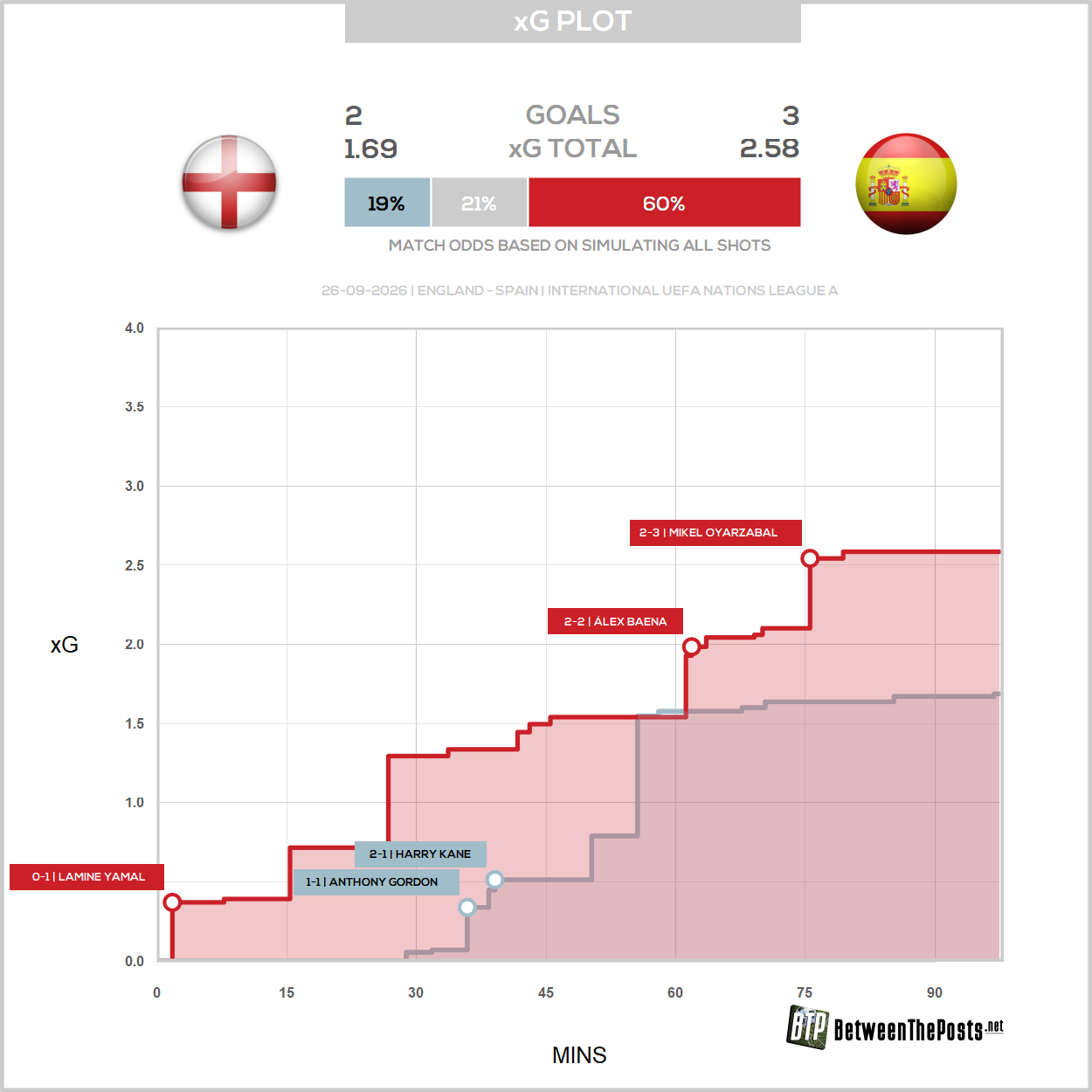
The game started in a terrible way for Tuchel’s side as they conceded within two minutes after Guéhi was caught dwelling on the ball by Yamal who managed to catch the Manchester City defender unawares on the edge of England’s penalty box.
Being behind put the emphasis on England to respond proactively though, and that’s exactly what they were able to do with their bold high pressing game.
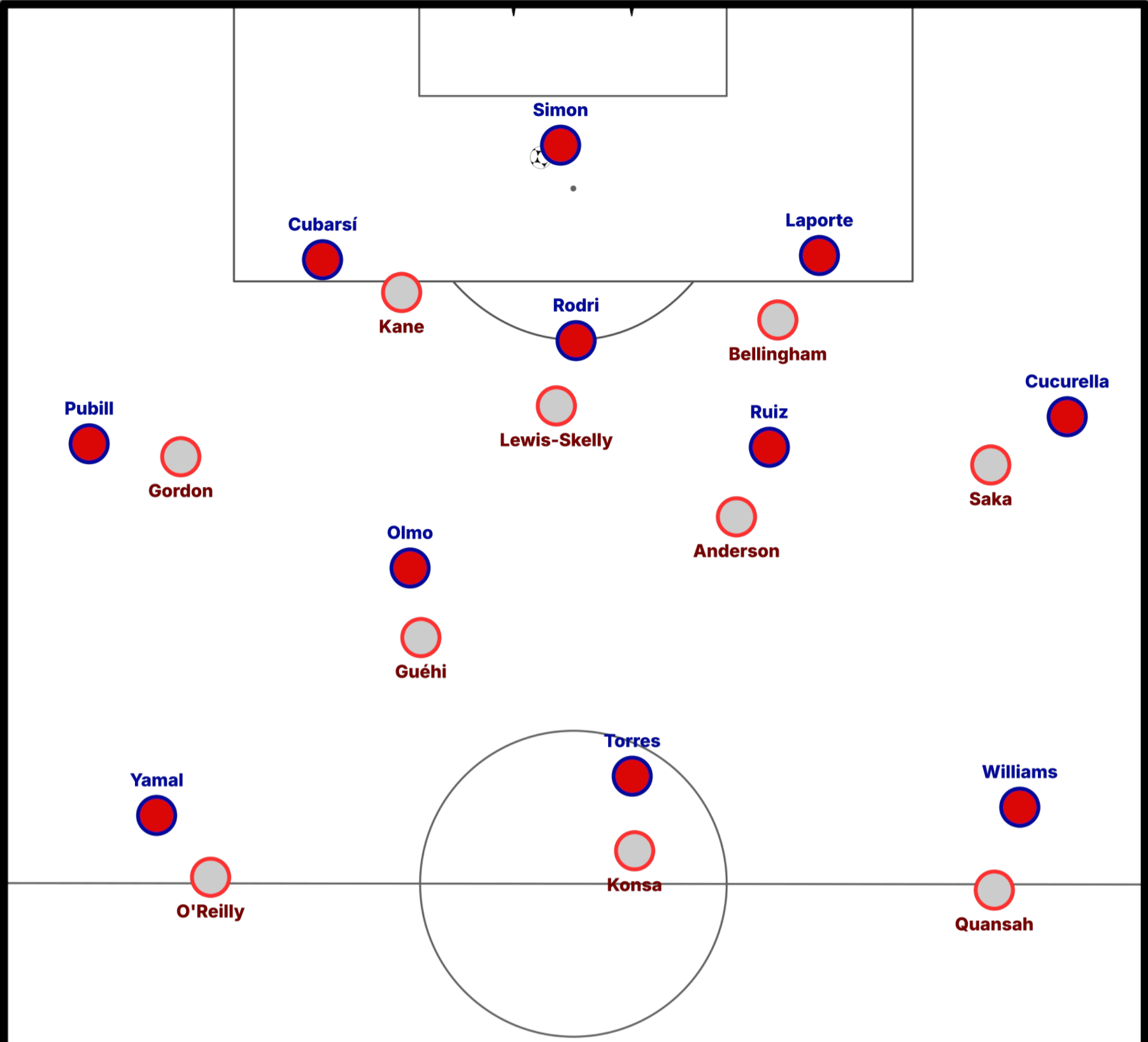
England’s high press.
England went man-to-man with Spain’s 4-3-3 buildup game from the back. Kane and Bellingham would push up onto Spain’s center-backs, while Lewis-Skelly jumped forward to mark Rodri in Spain’s number six area.
Anderson would then mark Ruiz, while either Konsa or Guéhi would step into midfield to mark Olmo, while the other marked Torres. England were content to play three versus three in the backline, forming a 3-4-1-2 shape in their high pressing phase.
The approach paid off well for England. Although Spain were tough to dispossess thanks to their comfort on the ball and structural soundness in possession, the high press allowed England to establish themselves in Spain’s half and gain more control of the game.
Splitting the center-backs
The most common possession system for England under Tuchel has been a 4-3-3 structure with Anderson as the pivot and a focus on rotations between the fullback, central midfielder, and winger trios on each side.
This time around, Tuchel put a slightly different spin on things. Anderson (or sometimes Lewis-Skelly) would often drop between the English center-backs in possession in this game, who then split wider to form a back three.
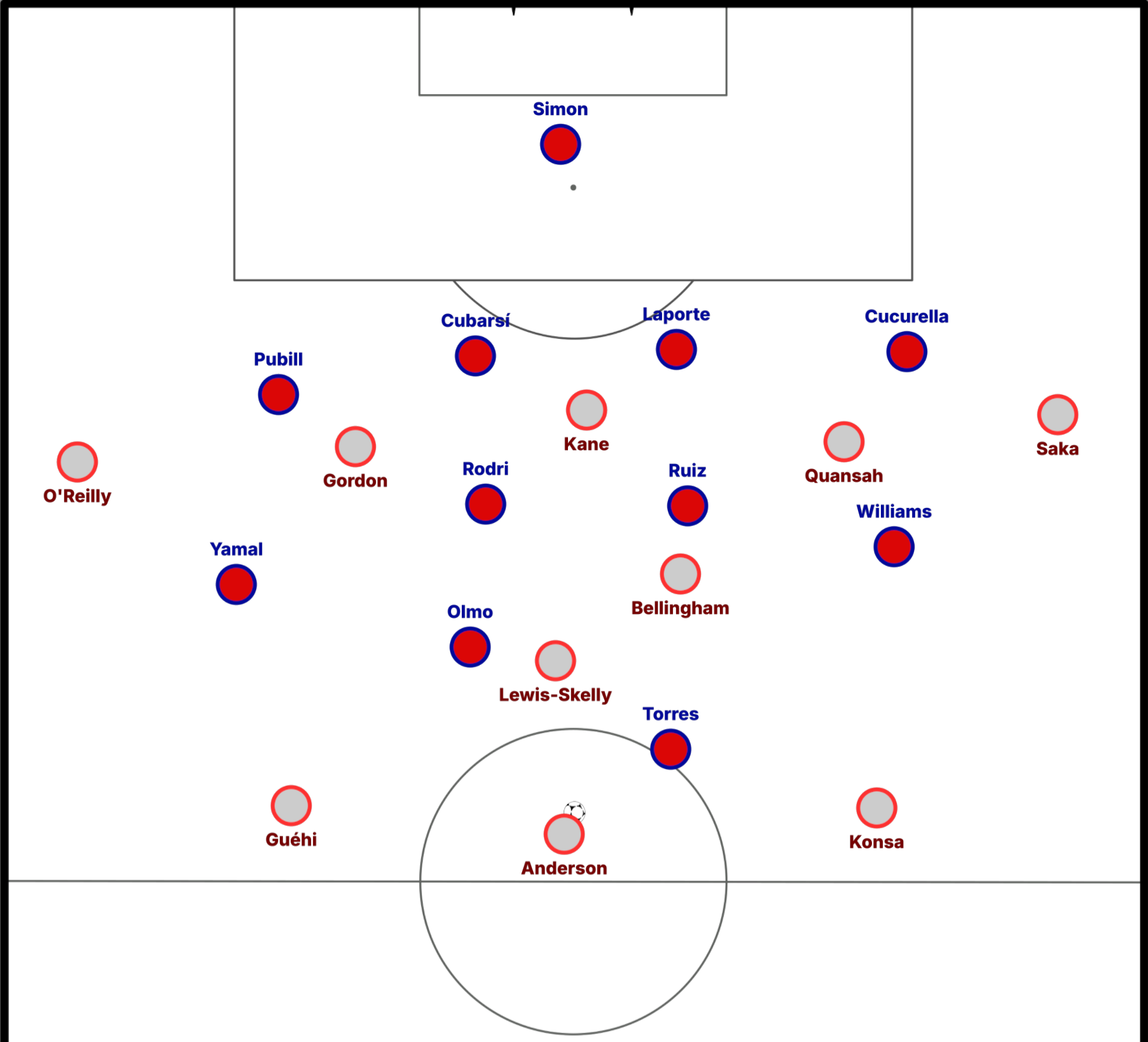
England in possession.
Quansah and O’Reilly would push higher up, either into the halfspaces between the lines, or to hold width while Saka or Gordon moved into the halfspaces.
England had the intention to play vertically within this setup to find these halfspace players, especially when it was Saka or Gordon in these positions. They would also use the switches of play out to the wingers wherever possible when they stayed wider.
With Anderson or Lewis-Skelly dropping out of the midfield, Bellingham would often come slightly deeper to ensure that England did not empty out the middle of the pitch. However, he crucially still had license to make runs into the final third and penalty box.
England’s goals came in quick succession towards the end of the first half. First was a slick counter-attack after a Spanish set-piece, with Gordon’s layoff helping Bellingham drive through the middle of the pitch with the ball before finding the throughball back to Gordon who had run in behind the Spanish defence.
The second showed the relationships between fullback and winger for England, as O’Reilly made an excellent underlapping run from the left halfspace underneath Gordon who was on the left wing. The resulting cross found Kane’s head, and he made it 2-1 to England.
Spain show their class
Despite the positive signs for England, they were still leaking chances at the other end due to their struggles to contain Spain and Yamal in transition phases, as well as turnovers conceded while trying to play out against Spain’s high press, which continued in the second half.
Spain’s pressing structure had some similarity with England’s in the sense that the likes of Olmo and Ruiz would push up aggressively to get tight to England’s deepest midfielder and center-backs. There were also some phases where Yamal would indent onto England’s left center-back.
England had a chance to extend their lead early in the second half through a Kane penalty, but England’s captain struck the bar. Immediately after this, Spain made two decisive substitutions, bringing on Álex Baena and Mikel Oyarzabal for Williams and Torres.
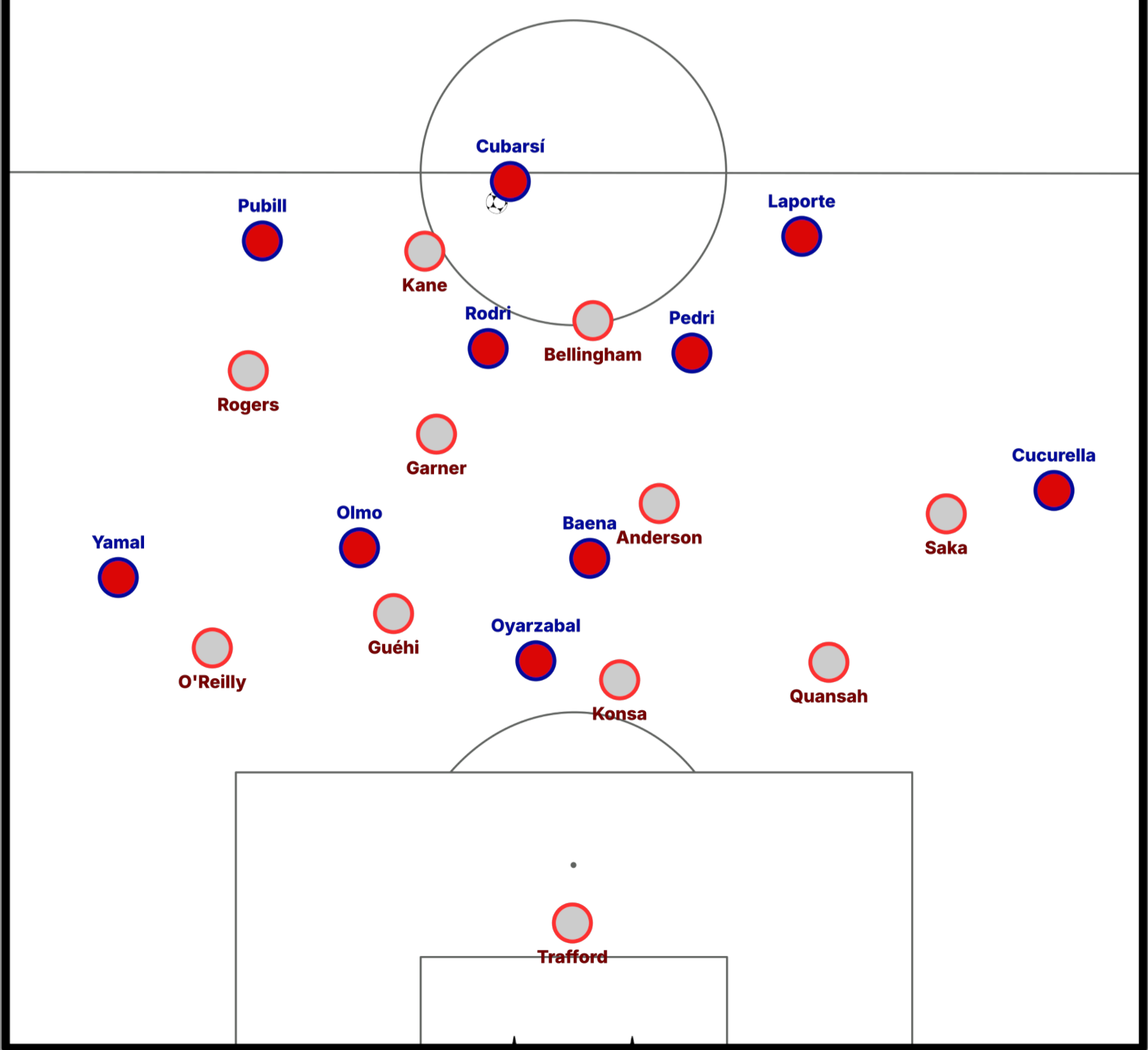
Spain’s second-half possession shape.
Just five minutes later, Spain had equalized through Baena after England once again displayed a lack of composure against the Spanish high press, giving the ball away to Olmo who found Baena on the edge of the box.
Baena’s presence presented a new threat for England as he would often drift off the left into central areas to freely create overloads, leaving the left wing to Cucurella. Pubill often stayed deeper as the right back, giving Spain a roughly 3-2-5 structure in attack.
Baena was instrumental in the second goal too. Spain were able to disorganize England’s backline as Olmo dragged Guéhi into midfield with a dropping movement and Oyarzabal found the vacated space. Quansah and Konsa were unable to adjust their positions quickly enough to get tight to Baena and Oyarzabal, who eventually applied the finish.
By this point in the game, Spain were starting to show their class on the ball against a slightly tiring English press. Pedri had replaced Ruiz and along with Rodri he proved elusive to England’s midfield which now included James Garner in place of Lewis-Skelly.
In the end, England were unable to grab another equalizer despite their best efforts, and Spain took all three points at Wembley.
Takeaways
This was a very high level game and England have reasons for encouragement from this performance. Their high press was positive, helping them earn a foothold in the first half, and they had some decent attacking moments. However, they looked shaky against the Spanish high press and the defensive fragility shown in the World Cup remains.
Spain showed the spirit and competence one would expect from world champions, especially in the second half where they took control of the ball and punished England’s mistakes at the back. The substitutes from de la Fuente proved highly effective in disorganizing England’s defense, and they eventually bagged the two decisive goals.
Use the arrows to scroll through all available match plots. Click to enlarge.
Check the match plots page for plots of other matches.