

Napoli – AS Roma: Old Dogs Do Not Learn New Tricks (3-3)
Massimiliano Allegri’s claims of “I want everyone attacking” in the post-match presser pulls no wool over the eyes. Nevertheless, one of Napoli’s better performances this season still saw major structural issues, whilst Gian Piero Gasperini had to reshuffle his own game plan to get back into the match.
Tactical analysis and match report by Joel Parker.
We decided to make this article free to read. If you want to support our work, consider taking a subscription.
Smiles were shared when Allegri and Gasperini exchanged conversation, after their respective wins in the Champions League. Yet even in light exchanges, Allegri can cut through with a statement that hints at the bubbling tension. Gasperini was uncharacteristically jubilant: “We both won, so we’ll arrive with morale sky-high.” Allegri admitted the tension: “You guys needed that win less than we did…”
After being open against Villarreal, feelings were aggravated when winless Venezia got their first three points against the Neapolitans. Stories had already circulated of Kevin de Bruyne ignoring instructions, a player who had a lot to say of Antonio Conte’s methods back in the summer. Additionally, medical staff were under fire for the number of injuries and reports of the squad being worn out and tired. Allegri was not wrong about the importance of victory over Bodø/Glimt, even if it required a dose of black magic that lingers around this particular coach: a second-best second half yet coming out on top.
There was more encouragement coming from Rome, not a surprise considering the start they have made in Gasperini’s second season. Paulo Dybala went off with a calf injury during that dramatic 4-3 defeat to Real Madrid, but there has been no shortage of attacking momentum. Santiago Castro scored a creative chip in a 2-0 victory to Daniele De Rossi’s Genoa, before they pumped Slovan Bratislava 4-0 in midweek. However, Roma are still yet to break their hoodoos: no victory in Naples since 2018.
Allegri banked on his gamble again. A Lobotka-less midfield with Kevin de Bruyne the deepest and Frank Anguissa also dropping with Scott McTominay on the left of the midfield three. The two changes from the Bodø/Glimt game saw an ever-present Amir Rrahmani out with flu and Benoît Badiashile return to the defense, whilst Mathías Olivera also came in at left fullback to complete the 4-3-3 formation.
Gasperini moved to a system that had been associated with this fixture. Back in 2024, his Atalanta Bergamo side thrashed them 3-0 with an extra midfielder dropping out of the attack to make a 3-5-2 system. Donyell Malen, who returned from suspension, and Matías Soulé were the two forwards, with Bryan Cristante returning to the midfield with Marten de Roon and Niccolò Pisilli. The other returnees were Gianluca Mancini, Evan Ndicka and Devyne Rensch.
Desperately flicking the spark wheel
Three seasons have passed since Luciano Spalletti’s Napoli breezed through the competition to win their first Scudetto in over thirty years, and the five managers between that period and now have all relied on the rotational work that team offered. Even a coach as dogmatic and successful as Conte recognized the team’s best condition is when they were in-possession and pushed his coaching into a different direction to try and accommodate, albeit without reaching the heights of the 2022/23 campaign.
Into the current season, Allegri is now turning towards this chemistry to try and make the team work. Anguissa and De Bruyne bounced off one another, and the position of the fullbacks tried to establish a variety of movements. Olivera inverted into pivot positions, whilst Giovanni Di Lorenzo could also take up narrower positions so that both wingers could stay wide and encourage space invasion from one of the midfield three. Plenty of movements to try and create a spark, Napoli struggled to cleanly progress despite a balanced game state, both in possession numbers and territory.
Napoli’s buildup issues can be boiled down to two major issues. Firstly, the positions of the fullbacks served little to the rotation and did not place tensions on the Roma defense. Both Olivera and Di Lorenzo could be part of the circulation around the defensive line or pivot, but were comfortably tracked by Gianluca Mancini and Wesley in the Roman man-marking scheme. Secondly, no countermovements from the midfielders aid short-distance passes: McTominay, Anguissa and De Bruyne constantly tried to push high against the defensive line, yet Napoli had not established any press-baiting or had a mechanism to exploit these runs. As a result, Roma’s own midfield trio tracked these movements and Gasperini’s team was capable of blocking off any free player from opening in the second line.
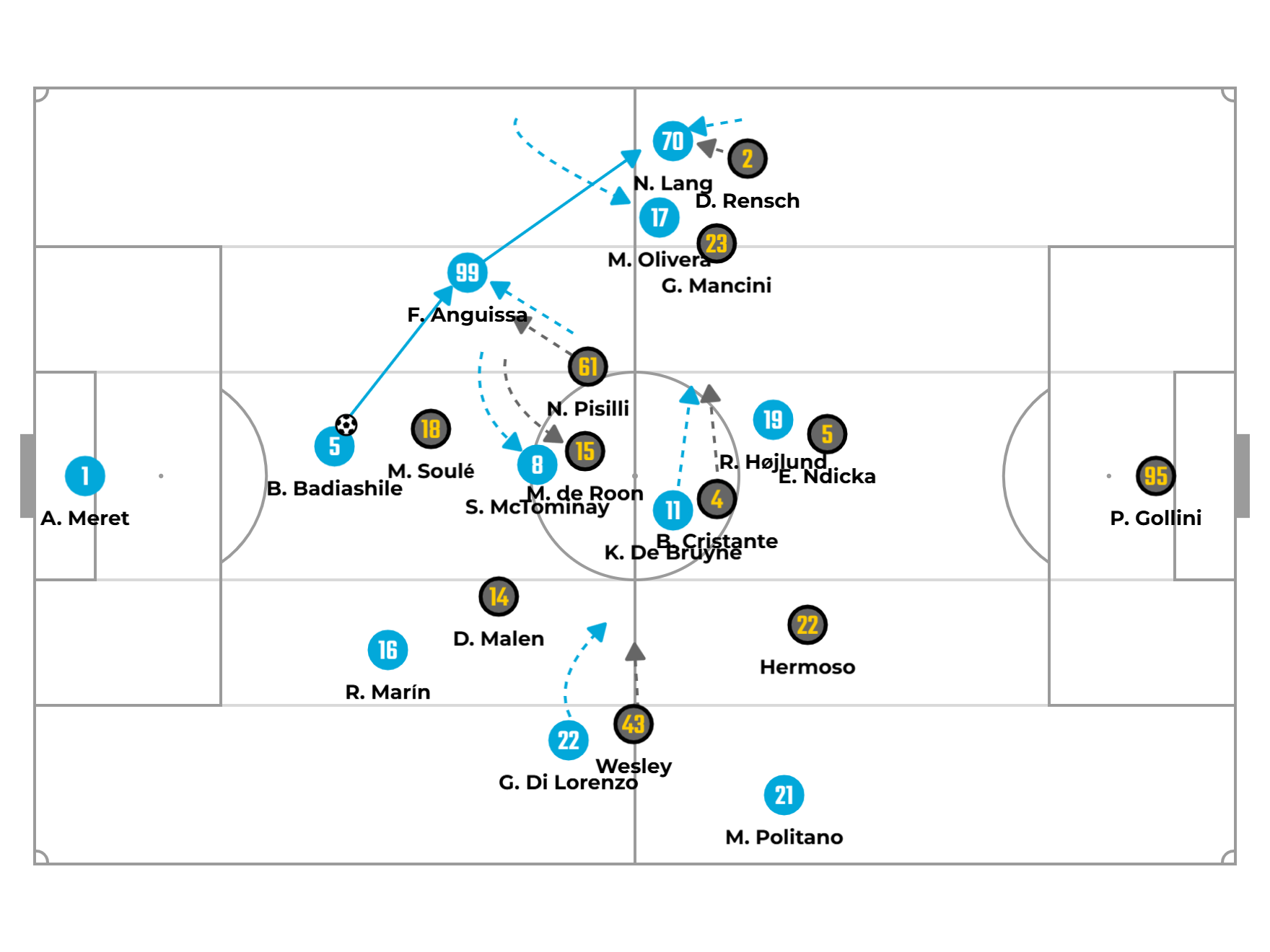
7th minute: Buildup issues from Napoli versus the Roman man-to-man scheme. Pisilli, De Roon and Cristante tracked the movements from the Napoli midfielders, whilst the inside runs from the fullbacks did not offer a creative route or combination for the wingers to work with. In this move, the ball was worked up to Noa Lang, but with his back facing his own goal, and Pisilli collapsing to make a two-versus-one, Lang passed back to an inside Olivera, who passed back to Anguissa, and the ball was moved back to Alex Meret.
The movements of the fullbacks brought an unusual dynamic. Spaces were available for Di Lorenzo and Olivera (or outside of Olivera on the left side) as the Roma wing-back/center-back would not always commit to high positions up the channel. However, Napoli could not utilize these spaces or attack the change in territory without much potency, especially down the left side of the pitch where Lang was isolated without much support from McTominay or Olivera to combine with.
Down the right side is where Napoli attacks came from. Matteo Politano, Di Lorenzo and Anguissa can still provide a stable base, and Di Lorenzo’s interpretation of space is vastly superior when he is attacking the final third, as opposed to the buildup. This was effective when Hermoso and Wesley were forced onto different lines when in the lower block, especially when Hermoso was encouraged to jump towards Politano hugging the touchline, after Wesley had followed Di Lorenzo inside. As a result, Napoli still produced a number of crosses from the likes of Rasmus Højlund, Lang or McTominay to attack.
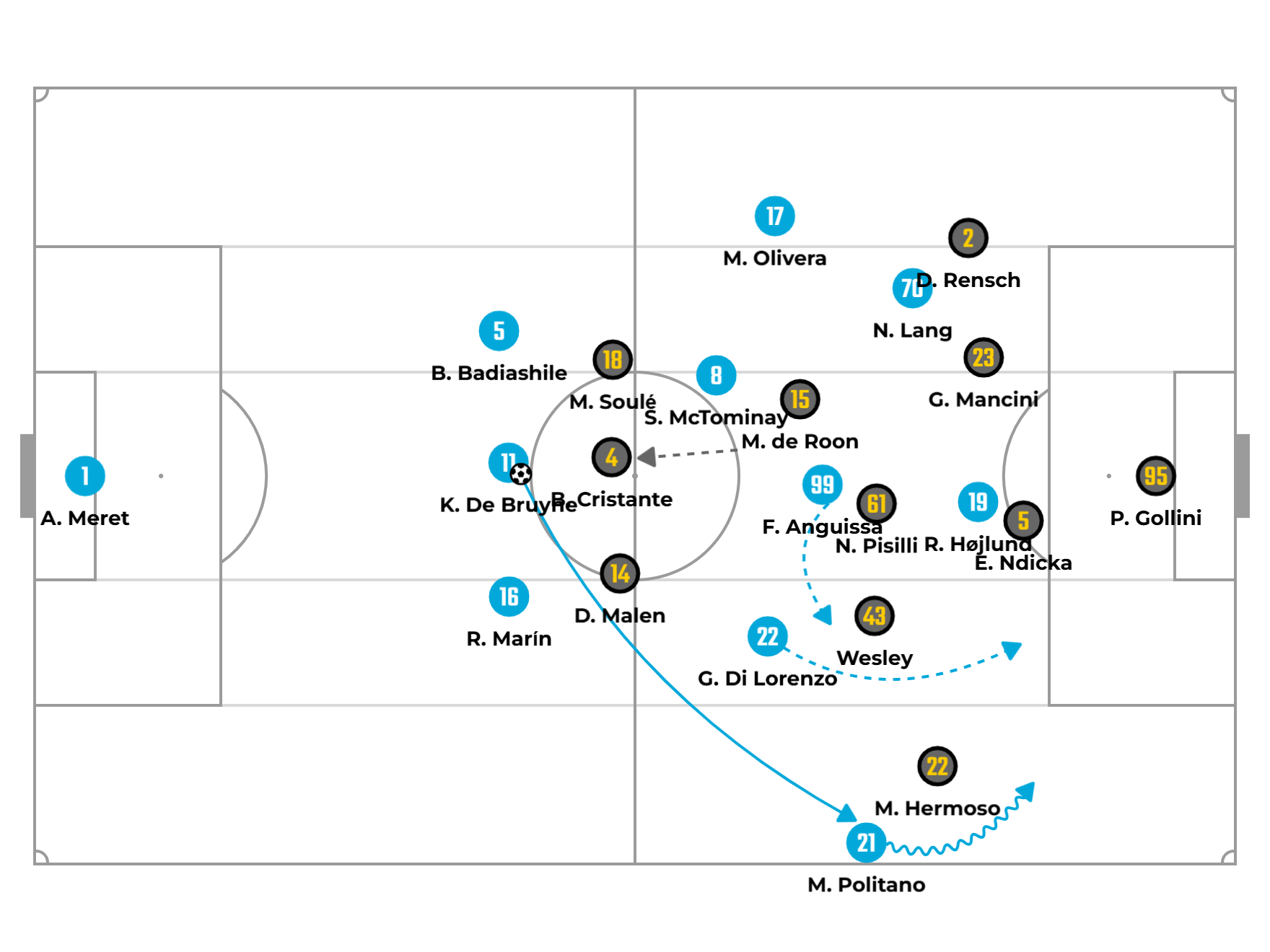
12th minute: Buildup to point-blank Højlund chance. De Bruyne had dropped between both center-backs and switched to Politano, where Napoli made better use of the dynamics. After Politano dribbled and cut inside, he played Di Lorenzo through into the box and his low cross across goal was intervened by Rensch and the Danish striker could not divert towards goal.
Malen had one of the better opportunities in the first period after Cristante won the aerial duel against McTominay and headed a high ball through to Soulé, who made the cutback. Meret made the save with his feet, and Napoli soon took advantage of an indirect free-kick, won after a loose throw by Pierluigi Gollini and a cheap foul was conceded by Cristante. Politano’s delivery was headed away, only for an overhead kick from Anguissa to fire Napoli into the lead: a player who has always shown up in the big games.
Ultra width made wider
From this point onwards, it was no surprise that more possession and territory were afforded to Roma as time went on. Gasperini’s arrangements have always been ultra-wide, yet the switch to an extra midfielder took this a step further. De Roon and Cristante sat on the shoulders of Ndicka, whilst Pisilli also dropped between situations, but also pushed up into the left halfspace.
In the buildup, the pass was constantly available behind Politano and towards Pisilli or Wesley. However, this line-break did not see a tempo shift or another pass to tee up a move. Roma constantly got into positions where a vast majority of their players were situated outside of the block, isolating the front three or having Malen/Soulé drop into positions outside of the midfielders to touch possession.
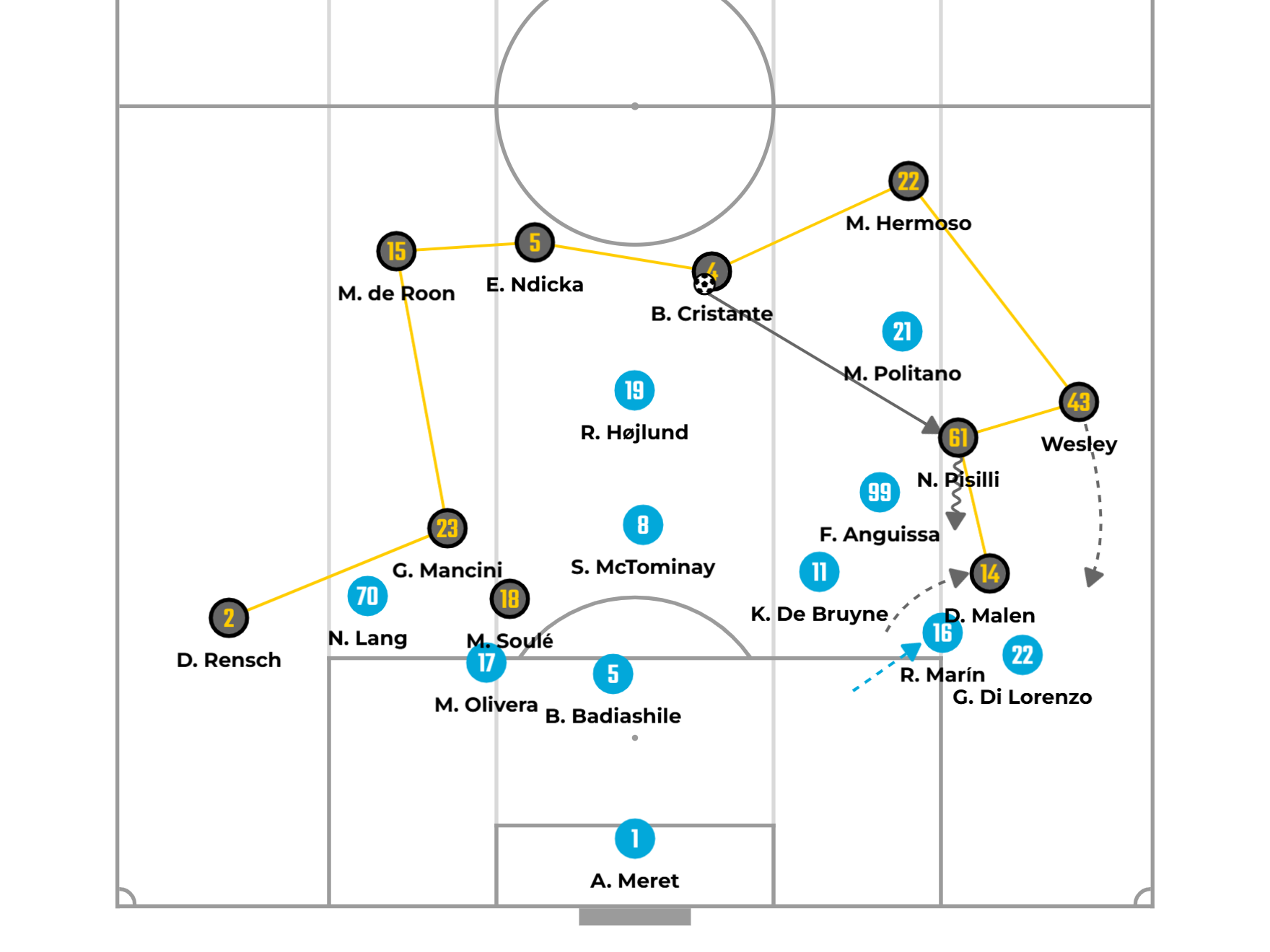
38th minute: Roma players commit way too many players onto the outside of the block in this move. After dropping to support the circulation, Pisilli pushed forward and the pass was made behind Politano. Malen decided to drop outwards in this situation, but Roma did not build a rotation between Malen dropping, Wesley pushing forward and Pisilli moving inward. After a few more passes on the outside, a cross was cleared by Anguissa.
However, Roma’s access to the final third was not limited. Passes in and around the halfspace were at a high volume and the two forwards got plenty of possession in the process: Soulé completed sixty, Malen completed twenty-two. Despite the high number of connections, Roma missed the fluidity that their rotations can deliver, especially on the right where Mancini constantly moved to become an aerial target in the center of the penalty area. On transition, their counterattacks missed the verticality to provide a direct threat, despite Napoli being vulnerable when they lost possession in their half.
Cristante hit the post, a header from an indirect free-kick, but it was Napoli who produced the better opportunities from the right side. Højlund failed to divert a header towards goal, before the Danish striker produced an excellent chance for Olivera on a fast break forward, only to shoot straight at the goalkeeper from close range. Nevertheless, Napoli soon got their second at the start of the second period: a Politano cross powerfully headed by McTominay, saved, but the Scotsman put the ball over the line off the rebound.
A dismal showing from Roma needed a change of direction. On the hour mark, Leonardo Balerdi replaced Hermoso, Nahuel Molina replaced Rensch and Pisilli came off for Castro. Unusually, Gasperini swapped the wing-backs so Wesley was now on the right, whilst Molina was on the left. In the attack, Soulé acted as a central connector, with two strikers and wide center-backs becoming the attacking targets in the box. Chances did not flurry, but the attacking structure improved with Soulé opening more angles from the second line.
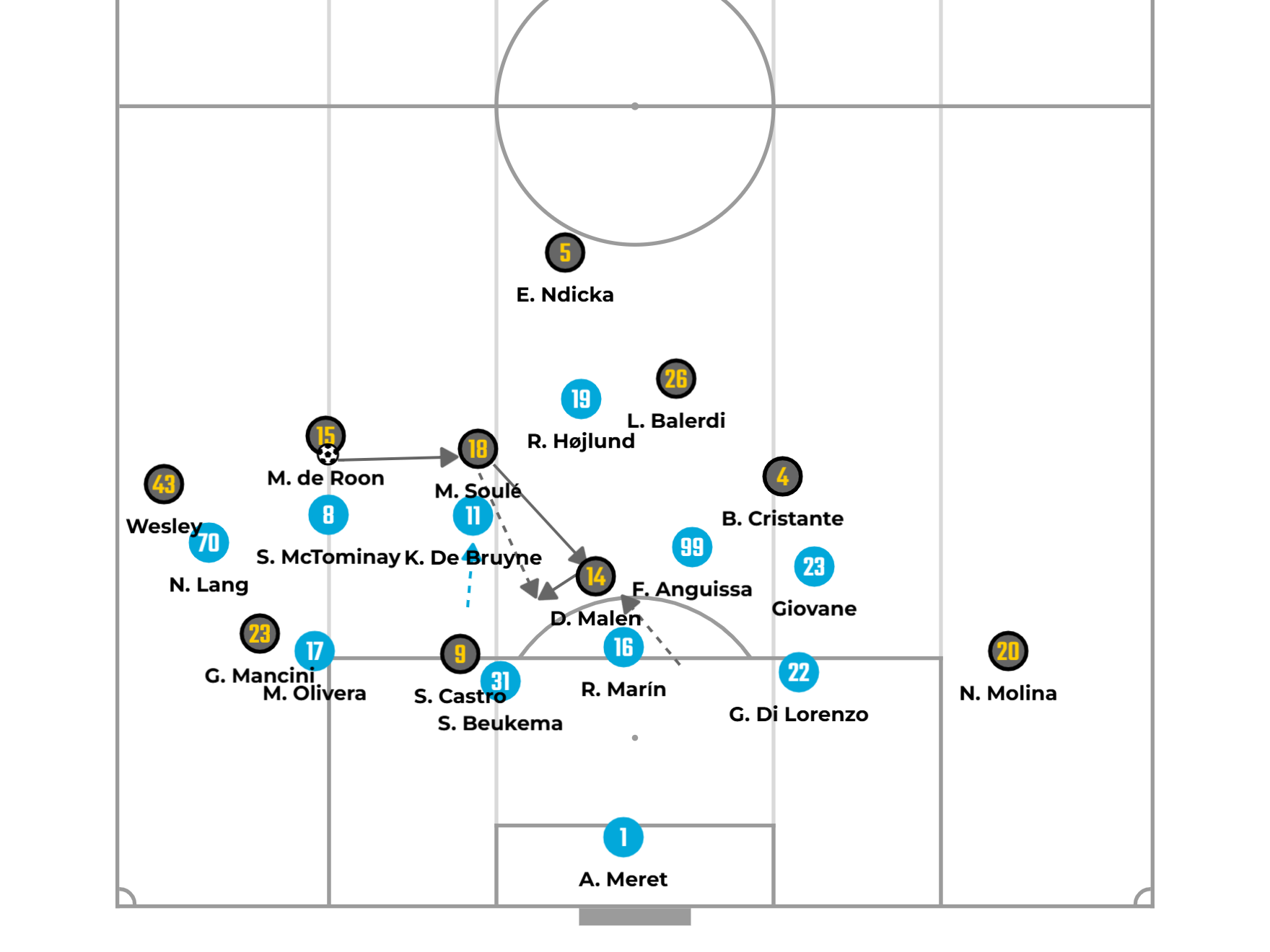
68th minute: Buildup to Roma’s first goal. Soulé attracted pressure and played the one-two with Malen against a very static Neapolitan defense. An excellent finish into the far corner from the Argentine attacker.
A series of weak responses
After Soulé scored a fantastic goal, it did not take long for Roma to find an equalizer. After shielding from Malen and trying to win a free-kick, Di Lorenzo conceded a corner and would clear the first delivery. The second had graver consequences: De Roon crossed from a short set piece and Castro teed Balerdi to fire into the roof of the net.
What followed was a tame response from Roma, after spells of high territory. Their rest defense had left spaces throughout the game for Højlund to remain high and sprint into the channels; Balerdi’s aggressive positioning meant that he could also gain access behind the left center-back down the flank. Additionally, Roma’s willingness to exchange on the transition meant they did not have a structure that could pin Napoli deep and bombard the box until they forced a complete comeback. Instead, Napoli were given the means to escape, even after Allegri’s triple substitution, ten minutes before time, had remained quite conservative.
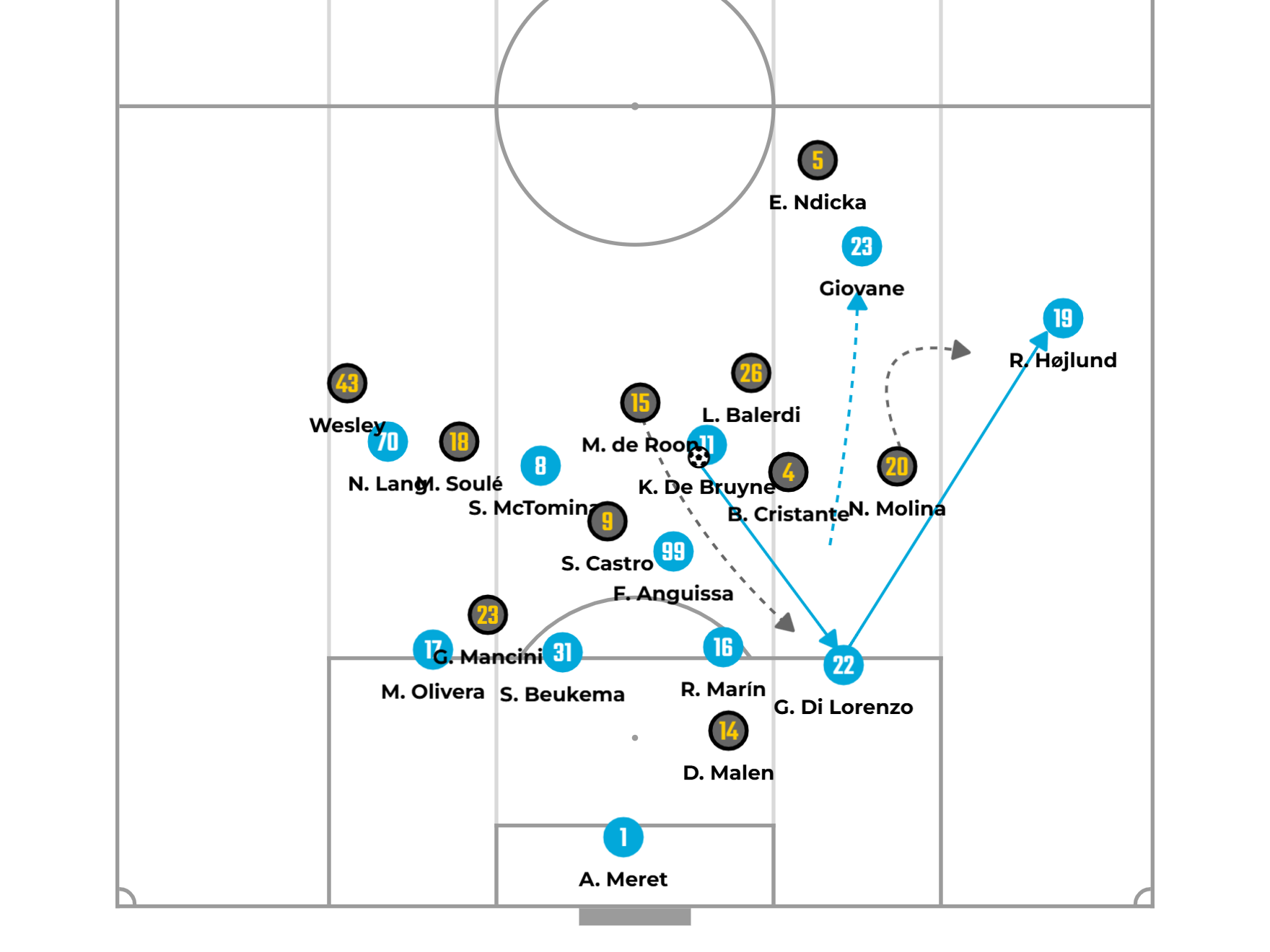
77th minute: Despite building momentum, Roma’s rest defense still left spaces for Napoli to play out and relieve pressure.
Meret collected an attempted from Ndicka and threw towards Højlund for Napoli to get up the pitch once more. Anguissa played a diagonal pass to Leonardo Spinazzola, positioned at right fullback, and his touch took him inside of Soulé. A low shot was saved by Gollini, but McTominay struck again. A low driven shot from range was too much for the goalkeeper at his near post, and Napoli restored their lead late on in the game.
The forthcoming tactical shift from Allegri was inevitable. Antonio Vergara, who had replaced Lang and switched wings with Giovane was now tasked with dropping into the last line. However, Napoli still had phases in possession during the last phases of the game, but their retention during this period was poor despite some of the regular faces on the pitch.
This enabled Roma to prod against the deep block, and what followed was an event that took the attention away from the tactical themes that got to this point and on Sam Beukema’s theatrics in the buildup to the goal. As Beukema tumbled, play continued and Rodrigo Mora pushed play wide to Wesley. He crossed into the box and Balerdi was there to grab Roma a point.
Takeaways
Allegri implied the tensions in the pre-match and the madness spilt into the post: “Last year they pocketed the Champions League for Roma, and I paid for it at Milan.” A bad look for all parties involved in Naples, yet it is plausible that Aurelio De Laurentiis will continue with the project despite their worst start to a season since they were in Serie B.
Roma produced two comebacks, but the quality of chances conceded should be a cause for concern, especially if Gasperini’s team is to compete for a title this season. With big matches also ahead in the Champions League, Gasperini may be willing to roll with the punches if his team’s attacking capabilities remain at a high standard.