
Barcelona – Real Madrid: José Mourinho’s Redemption (1-2)
Barcelona failed to pass the second big test of the season. After the Parc des Princes defeat, Hansi Flick’s side bit the dust against rivals, Real Madrid. A stale in-possession from Barcelona couldn’t overcome Real Madrid’s defensive unit, whereas famous defensive weaknesses tipped the scales in favor of Mourinho’s team to come out victorious.
Tactical analysis and match report by Achraf Lamdarhri.
We decided to make this article free to read. If you want to support our work, consider taking a subscription.
The state of Barcelona and Real Madrid brought back an old, similar story. Los Blancos hired José Mourinho in 2010 in order to steer the team back onto the trophies podium. Mourinho’s mission seemed complicated in the presence of the biggest rival, which dominated every stage and entertained with an eye-catching playing style. José Mourinho contributed to laying the foundation and left in his third season. Since then, Real Madrid has lifted six Champions League titles; three of them were won in a row, setting an unprecedented achievement. Thirteen years later, José Mourinho returned to Real Madrid to fix an analogous problem to his first stint.
Nonetheless, this time, almost everything is different. José Mourinho’s reputation isn’t as sound as it was before, given his failures and the clubs he managed before his return to the White House. Not only that, but his style of play has become questionable, considering the evolution of football since his departure from Real Madrid, making his comeback a chance to prove he still belongs to the elite class of managers. Since the start of the 2026/27 season, Real Madrid has won all of their games, except the matches against Real Betis and Atlético Madrid, which saw the team trail Barcelona by six points in La Liga. The performances have been fluctuating between low and high, especially against teams of similar quality. In these matchups, Real Madrid looked unconvincing, which raised question marks about Mourinho’s approach and the players’ ability to see out a successful season.
In contrast, since hiring Hansi Flick to replace Xavi Hernández in 2024, Barcelona dominated the national stage and progressively transitioned into a major force in Europe. Hansi Flick led Barcelona to two consecutive La Liga titles. At the beginning of his third season, the Catalans came out victorious in nine games out of nine, with a 30-goal difference before meeting Real Madrid. Nonetheless, public opinion revolved around the fact that these victories came against teams with less quality. The defeat against Paris Saint-Germain reinforced this claim, raising doubts about Barcelona’s capability to compete in Europe, since the Champions League is the ultimate goal of the Catalans this term.
Hansi Flick maintained the same backline as in the Paris Saint-Germain clash. Xavi Espart, Pau Cubarsí, Gerard Martín, and João Cancelo sat behind Rodri and Pedri. Ahead, Fermín López occupied the attacking midfielder spot, whereas Anthony Gordon and Lamine Yamal flanked Raphinha.
José Mourinho kept the majority of the players who started the 4-1 thrashing against Leipzig. Thibaut Courtois was left out with the flu, so Andriy Lunin had to replace him. At the backline, Ibrahima Konaté returned to partner with Dean Huijsen, and Federico Valverde occupied the right back position again. Marc Cucurella claimed the left back position. Bernardo Silva kept his place, forming the double pivot partnership with Aurélien Tchouaméni. Jude Bellingham operated behind Kylian Mbappé, who led the attack. Arda Güler and Yan Diomandé secured the width.
Mourinho’s defensive approach served Real Madrid in and out of possession
Both teams’ intentions became clear from kickoff. Real Madrid retreated into a 4-4-1-1 medium block. Kylian Mbappé stayed slightly higher than Jude Bellingham, who marked Rodri. Bernardo Silva and Aurélien Tchouaméni took charge of Pedri and Fermín López. Arda Güler and Yan Diomandé jumped from their positions onto the opposite fullbacks. Behind, Marc Cucurella was tasked with dealing with Lamine Yamal. Dean Huijsen and Ibrahima Konaté doubled up on Raphinha, with one of them operating zonal and the other monitoring Raphinha’s runs. Federico Valverde engaged with Anthony Gordon, who proceeded with his out-to-in runs, as the play was clustered on the opposite side.
In possession, Barcelona’s ball-side fullback pushed high up the pitch. On the left side, Gordon, tucking in, gave room for Cancelo to advance down the wide channels. The tight marking of Real Madrid’s midfielders toward their counterparts drove the Catalans to work the ball to the wide traps. As Cancelo received the ball, Arda Güler would step up diagonally from the half-space to the wide channels, cutting off access into Gordon, whilst the ball-side midfielders blocked off the inside and the backward lanes to attempt to regain the ball wide.
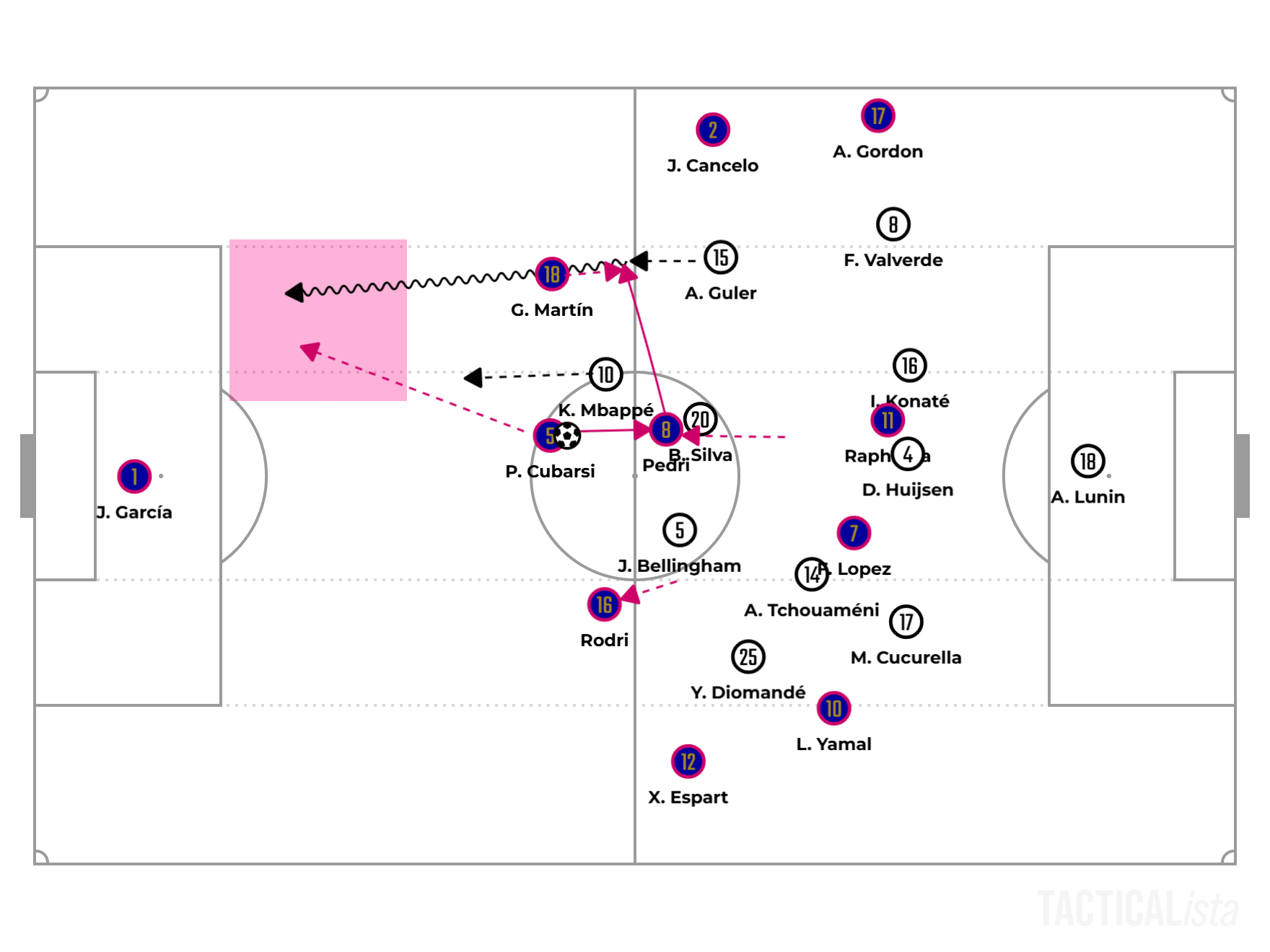
4th minute: Rodri steps back alongside Cubarsi and Martin. Mbappé cuts off the passing lane between Barcelona’s center-backs. So, Pedri comes short to bounce the pass off to Gerard Martin. Pedri misses his pass for Arda Guler to collect the loose ball and drives into the space behind Martin. Arriving at the box, Cubarsi cuts off the passing lane into Mbappé. So, Guler blasts the ball over.
Real Madrid pressed high up the pitch from goal kicks and adopted a man-to-man approach. In fact, the visitors forced the hosts long and wide toward Gordon. However, the latter was able to receive with ease. In the meantime, the rest of Real Madrid players returned to their zonal roles, as Bernardo Silva peeled off wide to support Valverde, whereas Arda Guler closed off the backward lane. However, Pedri became free to pass the ball inside. The visitors quickly worked their way back, especially the midfielders, who tightly marked their counterparts, which allowed Mourinho’s side to regain the ball quickly and exploit the large distances between Barcelona’s players.
To elaborate, the home team adopted a direct and vertical style in possession when building out of the back. As a consequence, the players were distant from each other during the transition from the moment of possession loss to a high press. Real Madrid took advantage of the distance between the deep Valverde and Cancelo for the former to have time on the ball and access Arda Guler behind the left back. Guler dropped in and pulled out Gerard Martin. That vacated the wide channels for Bellingham to dash into. However, the quality of the pass from Guler halted Real Madrid.
Thirteen minutes in, the intense jump from Valverde onto Gordon allowed the Uruguayan to collect the ball in the air. Meanwhile, Arda Guler and Bernardo Silva quickly withdrew and pounced on the second ball. As a result, Real Madrid regained possession in the middle of the park and swiftly worked the ball out to Diomandé, putting him in a one-versus-one situation against Xavi Espart. Arda Guler benefited from Lamine Yamal not tracking him back to attack the gap between Espart and Cubarsi. Guler reversed the pass into the space around the penalty area, as Mbappé’s run pushed Cubarsi toward the goal. However, Bellingham was late to pick up the pace, enabling Martin to clear the ball.
Barcelona lives and dies by the high press
At the start, Barcelona was able to regain the ball in higher positions because of late off-ball movements from the visitors’ midfielders or loose touches out wide. After three minutes, Tchaouméni was late in swinging across and behind Fermin Lopez. Lamine Yamal’s close position allowed him to capitalize on Huijsen’s pass into Tchaouméni and collect the loose ball. Yamal drove across, whereas Bernardo Silva stepped up on him. Yamal attempted to find Raphinha inside the box and between the center-backs, but he overhit the pass.
When working the ball down the left side, Cucurella made use of Lamine Yamal’s initial position before shifting to quickly find Diomandé coming short. Then, he immediately proceeded with an underlapping run to combine with the Ivorian winger and escape the touchlines. Due to Pedri’s dual role—marking Silva and operating zonal when the play is funnelled wide—the visitors had Bernardo Silva as a free option in the center. The quick retreat from Gordon toward the Portuguese midfielder pushed Real Madrid to the wide channels, giving his teammates the chance to retreat and squeeze the space around the ball on the left. Real Madrid held onto the ball, and under pressure, it led to loose touches and possession losses, allowing Barcelona to turn it over.
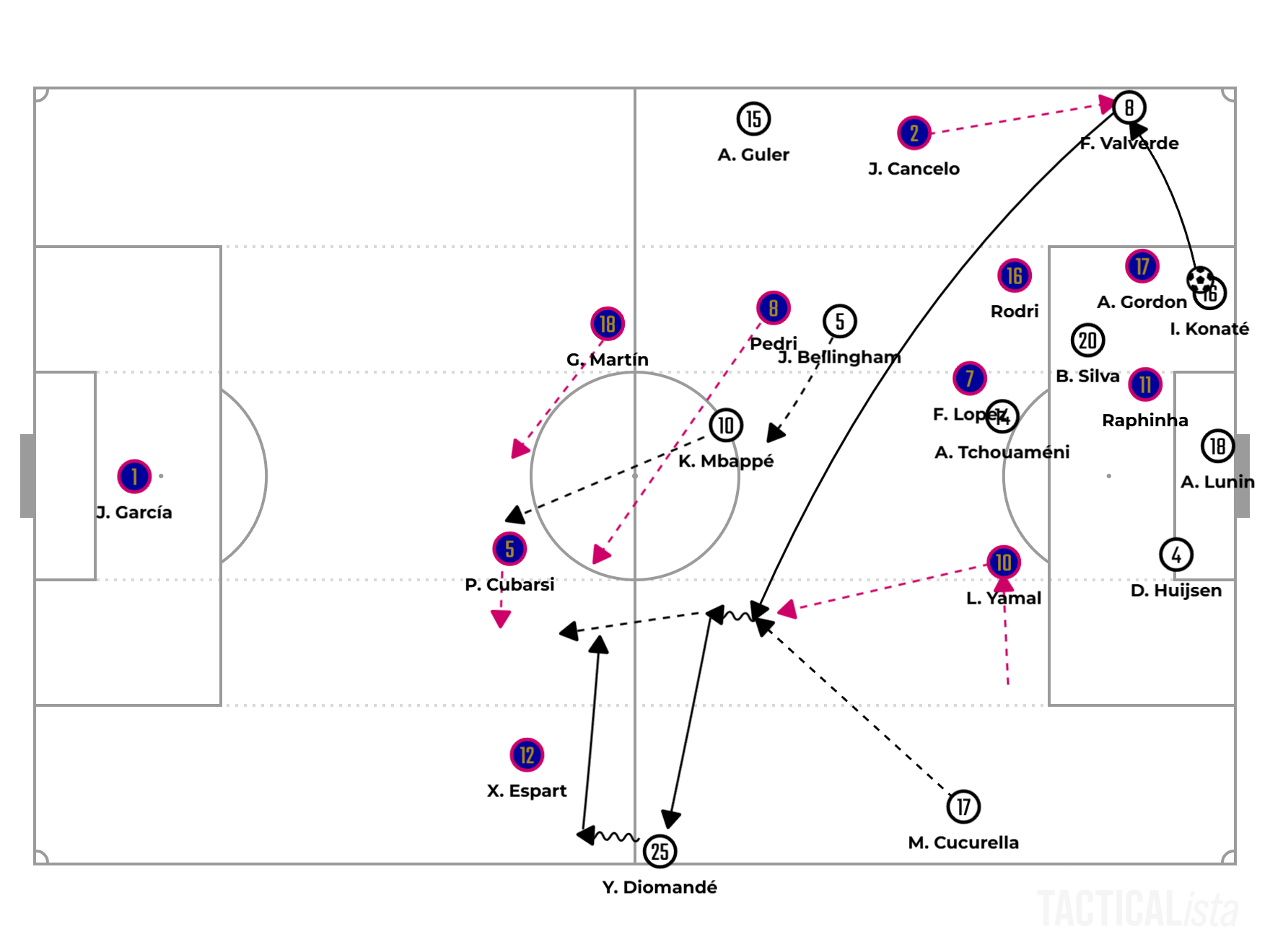
15th minute: deploying Valverde in a deep position expands the distance between him and Cancelo. Hence, Real Madrid’s right back has the time and space on the ball to switch to the opposite side. The visitors have the numerical advantage because Lamine Yamal narrows inside near Huijsen. Cucurella feeds Diomandé, who instantly heads to the gap between the right-back and center-back. Nonetheless, Diomandé prods the ball behind Cucurella for Pedri to collect the loose ball.
On the right side, Xavi Espart and Lamine Yamal swung between hugging the touchlines and tucking inside. Moreover, the latter tended to drop in, which enticed Tchouaméni to step up and take charge of him. That opened up a direct, diagonal passing lane between the backline and midfield line. Fortunately for Real Madrid, Bernardo Silva synced with Tchouaméni and shifted across to put pressure on the ball. Also, the French midfielder instantly collapsed to limit the space around the ball holder.
Lunin’s long diagonal balls served Real Madrid well to bypass Barcelona’s high press. The Ukrainian goalkeeper timed his long deliveries toward Guler with Cancelo’s jump onto Valverde. Arda Guler received on the blindside of the Portuguese left back, laying the ball off to Valverde in order to switch the ball to the opposite side. This time, Mbappé pinned Xavi Espart, permitting Diomandé to control the switch in space and set Mbappé free behind Espart, who pulled wide. Around the six-yard box, Cubarsi and Espart forced Mbappé back after closing down the shooting angles. Tchouaméni collected the ball at the edge of the box, picking out Guler around it. Guler pulled the trigger, but Juan Garcia saved the shot.
Real Madrid and Barcelona’s direct approach in possession
As aforementioned, Real Madrid’s midfielders marked their counterparts when sitting in a medium block. To generate gaps across the visitors’ defensive units, Pedri, Rodri, and Fermin Lopez operated in close proximity on the right side, dragging their markers across. That stretched the space on the far side between Real Madrid’s winger and midfielder for Raphinha to drop in. The visiting team was forced across, whereas Raphinha stepped back, roaming in front of Real Madrid’s block, until he spotted Fermin Lopez sneaking behind Tchouaméni on the right half-space. Lopez received on the half-turn, looking to shoot. However, Huijsen blocked Lopez’s delivery.
Both teams were direct in possession. Real Madrid capitalized on quick restarts to find Valverde free near the touchlines before Cancelo arrived. In the meantime, Barcelona was split into two distant units when pressing high. The front players, two midfielders, and Cancelo pressed up, whereas the rest were pinned by Real Madrid’s front line. Mbappé dashed into the space between the lines, unlocking an out-to-in passing lane with Valverde. Mbappé squared the ball to Guler, who pulled out Gerard Martin to vacate the wide channels for Mbappé to attack. The French striker galloped the length of the pitch, outpacing his marker to enter the box and cut the ball back to the players coming from behind. However, he underhit the pass.
Real Madrid had no central choices to look for against Barcelona’s medium block. The Catalans, compacting the space between the lines, limited the visitors’ options and forced them into backward passes. The jump from a medium block to a high press was what exposed the home team’s frailties. On occasion, Bernardo Silva and Valverde switched positions. Across the backline, Real Madrid’s wingers pinned the opposite fullbacks. At the front, Gordon was tasked with stepping up onto Konaté. As a reaction, Barcelona’s pivots had to shuffle across to cover the wide channels. On the right half-space, Rodri took a position between Bellingham and Silva, whereas Pedri shifted to mark the Portuguese midfielder. However, Valverde peeled off wide, which generated a two-versus-one situation. Real Madrid’s pair worked the ball into Arda Guler, whilst Valverde came late, attacking the gate between Martin and Cancelo in order to find a moment to reverse the pass to the players coming from behind.
Barcelona’s front line jumps to press up, and the backline being pinned by Real Madrid’s front three rendered the space around Pedri and Rodri vulnerable for the visitors to take advantage of. As Real Madrid worked the ball out of the left side, Pedri marked Bernardo Silva, whereas Rodri followed Bellingham’s diagonal runs from the center to the wide channels. That gave room for Diomandé to drop in diagonally into the half-space, opening up a lane with the backline. However, Real Madrid’s loose touches prevented them from going forward, as Barcelona’s midfielders immediately pounced on the ball holder, caging him centrally to regain possession. The high position of the Catalans’ wingers came in useful in the turnover. In other words, the space between Valverde and Konaté was stretched for Gordon to make use of. Fortunately for Real Madrid, Valverde’s recovery run enabled him to intercept the pass coming from the midfield.
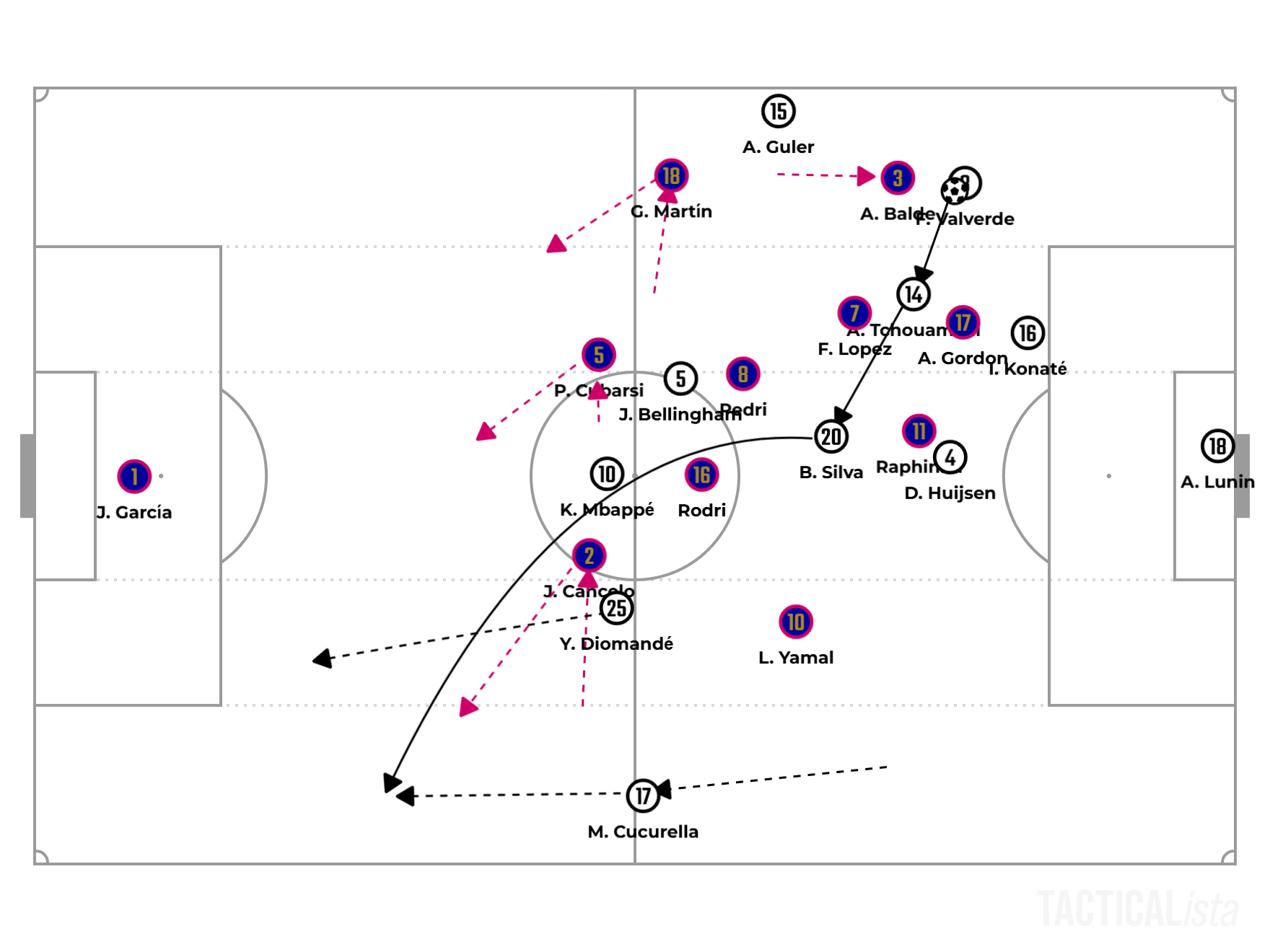
40th minute: Real Madrid’s goal. It’s true that Barcelona forces Real Madrid backward; however, Gordon and Raphinha’s jumps aren’t backed up by the rest of Barcelona’s players. As a result, Real Madrid has Tchaouméni and Bernardo Silva behind the Catalans’ first line of the press to work the ball across the pitch. Meanwhile, Diomandé tucks in, drawing Cancelo with him and vacating the wide channels for Cucurella to advance. A diagonal ball from Bernardo Silva to Cucurella, followed by a channel run from Diomandé between Cancelo and Cubarsi, set the Ivorian winger free inside the box. Diomandé prods the ball across onto Bellingham. Martin’s clearance collides with Mbappé coming from behind to give Real Madrid the lead.
To close down the center and prevent Barcelona from accessing the space between the lines, Bellingham tended to drop into the midfield line, screening the backline. As previously indicated, Barcelona committed numbers on the ball side to drag the visitors’ pivots across and stretch the space between the far side winger and pivot. Four minutes after Real Madrid’s goal, Bernardo Silva and Tchouaméni shuttled across to block off access to Fermin Lopez and Gordon, who drifted infield. On the opposite side, Balde tied up Arda Guler in the right half space. As a consequence, Pedri noticed Rodri operating in the space between Guler and Silva. Rodri scampered forward, whilst Raphinha, Lopez, and Gordon dragged the backline toward the goal. That gave room for Rodri to arrive at the edge of the box and shoot. However, Lunin easily collected the ball.
Real Madrid’s counters
Real Madrid entered the second half relying on the same approach as the first half. This time, Los Blancos’ block was deeper. The Catalans committed more players forward, especially on the left side, to drag the visitors across and quickly work the ball around to find Lamine Yamal in isolated situations against Cucurella. The hosts couldn’t find an inroad to threaten Lunin’s goal. Not only that, but involving more players forward left Barcelona vulnerable on the counterattack.
Five minutes into the second half, Fermin Lopez drove from the left to the center, finding Pedri to supply Lamine Yamal around the box. Meanwhile, Cancelo pushed high up the pitch, overlapping Yamal, who pulled out Cucurella. That widened the distance between the latter and Huijsen for Fermin Lopez to attack and drag Bernardo Silva with him. Lopez’s off-ball movement unlocked a diagonal passing lane between Lamine Yamal and Raphinha. Huijsen anticipated the pass, and Tchouaméni collected the loose ball and instantly released Bellingham and Mbappé against Cubarsi and Martin in the counter. The English midfielder dribbled past Cubarsi to gallop the length of the pitch. Gerard Martin closed down the distance with Bellingham and cut off the lane into Mbappé. As a consequence, Martin delayed Real Madrid’s counterattack and forced Bellingham toward the byline.
Wide rotations and combinations were another alternative that Real Madrid relied on to bypass Barcelona’s high press and high line. On the left side, Diomandé tended to drop in and drift infield, dragging Cancelo with him. That vacated the wide channels for Bellingham to occupy. Lamine Yamal, not fully committing to close down Cucurella, allowed the latter to have time and space on the ball. Moreover, Diomandé’s inside movements cleared the lane between Cucurella and Bellingham. The English midfielder dribbled past Cubarsi near the touchlines to get into the space behind Barcelona’s backline. At the same time, Mbappé delayed his run between Martin and Balde to avoid the offside. Bellingham’s pass to release the French striker was overhit, giving Balde the chance to recover and Juan Garcia the opportunity to sweep behind his teammates.
Real Madrid’s late runs, Dumfries was a press trigger
After half an hour, Barcelona leveled the score from a quick short corner, catching Real Madrid off guard. After that, the white team withdrew into a deep block. As a solution, Gordon hugged the touchline on the left, pulling Dumfries and Guler across. That stretched the gap between Konaté and Dumfries for Balde to exploit. Gordon played the ball between his markers to Raphinha around the six-yard box. The Brazilian’s shot was blocked by Konaté.
Cancelo’s over/underlapping runs were a double-edged sword. Cucurella was able to handle Lamine Yamal’s passes to the Portuguese fullback, whereas Tchaouméni or Bernardo Silva retreated to cover the space between Huijsen and Cucurella. Cancelo’s high position meant that Diomandé was free near the touchlines for Real Madrid to thread passes on the counter. As a reaction, Rodri and Pedri pulled wide to take charge of the Ivorian. The support runs from the likes of Bellingham to draw Pedri backward, and Diomandé’s dribbling ability to skip past pressure permitted Real Madrid to escape the flanks and find a route to the opposite side, where Barcelona’s fullback was overloaded by Guler and Dumfries. The pair worked the ball out into advanced areas to cross it to the players coming from behind.
In contrast to what Valverde provided, Denzel Dumfries was a pressing trigger for Barcelona to target and generate turnovers. From open play, the distance between Gordon and Dumfries served well the former to quickly jump on and cut off the diagonal, out-to-in passing lane. That forced Dumfries to play the ball to Arda Guler, who was closely marked by Balde. Thus, the Catalans were able to regain the ball high and wide. Not only that, but Camavinga’s forward runs vacated the space in front of the backline for Lamine Yamal to narrow inside at the edge of the box and find space to shoot.
Still three minutes left before injury time, Camavinga’s late runs offered his team a late winner. Seconds before, Camavinga, Konaté, Guler, and Bellingham hunted Jesus, shrinking the surrounding space in the middle of the park. Bellingham collected the loose ball. In the style of Zidane, Bellingham skipped past Pedri, Jesus, and Balde to feed Camavinga before the halfway line. The French midfielder picked out Guler near the touchlines and proceeded with a late run to access the space behind Barcelona. Camavinga poked the ball to dribble past Cubarsí inside the box and cut it back to Mbappé to guide the ball home.
Takeaways
Real Madrid headed to El Clásico as underdogs, with the probability of conceding a historic scoreline to their direct rivals. The situations of both teams contributed to drawing such a narrative before the clash. However, Los Blancos and José Mourinho girded themselves for battle in the best possible way.
Real Madrid closed down Barcelona’s key players, adopting a solid medium block to make the Catalans look stale on the ball. In possession, José Mourinho’s side exposed Barcelona’s everlasting problems under Hansi Flick via quick switches to the opposite side, where the Catalans lacked numbers and late runs to break down the high line and offside trap. Add to that, Real Madrid made use of the numbers Barcelona committed forward to enjoy the large spaces on the counter-attacks.
In La Liga, Barcelona’s winning streak has come to an end. Not only that, but El Clásico’s defeat reduced the points’ difference to two points with Atlético Madrid and three with Real Madrid. What added insult to injury was that teams of a similar quality became more capable of coming up with solutions to Barcelona’s defensive woes.
Use the arrows to scroll through all available match plots. Click to enlarge.
Check the match plots page for plots of other matches.