
AC Milan – Internazionale: The Devil Gives Chivu A Historic Fright (3-1)
During a transformative period for both teams, Cristian Chivu needs to prove that he can have Internazionale competing in the big games, none bigger than this one. An early bombardment had AC Milan two goals up in ten minutes, and a limp response that followed hints that the Romanian coach is still tactically out of his depth when it comes to managing the big Serie A clashes.
Tactical analysis and match report by Joel Parker.
In the week both clubs announced the ambitious stadium project, ‘The Generali’, the one-hundredth edition of Derby della Madonnina came at a time when both Milan clubs are trying to be at the forefront of progress in Italian football.
AC Milan owner Gerry Cardinale has been more vocal than ever, having bestowed a personal quest to hire the next coach in the summer. As a result, Ruben Amorim was the only major coaching arrival from abroad, and he has tried to show more adaptability, at least on paper, by switching from a back three to a four between games. Young Italian striker Alphadjo Cisse has been one of the benefactors of the Portuguese’s arrival, seven goals in total, which includes a hat-trick in the Europa League. However, this is far from a stable situation. The week also included a heavy 4-2 defeat at home to Bologna, and Cardinale expressed support for his choice in the papers.
Inter’s own European record is a cause for concern; at home, their quality is undisputed. Nevertheless, Chivu and his team need major improvements in the big games against the traditional clubs. In the derby, Inter have been without a victory since April 2024, when they were crowned champions against their grandest rivals, and did not score in either fixture last season. Their form in these games is questionable, but Inter remains the best team in Italy, even if a remarkable start from Lazio has them level on points with the champions at the top.
For the derby, Amorim turned to experienced heads. Luka Modrić and Adrien Rabiot came back into midfield, and all personnel were changed down the channels. Diego Moreira was the right wing-back and Christian Pulisic, fresh from a new contract, was one of the attackers behind the striker. Mario Gila was the right center-back and Sankhoun Diawara started as the left wing-back in the 3-4-2-1 formation.
Lautaro Martínez is still out with an injury, so it was Andy Diouf and Petar Sučić behind Marcus Thuram up front. Federico Dimarco did not start; Carlos Augusto was pushed higher as the left wing-back. Other changes included Hakan Çalhanoğlu and Nicolò Barella in the midfield, Djed Spence at right wing-back, Manuel Akanji as the central center-back and Josep Martínez in goal to complete the 3-4-2-1 system.
Terror from the tens
Chivu’s decision to start with just a single striker had a big effect on how the midfield line operated in the block and the press. This is a team that has established itself in the 5-3-2 defensive block for a long time, one that did not mind the spaces opening on the outside of the strikers, as the ball-sided midfielder would jump with the diagonal coverage from the six, often Çalhanoğlu in this case.
The addition of Diouf and Sučić changed this dynamic; both players could make the middle third very compact with their positions, and made the wide jump when required, not Barella, as has so often been the case, who would sit on the same line as Çalhanoğlu, with the diagonal coverage not being prepared. From the first stages, Milan showcased they had the tools to cause problems for this midfield line. Modrić and Yunus Musah dropped, often to the left of Koni De Winter, in circulation. This pushed Gila and Strahinja Pavlović wider, where they could take on Diouf and Sučić in more isolated situations: Pavlović dribbling against Diouf is a particularly bad matchup from an Inter perspective.
Another bad matchup would be Barella on Pulisic; without the diagonal cover, Pulisic was free to move behind Barella and Milan had an accessible route for them to make progress. Pulisic’s goal after three minutes stemmed from Pavlović sprinting around Diouf and passing to him, already behind Barella to establish play in the final third. Milan circulated, Moreira took on Augusto and cut back onto his left foot, before his lofted cross found Pulisic in the box and completely free from Inter bodies for a header into the far corner.
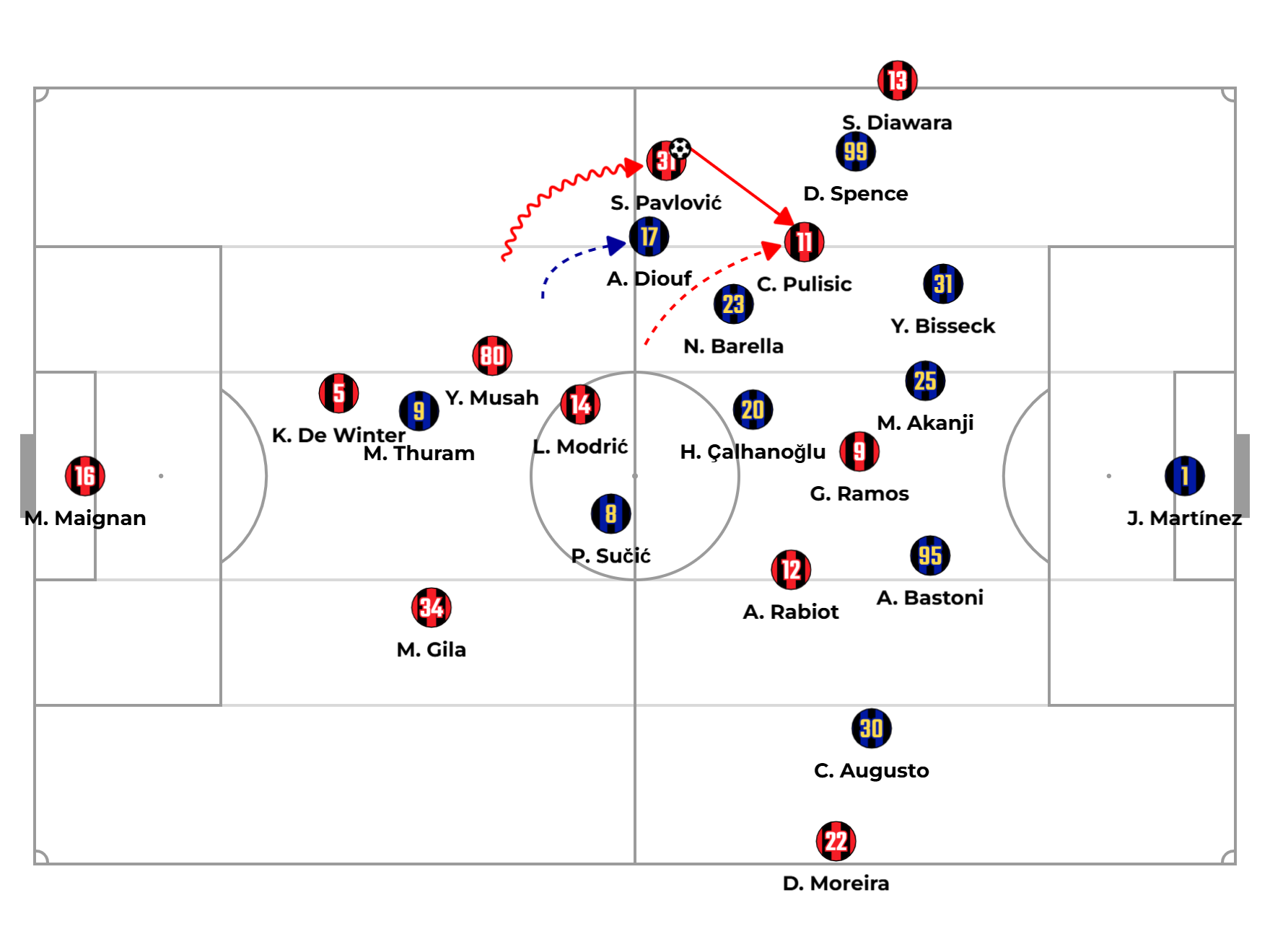
3rd minute: Buildup to Pulisic’s goal. Musah dropped to spread the wide center-backs and Pavlović was isolated with Diouf. As the Serbian sprinted round Diouf, Pulisic was already positioned behind Barella to offer further progress into the final third.
After Milan scored, they kept the early momentum. Inter’s defensive arrangements were ill-prepared to disrupt Modrić’s game, further exacerbated when they tried to press higher, and Musah freed up space for the Croatian as he could push wider into the next line and Modrić moved laterally, which enabled him plenty of time to receive back inside of the buildup. Because Inter’s vertical distances were too large, the lack of compactness led to defensive/midfield lines looking to drop back more, even when Diouf and Spence jumped in the press down the right side.
Milan had their second goal after ten minutes. Modrić had the time to knock the ball over the center-backs from the halfway line, meeting Moreira’s diagonal run in the process. Augusto did enough to cover, but the subsequent corner was driven low and Rabiot found the corner of the far post, wrapping into the net in the process.
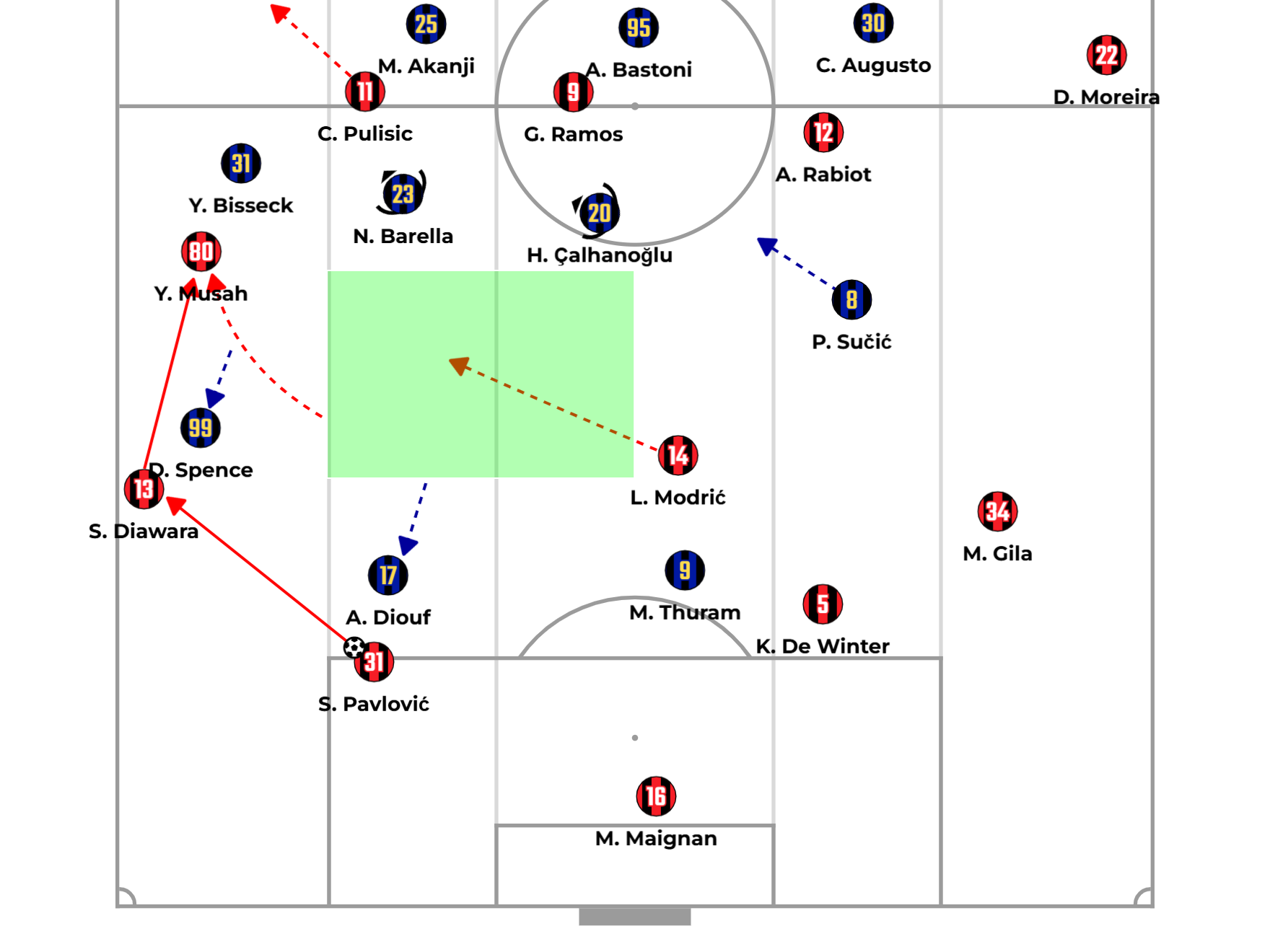
8th minute: Inter attempted to jump high, but the jumps from Spence and Diouf were not supported by the system in place. Musah pushed high and wide between Diawara and Pulisic, whilst Modrić moved laterally towards the vacant space; no jumps to compress the area from either Barella or Çalhanoğlu. Inter were soon encouraged into their defensive block, with big holes left on the inside of the press.
Momentum continued. After the two goals, more attention was taken to the right side, where Rabiot made more vertical runs behind Alessandro Bastoni and Moreira was a livewire for Augusto to handle. This was not a game heavy on shots, or even high-pressing moments that pinned the opponent deep. Even without these factors, Milan controlled the early period.
Rigid rotations
All was not lost for Inter. Occasional breaks from turnovers would buy territory and corners, Inter were rewarded in the twenty-first minute. Çalhanoğlu’s corner was flicked on by Akanji, for Bastoni to guide the ball home at the goalkeeper’s near post. This response triggered one of the more dominant spells of Inter in possession of the ball, as Milan dropped into a 5-4–1 defensive block whose distances were smaller and height was deeper.
With territory from the halfway line established, Inter moved into familiar movements with the wide center-backs (unlike the Milan center-backs, Inter’s tried to box crash with more frequency, as opposed to teeing the wing-backs/wide forwards deeper in the field). However, neither Çalhanoğlu nor Barella took command in the buildup, certainly in the way that Modrić had shown in the first quarter of the game. As a result, passes were very lateral and familiar Inter issues bled through: the lack of dribblers left few creative exits from any individual, and the dropping of both Çalhanoğlu and Barella meant a lack of diagonality from the buildup, even with the addition of two extra midfielders to support in the halfspaces.
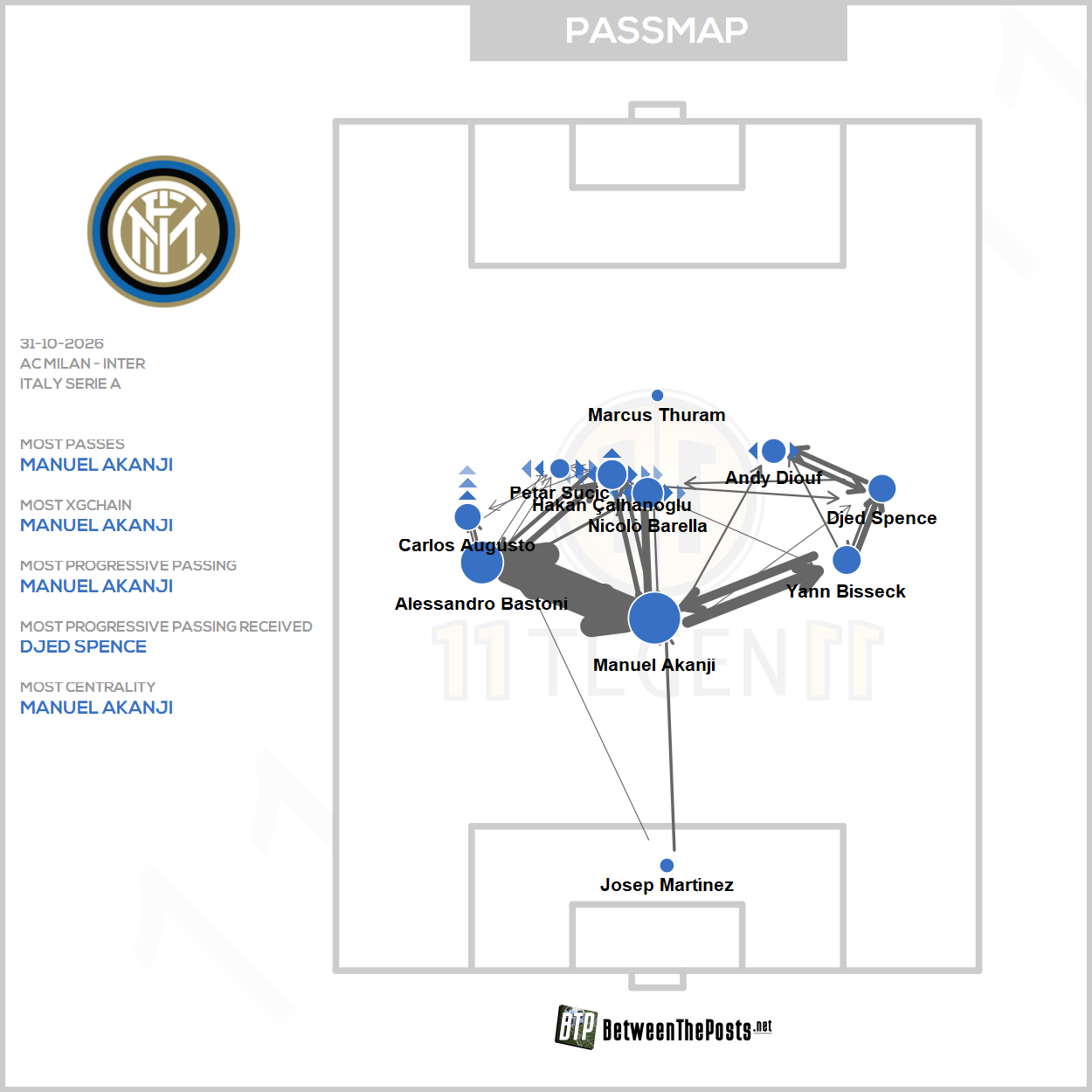
Inter’s passmap indicates a lot of passes around the halfway line, and some exchanges towards the right. However, the team was often far from the goal, had no lead from the midfielders and very limited support around Thuram.
Shorter-distance moves turned to the right side of the Inter buildup. Diouf provided some more flexibility than Sučić, whilst Spence and Bisseck moved into different positions to try and find a teammate free. On the left side of the Milan defense, Pavlović and Diawara remained flat, whilst Pulisic did not drop to cover the run from Bisseck, yet Inter could not find the execution to play Bisseck through in the halfspace or tee Spence/Diouf to provide an effective cross towards Thuram at the back post.
Instead, these movements did show promise but were not exploited. Diouf is a very left-footed midfielder, so the pass played onto the outside was harder to complete. Nevertheless, Inter struggled to offer/connect a fourth player to join the rotation. Countermovements were not timed to find an Inter player between the lines, so there was a lack of wall/bounce passes coming from Chivu’s team that could spark life into some of the moves.
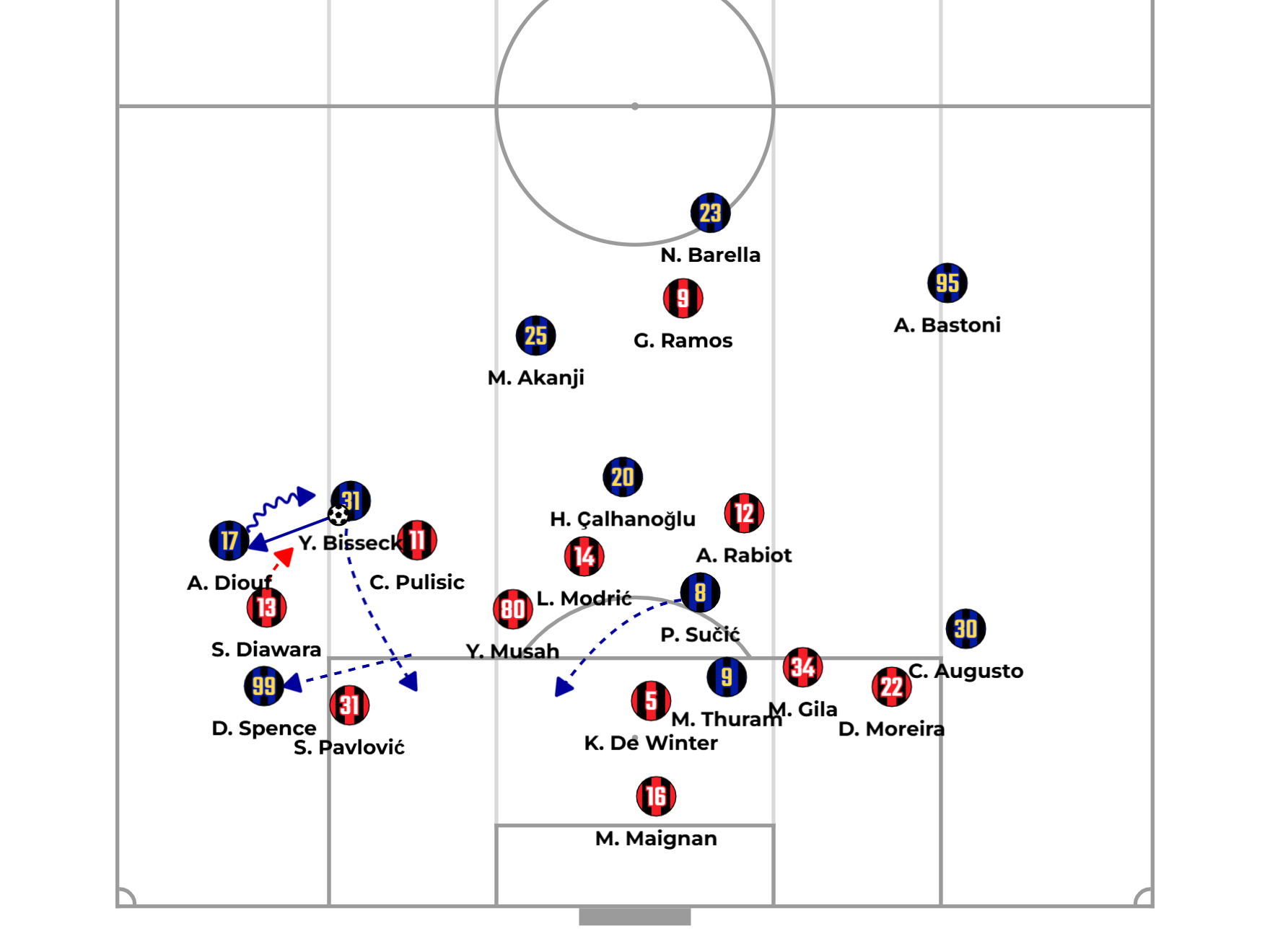
28th minute: Missed opportunity for an Inter player to be played in the halfspace. Diouf cut inside with the ball, as Diawara followed and Pulisic remained. In the process, Bisseck was in space for the return ball and Sučić also began to make a run between Musah and De Winter, to try and exploit the space that had opened. However, Diouf took the extra touch, a pass moved the ball back to Akanji and up to Spence on the outside of the block.
On the left side, attacks were more direct and Inter produced more danger off the back of these crosses. The best chance came when a deflected cross bounced perfectly behind the line of Milan center-backs and Thuram, to find Spence at the back post, a shot that saw incredibly strong wrists from Mike Maignan.
Inter would not have a better opportunity to equalize. Towards the end of the first half, the match started to move into a more balanced affair as Milan started to get possession back up the pitch. A cheap foul conceded by Barella gave Milan an opportunity to shoot from a free-kick, and Moreira would not disappoint. His attempt was too quick for Martínez to get near too, and Milan found their third goal right before half-time.
Too little, too late
Milan saw out the game with a relative degree of ease. Inter did not start dominating possession straight away in the second period; in fact, Chivu did not change much to the structure that they had in place. As a result, the same buildup issues continued to occur, with Inter showing very little penetration upon entering the final third.
In the defense, this was not even a flawless set-up from Amoirm. Inter’s final big opportunity to get into the game occurred when Çalhanoğlu had moved a few yards further forward for the halfspace cross to become accessible. As Moreira fell asleep at the back post, Augusto charged through, only to make a diving header go wide.
Instead, the story was not what followed, but what did not follow when the game state was stuck in the same cycle as the first half. Chivu did not make his first substitutions until the seventy-second minute, like-for-like changes as Piotr Zieliński and Henrikh Mkhitaryan came on. After a penalty call was correctly overturned, it took until eight minutes from time until Chivu brought on the cavalry: Dimarco, Francesco Pio Esposito and Ange-Yoan Bonny, who replaced Bastoni, Barella and Bisseck.
Likewise, with the game state not changing, Amorim had no reason to drastically change a team that was not facing much offensive pressure. After Augusto’s headed effort, fifty-five minutes into the game, Inter failed to record over an expected goal, despite having more of the possession and eight more attempts at goal.
Takeaways
A strong record for Milan in the derby continues, one that came at an important time for Amorim. Much of the pre-match attention focused on the possibility of Inter already being ten points ahead of them with a victory; instead, the difference is now four after ten games. Milan have a long way to go to become a consistent force in the league, and have some tough trips towards the end of the year. However, some of the work in possession is a stark improvement to the team that finished last season.
Inter remain static yet open in these kinds of fixtures, Chivu is still out of his depth when it comes to providing a blueprint when the stakes are raised. However, despite parts of this team coming to the end of their cycle, Inter still has the firepower to breeze through games against the middle-to-lower table. Ironically, the next Serie A matches against Como and Atalanta are against two teams that have been at a high level in Serie A, yet Inter do not seem to have problems when facing either. A bad result against either side and things may start to turn sour for the champions.