
Ivory Coast – Norway: Vikings Row the Elephants Out of the World Cup (1-2)
Norway keeps quietly making its way through this World Cup after defeating Ivory Coast in the Round of 16. In a match where both sides played to their strengths, it was the Vikings who earned the right to remain on American soil. Haaland delivered once again, Nusa showcased the full extent of his talent, while Diallo almost stepped into the role of hero before stopping just short of the cape and boots.
Tactical analysis and match report by André Martins.
We decided to make this article free to read. If you want to support our work, consider taking a subscription.
Norway are not necessarily the most tactically original or romantic side at this World Cup. Their victories over Iraq and Senegal were deserved, but lacked the touch of madness that usually makes underdogs so easy to root for. Even their defeat to France, with every regular starter rested, was a calculated one.
Ivory Coast, on the other hand, had become exactly the kind of team people inevitably grow attached to over the course of a World Cup. Much of that came from their brave display against Germany, which ended in a cruel defeat after wasting several clear-cut chances.
Ivory Coast and Norway met in Texas for a place in the Round of 16. It was a meeting between two teams that had both finished second in difficult groups with six points.
The Vikings came in fresher than ever after rotating heavily against France. Ståle Solbakken was therefore able to field his most balanced starting XI, beginning with Ørjan Nyland in goal, behind a back four of David Møller Wolfe, Torbjørn Heggem, Kristoffer Ajer and Marcus Pedersen. The latter replaced Julian Ryerson, who had picked up an injury against Senegal. The midfield trio featured Patrick Berg, Sander Berge and Martin Ødegaard, while Antonio Nusa, Erling Haaland and Alexander Sørloth led the attack. After starting all three group-stage matches, Fredrik Aursnes began on the bench.
For Ivory Coast, the biggest surprise was perhaps Amad Diallo being left out of the starting lineup, with Nicolas Pépé preferred on the right wing in their 4-1-4-1.
Yahia Fofana started in goal behind Ghislain Konan, Emmanuel Agbadou, Odilon Kossounou and Guéla Doué. Ibrahim Sangaré sat in front of the defence, with Christ Inao Oulaï and Franck Kessié ahead of him. Pépé and Yan Diomandé occupied the wings, while Ange-Yoan Bonny led the line.
Norway’s structured build-up against Ivory Coast’s mid-block
Norway have been a fairly rigid side in terms of positional structure since the start of the tournament. The match against Ivory Coast was no exception. The Vikings built deep in their nominal 4-3-3. Ødegaard and Berg occupied high positions in the half-spaces, while Berge operated as the deepest midfielder. The Arsenal man would occasionally drop to distribute while facing the play. The full-backs stayed wide but relatively deep, allowing Norway to work around the Ivorian block. As throughout the group stage, Sørloth was once again positioned wide on the right to provide a target for Norway’s and Nyland’s long balls.
That being said, the clearest pattern in Norway’s build-up consisted of dropping a more advanced player, bouncing the ball off him, before finding a runner arriving from deeper positions. Nusa into Wolfe, Wolfe into Berg, Sørloth into Pedersen. Different heights, same dynamics, same outcome.
The pattern was on display as early as the second minute when Pedersen delivered a dangerous cross towards Haaland. The right-back had overlapped a completely unpressured Sørloth, who had plenty of time to receive, turn and pick his pass.
Despite Norway’s predictable positional structure, Ivory Coast were unwilling to press high and instead remained fairly passive in a 4-5-1/4-1-4-1 mid-block. That also explains why Norway’s one-twos worked so consistently, because the first pass of the combination was almost always played without pressure.
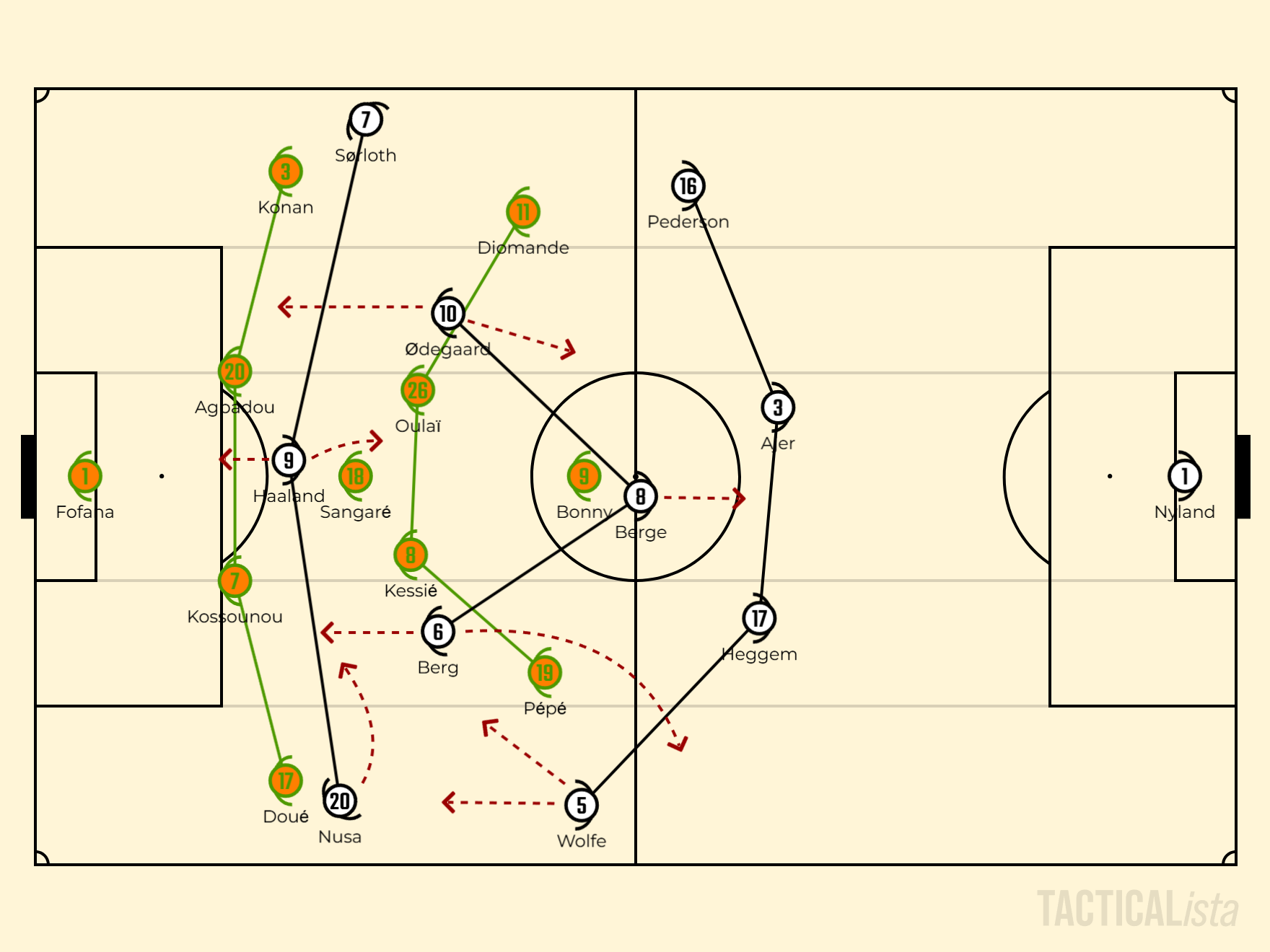
Image 1. Norway’s attacking structure embedded inside Ivory Coast’s 4-1-4-1 / 4-5-1 out-of-possession mid-block. The left side was the most dynamic zone, with Nusa often staying wide on reception before drifting inside, creating space for Wolfe’s overlap. The full-back could also start inside the half-space from the beginning of the phase. Berg operated freely in the channel and at times even stepped into full-back areas. It was Norway’s most complementary triangle.
Ivory Coast had experimented with a more man-oriented press earlier in the tournament, but it exposed the backline too often and was eventually abandoned. That allowed Norway to manipulate Ivorian marking assignments, particularly through the positioning of their two number eights in the half-spaces.
The African side did occasionally attempt a more zonal press, with the striker jumping towards the right centre-back using a curved run, while one of the midfielders—most often Kessié—stepped up onto the left centre-back while simultaneously blocking the passing lane into the number six. The same mechanism could also be mirrored on the opposite side.
The problem was the amount of ground the midfielder had to cover. He rarely arrived quickly enough to apply real pressure, allowing the defender to almost always find his full-back beforehand.
During those moments, Ivory Coast’s defensive shape resembled more of a 4-4-2. Norway’s objective then became overloading the two remaining Ivorian pivots.
They had two ways of doing so.
The first was to keep both number eights in the half-spaces while Haaland dropped onto the same line. That was relatively uncommon.
More often, one of the eights occupied a half-space, the other positioned himself more centrally, while a third player filled the opposite half-space. This usually happened on the left, with either Nusa or Wolfe tucking inside while the other stayed wide.
Both structures forced the Ivorian wingers to narrow their positioning slightly in order to cut the passing lanes into the half-spaces. Sangaré and Oulaï could not reliably jump onto Norway’s midfielders without risking leaving Haaland with acres of space through the middle.
That detail proved crucial in making the Ivorian block less effective at protecting the width.
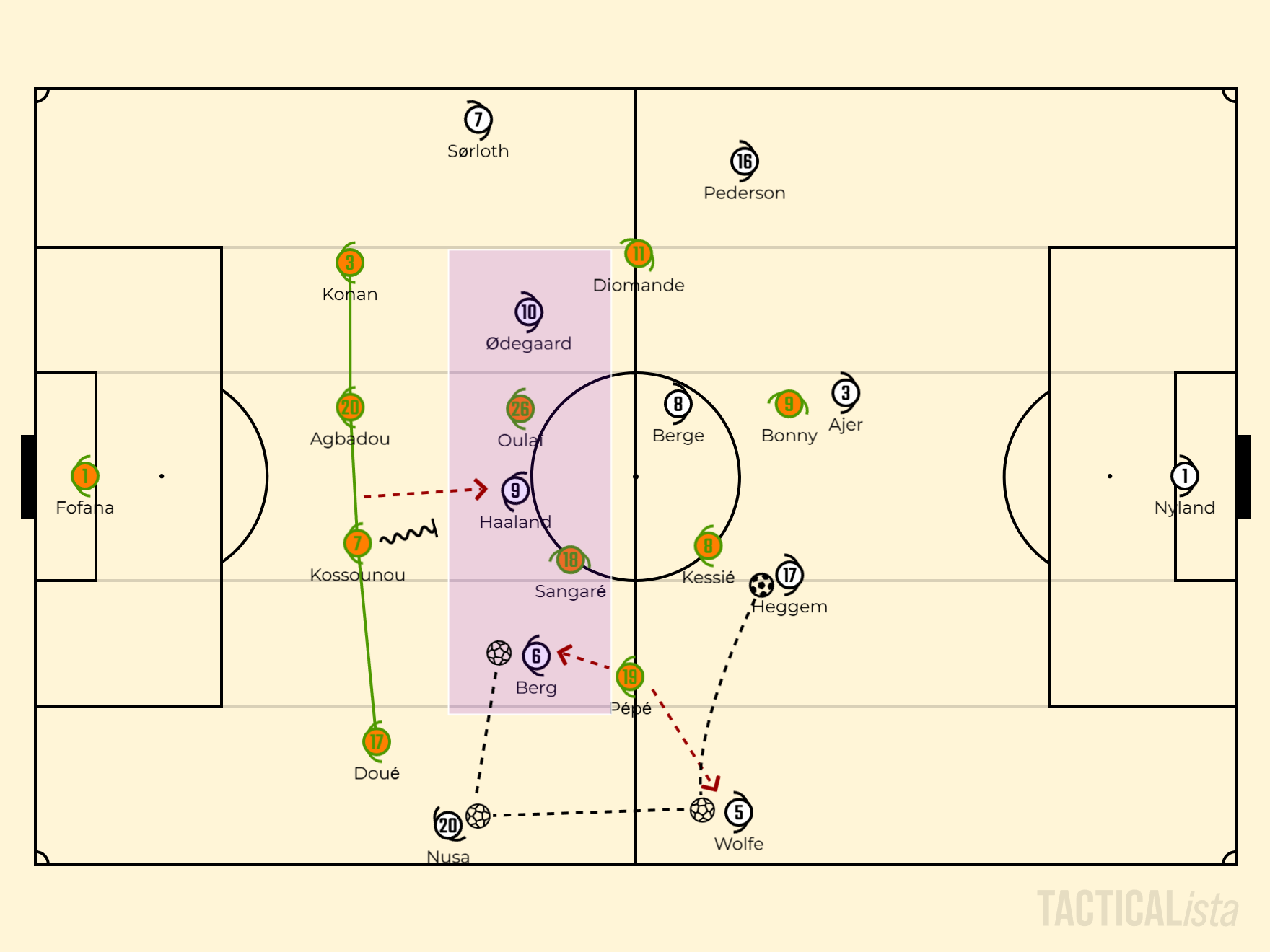
Image 2. 14th minute. Ivory Coast switch into a 4-4-2 structure in an attempt to initiate a press with Bonny and Kessié stepping out. Haaland drops into midfield to overload the two remaining Ivorian midfielders. They cannot leave the central zone to jump onto Norway’s wide eights, which forces the wingers—here Pépé—to cut passing lanes instead. It is impossible for him to step out in time to the full-back when needed. The move did not go all the way through, but it clearly shows how Norway were consistently able to access Wolfe and then Nusa.
Norway’s left-sided combinations finally break through
That is precisely why Norway consistently managed to activate the flanks during their deep build-up. The next key was their ability to establish the wide triangle on the left and unlock passing sequences between Nusa, Wolfe and Berg.
The latter’s mobility, making runs into the half-space or positioning himself alongside the full-back, proved indispensable. In many ways, he was the missing piece in Norway’s midfield three. His ball-carrying ability allowed him to create connections and compensate for Berge and Ødegaard, who both prefer receiving to feet.
As the first half wore on, chances remained few and far between. The crosses aimed at Haaland were too floated to allow him to generate much power with his headers. At the other end, Ivory Coast’s movements inside the box regularly disrupted Norway’s marking assignments, but the final action lacked quality.
In their high 4-3-3, Ivory Coast produced some excellent rotations within the interior triangles.
Norway, meanwhile, maintained almost exactly the same attacking structure throughout their possessions, which inevitably made them more predictable. It is a deliberate choice from Ståle Solbakken, one that is also reflected in certain player profiles not quite operating in their ideal roles, Sørloth being the clearest example.
His positioning enables the long build-up pattern mentioned earlier but also limits some of Norway’s shorter combinations down that side. The right-sided wide triangle between Sørloth, Ødegaard and Pedersen is not ideal, whether technically, in terms of mobility, or simply because of the players’ relationships, with regular starter Ryerson sidelined through injury.
On the opposite flank, the Wolfe-Nusa connection flowed much more naturally, with Berg constantly moving into the channel to combine and provide an extra passing option.
Nusa’s goal originated from a vertical pass straight through the middle from Ødegaard into Berge. That single pass allowed Norway to move away from their rigid, all-over-the-pitch 4-3-3 structure and pin Ivory Coast back.
By the time Nusa received the ball just outside the box on the left, Wolfe, Sørloth and Haaland were all occupying the heart of the penalty area, while Ødegaard had also arrived around the penalty spot.
The Leipzig winger found himself surrounded by three defenders, but only one was truly close enough to engage him. That gave him enough room to dribble before curling a magnificent finish into the far corner with his right foot.
That is exactly what you want from a winger. Sørloth would probably not be capable of producing that kind of individual action, but a more natural winger would not necessarily have offered the same presence inside the box either.
Ivory Coast’s response and Diallo’s impact
Given the overall defensive level on display throughout this World Cup, many teams have increasingly relied on wide play. Even when well organised in possession, the most common route has often been to work the ball around the outside before delivering crosses into a crowded penalty area.
Ivory Coast began the second half with renewed ambition. Their plan was to attract Norway’s deep 4-5-1 block towards the left before switching play to Pépé on the right.
In the 55th minute, he fixed both Wolfe and Nusa before laying the ball back to Doué. His deflected cross fell kindly back into the Villarreal player’s path, but his first-time effort at the near post was well saved by Nyland.
Shortly afterwards, Pape Thiaw replaced Bonny and Oulaï with Elye Wahi and Amad Diallo. Ivory Coast immediately began committing more bodies forward. In possession, they reorganised into a 3-2-5. Sangaré dropped between the centre-backs, while Kessié and Konan tucked inside in more advanced positions. On the right, Diallo stayed wide, whereas Pépé was given a freer role. He could operate in the half-space to combine, or carry the ball inside before distributing or taking defenders on himself. Doué remained close enough to complete a very aggressive right-sided wide triangle.
Whenever Norway’s block dropped particularly deep, Ivory Coast’s double pivot would also push closer to the defensive line.
Norway still looked dangerous on the counter and from set pieces. Pedersen thought he had doubled the lead from a corner, only to see his effort cleared off the line by Diallo. It was the first of several decisive moments from the Ivorian.
The more aggressive structure adopted by the three-time African champions quickly paid off.
Sangaré boldly carried the ball through the gap between Ødegaard and Haaland before finding Diallo out on the right. He entered the box through a one-two with Pépé, chopped back inside Berge and beat Nyland from close range.
Despite enjoying a four-versus-two numerical advantage in such a small area, Norway allowed the two Ivorians too much room to combine. From there, individual quality did the rest. Berg had been pinned by Doué’s wide positioning.
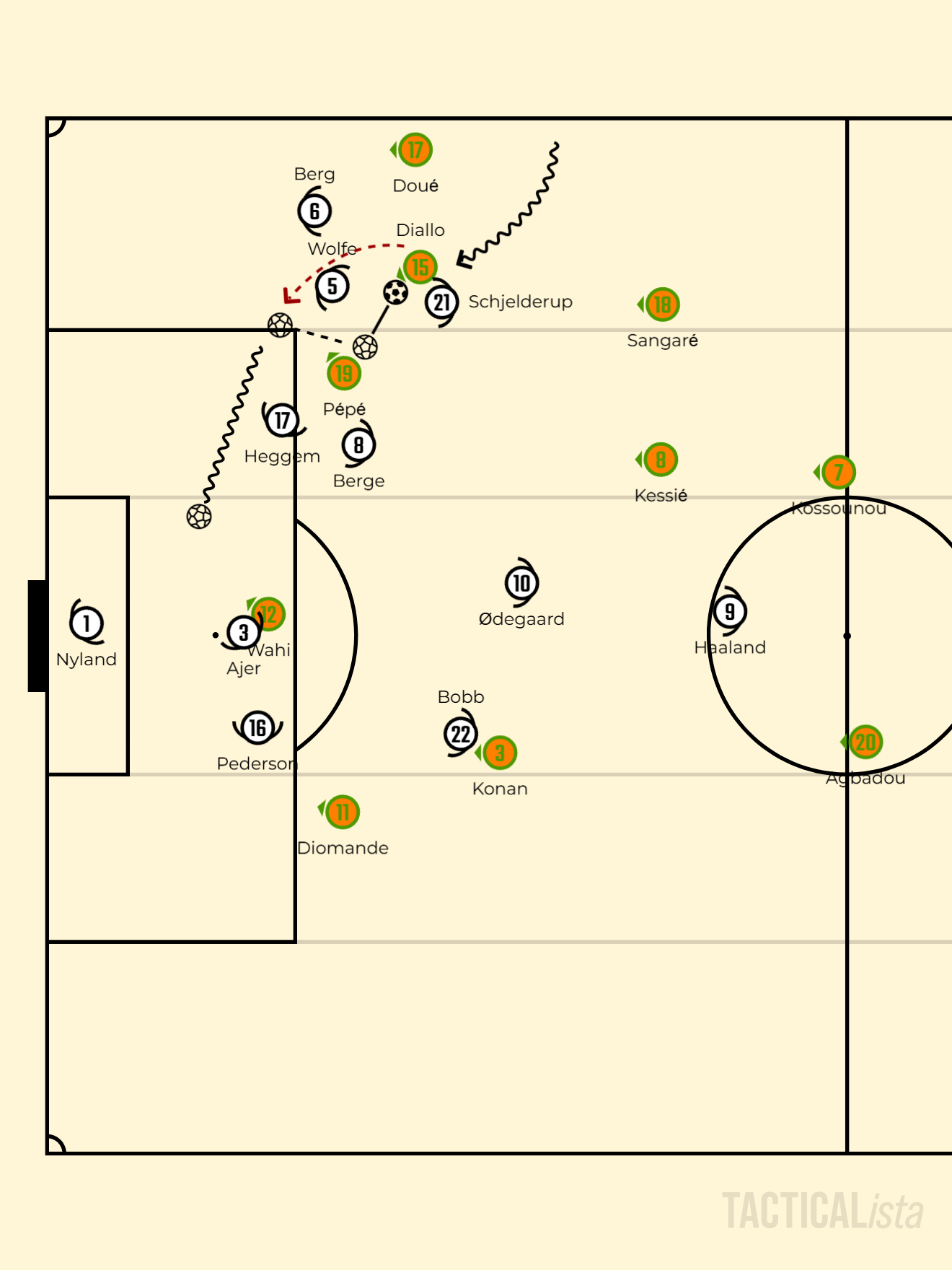
Image 3. Ivory Coast’s equaliser. Norway hesitate to engage in duels and allow Diallo and Pépé to combine in tight spaces. Individual quality makes the difference afterwards. Worth noting is the proximity between the two attackers and Doué, forming a particularly dynamic wide triangle.
Ivory Coast can feel guilty for having, quite strangely, dropped off after the equaliser instead of riding the momentum. It was as if the players simply switched off a button. The intensity in their defensive actions decreased, and Norway took advantage to regain control of possession.
It was no longer as difficult for the Vikings to break the first line with passes played between Ivory Coast’s two pivots. The new 4-4-2 structure, with Wahi and Diallo up front, proved fragile, too passive, and lacking defensive presence in midfield.
The first line was consistently outnumbered, while too much space opened up between the midfield and defensive lines. This allowed Norway to progress without even needing to push their full-backs higher.
They could have retaken the lead through a floated cross from Berg towards the penalty spot, but the ball eventually dropped onto Ødegaard’s right foot instead.
With passivity comes tactical looseness, and Ivory Coast can be criticised for opening up too much space between the left-back and left centre-back in the sequence leading to their elimination.
Konan stepped out towards Osbar Bobb, who had received wide. Fredrik Aursnes made an underlapping run and was tracked by Diomande, but Agbadou left his position to close down Aursnes and anticipate a potential through ball. The issue was that Berg, once again, was simultaneously making a run into the right half-space. He was found by Bobb before delivering a cross into the box for Haaland’s tap-in.
The Ivory Coast failed to pin Norway’s defensive line in advance, which would have allowed them to gain territory higher up the pitch. At times, they kept too many players behind the opposition block and only progressed once a forward had already received between the lines. Teammates would then advance to provide passing options, but this delay made their attacks easier for Norway to manage.
Diallo, once again, could have pushed the game into extra time with a long-range free kick, but Nyland took a small step to his side before launching himself to push it away, earning praise from his teammates.
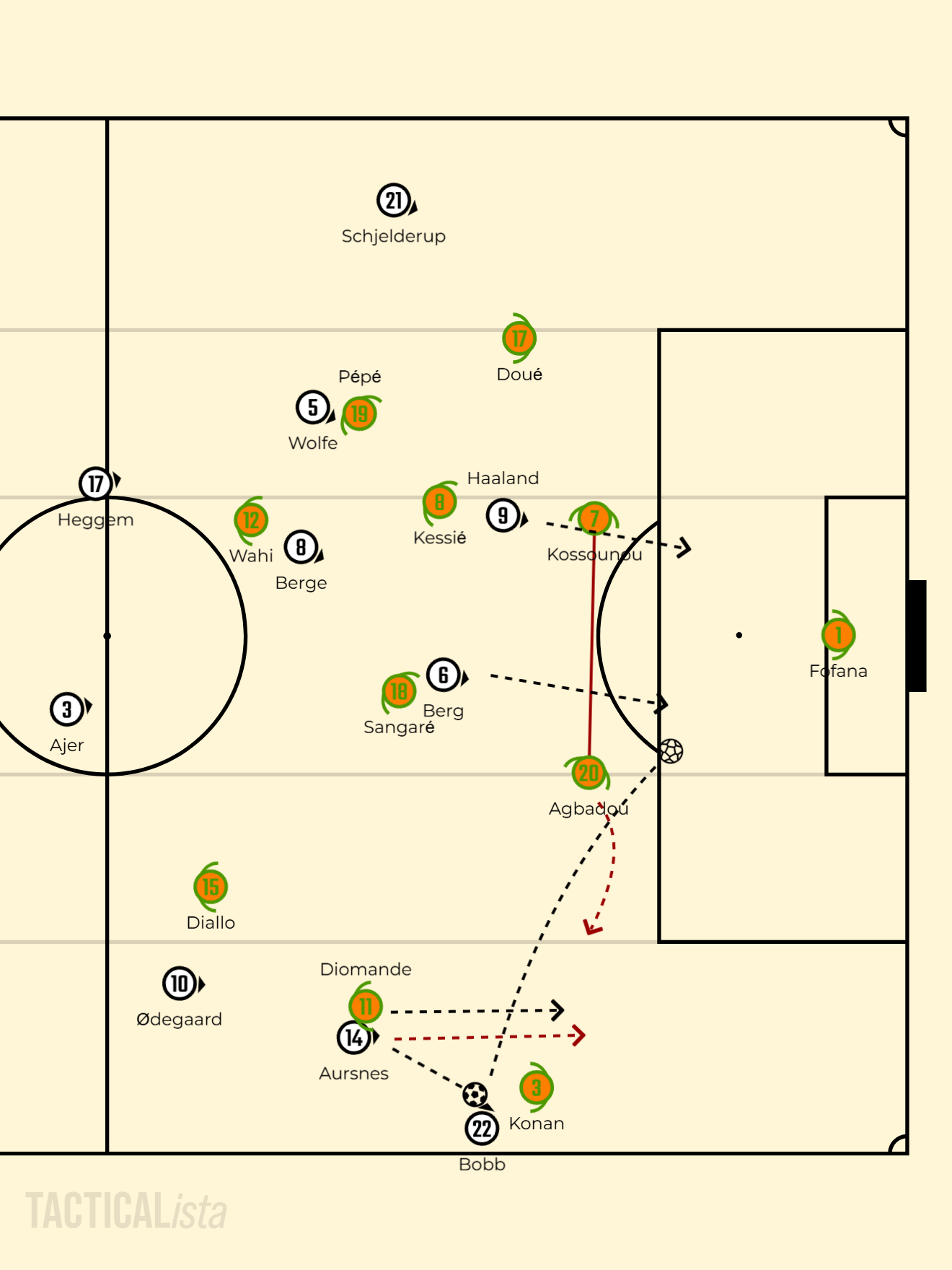
Haaland’s winning goal. The distance between Ivory Coast’s centre-backs is too large. Agbadou steps out to cut a potential pass into Aursnes’ underlapping run, while Berg is already attacking the central space. Bobb’s technical quality allows him to find his teammate inside the box. He delivers a low cross towards Haaland for the tap-in.
Norway find control again through familiar patterns
The final minutes were split between transitions in both directions and slower phases of possession, especially when Bobb and Ødegaard started circulating the ball on the right side. A recurring theme throughout the match—and one that became even more decisive late on—was Ivory Coast’s lack of presence inside the penalty area.
Even in crossing situations, there were rarely more than one or two attackers attacking the box. This forced them to rely heavily on combination play or individual ball carrying, such as Diallo’s late incursions.
Ivory Coast failed to pin Norway’s defensive line in advance, which would have allowed them to progress higher up the pitch. Instead, they often kept too many players behind the opposition block and only advanced once a forward had already controlled the ball between the lines. Teammates would then push up to offer passing options, but the delay made their attacks far easier for Norway to manage.
Diallo, once again, came close to forcing extra time with a powerful long-range free kick, but Nyland read it well, taking a small step before diving to push it away. Immediately congratulated by his teammates.
Takeaways
At their best, Ivory Coast showed some interesting ideas in possession that allowed them to come very close to beating Germany. That path might have led them into a Round of 16 clash with a well-drilled Paraguay side playing a hyper-organised 4-4-2, and maybe the talent of Diomande and Diallo could have made the difference against Julio Enciso and Miguel Almirón. But football is not written in “ifs”. Ivory Coast eventually ran into a stubborn and efficient Norwegian side, who rowed their way into the next round while leaving the Elephants stranded on the coast.
Because that’s exactly the vibe this team gives off. With their signature celebration and the atmosphere on the pitch. For their return to the tournament since 1998, let’s chill, give it our all and play to our strengths. Why make things complicated when simplicity works? Brazil will be a different kettle of fish. Nyland has already shown he can deliver at the highest level, but the entire back line will have a massive task trying to contain the likes of Vinícius and co. If Norway plays it right, they could cause real damage on the counter-attack, and not just there.


Comments